What Is a Sinking Fund? How to Save for Planned Expenses

Finnovate’s editorial team researches and creates financial content using trusted sources, regulatory references and inputs from subject experts.
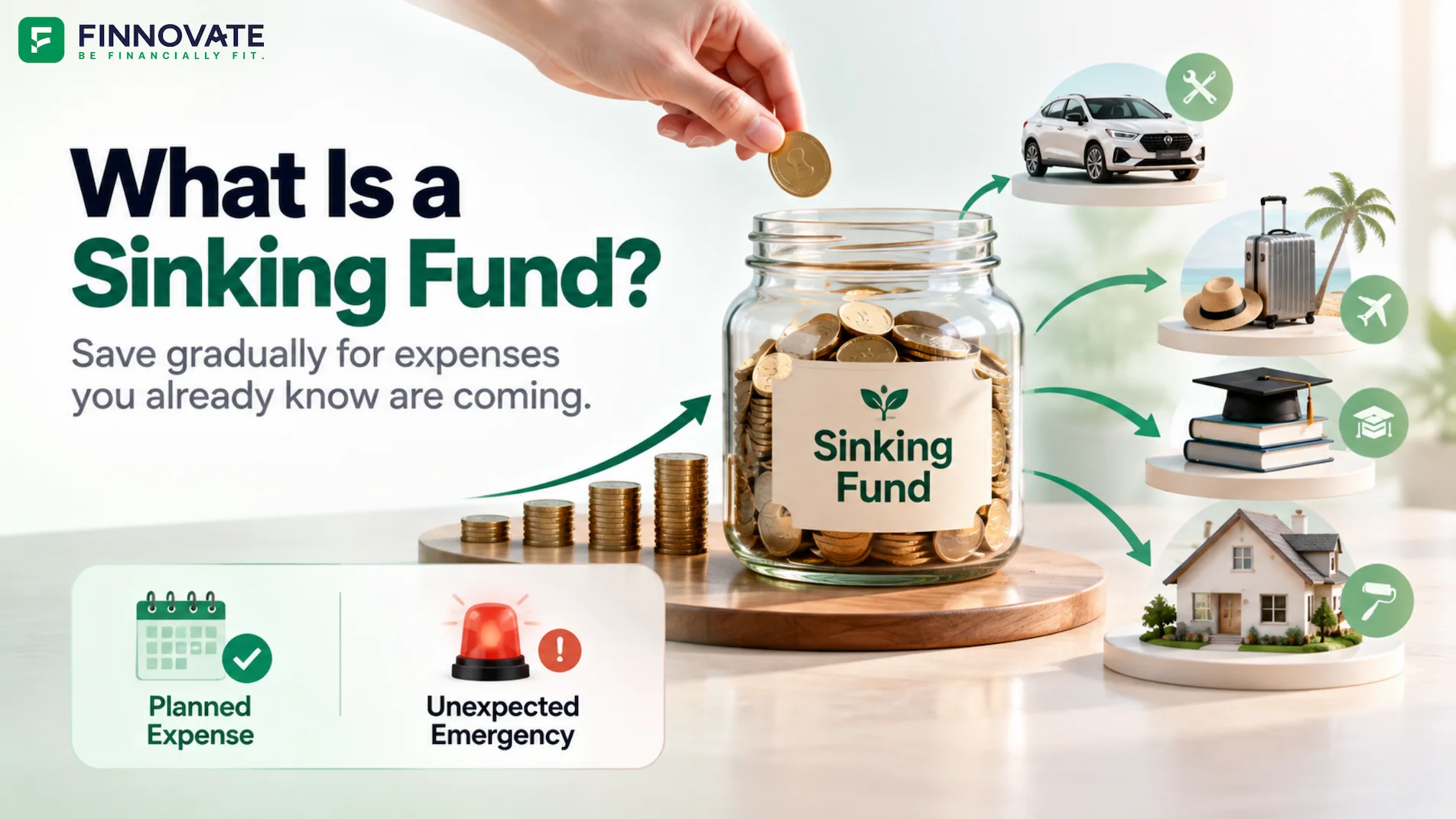
A sinking fund is money you set aside gradually for an expense you already know is coming.
Suppose your annual car insurance, servicing and another planned vehicle expense will cost around ₹60,000 six months from now.
Instead of arranging ₹60,000 when the bill arrives, you could save ₹10,000 per month for six months.
The idea is simple:
How Does a Sinking Fund Work?
A sinking fund usually has four things:
For example, suppose you are planning a family vacation.
- Expected cost: ₹1,20,000
- Already saved: ₹20,000
- Time remaining: 10 months
Instead of arranging ₹1 lakh close to the travel date, you deliberately save ₹10,000 every month.
What Can You Use a Sinking Fund For?
Many expenses that feel unexpected are actually predictable.
The key is that the expense should be specific and reasonably foreseeable.
You do not need a separate sinking fund for every small expense in your life.
Sinking Fund vs Emergency Fund: What Is the Difference?
| Sinking Fund | Emergency Fund | |
|---|---|---|
| Expense | Expected | Unexpected |
| Purpose | Specific | General financial protection |
| Date & Timing | Known | Unknown |
| Example | Annual car insurance | Job loss |
| Expected to be used? | Yes | Hopefully rarely |
For example, tyres you expect to replace six months from now can be planned through a sinking fund.
A sudden medical emergency is different.
If you are building that second type of reserve, read Finnovate's guide on where to keep your emergency fund .
What Does a Sinking Fund Look Like in a Household Budget?
Consider a family expecting the following expenses over the coming year:
| Planned expense | Expected amount | Due in | Monthly amount |
|---|---|---|---|
| Car insurance and servicing | ₹36,000 | 6 months | ₹6,000 |
| Family vacation | ₹90,000 | 9 months | ₹10,000 |
| Festivals and gifts | ₹30,000 | 10 months | ₹3,000 |
| Annual school-related expense | ₹48,000 | 12 months | ₹4,000 |
| Total monthly contribution | ₹23,000 |
These four expenses total ₹2.04 lakh.
Without planning, each one may feel like a separate hit to the household budget.
With sinking funds, the family knows in advance that:
Where Should You Keep a Sinking Fund?
Where the money sits should depend mainly on how soon you will need it.
For an expense due within a few months, the priorities usually include:
- easy access,
- low risk of losing value,
- and simplicity.
Depending on the timeline and your circumstances, that may mean a separate savings balance, an appropriate bank deposit or another suitable low-volatility avenue.
Money for next year's insurance premium has a different job from money being invested for retirement 25 years from now.
For long-term goals such as retirement or a child's education, a broader financial-planning approach is more useful. Finnovate's personal financial plan example shows how one household can organise short-term cash needs and long-term goals together.
Do You Need a Separate Account for Every Sinking Fund?
Not necessarily.
You could keep separate accounts if that helps you stay disciplined.
But you could also keep one sinking-fund account and track individual categories in a spreadsheet, budgeting app or simple note.
What matters is knowing how much belongs to each purpose.
When Should You Start a Sinking Fund?
As soon as the expense becomes predictable.
Suppose an annual insurance premium of ₹36,000 is due every March.
Instead of remembering it in February, start preparing for next year's premium immediately after paying this year's bill.
The annual bill now becomes part of normal monthly cash flow.
The earlier you begin, the smaller the monthly amount generally needs to be.
What Should Not Be Treated as a Sinking Fund?
A sinking fund works best for planned, relatively near-term expenses.
- It should not replace your emergency fund.
- It should not replace long-term investment planning for retirement or education many years away.
- It does not automatically make an expensive goal affordable.
If a vacation requires ₹20,000 a month but your budget cannot comfortably spare that amount, the sinking-fund calculation has still helped.
It has shown that the current cost or timeline does not fit.
The Simple Rule to Remember
For any large planned expense, ask three questions:
A sinking fund does not make the expense cheaper.
It makes the expense easier to prepare for.