Should I Keep My Emergency Fund in a Savings Account?
Finnovate’s editorial team researches and creates financial content using trusted sources, regulatory references and inputs from subject experts.
You have built an emergency fund and the money is sitting safely in your savings account, ready for the day something goes wrong.
That works well when the amount is ₹50,000 or ₹1 lakh. But once the reserve grows to ₹5 lakh, ₹8 lakh or even more, keeping every rupee in the same savings account may not be necessary.
So where should the money actually sit?
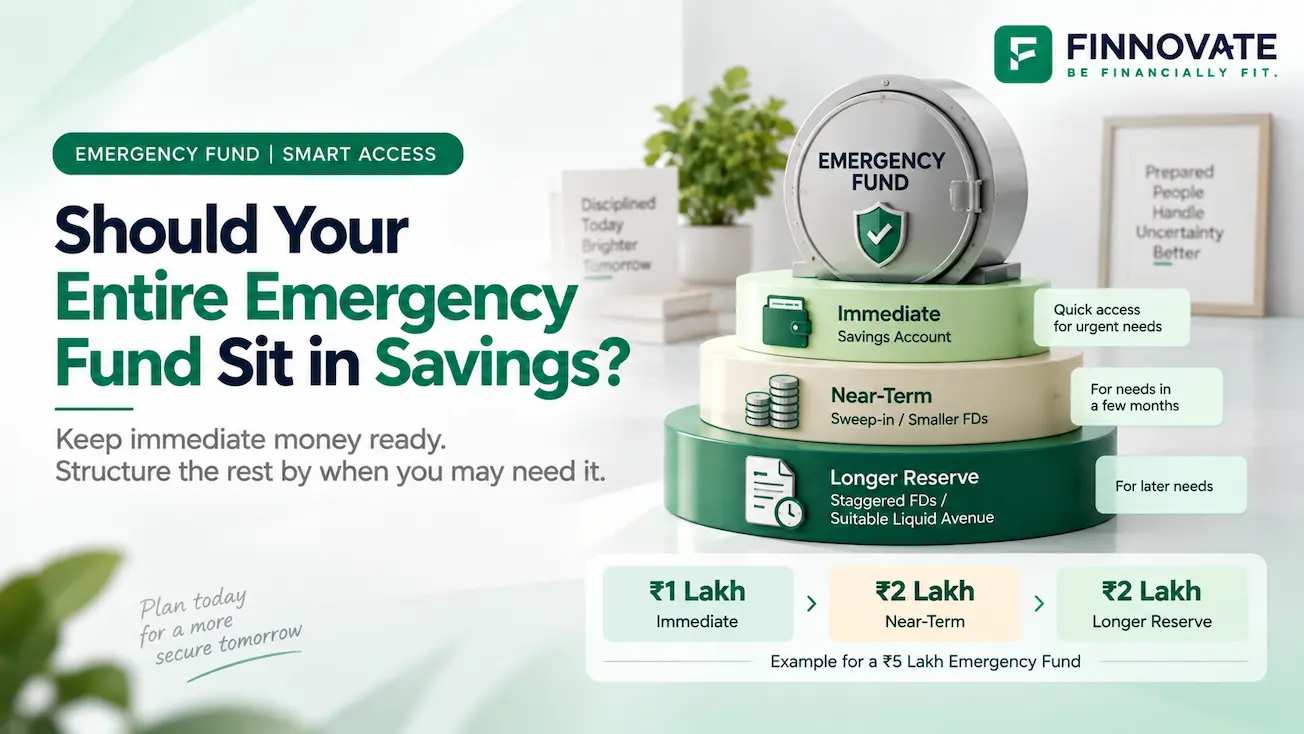
Sweep-in FDs or smaller FDs can work for the next layer. For a larger reserve, staggered FDs, more than one bank or a suitable liquid avenue may also have a role.
The goal is not to earn the highest possible return on emergency money.
It is to make sure an unexpected expense or loss of income does not force you to borrow, sell long-term investments or wait for money you thought was readily available.
First, How Much Emergency Fund Do You Need?
Before deciding where to keep the money, make sure the total emergency fund itself is appropriate.
For many households, 3 to 6 months of essential expenses is a useful starting point. A larger reserve may make sense when income is irregular, there is only one household earner, EMIs are high or several people depend on the same income.
| Essential monthly outgo | 3 months | 6 months | 9 months | 12 months |
|---|---|---|---|---|
| ₹60,000 | ₹1.80 lakh | ₹3.60 lakh | ₹5.40 lakh | ₹7.20 lakh |
You can calculate your own requirement using Finnovate's Emergency Fund Calculator.
If you are still deciding whether 3, 6, 9 or 12 months is more appropriate for your situation, our 3-6-12 Emergency Fund guide explains how income stability, dependants and financial responsibilities can change the target.
Match Your Emergency Money to When You May Need It
Not every emergency requires your entire corpus on the same day.
A hospital payment may need money tonight. A major repair may need money over the next few days. A job loss may require you to draw from the reserve gradually over several months.
Savings Account vs Sweep FD vs FD vs Liquid Fund
Once you know how quickly each portion may be needed, the product choice becomes much easier.
The best option is therefore not necessarily the one with the highest advertised return. It is the one whose access rules fit the role that money needs to play.
How Much Should Stay in the Savings Account?
Keep enough to comfortably handle the first stage of an emergency without having to move money from somewhere else.
Suppose your total emergency fund is ₹5 lakh and you decide that ₹1 lakh would comfortably handle most urgent expenses.
Keeping that ₹1 lakh in savings can be perfectly reasonable even if another option offers a somewhat higher return.
You may prefer to keep more readily available if your income is irregular, you support dependants, have high fixed commitments or rely on one household income.
Should You Keep Your Emergency Fund in a Separate Bank Account?
A separate account can be useful, especially if your normal savings account is also used for salary credits, UPI payments, bills and everyday spending.
The second account should still be easy to access. There is little benefit in separating the money if doing so makes it difficult to use during an emergency.
If the account is held with a different bank, it can also give you a second banking relationship and separate per-bank DICGC coverage, subject to the applicable ownership rules.
How Should You Use FDs for Emergency Money?
Once the immediate reserve is covered, the next portion can tolerate a little more friction.
A sweep-in or auto-sweep FD can be useful when you want the money closely connected to your savings account. But the exact mechanism differs across banks.
Check:
- How the sweep is triggered
- The minimum amount involved
- Whether the process is automatic
- Whether only the required amount is broken
- Premature-withdrawal treatment
One Large FD or Several Smaller FDs?
For emergency money, smaller FDs can make the reserve easier to use in parts.
FD laddering means splitting money across deposits with different maturity dates, so the entire amount is not tied to one maturity.
If you are considering this approach, see our FD Laddering guide for examples of how the structure works and how different maturities can be organised.
Can a Liquid Fund Be Used for an Emergency Fund?
A liquid fund can be considered for a secondary portion of the emergency reserve, particularly for money that does not need to function like same-day bank cash.
SEBI's framework provides for a graded exit load when units of a liquid fund are redeemed within the first seven days.
Redemption timing and any faster-access facility can also vary by scheme and platform, so check the actual scheme terms rather than assuming that “liquid” means the same thing as money already available in your bank account.
Source: SEBI framework for liquid schemes
If you are deciding specifically between an FD and a liquid fund for this portion of the reserve, our Liquid Fund vs FD for Contingency Money comparison looks at access, early withdrawal and where each option can fit.
What About Overnight Funds?
Overnight funds are another very short-duration mutual-fund category. They can be evaluated for a secondary reserve by someone comfortable holding part of the emergency fund outside bank deposits.
They still require redemption before the money becomes spendable, so they do not remove the need for a genuinely accessible first layer.
What If Your Emergency Fund Is More Than ₹5 Lakh?
Once a large part of the emergency reserve sits in bank deposits, look at how much is concentrated with a single bank.
DICGC currently insures eligible deposits up to ₹5 lakh per depositor per bank, including principal and interest, when held in the same right and same capacity.
Savings accounts, FDs and other eligible deposits across different branches of the same bank are aggregated for this limit.
Deposits held with different banks receive separate coverage under the applicable limit.
Also remember that the ₹5 lakh limit includes both principal and accrued interest.
For example, if ₹5 lakh of principal is already held in the same right and capacity at one bank, the insurance limit does not provide an additional ₹5 lakh cover for the interest.
Source: DICGC FAQs
For a larger FD-based reserve, two practical ideas can therefore work together:
- Spread deposits across suitable banks when concentration is a concern.
- Split or stagger FDs so that access does not depend on one large deposit or one maturity date.
If your emergency reserve has reached the point where you are managing several FDs, our FD Laddering guide can help you think through the maturity structure.
How Could a ₹5 Lakh Emergency Fund Be Structured?
Take someone with essential monthly expenses of ₹50,000 and an emergency fund of ₹5 lakh.
That gives roughly 10 months of essential expenses.
Suppose ₹1 lakh feels sufficient for expenses that may need to be paid without warning.
Ready before anything needs to be moved.
Relatively easy to access if the emergency continues.
Intended mainly for the later months of the disruption.
A freelancer with unpredictable income and dependants may prefer more money in the first two portions.
A dual-income household with stable jobs, low debt and adequate insurance may be comfortable with a smaller same-day reserve.
What If You Suddenly Need ₹50,000 Tonight?
This is a better test of an emergency fund than comparing interest rates.
Suppose an unexpected medical expense of ₹50,000 appears.
Ideally, a ₹50,000 emergency should not force you to sell long-term investments, borrow because your own money is inaccessible or disturb a much larger deposit than necessary.
Where Should You Not Keep the Core Emergency Fund?
Emergency money should not depend on an asset that may be sharply down when you need to sell it or on a product that prevents timely access.
Your emergency fund has a different job from your long-term investment portfolio.
Its purpose is to absorb a short-term financial shock without damaging the rest of your financial plan.
How Should You Build Your Own Emergency-Fund Setup?
Base it on essential expenses, EMIs and the number of months appropriate for your household.
This is the portion where direct access matters more than earning a little extra return.
Money for week two or month four of an emergency does not need the same accessibility as tonight's hospital payment.
Understand FD breakage, mutual-fund redemption, bank access and DICGC coverage before relying on the structure.
An emergency reserve is more useful when access does not depend entirely on one person being available.
So, Should You Keep Your Emergency Fund in a Savings Account?
Keep enough of it there to handle the part of an emergency that cannot wait.
The rest can be structured according to when you are likely to need it.
- Savings account for immediate requirements
- Sweep-in or smaller FDs for the next layer
- Staggered FDs or a suitable liquid avenue for money mainly intended for a longer disruption
If the deposit portion becomes large, using more than one bank can also reduce concentration and give you another banking relationship.
But avoid turning the emergency fund into a complicated mini-portfolio.
Your emergency fund does not need to be your best-performing investment.
It needs to be available in the amount you need, when you need it, without forcing you to create another financial problem.
How Much Emergency Fund Do You Need?
Enter your essential expenses, EMIs and existing reserve to compare 3, 6, 9 and 12 months of emergency cover.
Use the Emergency Fund CalculatorOnce you know the target, you can decide how much needs immediate access and how the remaining reserve should be structured.
FAQs
1. Should I keep my entire emergency fund in a savings account?
You can, particularly if the reserve is relatively small and simplicity matters most. As the amount becomes larger, it can be practical to keep the immediate-access portion in savings and structure the rest according to when you may need it.
2. How much of my emergency fund should stay in savings?
There is no fixed percentage. Keep enough to comfortably handle expenses that may require immediate payment. Your monthly commitments, dependants, income stability, insurance and household structure should guide the amount.
3. Should my emergency fund be in a separate bank account?
A separate account can make it easier to keep emergency money away from routine spending. The account should still remain easy to access when required.
4. Is an FD good for an emergency fund?
An FD can work for the portion that does not need immediate same-day access. Smaller FDs can improve flexibility, while a larger FD reserve may benefit from staggered maturity dates.
5. Is a sweep-in FD useful for emergency money?
It can be useful for the near-term portion of the reserve if the bank's sweep and premature-withdrawal rules suit your requirements. Check the exact mechanism before relying on the facility.
6. Should I make one large FD or several smaller FDs?
Smaller FDs can make partial access easier because you may be able to disturb only the amount required. If the FD reserve becomes larger, staggering maturity dates through an FD ladder can add further flexibility.
7. Should I split emergency FDs across different banks?
If eligible deposits at one bank materially exceed the ₹5 lakh DICGC limit and deposit concentration is a concern, using more than one bank is a practical option. DICGC applies the insurance limit separately per depositor per bank, subject to the applicable right-and-capacity rules.
8. Can liquid mutual funds be used for an emergency fund?
They can be considered for a secondary portion of the reserve. Liquid funds are mutual funds rather than bank deposits, so returns are market-linked, redemption is required and DICGC deposit insurance does not apply.
9. Is ₹5 lakh the maximum I should keep in a bank?
No. ₹5 lakh is the current DICGC insurance limit for eligible deposits per depositor per bank in the same right and capacity, including principal and interest. It is not a limit on how much money you are allowed to keep with a bank.
10. Can a credit card replace an emergency fund?
No. A credit card can help make an immediate payment, but the amount used becomes debt that must be repaid. It can act as a short payment bridge, but it does not replace emergency savings.
11. What is the simplest emergency-fund setup?
For someone who values simplicity, an accessible savings balance combined with smaller or sweep-in FDs for the remaining reserve can be enough. Additional products should be used only when they genuinely improve access or reduce concentration.
12. How often should I review my emergency fund?
Review it when your essential expenses or financial responsibilities change materially, such as after a new EMI, marriage, child, change in household income, increase in dependants or a significant change in monthly expenses.