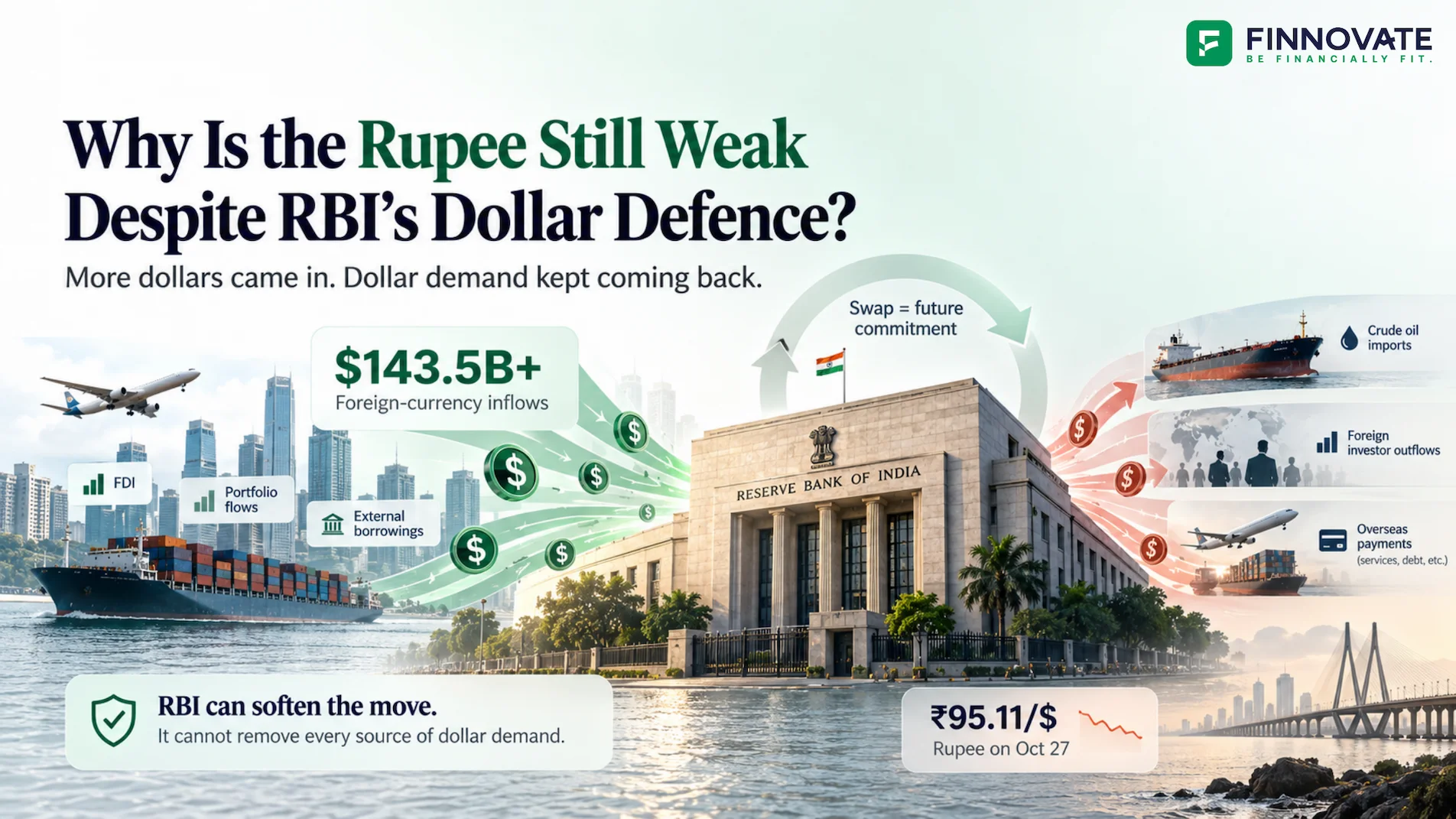
Why Is the Rupee Still Weak Despite RBI’s Dollar Defence?

Finnovate’s editorial team researches and creates financial content using trusted sources, regulatory references and inputs from subject experts.
Bring more dollars into India, and the pressure on the rupee should ease.
That was the appeal of the RBI’s special foreign-currency swap facility. Banks attracted overseas deposits, bringing in a substantial supply of foreign currency that could strengthen India’s external buffers.
FCNR(B) deposits mobilised under the scheme reached approximately $133 billion. Including two other borrowing channels, total inflows exceeded $143.5 billion by September 18, 2026.
Yet the rupee remained under pressure. On October 27, it closed at ₹95.1150 per dollar, with elevated oil prices, foreign equity selling and higher US yields weighing on the currency.
How can such a large inflow coexist with a weak rupee?
The answer lies in where those dollars came from, what they are being used for, and the obligations attached to them.
Dollars arrive once. Demand keeps returning.
An oil importer needs dollars to pay an overseas supplier. A foreign investor selling Indian investments may convert the proceeds into dollars before taking the money home.
Export earnings, overseas investment, remittances and foreign borrowing supply dollars on the other side.
The exchange rate responds to the balance between these flows, alongside expectations about what comes next.
A large deposit scheme can increase dollar supply over a few months. Meanwhile, import payments continue, investment flows change and businesses adjust their currency positions.
A successful fundraising programme can improve the ability to meet dollar demand without removing the forces creating that demand.
Oil makes this particularly important for India.
When crude becomes more expensive, importers need more dollars to purchase the same quantity. If the rupee also weakens, the cost rises again when converted into Indian currency.
That combination can put pressure on corporate costs, inflation and the external trade balance.
What happens when the RBI sells dollars?
Suppose dollar demand rises sharply and the rupee begins falling quickly.
The RBI can sell dollars from its reserves to banks, receiving rupees in exchange. This adds dollar supply to the market and absorbs rupee liquidity.
Such intervention can soften abrupt movements and give businesses more time to adjust.
But each outright sale uses part of the reserve buffer. If the underlying pressure continues, maintaining the same exchange rate can require repeated intervention.
There is also an important accounting detail: a fall in reported reserves is not a direct measure of dollars sold.
Reserve values also change when currencies and gold prices move. Swaps and other transactions can affect the total too.
This makes claims that the RBI has “spent” a particular amount more complicated than subtracting one week’s reserves from another.
For example, estimates published on October 15 put deployment since June at approximately $75–80 billion, covering both spot dollar sales and dollar-rupee swaps. These were market estimates, and the transactions served different purposes.
Follow the money behind the deposit scheme
FCNR(B), or Foreign Currency Non-Resident (Bank), deposits are foreign-currency term deposits placed by eligible non-residents with Indian banks.
The special swap facility made it easier for banks to mobilise these deposits and exchange the dollars with the RBI for rupees.
Consider a simplified example.
An overseas depositor places $100,000 with an Indian bank. The bank exchanges those dollars with the RBI and receives rupees under an agreed swap arrangement.
The RBI receives dollars today. The bank receives rupee funding.
At maturity, the transaction reverses according to the agreed terms. The bank returns rupees, including the applicable swap premium, and receives dollars from the RBI. The bank remains responsible for meeting its obligation to the depositor.
The facility covered eligible deposits with tenors of three to five years, with the swap tenor aligned to the underlying deposit.
The dollars strengthen today’s buffer, while the swap creates a future dollar repayment obligation.
That is why the mobilisation figure and the reserve figure need to be read alongside the RBI’s forward commitments.
Why the $200 billion forward position matters
At August-end, the RBI’s reported net short dollar position in its forward book stood at $200.06 billion. Much of the increase was linked to longer-term obligations associated with the foreign-currency deposit inflows.
“Short dollars” can sound like a speculative bet. In this setting, it also reflects contractual commitments to deliver dollars in the future.
The deposit swap illustrates how that happens. The RBI receives dollars at the start and promises to return dollars at maturity.
The timing matters.
A commitment due next month presents a different funding requirement from one due several years later. Incoming foreign currency, reserve management and the maturity schedule all affect how those obligations can be met.
The relevant questions are therefore:
- How much is due, and when?
- How large are the available reserves?
- What other dollar inflows and outflows are expected?
- How much intervention might still be needed?
Reading only the headline forward position misses this connection between the dollars received and the dollars promised back.
RBI’s choices come with different costs
The central bank has several ways to respond to currency pressure. Each tackles a different part of the problem.
| Measure | How it can help | Main trade-off |
|---|---|---|
| Sell dollars in the spot market | Supplies dollars immediately and can moderate sharp currency moves | Uses reserves and absorbs rupee liquidity |
| Use forward transactions or swaps | Changes the timing of dollar supply and helps manage liquidity | Creates future commitments or reversals that need managing |
| Encourage foreign-currency deposits | Brings in foreign currency and strengthens near-term buffers | Banks owe depositors; related RBI swaps carry future obligations |
| Raise policy interest rates | Can support inflation control and influence the appeal of rupee assets | Raises borrowing costs and can weaken demand and investment |
Scroll horizontally to view the full table →
The direction of a swap is particularly important.
In a buy/sell swap, the RBI receives dollars now and agrees to return them later. In a sell/buy swap, it supplies dollars now and agrees to receive them back later.
Treating both as permanent dollar sales would give a misleading picture of the reserve position.
Could higher interest rates solve it?
Higher Indian interest rates can make rupee investments more attractive. They can also help contain inflation expectations.
However, an overseas investor considers the return after currency movements and, where relevant, hedging costs.
Take a simplified illustration.
An investment earns 7% in rupees over a year. During that year, the dollar becomes 3.5% more expensive in rupees.
The investor’s dollar return would be approximately:
1.07 ÷ 1.035 − 1 = 3.38%
That is before taxes and transaction costs.
It explains why a higher domestic yield alone may not attract foreign money. Expected currency movements, risk and the cost of protection against those movements also matter.
The RBI had already raised the policy repo rate by 25 basis points to 5.50% on October 7, so the debate concerns the scale of further tightening, rather than whether rate increases have begun.
Larger increases could support the currency under some conditions. They would also make borrowing more expensive for households, businesses and the government.
And higher Indian interest rates cannot directly lower the global price of oil.
What would success look like?
A currency can weaken even while intervention reduces the speed and disorder of that adjustment.
The difficult comparison is with what might have happened without intervention. The exchange rate alone cannot answer that question.
A fuller assessment would consider the size of daily swings, market liquidity, reserve use, future dollar commitments and the persistence of the external shock.
For households, prolonged rupee weakness can raise the cost of overseas education, travel and imported purchases.
For companies, the effect depends on the balance between foreign-currency revenues, import costs, overseas debt and hedging arrangements. An exporter earning dollars and an importer paying dollars can face very different outcomes.
The RBI’s task is to manage these pressures while preserving room to respond to the next shock.
Foreign-currency mobilisation buys time. Intervention can soften sharp moves. Interest rates can influence inflation and capital flows.
A more durable easing of currency pressure would depend on changes in the flows themselves, such as a lower import bill, stronger export earnings or more sustained investment inflows.
The RBI can supply dollars to the market. Lasting relief depends on the balance between the dollars India earns, attracts and spends.
Sources
- Ministry of Finance: RBI’s USD-INR swap facility and foreign-currency inflows
- RBI circular: Swap Facility for FCNR(B) Deposits, June 8, 2026, hosted by ICAI
- September mobilisation figures and reporting dates
- RBI’s August-end forward position and maturity breakdown
- Reuters: Estimates of RBI dollar sales and swaps, October 15
- Reuters: Rupee market update, October 27
- October 7 monetary policy statement, reproduced by Taxguru
Disclaimer: This article is for information and education only and is not investment advice or a currency forecast. Exchange rates and interest rates can change. The return calculation is illustrative and excludes taxes, transaction costs and hedging.