
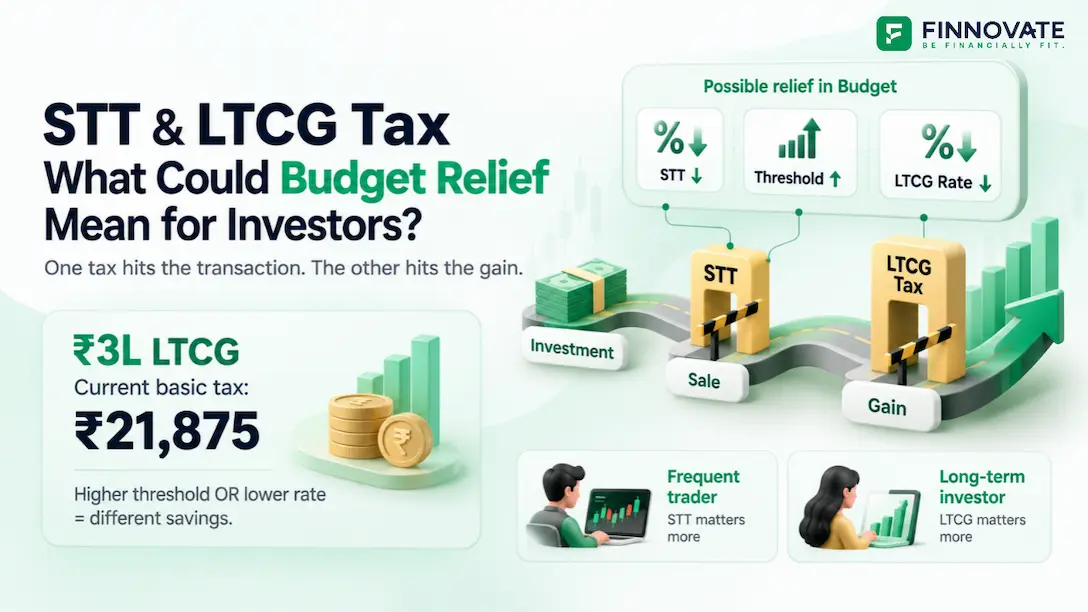
STT and LTCG Tax: What Budget Relief Could Mean for Investors
Understand how STT cuts, a higher LTCG exemption or lower capital gains tax could affect i...
19 October 2026

Finnovate’s editorial team researches and creates financial content using trusted sources, regulatory references and inputs from subject experts.

Last reviewed: 16 October 2026 | Includes relevant Tax Year 2026-27 updates
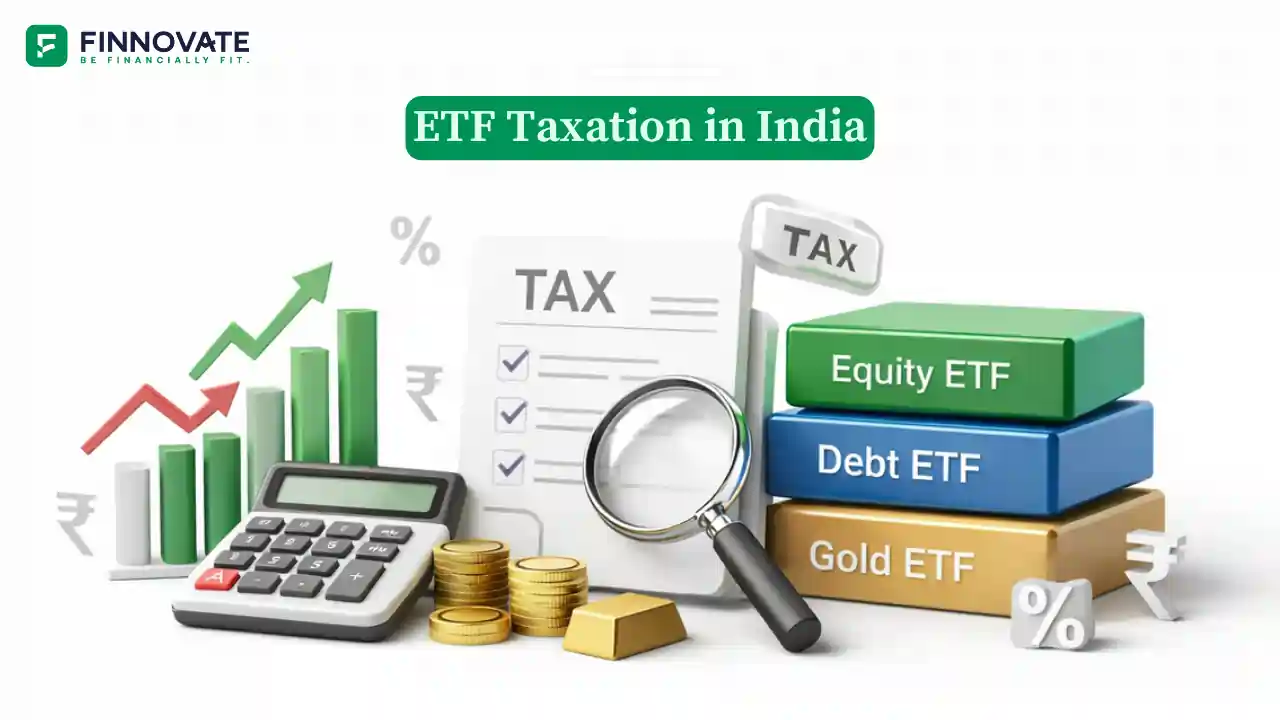
Not all ETFs in India are taxed the same way. An equity ETF, a debt ETF, and a gold ETF may all trade on the stock exchange, but their tax treatment can be very different. The underlying exposure is what determines the tax outcome, not the fact that the instrument is exchange-listed.
This guide covers how each category of ETF is taxed in FY 2025-26 (AY 2026-27), what changed from earlier years, and key provisions applicable from Tax Year 2026-27 under the Income-tax Act, 2025. The holding period and fund classification must still be checked for the specific investment.
Table of Contents
Tax Year 2026-27 update (from 1 April 2026): The Income-tax Act, 2025 applies to transactions in Tax Year 2026-27. The broad equity, debt, gold and silver ETF distinctions described in this guide continue, with updated statutory section references. The specified-mutual-fund rule in Section 50AA of the 1961 Act is now covered by Section 76 of the 2025 Act.
Important SGB change: For redemptions in Tax Year 2026-27 and later, the capital gains exemption for Sovereign Gold Bonds is limited to an individual who subscribed at original issue and held the bonds continuously until redemption at maturity. Secondary-market acquisitions and premature redemptions do not meet this exemption condition. This affects the SGB comparison later in the article; it does not change the tax rules for gold ETFs. See Section 70(1)(x) of the Income-tax Act, 2025.
An ETF (Exchange Traded Fund) is a market-linked investment that usually tracks an index, a basket of securities, or a commodity like gold. It trades on the stock exchange like a share, with prices fluctuating through the trading day.
Being listed on an exchange does not automatically determine the tax treatment. For holding period purposes, listed ETF units are treated as listed securities, which means a 12-month threshold for long-term status. However, the applicable tax rate depends on what the ETF holds: equity-oriented rules apply to equity ETFs, while non-equity rates apply to gold, silver, and debt ETFs.
ETF investors can face tax in two ways.
Listed ETF units generally cross the long-term holding-period threshold after more than 12 months. Physical gold and silver and the unlisted fund structures compared below generally require more than 24 months. However, for a debt ETF covered by the specified-mutual-fund provisions, the law deems gains to be short-term regardless of how long the units are held. The holding period by itself does not override that rule.
| ETF / Fund Type | Listed? | LTCG Holding Period |
|---|---|---|
| Equity ETF (equity-oriented) | Yes | More than 12 months |
| Gold ETF (listed on exchange) | Yes | More than 12 months |
| Silver ETF (listed on exchange) | Yes | More than 12 months |
| Debt ETF (listed, not covered by Section 50AA) | Yes | More than 12 months |
| Gold Fund of Funds (unlisted structure) | No | More than 24 months |
| Silver Fund of Funds (unlisted structure) | No | More than 24 months |
| Physical gold / digital gold | No | More than 24 months |
| Physical silver / digital silver | No | More than 24 months |
An equity ETF is generally taxed like other eligible equity assets when it qualifies as an equity-oriented fund under the applicable domestic equity exposure conditions. The fund's legal classification, rather than its marketing category alone, determines eligibility for these rates.
Short-term capital gains on eligible equity-oriented ETFs held for 12 months or less are taxed at 20% under Section 111A. Surcharge and 4% health and education cess apply on top.
Long-term capital gains are taxed at 12.5% under Section 112A on gains above the annual Rs 1.25 lakh exemption, where the ETF qualifies for equity-style treatment and STT was paid. The Rs 1.25 lakh exemption is an annual aggregate across all eligible equity LTCG, not a per-ETF or per-holding benefit. If LTCG from multiple equity holdings combined crosses Rs 1.25 lakh in a financial year, the excess is taxed at 12.5%.
STT applies on equity-oriented ETFs sold through a recognised stock exchange (0.001% on delivery-based sale). Where STT is paid, the STT condition required to access Section 111A and Section 112A rates is generally met. Gold ETFs, silver ETFs, liquid ETFs, and gilt ETFs do NOT attract STT. The absence of STT on gold/silver ETFs does not affect their capital gains rates, which follow listed securities rules regardless.
An investor buys an eligible equity ETF for Rs 8,45,000 and sells it after 13 months for Rs 10,55,000.
| Particulars | Amount |
|---|---|
| Purchase value | Rs 8,45,000 |
| Sale value | Rs 10,55,000 |
| Total capital gain | Rs 2,10,000 |
| Less: annual LTCG exemption (if not used elsewhere in same FY) | Rs 1,25,000 |
| Taxable LTCG | Rs 85,000 |
| LTCG tax at 12.5% | Rs 10,625 |
| Post-tax gain | Rs 1,99,375 |
Illustrative only. Excludes surcharge and cess. The Rs 1.25 lakh exemption is an annual aggregate. If other equity LTCG was realised in the same year, the exemption available here may be lower or nil.
Debt ETF taxation is not one rule for all products. The revised specified-mutual-fund definition applies to transfers from FY 2025-26; it is important to check both the fund's classification and when its units were acquired.
Section 50AA of the Income-tax Act, 1961 deems gains from specified mutual fund units acquired on or after 1 April 2023 to be short-term capital gains, irrespective of holding period. Such gains are generally taxed at the investor's applicable rates. The definition of a specified mutual fund was revised by the Finance (No. 2) Act, 2024. For Tax Year 2026-27, see Section 76 of the Income-tax Act, 2025.
| Period | Section 50AA Definition | What Was Caught |
|---|---|---|
| FY 2023-24 and FY 2024-25 | Fund with 35% or less invested in domestic equity shares | Debt funds, but also gold ETFs and international ETFs (inadvertently) |
| From FY 2025-26 onwards | Fund investing more than 65% in debt and money market instruments, or a FoF investing at least 65% in such funds (based on annual averages) | Qualifying debt-oriented funds and debt FoFs. Gold ETFs and international ETFs are generally outside the revised definition |
For specified mutual fund units acquired on or after 1 April 2023, debt ETFs that meet the revised definition (more than 65% invested in debt and money market instruments) are covered by the short-term deeming rule regardless of holding period; the gains are generally taxed at the investor's applicable rate. The 65% threshold is calculated using the annual average of daily closing figures, not a single day's portfolio snapshot. Qualifying debt FoFs have a separate threshold of at least 65% invested in such funds. If the units fall outside this rule, normal listed non-equity capital gains treatment can apply: a holding period exceeding 12 months for LTCG, generally taxed at 12.5% without indexation, and shorter holdings taxed at applicable rates.
Product structure, underlying composition, the date of acquisition and the date of sale all matter. Debt ETF units acquired before 1 April 2023 require a separate check rather than automatic application of the specified-mutual-fund rule. Verify the relevant AMC's tax disclosure and your transaction dates before classifying gains.
Official provisions: Section 50AA (1961 Act) and Section 76 (2025 Act).
Gold and silver ETFs are not taxed like equity ETFs. They do not qualify as equity-oriented. However, because they are listed on the exchange, they benefit from the 12-month holding period for long-term status, which is shorter than the 24 months required for physical gold/silver or gold/silver mutual fund FoF structures.
STT (Securities Transaction Tax) is NOT applicable on gold ETF or silver ETF transactions. STT applies only to equity-oriented ETFs. The absence of STT on gold/silver ETF trades does not affect their capital gains rates, which are governed by listed securities rules regardless of whether STT is paid.
Purchases and sales of gold ETF or silver ETF units are transactions in securities, which fall outside the scope of GST. This is technically different from a GST exemption. GST may still apply to separately charged brokerage, platform or other taxable services. Physical gold and physical silver generally attract 3% GST on their sale, as does digital gold at purchase. These differences affect the upfront transaction cost, alongside any brokerage, fund expenses, storage or making charges.
Source: CBIC GST Sectoral FAQs (securities and GST).
Silver can be held in several forms in India, and the tax treatment differs meaningfully across them. The table below covers the key differences for FY 2025-26.
| Particulars | Silver ETF (listed) | Silver FoF (unlisted) | Physical Silver | Digital Silver |
|---|---|---|---|---|
| LTCG holding period | More than 12 months | More than 24 months | More than 24 months | More than 24 months |
| STCG rate | Slab rate | Slab rate | Slab rate | Slab rate |
| LTCG rate | 12.5% without indexation | 12.5% without indexation | 12.5% without indexation | 12.5% without indexation |
| Rs 1.25 lakh exemption? | No | No | No | No |
| STT applicable? | No | No | Not applicable | Not applicable |
| GST on purchase? | No, on securities transaction | No, on securities transaction | 3% GST | 3% GST |
Digital silver platforms are not the same as SEBI-regulated silver ETFs; platform terms, ownership and applicable tax treatment should be checked. The table assumes capital-asset treatment for an ordinary investor. For jewellery sold to the customer, GST is generally 3% on the total transaction value including making charges. A separate qualifying job-work service can attract 5% GST on job charges; this is not a general extra 5% tax on jewellery making charges. All capital gains rates shown exclude applicable surcharge and 4% Health and Education Cess. CBIC clarification.
The primary tax advantage of a listed silver ETF over physical silver or a silver FoF is the shorter LTCG threshold: 12 months versus 24 months. The LTCG rate itself (12.5%) is the same across all structures. The ETF route also avoids the 3% GST on physical purchase and eliminates storage and making-charge costs.
Gold is available in more investment forms than silver, including Sovereign Gold Bonds (SGBs). The tax treatment differs across each form.
| Particulars | Gold ETF (listed) | Physical Gold | SGB (held to maturity) | SGB (sold on exchange) | Gold MF / FoF (unlisted) |
|---|---|---|---|---|---|
| LTCG holding period | More than 12 months | More than 24 months | 8-year maturity | More than 12 months (listed) | More than 24 months |
| STCG rate | Slab rate | Slab rate | Not applicable (hold to maturity) | Slab rate | Slab rate |
| LTCG rate | 12.5% without indexation | 12.5% without indexation | FY 2025-26: exempt on qualifying RBI redemption. From TY 2026-27: exempt only for an individual who subscribed at original issue and holds until maturity |
12.5% without indexation | 12.5% without indexation |
| Annual interest? | None | None | 2.5% per annum (taxable at slab rate) | 2.5% per annum (taxable at slab rate) | None |
| Rs 1.25 lakh exemption? | No | No | Not applicable | No | No |
| STT applicable? | No | Not applicable | Not applicable | No (SGBs are listed but not equity) | No |
| GST on purchase? | No, on securities transaction | 3% GST | No | No | No, on securities transaction |
SGB capital gains exemption: two different tax years. For FY 2025-26, the earlier exemption covered qualifying redemption by an individual through RBI, including permitted premature RBI redemption after year five; sale on an exchange was not covered. For Tax Year 2026-27 onwards, the amended rule under Section 70(1)(x) is narrower: the individual must have subscribed at original issue and held continuously until RBI redemption at maturity. Secondary-market purchases, exchange sales and premature redemptions do not qualify for that exemption. In a taxable disposal, the applicable holding-period, cost and capital gains provisions must be checked.
The SGB interest shown in the table remains taxable according to the investor's applicable rules. All illustrative capital gains rates exclude surcharge and 4% Health and Education Cess.
| Particulars | Equity ETF | Debt ETF | Gold / Silver ETF |
|---|---|---|---|
| Classification | Equity-oriented (if qualifying) | Depends on composition | Non-equity, listed security |
| LTCG holding period (listed) | More than 12 months | More than 12 months (if outside Section 50AA) | More than 12 months |
| STCG rate | 20% (Section 111A) + surcharge + cess | Slab rate (whether inside or outside Section 50AA) | Slab rate |
| LTCG rate | 12.5% above Rs 1.25 lakh annual exemption | 12.5% if outside specified-mutual-fund rule; applicable rates if covered by Section 50AA / Section 76 regardless of holding | 12.5% (no Rs 1.25 lakh exemption) |
| Rs 1.25 lakh annual exemption? | Yes (Section 112A) | No | No |
| STT applicable? | Yes (0.001% on delivery-based sale) | No (liquid and gilt ETFs) | No |
| GST on purchase? | No, on securities transaction | No, on securities transaction | No, on securities transaction |
| Section 50AA applies from FY 2025-26? | No | Yes, for eligible units acquired on/after 1 April 2023, if more than 65% in debt/money market instruments (annual average) | No (removed from FY 2025-26) |
| Key check required | Confirm equity-oriented status and STT payment | Confirm fund composition and Section 50AA applicability | Confirm listed ETF vs unlisted FoF structure |
ETF taxation involves classification checks, holding period tracking, and the Rs 1.25 lakh annual exemption aggregate. Our advisory team can help you plan your disposals before the financial year ends.
Book a Tax Planning CallETF capital losses can be set off only against capital gains, not against salary or other income categories.
The set-off rules are based on the nature of the loss (short-term or long-term), not the asset category. A long-term capital loss from a gold or silver ETF sale can therefore be set off against long-term capital gains from equity ETFs or any other capital asset in the same financial year.
| Mistake | What Actually Applies |
|---|---|
| Assuming all ETFs are taxed the same way | Equity, debt, and gold/silver ETFs have different applicable rates and rules. The underlying composition of the fund and its classification under the Income Tax Act determine the outcome |
| Applying 24-month LTCG threshold to listed gold or silver ETFs | Listed gold and silver ETF units are listed securities. Their LTCG holding period is 12 months, not 24 months. 24 months applies to physical gold/silver and unlisted fund structures like FoFs |
| Assuming STT is applicable on gold or silver ETF transactions | STT does not apply to gold ETFs, silver ETFs, liquid ETFs, or gilt ETFs. Only equity-oriented ETFs attract STT. The absence of STT on gold/silver ETFs does not change their capital gains rates |
| Assuming gold ETFs are still caught by Section 50AA in FY 2025-26 | The Section 50AA definition was amended by Finance (No. 2) Act 2024. From FY 2025-26, only debt-oriented funds (more than 65% in debt/money market) are covered. Gold ETFs and international ETFs are no longer included |
| Treating the Rs 1.25 lakh LTCG exemption as per-ETF or per-holding | It is an annual aggregate across all eligible equity LTCG (equity shares, equity ETFs, equity mutual funds). The total across all such holdings in the year must stay below Rs 1.25 lakh for the full exemption to apply |
| Confusing STCG rates across ETF types | Equity ETF STCG is 20% under Section 111A. Gold and silver ETF STCG is at the investor's slab rate. These are different rates from different sections |
| Ignoring acquisition date for debt ETFs | Section 50AA (and Section 76 for Tax Year 2026-27) applies to specified mutual fund units acquired on or after 1 April 2023. Earlier acquisitions require a separate check; the annual-average portfolio test also matters |
Yes. ETF investors face tax on IDCW distributions (at slab rate) and on capital gains when units are sold. The applicable rate depends on the type of ETF and the holding period.
No. Equity ETFs, debt ETFs, and gold or silver ETFs have different applicable rates and rules. The underlying composition of the fund and its classification under the Income Tax Act determine the outcome.
For eligible equity-oriented ETFs, LTCG is taxed at 12.5% under Section 112A on gains above the annual Rs 1.25 lakh exemption. The exemption is an annual aggregate across all eligible equity LTCG, not a per-ETF benefit.
Short-term capital gains on eligible equity-oriented ETFs (held 12 months or less) are taxed at 20% under Section 111A, plus applicable surcharge and 4% cess.
For a listed gold ETF, the holding period for long-term status is more than 12 months, since listed ETF units are listed securities. This is different from physical gold or gold mutual fund FoF structures, which require more than 24 months. Both are taxed at 12.5% LTCG, but the threshold to reach LTCG treatment differs.
No. STT (Securities Transaction Tax) does not apply to gold ETFs, silver ETFs, liquid ETFs, or gilt ETFs. STT applies only to equity-oriented ETFs. The absence of STT on gold and silver ETF transactions does not affect their capital gains rates, which are governed by normal listed securities rules regardless.
No GST is charged on buying or selling gold ETF or silver ETF units because securities transactions are outside the scope of GST. Separately billed brokerage and other taxable services may attract GST. Physical gold, physical silver and digital gold generally attract 3% GST on sale or purchase, as applicable.
The key difference is the holding period for LTCG. A listed silver ETF qualifies for LTCG after more than 12 months. Physical silver and an unlisted silver FoF generally require more than 24 months, as does digital silver when treated as a capital asset on the stated facts. The LTCG rate is generally 12.5% without indexation for such gains. Physical silver attracts 3% GST on sale, while buying silver ETF units as securities falls outside GST. Transaction-specific classification should be checked with a qualified Chartered Accountant.
No. The Rs 1.25 lakh annual LTCG exemption under Section 112A applies only to eligible equity assets (equity shares, equity-oriented mutual funds, and units of business trusts). Gold and silver ETFs are not equity-oriented and do not qualify for this exemption.
No. For eligible specified mutual fund units acquired on or after 1 April 2023, Section 50AA (Section 76 under the Income-tax Act, 2025) treats gains as short-term if the fund invests more than 65% in debt and money market instruments, measured using the annual average of daily closing figures. Debt ETFs outside that classification may follow normal listed non-equity gains rules, including LTCG after more than 12 months at 12.5%. Acquisition date, sale date and fund composition should all be checked.
Yes. Eligible capital losses can be carried forward for up to 8 assessment years, provided the ITR for the loss year was filed on time. Short-term capital loss can offset both STCG and LTCG from any capital asset. Long-term capital loss can only offset LTCG from any capital asset. A gold ETF long-term capital loss can therefore be set off against equity ETF LTCG in the same year. Please consult a qualified Chartered Accountant for transaction-specific guidance.
Report gains or losses from selling gold and silver ETF units under Schedule CG (Capital Gains) in the applicable income-tax return, using the entries for the relevant non-equity asset and holding period. Do not automatically report them as equity-oriented gains eligible for the Rs 1.25 lakh exemption. Reconcile broker statements, purchase dates, sale values and the AIS with your records, as pre-filled information may need verification. The appropriate ITR form depends on your other sources of income and individual circumstances.
Disclaimer: This article is for general information and educational purposes only. It does not constitute investment advice, a recommendation, or an offer to buy or sell any ETF or securities. FY 2025-26 (AY 2026-27) references follow the Income-tax Act, 1961 as amended; the explicitly labelled Tax Year 2026-27 updates follow the Income-tax Act, 2025 and applicable amendments, including the revised Sovereign Gold Bond redemption exemption. Actual taxation depends on fund classification, acquisition and transfer dates, investor status and applicable law. Please consult a qualified Chartered Accountant or tax professional for transaction-specific guidance, and a SEBI-registered investment adviser for investment decisions.
No spam. Only new posts, simple explainers, and practical money checklists for busy professionals.
Finnovate is a SEBI-registered financial planning firm that helps professionals bring structure and purpose to their money. Over 3,500+ families have trusted our disciplined process to plan their goals - safely, surely, and swiftly.
Our team constantly tracks market trends, policy changes, and investment opportunities like the ones featured in this Weekly Capsule - to help you make informed, confident financial decisions.
Learn more about our approach and how we work with you:
No comments yet. Start the conversation. What would you add?
No spam. Only new posts, simple explainers, and practical money checklists.
You may also like
Understand how STT cuts, a higher LTCG exemption or lower capital gains tax could affect i...

Tax planning for married couples in India explained for 2026. Compare tax regimes, deducti...
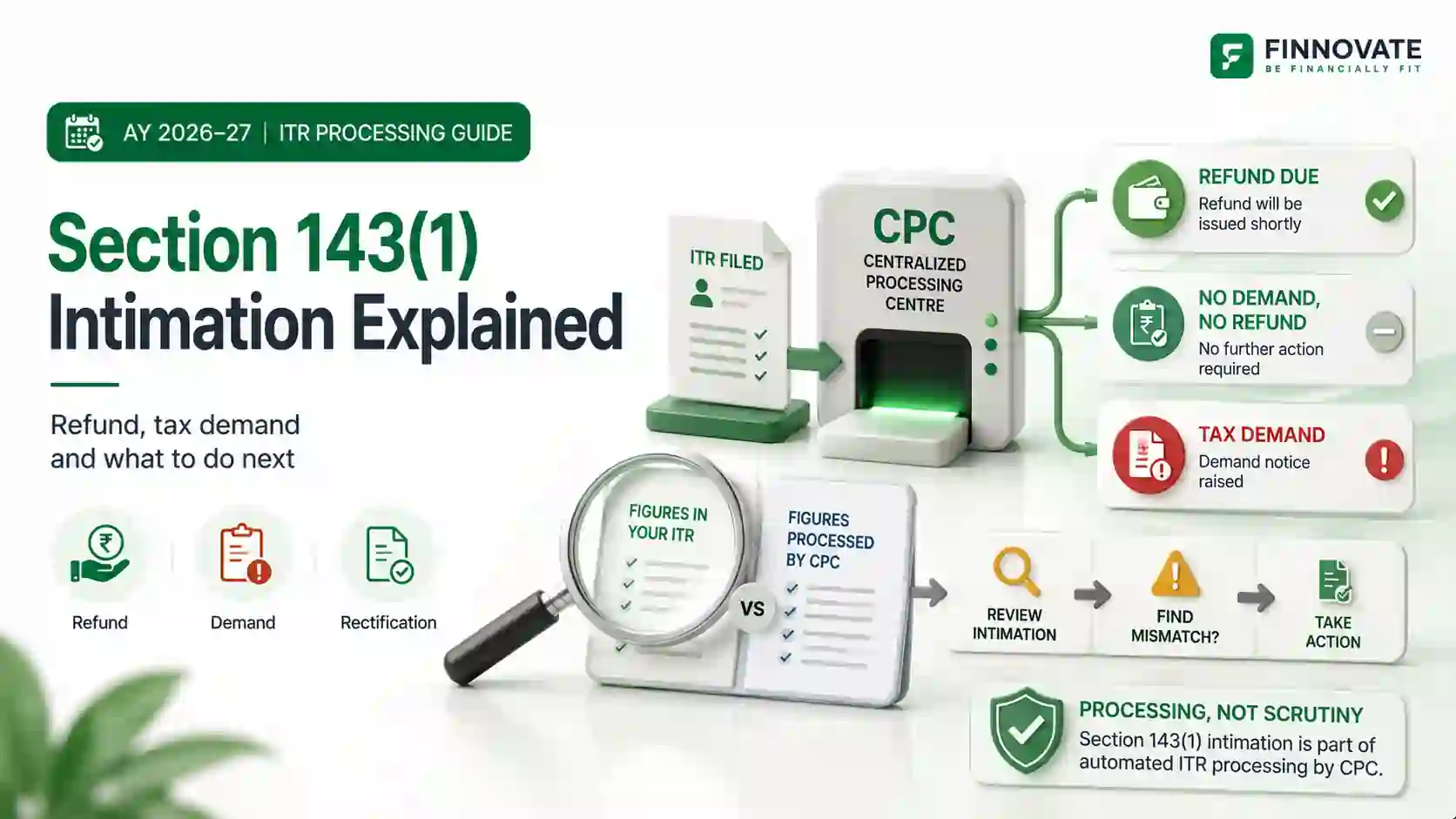
Received a Section 143(1) intimation? Understand CPC adjustments, refunds, tax demands, re...

Zero tax on a ₹14.65 lakh salary is real, but only if your employer contributes EPF on f...
Popular now

Learn how to easily download your NSDL CAS Statement in PDF format with our step-by-step g...

Looking for the best financial freedom books? Here’s a handpicked 2026 reading list with...
Learn what SIF investment means in India, SEBI rules, Rs 10 lakh minimum investment, avail...

Clear guide to mutual fund taxation in India for FY 2025–26 after July 2024 changes: equ...