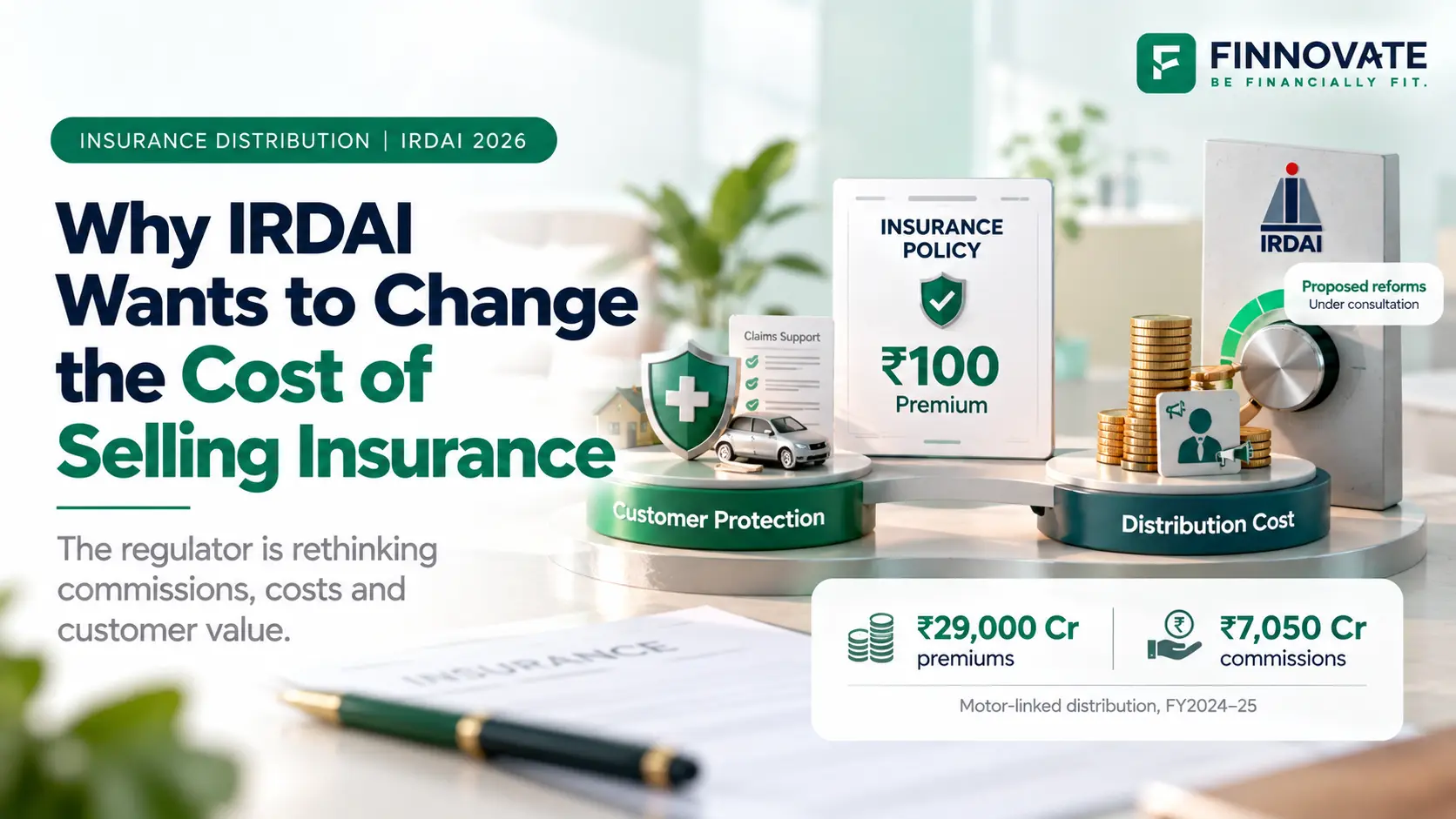
Why IRDAI Wants to Change the Cost of Selling Insurance?
You spend weeks comparing cars. You check the mileage, negotiate the price and look for a better loan rate. Then the insurance quote arrives with the rest of the paperwork, and it gets far less attention.
For the seller, that last purchase can be a valuable source of income.
According to India’s insurance regulator, motor manufacturer-linked brokers and motor insurance service providers generated approximately ₹29,000 crore in premiums in FY2024–25 and received almost ₹7,050 crore in commissions. That works out to roughly ₹24 for every ₹100 of premium across that business.
Those payments help explain why IRDAI is taking a closer look at how insurance reaches customers.
On September 23, 2026, the Insurance Regulatory and Development Authority of India released its consultation paper, Recalibrating Economics of Insurance Distribution. It proposes changes to insurer expenses, distributor commissions, online disclosures and sales practices.
The proposals are open for feedback until October 25, 2026. They are not final regulations.
What made the regulator step in?
Selling insurance involves real work. Someone must explain the cover, assess the customer’s needs, help with documents and support servicing. An agent may spend considerable time on a customer who ultimately buys nothing.
The concern begins when payments grow much faster than the business being brought in.
IRDAI’s paper presents two comparisons for the period from FY2022–23 to FY2024–25:
| Where the insurance was sold | Growth in premiums | Growth in payments to sellers |
|---|---|---|
| Life insurance through corporate agents, including banks, in the regulator’s sample | 28% in new-business premiums | 125% in total payments, including commissions, rewards and incentives |
| General insurance through brokers | 37% | 173% in commissions |
Scroll horizontally on smaller screens to view the full table.
The gap is what matters here. For life insurance sold through banks and other corporate agents, premiums from new business grew by 28%, but payments to the sellers more than doubled. This comparison covered about 92% of premiums brought in through that channel.
For general insurance sold through brokers, the average commission rate doubled from 8.5% to 17%. In everyday terms, brokers received about ₹17 for every ₹100 of premium, compared with ₹8.50 earlier.
Paying more could be justified if customers received better advice or ongoing support.
IRDAI’s question is whether those higher payments reflect better service, or the price insurers must pay to reach customers.
Why access to customers can become expensive
A bank already knows when someone is taking a loan. A car dealer meets the customer at the moment insurance is needed. An online platform attracts people who are actively comparing policies.
That access is valuable. Insurers competing for those customers may therefore compete on how much they pay the seller.
Here is where the customer’s interests can get pushed aside. If one policy pays the seller more than another, there is an incentive to recommend it, even when another policy might be a better fit.
IRDAI’s paper identifies this conflict. It also points out that the stated commission may reveal only part of the cost. Rewards, incentives and other payments can raise the total amount a distributor receives.
The proposed response covers both sides of the transaction: how much insurers spend to sell policies, and how customers are treated during the sale.
The first change: lower overall expense limits
Before looking at individual commissions, IRDAI wants to tighten the insurer’s overall spending limit.
This covers commissions and operating costs, such as staff, offices and technology. The regulatory term is Expenses of Management, or EoM.
Think of it as the spending envelope within which an insurer must run its business and pay its sellers.
For life insurers, the paper proposes bringing these expenses down to 15% of premiums within two years and 12.5% within five years. It sets a five-year target of 10% for life insurers already below the stated benchmark in FY2024–25.
For general insurers, the proposed limits are 25% within two years and 20% within five years.
The timetable would begin with FY2027–28 as Year 1, with reductions required each year.
The paper also proposes changes to how these expenses are calculated. For general insurance, the premium base would exclude business accepted from other insurers through reinsurance. This matters when comparing the proposed limits with existing expense ratios.
For distributors, a smaller spending envelope could mean tougher negotiations over commissions. For insurers, it creates pressure to improve efficiency across the business.
The second change: pay according to the work involved
Explaining a family’s first health insurance policy can take considerable effort. Renewing a familiar policy may involve less work. Selling compulsory third-party insurance with a new car is a different transaction again.
IRDAI wants commission limits to reflect those differences.
Under the framework introduced in 2023 and 2024, insurers have had flexibility to set commissions through board-approved policies within overall expense limits. The consultation proposes specific commission ceilings based on the product and the seller.
So, how would the proposed limits compare with existing payouts?
The table below brings together the regulator’s reported figures and its proposed ceilings. Every percentage refers to the seller’s commission as a share of premium, not a reduction in the customer’s premium.
| Insurance type | Payouts reported in IRDAI’s paper | Proposed maximum for distribution businesses, including brokers and corporate agents | Proposed maximum for individual agents and applicable associates |
|---|---|---|---|
| Individual health insurance | Retail health commissions through brokers averaged around 30% in FY2024–25. This is a broader average, not a first-purchase-only rate. | 15% for a first purchase; 5% for renewal or transfer to another insurer | 20% for a first purchase; 10% for renewal or transfer |
| Motor third-party insurance, covering liability to others | Average commissions in the broker-channel discussion were 22% in FY2024–25, covering the category rather than new vehicles alone. | Nil for new vehicles; 2.5% for old vehicles | 2.5% for new vehicles; 5% for old vehicles |
| Motor own-damage insurance, covering damage to your vehicle | The paper’s quoted 25% motor average combines motor business. It does not provide a separate own-damage average in that comparison. | 5% for new vehicles; 10% for old vehicles | 10% for new vehicles; 15% for old vehicles |
| Individual pure term life insurance, with premiums paid over multiple years | No directly comparable existing average is supplied in the cited commission comparison. | 25% in the first year; 7.5% on renewal | 30% in the first year; 10% on renewal |
Scroll horizontally on smaller screens to view the full table.
Source: IRDAI consultation paper, Part 1, paragraphs 51–52 and Boxes 4A–4B. Reported averages describe the business covered by the data; proposed ceilings apply to the specified transactions. Separate provisions cover loan-linked products and additional incentives for specified underserved markets.
The direction is clear: the proposal would place tighter limits on seller payments and distinguish between finding a new customer and renewing an existing policy. The exact reduction would depend on what the insurer currently pays for that particular product and seller.
First purchase
Proposed ceiling for a distribution business: 15%
Up to ₹3,000Commission to the seller
Renewal
Proposed ceiling for a distribution business: 5%
Up to ₹1,000Commission to the seller
Assumes the premium stays unchanged at ₹20,000. These are proposed maximum seller payments.
Those are payments to the seller. Any saving passed on to the customer would depend on the insurer’s pricing and other costs.
The proposal also brings direct and indirect payments within the commission limit. Rewards, gifts and selling-expense reimbursements would count too, limiting the ability to replace a lower commission with a payment under another name.
The broader aim is to reward the work involved in selling and servicing insurance, while encouraging sellers to help customers keep suitable policies over time.
The third change: let people compare before becoming a sales lead
For customers, the most noticeable change may come before they buy anything.
You open an insurance website to check a premium. Before you can see enough information to compare policies, you are asked for your name, phone number and email address. A simple search can quickly become a series of sales calls.
IRDAI proposes making key product and pricing information available without requiring those personal contact details.
That includes product information sheets, brochures, frequently asked questions, premium rates and performance information. Details needed to assess risk or complete an application would still be relevant later in the buying process.
The paper also proposes easier-to-compare disclosures, including standardised one-page information and information about claims and complaints.
This matters because a low premium tells only part of the story. A customer also needs to understand what the policy covers, what it excludes and how the insurer handles problems.
Better access to that information could help people compare policies on more than the price displayed on a screen.
What happens to insurance sold with loans?
The same question of choice arises when insurance is offered alongside a loan.
A borrower may feel that accepting the policy is part of getting the loan approved. The insurance purchase then receives less scrutiny than it would as a separate decision.
The paper proposes prohibiting banks and non-bank lenders acting as insurance distributors from compulsorily bundling insurance with their products and services.
It also sets out examples of acceptable packages that offer a demonstrable benefit to the customer.
One example is a loan with a lower interest rate when the borrower provides specified insurance protection. Under the proposed safeguards, the lender would need to show the interest rate with and without that protection. The borrower could buy the insurance elsewhere, and the premium would be paid separately rather than taken from the loan amount.
That makes the trade-off easier to assess: how much does the borrower save on interest, what does the insurance cost, and is the policy suitable?
Why insurance stocks reacted so sharply
For a distributor, commission is revenue. A lower commission on each policy can put pressure on earnings unless the business sells more policies, reduces costs or changes its mix of products.
That helps explain the market reaction.
On September 24, PB Fintech fell 36% and Turtlemint fell 20%. Among life insurers, HDFC Life fell 6.2% and ICICI Prudential Life fell 4.23%. General insurers ICICI Lombard and Go Digit, however, gained.
The different reactions reflect different business pressures. An insurer may benefit from paying less to acquire business, but it also needs sellers willing to bring in customers. A distributor must assess whether the proposed payments would cover its acquisition and servicing costs.
These share-price moves reflect investors’ expectations about a proposal. The eventual business impact will depend on the final rules and how companies adapt.
Will customers pay less for insurance?
Lower selling costs could create room for more competitive premiums. For life insurance products that combine savings with cover, lower expenses could also improve the value left for policyholders.
But the size of any benefit will depend on more than commissions.
Health insurance prices, for example, also depend on treatment costs and claims. A reduction in selling expenses could be partly offset by higher claims costs.
There is another balance to get right. Good intermediaries help customers understand exclusions, choose suitable cover and get support when a claim becomes difficult. That service has value.
If payments become too low to support it, some sellers may reduce the time they spend helping customers or focus on larger policies.
The useful test is therefore whether customers receive better value across the life of the policy: a fair price, suitable cover and dependable service.
What should customers watch next?
The next milestone is the close of consultation on October 25, 2026, followed by IRDAI’s decisions on the final framework and implementation.
For customers, the changes will become meaningful in everyday situations:
Can you compare policies without first handing over your contact details?
Does the seller explain why a policy suits your needs?
Can you assess insurance offered with a loan and choose where to buy it?
Will someone help you after the sale, especially when you need to make a claim?
The car buyer at the start of this story may still spend more time comparing mileage than insurance. But easier comparisons and better-aligned seller incentives could make that overlooked purchase work better for them.
IRDAI’s paper puts the cost of selling insurance under scrutiny. Its success will depend on whether that produces better insurance to own.
Disclaimer:This article is for educational purposes and does not constitute investment or insurance advice. It discusses consultation proposals available as of September 25, 2026, which may change before final regulations are issued. The ₹20,000 premium example is illustrative.