SCSS vs Post Office MIS vs Bank FD: Which Is Better for Retirement Income?

Finnovate’s editorial team researches and creates financial content using trusted sources, regulatory references and inputs from subject experts.
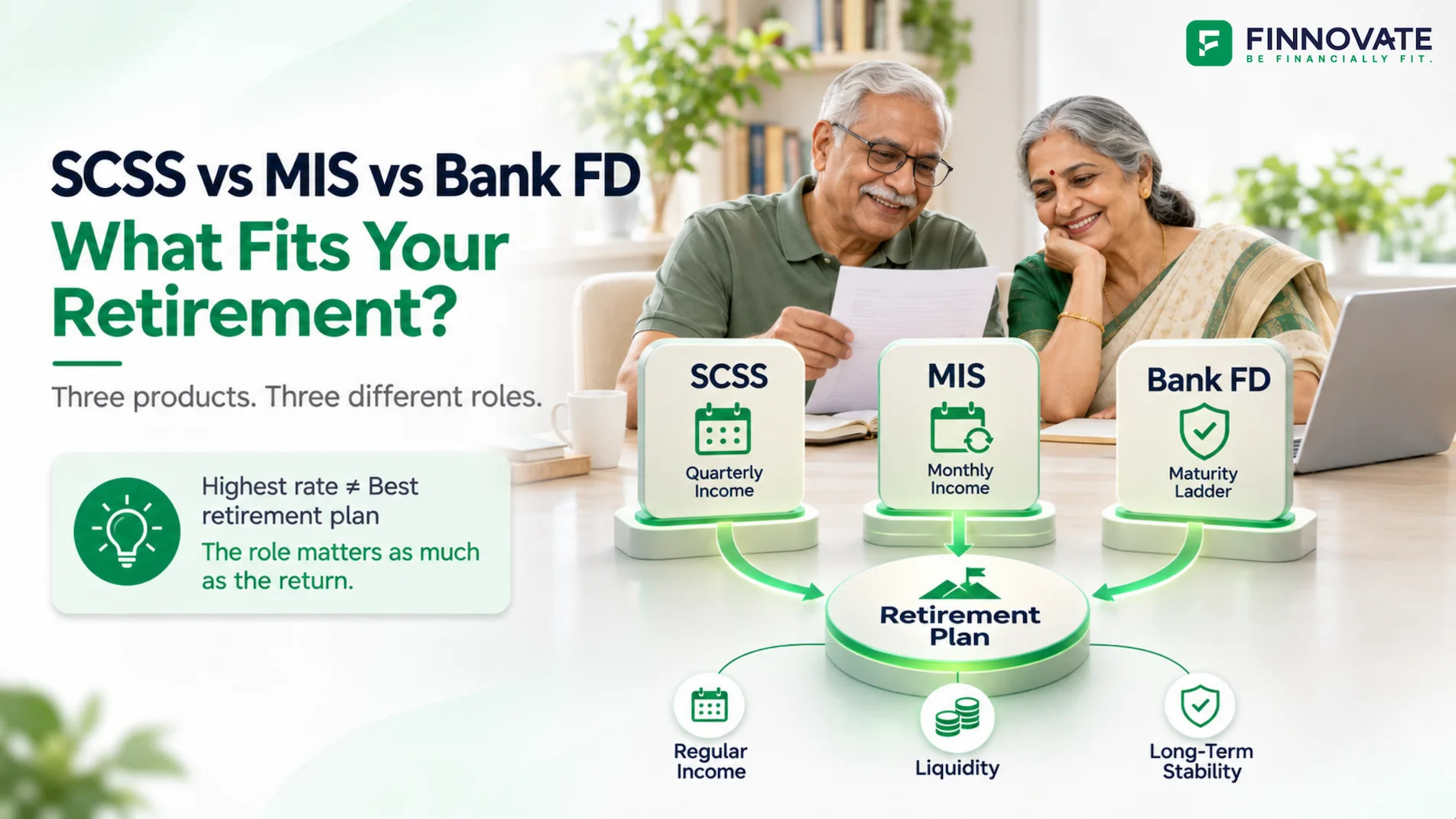
SCSS, Post Office MIS and bank FDs can all generate predictable retirement income. But choosing the product with the highest interest rate is not the same as building a retirement-income plan.
If you are eligible, SCSS currently offers the highest stated rate among these three at 8.2% p.a. Post Office MIS offers 7.4% p.a. with monthly interest, while bank FDs can offer greater flexibility in tenure and maturity structure.
But the better retirement strategy may be to use these instruments for different jobs rather than putting the entire corpus into whichever one currently pays the highest rate.
SCSS vs MIS vs Bank FD at a Glance
| Feature | SCSS | Post Office MIS | Bank FD |
|---|---|---|---|
| Current rate used here | 8.2% p.a. | 7.4% p.a. | 7.05% p.a.* |
| Income frequency | Quarterly | Monthly | Depends on payout option |
| Tenure | 5 years initially | 5 years | Varies |
| Maximum investment | ₹30 lakh per eligible individual | ₹9 lakh single / ₹15 lakh joint | No comparable scheme ceiling; bank rules apply |
| Premature access | Subject to scheme rules | Subject to scheme rules | Usually possible subject to bank terms |
| Government small-savings scheme | Yes | Yes | No |
| Deposit-insurance framework | Not a bank deposit | Not a bank deposit | DICGC up to ₹5 lakh per depositor per bank |
| Potential role | Predictable quarterly income | Monthly cash flow | Liquidity and maturity management |
*For the bank FD illustration, we use SBI's published senior-citizen rate for 5 to 10-year retail deposits. FD rates vary across banks and tenures.
First, Compare the Same ₹9 Lakh Across All Three
A fair comparison should begin with an amount that can actually fit into all three products.
Post Office MIS currently allows up to ₹9 lakh in a single account, so ₹9 lakh gives us a useful common comparison.
SCSS at 8.2%
The monthly equivalent is ₹6,150, but SCSS does not actually pay ₹6,150 every month.
Post Office MIS at 7.4%
Here the ₹5,550 matches the scheme's monthly payout structure.
SBI Senior-Citizen FD at 7.05%
The simple monthly equivalent is about ₹5,288, but the actual monthly credit can differ because monthly-interest deposits may use a discounted payout rate.
| ₹9 lakh invested | Approx. annual gross interest | Payout structure |
|---|---|---|
| SCSS @ 8.2% | ₹73,800 | ₹18,450 quarterly |
| Post Office MIS @ 7.4% | ₹66,600 | ₹5,550 monthly |
| SBI senior FD @ 7.05% | ₹63,450 annual equivalent | Depends on payout option |
SCSS: Where Does It Fit Best?
SCSS is designed primarily for eligible senior citizens and certain eligible retirees.
The current rate is 8.2% per annum, with interest paid quarterly.
The initial tenure is five years, and the scheme can currently be extended in further three-year blocks subject to the applicable rules.
The maximum investment across SCSS accounts for one eligible individual is currently ₹30 lakh.
SCSS can therefore be useful for the portion of retirement money whose job is predictable income.
The amount should still depend on the retiree's liquidity needs, other sources of income and overall retirement plan.
Post Office MIS: Where Does It Fit Best?
The strongest practical feature of Post Office MIS is its monthly payout.
This can match the way many retirement expenses occur, such as groceries, utilities, medicines and household bills.
But monthly payout alone should not automatically make MIS necessary.
A retiree receiving a quarterly SCSS credit could also keep that money in a bank account and use it gradually each month.
Its current investment ceiling is also important:
- ₹9 lakh for a single account
- ₹15 lakh for a joint account
So MIS may be useful as one income layer, but it is unlikely to absorb a large retirement corpus on its own.
Bank FD: Where Does It Fit Best?
A bank FD's strongest advantage is often not return.
It is flexibility.
Retirees can choose different tenures and create an FD ladder.
As each FD matures, the retiree can use the money, retain part as liquidity or renew it at the rate available then.
FDs can therefore be useful for:
- staggering future maturities,
- funding known near or medium-term needs,
- creating additional periodic income,
- and keeping part of the retirement portfolio relatively accessible.
You Have ₹1 Crore for Retirement. Should You Simply Max SCSS, MIS and FDs?
₹1 crore is a more useful example for retirement planning because the scheme limits now start affecting the decision.
This does not mean ₹1 crore is enough for retirement. The required corpus depends on expenses, retirement duration, pension income, healthcare needs, inflation and other assets.
Now consider one eligible senior citizen with ₹1 crore earmarked for retirement.
A simple product-first strategy could look like this:
On paper, this looks attractive.
You have used the highest-rate scheme first, added monthly MIS income and placed the rest into FDs.
But before calling this a retirement plan, four questions need to be answered.
Product-First vs Planning-First: The Better Way to Think About ₹1 Crore
A Better Retirement-Income Framework: Give Every Rupee a Job
Instead of thinking only in terms of products, divide the retirement corpus by purpose.
This changes how the three products are used.
SCSS can help fund the predictable-income bucket.
MIS can be useful where monthly credits help the household manage spending.
Bank FDs can help match future liabilities and create staggered maturities.
But money that will not be required for 10, 15 or 20 years has a different job from next month's household expenses.
For a broader view of how retirement assets, withdrawals and inflation can work together, see Finnovate's retirement planning guides .
Stress Test 1: What Does “Safe” Actually Mean?
Deposits held across different branches of the same bank are aggregated for the ₹5 lakh limit.
Deposits held with different insured banks receive separate insurance limits under the applicable DICGC rules.
But the practical answer is also not to automatically open a large number of bank accounts just to keep every deposit under ₹5 lakh.
Large FD allocations should balance concentration risk, the DICGC framework, maturity dates and how manageable the structure is for the retiree and family.
Stress Test 2: Gross Interest Is Not Spendable Income
The ₹1 crore product-first example generated approximately:
But that does not automatically mean the retiree can spend the entire ₹7.43 lakh.
Interest from SCSS, Post Office MIS and bank FDs can form part of taxable income depending on the investor's overall tax position and applicable provisions.
For senior citizens, the current Section 194A threshold for deduction of TDS on qualifying interest paid by banks, co-operative banks and post offices is ₹1 lakh in a financial year.
TDS is only the tax deducted at source mechanism.
The retiree's final tax liability depends on total income, applicable tax regime and other relevant provisions.
Stress Test 3: What Happens to Fixed Income When Expenses Rise?
Suppose the ₹1 crore product-first allocation produces a gross monthly income equivalent of roughly:
Assume that nominal income remained unchanged while living costs increased at 6% a year.
The nominal income has not fallen.
Its purchasing power has.
That is why a retirement lasting 20 or 30 years cannot automatically be solved by maximising today's highest fixed-income rate.
If you are trying to understand how much corpus may be required once inflation and retirement duration are considered, read Finnovate's guide on whether ₹3 crore is enough for retirement .
Stress Test 4: What Happens When the Product Matures?
Retirement-income planning also has to consider reinvestment risk.
Today's rates are known.
Future rates are not.
When an SCSS account reaches maturity or extension, an MIS account matures, or an FD comes due, the rate available at that time may be higher or lower than today's rate.
This is another reason staggered maturities and a wider retirement strategy can matter.
Where Does Each Instrument Fit in a Retirement Plan?
Final Takeaway
If you compare only current interest rates, SCSS leads these three at 8.2%.
If actual monthly credit is important, Post Office MIS can be useful.
If you want to stagger maturities and manage liquidity, bank FDs can play an important role.
But the retirement decision should not begin with:
It should begin with:
How much needs to remain accessible? How much monthly income is actually required? How much can remain invested for many years? And how will the plan deal with tax, inflation and changing interest rates?
Once those questions are answered, SCSS, MIS and bank FDs can be assigned the roles they are best suited to perform.
FAQs
1. Is SCSS better than a bank FD for senior citizens?
SCSS currently offers a higher stated rate than the SBI senior-citizen FD used in this comparison. But bank FDs offer greater flexibility in tenure and maturity structure. The better fit depends on income requirements, liquidity and the role assigned to the money.
2. Should I invest the maximum ₹30 lakh in SCSS after retirement?
Not automatically. ₹30 lakh is the current maximum investment limit, not a recommended allocation. The amount should depend on your liquidity requirements, other income sources, tax position and how much of the retirement corpus needs to generate predictable income.
3. Which gives higher interest, SCSS or Post Office MIS?
As of 4 November 2026, SCSS is listed at 8.2% per annum while Post Office MIS is listed at 7.4% per annum. SCSS pays interest quarterly, while MIS pays interest monthly.
4. Can I invest ₹30 lakh in Post Office MIS?
Not in one MIS account. The current maximum is ₹9 lakh for a single account and ₹15 lakh for a joint account.
5. How should ₹1 crore be invested for retirement income?
There is no standard SCSS, MIS and FD split for ₹1 crore. First determine how much money needs to remain liquid, how much monthly income needs to be generated and how much of the corpus will not be required for many years. The product allocation can then be built around those requirements.
6. Is SCSS interest paid monthly?
No. SCSS interest is paid quarterly. Monthly figures shown in comparisons are monthly equivalents, not the actual payment frequency.
7. Are SCSS, MIS and bank FD interest taxable?
Interest can form part of taxable income depending on your overall income and applicable tax provisions. The TDS threshold should not be confused with a tax exemption.
8. Can retirees use SCSS, MIS and bank FDs together?
Yes, subject to eligibility and product rules. They can perform different jobs within a retirement plan. The allocation should depend on liquidity, required income, tax position and longer-term retirement needs rather than simply filling each product to its maximum limit.