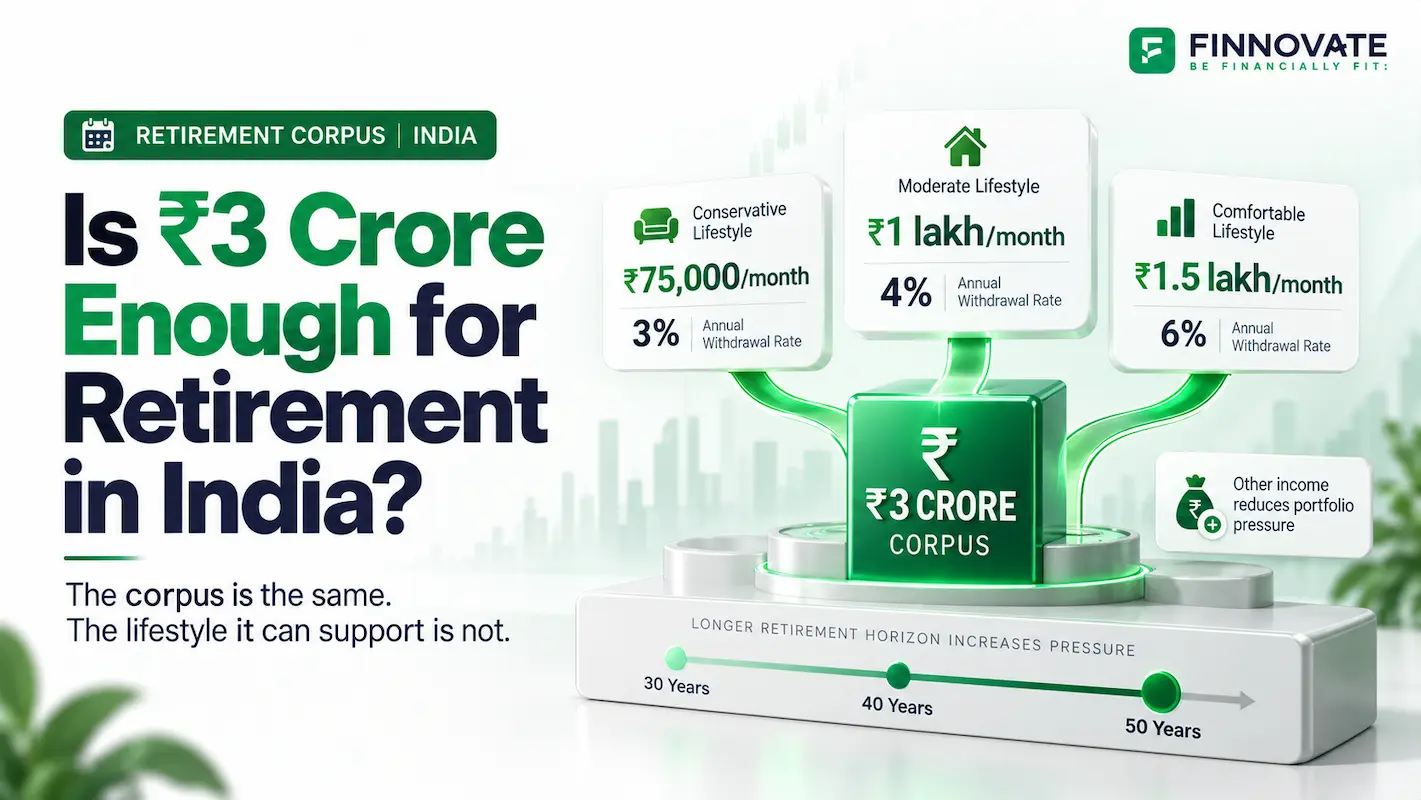
Is ₹3 Crore Enough for Retirement in India?

Finnovate’s editorial team researches and creates financial content using trusted sources, regulatory references and inputs from subject experts.
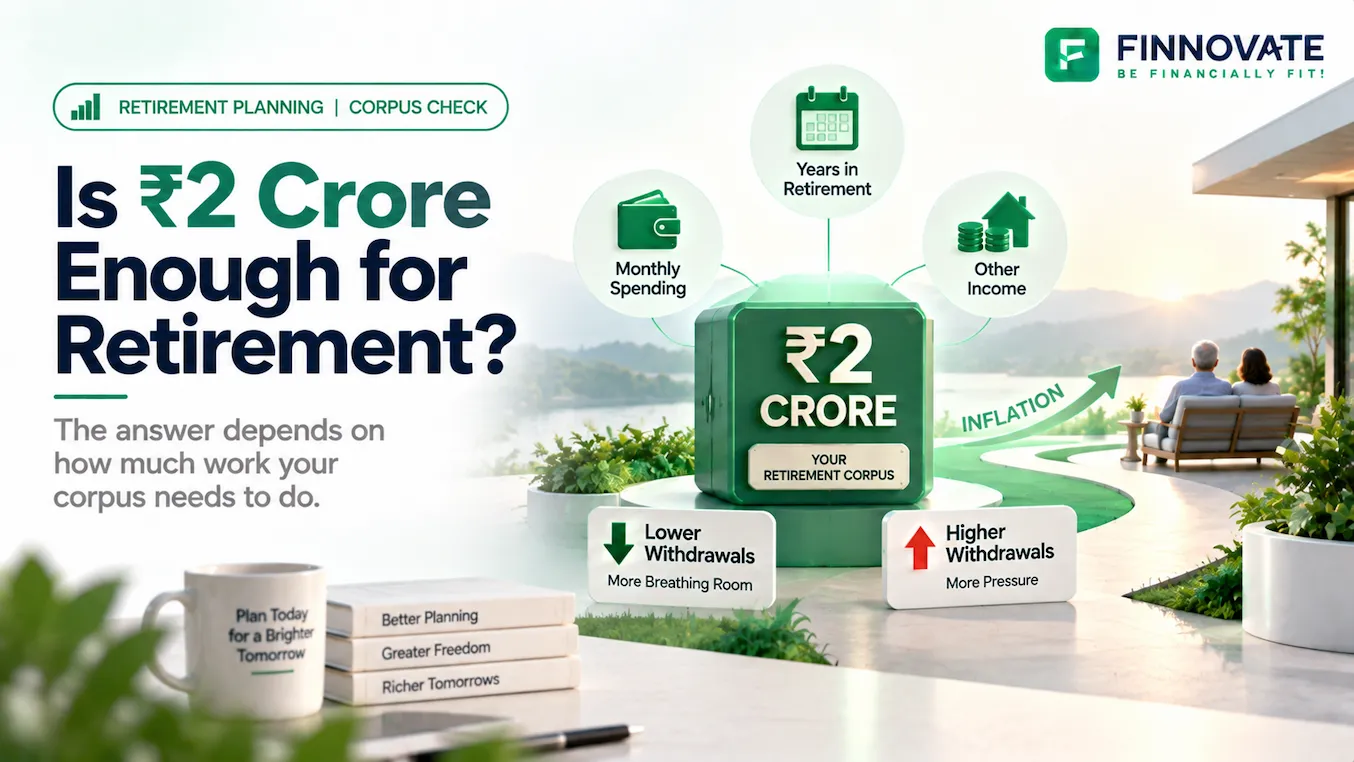
₹3 crore sounds like a retirement milestone. But a corpus only tells you how much capital you have. It does not tell you how much income that capital needs to provide, how long it must last or whether it can keep up with the lifestyle you want.
Someone spending ₹75,000 a month is asking a ₹3 crore portfolio to do one job. Someone spending ₹2 lakh a month is asking the same portfolio to do something very different.
At a 3% initial withdrawal, ₹3 crore corresponds to ₹75,000 a month in the first year. At 4%, it is ₹1 lakh. At 6%, it becomes ₹1.5 lakh.
Whether those withdrawals are workable depends on how long retirement lasts, inflation, other income, major future expenses and how the portfolio performs while money is being withdrawn.
What Does a ₹3 Crore Retirement Corpus Actually Mean?
Before doing any retirement math, let's define what the ₹3 crore actually represents.
For the calculations below, ₹3 crore means financial assets available to fund retirement withdrawals.
A self-occupied home may be part of your net worth, but it should not automatically be treated as retirement capital if you do not plan to sell, rent, downsize or otherwise use its value to fund your lifestyle.
Once the investible corpus is clear, connect it to spending.
| Monthly retirement spending | Annual spending | Initial withdrawal from ₹3 crore |
|---|---|---|
| ₹75,000 | ₹9 lakh | 3% |
| ₹1 lakh | ₹12 lakh | 4% |
| ₹1.25 lakh | ₹15 lakh | 5% |
| ₹1.5 lakh | ₹18 lakh | 6% |
| ₹2 lakh | ₹24 lakh | 8% |
These percentages describe only the first year's withdrawal. They do not tell us, by themselves, whether the same lifestyle can be sustained for 20, 30 or 50 years.
Is 4% a safe retirement withdrawal rate?
The familiar 4% framework comes from historical US retirement research. William Bengen's original work found that an initial withdrawal of about 4.15%, subsequently adjusted for inflation, survived at least 30 years across the historical periods he studied.
That research was based on US market history and was not designed as a universal Indian retirement rule.
Current Morningstar research similarly shows that the starting withdrawal rate changes when the retirement horizon and portfolio assumptions change. Its current model estimates 3.9% for a 30-year horizon under its specified assumptions, while the rate falls for longer retirement periods.
Sources: William Bengen: The 4% Rule · Morningstar: Withdrawal Rates for Longer Retirement Horizons
What Monthly Lifestyle Can ₹3 Crore Support?
One useful starting point is to ask how much of the portfolio your first year's lifestyle would consume.
Someone spending ₹75,000 a month withdraws ₹9 lakh in the first year, which is 3% of ₹3 crore.
Someone spending ₹1.5 lakh a month withdraws ₹18 lakh, or 6%.
The second retiree is asking the same corpus to fund twice the lifestyle.
That does not automatically tell us that one plan succeeds and the other fails. It tells us that the second portfolio begins retirement with a much heavier withdrawal requirement and therefore has less room for unfavourable returns, higher inflation or unexpected spending.
How Does Your Retirement Age Change the Answer?
The ₹3 crore does not change when retirement starts earlier.
The number of years it needs to support you does.
Consider one smooth mathematical model with these assumptions:
- Starting corpus: ₹3 crore
- Annual portfolio return: 8%
- Annual spending increase: 6%
- No pension or other retirement income
- No separate tax, healthcare or major one-time expense adjustment
Under those assumptions, the approximate first-year monthly withdrawal supported by the model changes materially with the retirement horizon.
For example, retiring at 40 and planning until age 90 creates a 50-year withdrawal horizon. Retiring at 60 and planning until 90 creates a 30-year horizon.
The retirement age therefore changes the job assigned to the same corpus.
Life expectancy is not the same as a planning deadline
India's Sample Registration System Abridged Life Tables 2019–23 show that a person who had already reached age 60 had an average remaining life expectancy of 18.4 years nationally. The corresponding figures were 17.3 years for men and 19.6 years for women.
But an average is not the age at which an individual will die. A retirement plan may need to remain funded for materially longer, which is why retirement calculations usually need an explicit planning age rather than simply using life expectancy at birth.
Source: Office of the Registrar General & Census Commissioner, India: SRS Abridged Life Tables 2019–23
SEBI's own financial goal planner similarly asks for current expenses, retirement age, expected lifespan, inflation during retirement and post-tax return rather than relying on one round corpus number.
Source: SEBI Investor: Financial Goal Planner
What If Retirement Is Still 10 Years Away?
There is another difference between saying:
“I have ₹3 crore today.”
and:
“My retirement target is ₹3 crore ten years from now.”
At an illustrative 6% inflation rate, ₹3 crore received ten years from now would have purchasing power equivalent to only about ₹1.68 crore today.
Conversely, if you want the purchasing power of ₹3 crore today to remain intact ten years later, you would need approximately:
This is why a retirement target needs both a number and a date.
For a deeper explanation, see Finnovate's guide to how inflation changes your retirement corpus .
Inflation Does Not Stop When Retirement Begins
Inflation affects retirement twice.
Before retirement, it changes how much your current lifestyle will cost when salary stops.
After retirement, it continues increasing the amount the portfolio may need to provide.
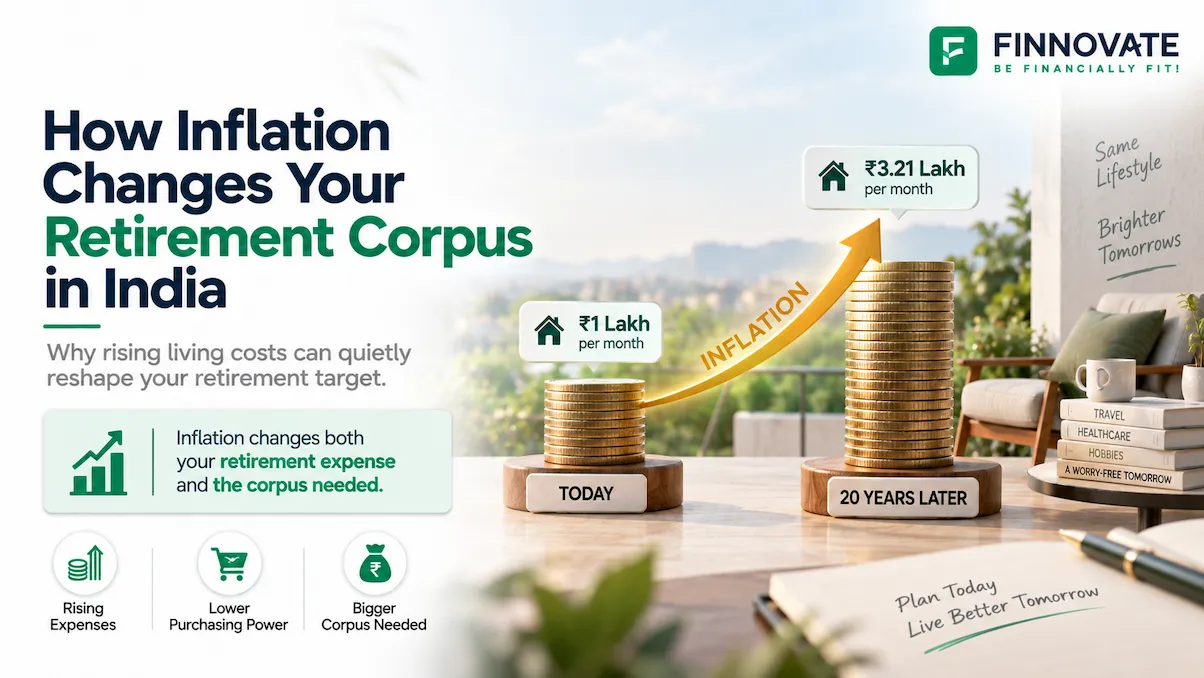
Suppose your first-year retirement lifestyle costs ₹1 lakh a month and that spending rises by an illustrative 6% every year.
| Point in retirement | Approx. monthly cost of the same lifestyle |
|---|---|
| Year 1 | ₹1.00 lakh |
| After 10 years | ₹1.79 lakh |
| After 20 years | ₹3.21 lakh |
| After 30 years | ₹5.74 lakh |
The ₹1 lakh is therefore not a permanent retirement withdrawal. It is simply the starting cost of the lifestyle under this assumption.
Question 2: How will those expenses continue rising after retirement?
₹3 Crore With Pension vs Without Pension
The portfolio does not necessarily need to fund your entire lifestyle.
Suppose retirement expenses are ₹1.25 lakh a month.
| Monthly lifestyle | Dependable monthly income | Portfolio provides | Initial withdrawal from ₹3Cr |
|---|---|---|---|
| ₹1.25L | ₹0 | ₹1.25L | 5% |
| ₹1.25L | ₹25,000 | ₹1L | 4% |
| ₹1.25L | ₹50,000 | ₹75,000 | 3% |
The lifestyle has not changed.
The pressure on the ₹3 crore corpus has.
Pension, rental income, annuity income or another dependable household income source can reduce the amount the portfolio needs to provide.
The important word is dependable. An uncertain side income should not be treated as guaranteed retirement cash flow.
What Costs Should Sit Outside Your Regular Monthly Retirement Budget?
Regular household spending is only one part of retirement.
Some costs are irregular, unusually large or difficult to capture inside one monthly number.
Keeping the two visible prevents the full ₹3 crore from being treated as though every rupee is available for routine monthly withdrawals.
What If Some Retirement Costs Rise Faster Than Your Main Inflation Assumption?
A 6% general inflation assumption does not mean every category of spending will rise at exactly 6%.
Healthcare is one example of an expense category that may behave differently.
Suppose a cost that is ₹10 lakh today rises for ten years.
This is a sensitivity example. It does not assume that healthcare inflation will necessarily be 10%.
The point is that using one inflation rate for every future expense can hide risks that are concentrated in a particular spending category.
How Should a ₹3 Crore Corpus Be Used After Retirement?
Reaching ₹3 crore is an accumulation milestone.
Retirement creates a different problem: turning capital into income while still keeping enough invested for expenses many years into the future.
One useful way to view the corpus is according to when the money will be required.
Suppose a retiree starts with ₹3 crore, spends ₹1 lakh per month in the first year and increases that spending by 6% annually.
The exact asset allocation depends on the retiree's withdrawal requirement, pension income, risk capacity, liquidity needs and retirement duration.
The broader principle is that money required next year and money that may not be required for 15 years do not have the same investment horizon.
Portfolio return is not automatically spendable return
A spreadsheet may assume an 8% portfolio return, but the amount ultimately available to support spending can also be affected by taxes and investment costs.
The tax impact depends on what assets are sold, how much gain is realised and the tax rules applicable at that time. Investment products can also carry costs. For example, mutual-fund expenses are reflected through the scheme's Total Expense Ratio and NAV.
Source: AMFI: Understanding Total Expense Ratio
What Happens If Markets Fall Early in Retirement?
Smooth-return calculations are useful for understanding the mathematics.
Real markets do not deliver the same return every year.
Imagine retiring with ₹3 crore and starting withdrawals immediately.
If markets fall sharply during the first few years, expenses still need to be paid. That can require selling assets while prices are down, leaving less capital invested when markets eventually recover.
This is known as sequence-of-returns risk.
This is why an 8% average return assumption should not be interpreted as receiving 8% every year.
Finnovate's Sequence-of-Returns Risk Explained shows how the order of returns can affect a portfolio that is already funding regular withdrawals.
Three Retirees. Same ₹3 Crore Corpus.
The easiest way to see why ₹3 crore cannot produce one universal retirement answer is to give the same corpus to three different households.
When Is ₹3 Crore More Likely to Be Enough?
₹3 crore becomes more workable when the portfolio is not required to solve every financial need on its own.
- Monthly spending is modest relative to the corpus
- Housing is largely settled
- Pension or other dependable income covers part of expenses
- Major future goals have separate funding
- Healthcare and emergency needs have been considered
- The ₹3 crore is genuinely accessible retirement capital
- The withdrawal requirement can adjust when circumstances change
A household with ₹3 crore, ₹75,000 monthly expenses, a paid-off home and ₹30,000 of dependable monthly pension income is facing a different retirement problem from a household with ₹3 crore, ₹1.5 lakh monthly expenses and no other income.
When Could ₹3 Crore Fall Short?
The same corpus can become stretched when several pressures occur together.
Starting spending is high
₹2 lakh per month means ₹24 lakh of first-year withdrawals, or 8% of ₹3 crore.
Retirement lasts for several decades
A longer retirement exposes the portfolio to more years of inflation, withdrawals and market uncertainty.
Expenses rise faster than expected
Healthcare, family responsibilities and changes in lifestyle can push future spending above the original estimate.
Returns are weaker than the spreadsheet assumes
An 8% return assumption is a modelling input, not a promise.
Major goals come from the same ₹3 crore
If the corpus must also fund a house purchase, large family commitment, healthcare reserve or another major goal, less money remains available for regular retirement income.
₹3 crore is actually total net worth
If a large portion is tied up in a self-occupied property or another asset that you do not plan to monetise, your actual retirement-income corpus can be materially smaller.
How to Test Whether ₹3 Crore Is Enough for Your Retirement
Instead of asking whether ₹3 crore is enough in general, run your own retirement through the following sequence.
Separate expenses likely to continue after retirement from those that may disappear.
A retirement beginning ten years from now needs future-rupee spending, not today's spending.
Pension, rent, annuity or other reliable income reduces the amount the portfolio needs to provide.
Keep healthcare reserves, large purchases and future goals visible instead of hiding them inside one monthly number.
This shows how much pressure your lifestyle initially places on the corpus.
A 30-year retirement and a 50-year retirement are different mathematical problems.
Test lower returns, higher inflation, longer retirement and larger-than-planned spending rather than relying on one spreadsheet outcome.
Do not automatically count property or other assets that will not fund retirement withdrawals.
Check What ₹3 Crore Means for Your Retirement
Finnovate's Retirement Calculator lets you model your retirement age, planning age, household expenses, inflation, post-retirement returns, existing investments, pension and other income, healthcare assumptions, reserves and legacy requirement.
Use the Retirement CalculatorThe calculator estimates required corpus, projected corpus and potential funding gap using the assumptions you enter rather than applying one fixed 25x or 30x rule.
Final Verdict: Is ₹3 Crore Enough for Retirement in India?
It can be.
But ₹3 crore by itself cannot answer the question.
If you need ₹75,000 a month from the corpus, your first-year withdrawal is 3%.
At ₹1 lakh a month, it becomes 4%.
At ₹1.5 lakh, it becomes 6%.
At ₹2 lakh, it becomes 8%.
Those are only the starting withdrawals. Expenses can rise with inflation, retirement can last longer than expected, markets can deliver poor returns at inconvenient times and major healthcare or family costs may also need funding.
So instead of asking:
ask:
That is what determines whether ₹3 crore is enough for your retirement.
FAQs
1. Is ₹3 crore enough to retire in India?
It can be enough for some households, but there is no universal answer. Monthly spending, retirement age, inflation, retirement duration, other income, healthcare needs and the amount of genuinely investible retirement capital all affect the result.
2. How much monthly income can ₹3 crore provide?
At a 3% initial withdrawal, ₹3 crore corresponds to ₹75,000 per month in the first year. At 4%, it is ₹1 lakh; at 5%, ₹1.25 lakh; and at 6%, ₹1.5 lakh. These are starting withdrawal illustrations, not guaranteed sustainable income levels.
3. Is ₹3 crore enough if I also receive a pension?
A dependable pension can materially reduce how much the portfolio needs to provide. For example, if your lifestyle costs ₹1.25 lakh a month and a pension provides ₹50,000, the portfolio needs to provide ₹75,000 a month, equivalent to a 3% initial withdrawal from ₹3 crore.
4. Is ₹3 crore enough to retire at 40?
It depends on the lifestyle and other income the corpus needs to support. Retiring at 40 may require the portfolio to fund several decades of withdrawals, which makes inflation, withdrawal rate and investment-return assumptions particularly important.
5. How much will ₹3 crore be worth after 10 years?
At an illustrative 6% annual inflation rate, ₹3 crore received ten years from now would have purchasing power equivalent to roughly ₹1.68 crore today. To preserve the purchasing power of ₹3 crore today, you would need approximately ₹5.37 crore after ten years.
6. Does my house count as part of my ₹3 crore retirement corpus?
It can form part of your net worth, but it should not automatically be treated as spendable retirement capital. Whether it can fund retirement depends on whether you plan to sell it, rent it, downsize or otherwise monetise its value.
7. What can make ₹3 crore fall short?
High starting withdrawals, a long retirement period, higher-than-expected expenses, large one-time costs, weak investment returns, poor early market returns and counting non-spendable assets as retirement corpus can all place additional pressure on the plan.
8. Is the 4% rule enough for a ₹3 crore retirement?
The 4% framework is a useful reference point, but it is not a guarantee or a universal Indian withdrawal rule. A 4% starting withdrawal from ₹3 crore equals ₹12 lakh in the first year, but the long-term outcome depends on retirement duration, inflation, investment returns, asset allocation and the sequence in which those returns occur.