

Retirement Income During a Bear Market: What Should You Do?
Learn how to manage retirement income during a bear market in India, including SWP withdra...
09 October 2026

Finnovate’s editorial team researches and creates financial content using trusted sources, regulatory references and inputs from subject experts.
Retirement changes the job of your money.
During your working years, the objective is largely to build a retirement corpus.
After retirement, the question changes:
"How do I turn that corpus into regular income without exhausting it too early?"
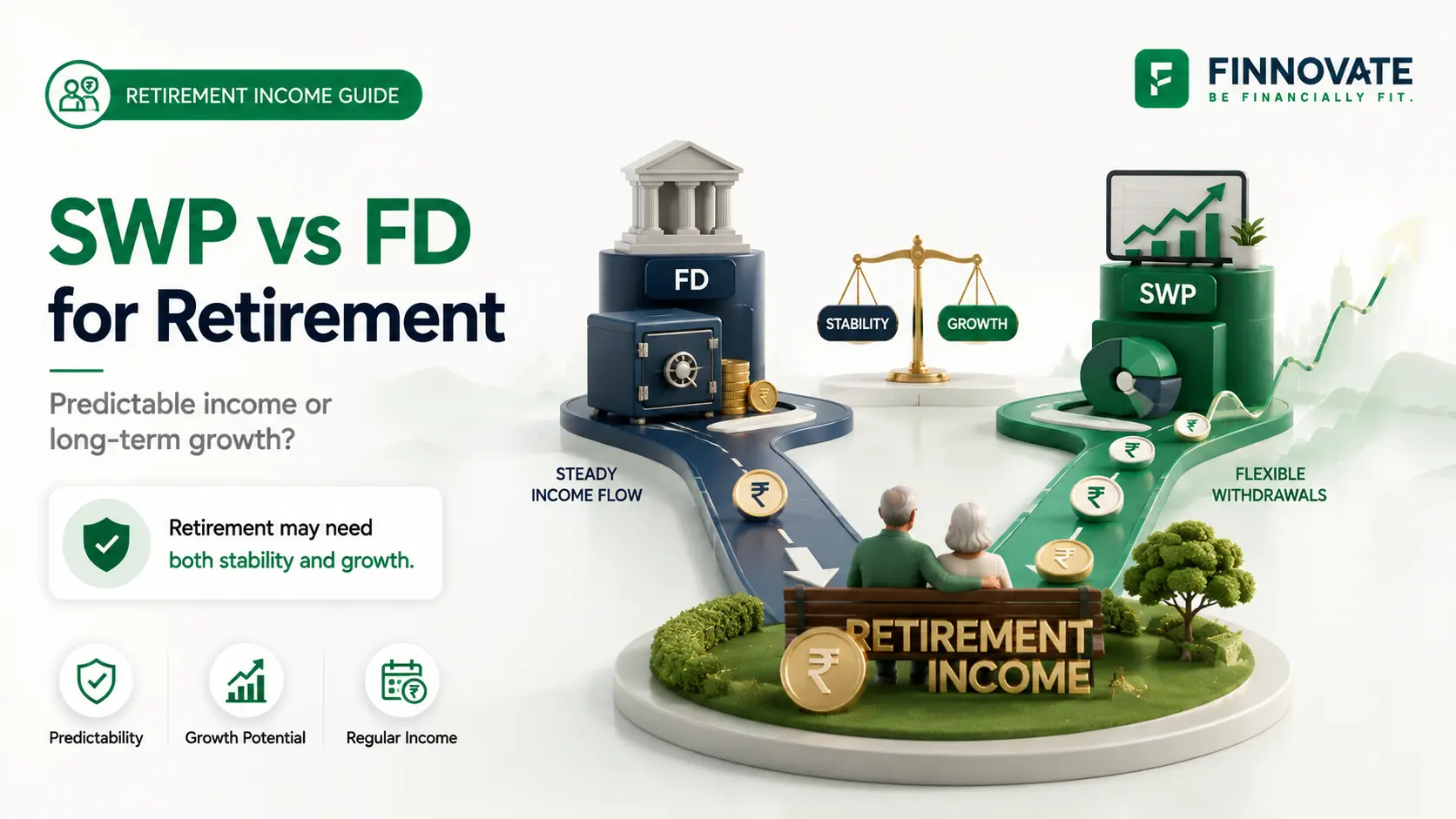
This is where two options commonly enter the conversation: a bank Fixed Deposit (FD) and a Systematic Withdrawal Plan (SWP).
Neither is automatically better.
An FD offers relatively predictable returns and low market-linked volatility. An SWP allows you to withdraw money periodically from a mutual fund portfolio, which can offer greater long-term growth potential but also carries market risk.
For many retirees, therefore, the real question is not:
"SWP or FD?"
It is:
Before deciding between products, it also helps to know whether your overall retirement corpus is adequate. Finnovate's Retirement Calculator can help estimate the corpus required based on your expenses, retirement age and assumptions.
Table of Contents
FD may be more suitable for money where predictability and capital stability are the priority. The interest rate is known for the deposit tenure and the value does not move daily with financial markets.
An SWP may be more suitable when part of the retirement corpus still needs growth and flexible withdrawals. But an SWP is market-linked because units are redeemed from a mutual fund, so neither the return nor the life of the corpus is guaranteed.
For a retirement that may last 20 to 30 years or more, the better answer may therefore be a combination of stable assets for near-term spending and suitable growth assets for later years.
There is an important distinction.
A Systematic Withdrawal Plan allows you to periodically redeem units from a mutual fund.
Suppose you have ₹50 lakh invested in a mutual fund and set an SWP of ₹30,000 per month.
Every month, units worth approximately ₹30,000 are redeemed at the applicable NAV and the proceeds are paid to you.
The units that remain continue to stay invested.
So when someone compares SWP vs FD, they are really comparing:
a mutual fund portfolio from which money is being systematically withdrawn
with
a fixed deposit earning a predetermined rate for a specified tenure.
This matters because the risk, return and taxation of an SWP depend heavily on the mutual fund used.
A Fixed Deposit is relatively straightforward.
You place money with a bank for a chosen tenure at an agreed interest rate.
Depending on the FD, interest can be paid periodically or accumulated until maturity.
For retirees, the appeal is easy to understand:
But an FD also has limitations.
The rate available when the deposit matures may be lower or higher when you reinvest. This creates reinvestment risk.
And although the deposit amount itself may remain stable, its purchasing power can reduce over a long retirement because of inflation.
Suppose part of your retirement corpus remains invested in mutual funds.
Instead of redeeming the entire amount, you can instruct the fund house to redeem a fixed amount periodically.
For example:
Each withdrawal involves selling mutual fund units at the applicable NAV.
If portfolio growth is sufficient relative to withdrawals over time, part of the corpus may continue growing.
If withdrawals are high relative to returns, the corpus can gradually decline.
And if markets fall while withdrawals continue, the corpus can fall faster because more units may need to be sold at lower NAVs.
| Factor | Fixed Deposit | Mutual Fund + SWP |
|---|---|---|
| Regular cash flow | Yes | Yes |
| Return | Predetermined for the FD tenure | Market-linked |
| Capital fluctuation | Generally low | Depends on underlying mutual fund |
| Guaranteed return | Contracted deposit rate for tenure | No |
| Inflation protection | Limited | Potentially better where suitable growth assets are used |
| Tax treatment | Interest is generally taxable | Tax generally arises on the capital-gain component of redeemed units |
| Liquidity | Premature withdrawal conditions may apply | Generally flexible, subject to scheme rules and exit load |
| Growth potential | Limited to deposit return | Depends on underlying assets |
| Market risk | No NAV-linked market fluctuation | Yes |
| Suitable for entire retirement corpus? | Not necessarily | Not necessarily |
The basic trade-off is straightforward.
FD has the advantage on return predictability during the deposit tenure.
If you invest in an FD at a fixed rate for three years, you broadly know how much interest the deposit is expected to earn during those three years.
An SWP works differently.
You can decide to withdraw ₹40,000 every month.
But that does not mean the mutual fund is earning ₹40,000 every month.
The withdrawal may contain:
So an SWP can make the cash flow predictable, but the investment return and remaining corpus are not predictable.
This is where retirement planning becomes more complicated.
Suppose you require ₹60,000 per month when retirement begins.
At 6% annual inflation, the same lifestyle would cost approximately:
Actual household inflation will differ, particularly because expenses such as healthcare can behave differently from general inflation.
But the problem remains.
An FD can provide stable interest income, but the interest does not automatically rise because your groceries, travel, insurance premiums or healthcare expenses have increased.
Keeping every rupee of a retirement corpus in low-growth assets can therefore create another risk: loss of purchasing power.
A suitable allocation to growth assets may help part of the portfolio keep pace with inflation over a long retirement.
The right allocation depends on the retiree's expenses, corpus, income sources and ability to handle volatility. Our guide to asset allocation in India explains how different asset classes can play different roles inside a portfolio.
Tax is one of the most misunderstood parts of the comparison.
Interest earned on a fixed deposit is generally taxable according to the investor's applicable income-tax position.
For tax year 2026-27, the current TDS threshold on qualifying interest paid by banks, co-operative banks and notified post-office deposits is ₹1 lakh for a senior citizen.
Your final tax liability depends on your total income, applicable tax regime, deductions or reliefs available to you and other individual factors.
An SWP is taxed differently because each withdrawal is a redemption of mutual fund units.
The entire amount withdrawn is not automatically treated as investment income.
Each redemption effectively contains:
The tax treatment then depends on factors such as:
The tax depends on the mutual fund and the units being redeemed.
Both can provide access to money, but in different ways.
With an FD, premature withdrawal is generally possible subject to the bank's terms. The bank may reduce the applicable interest rate or impose a premature withdrawal condition.
Mutual fund units can generally be redeemed subject to the scheme's applicable rules.
Some schemes can also charge an exit load when units are redeemed within a specified period.
An SWP usually allows the investor to:
subject to scheme and operational conditions.
This flexibility can matter because retirement expenses rarely remain identical for decades.
This is one of the biggest risks of depending on a market-linked portfolio for regular retirement expenses.
Imagine two investors retire with exactly the same corpus.
Both withdraw the same amount and both ultimately experience similar long-term average returns.
But one gets poor market returns in the first few years while the other gets strong returns first.
The outcomes can be very different.
This is known as sequence-of-returns risk.
Suppose you need ₹50,000 from an equity mutual fund.
| Mutual Fund NAV | Withdrawal Required | Units Redeemed |
|---|---|---|
| ₹50 | ₹50,000 | 1,000 units |
| ₹40 | ₹50,000 | 1,250 units |
You receive ₹50,000 in both situations.
But when NAV is lower, more units have to be sold.
Those extra redeemed units can no longer participate if markets later recover.
Yes.
An SWP does not create unlimited income.
A retirement corpus can be depleted if:
Suppose someone has ₹1 crore and withdraws ₹1 lakh every month.
That is ₹12 lakh during the first year itself.
Whether the withdrawal can continue for 15, 20 or 30 years cannot be answered simply by assuming:
"My mutual fund should earn 12%."
Returns are not guaranteed and they do not arrive at the same rate every year.
The withdrawal strategy therefore needs to be tested across:
See how your retirement corpus changes when you adjust the monthly withdrawal, retirement period, expected return and annual inflation increase. You can also connect your pre-retirement SIP journey with the post-retirement withdrawal phase.
Try the SIP-SWP CalculatorThe answer depends on the job the money needs to perform.
Neither list means that the entire retirement corpus should automatically be placed in that option.
Imagine retiring at 60.
You may need your money to support you until age 85, 90 or beyond.
Money required next year has a very different job from money you may not need for another 15 years.
One way of structuring retirement is to separate money by time horizon.
Money required for upcoming expenses may be held in relatively stable and liquid assets.
The objective is not maximum return.
It is to avoid depending entirely on what equity markets do immediately before a withdrawal.
Money that will be required later may take a suitable level of risk while maintaining a stronger focus on stability.
Money that may not be needed for many years has more time to remain exposed to suitable growth assets.
Over time, these buckets can be reviewed and replenished according to the retirement-income strategy.
Bank FDs are often described as completely risk-free.
That description needs some qualification when a very large retirement corpus is involved.
Eligible deposits with an insured bank are covered by the Deposit Insurance and Credit Guarantee Corporation, or DICGC, up to ₹5 lakh per depositor per bank, including principal and interest, subject to the applicable same-right and same-capacity rules.
Deposits across different branches of the same bank are aggregated for this purpose.
This does not make FDs comparable in risk to market-linked mutual funds. They have fundamentally different risk characteristics.
But someone placing a large retirement corpus into deposits should still think about:
A retirement plan should not begin with:
"Should I choose FD or SWP?"
Start with:
Only then should you decide how much of the retirement corpus needs stability, how much still needs growth and which assets should fund your regular withdrawals.
FDs can provide predictability.
Growth assets can help a long retirement deal with inflation.
SWP can convert a suitable mutual fund portfolio into periodic cash flow.
The objective is not to find a single winner between FD and SWP.
It is to build a retirement income structure that can continue working through changing expenses, market cycles and a retirement that may last several decades.
Finnovate's retirement planning process looks at your corpus, monthly expenses, inflation, NPS and other retirement assets, healthcare reserve, asset allocation and SWP structure together before deciding how your retirement money should be invested and withdrawn.
Explore Retirement PlanningNot universally. An FD provides greater return predictability during its tenure, while an SWP from a mutual fund can provide greater withdrawal flexibility and long-term growth potential but involves market risk. The appropriate choice depends on the retiree's expenses, corpus, time horizon, asset allocation and ability to take risk.
An SWP is only a withdrawal facility. Its risk depends largely on the mutual fund from which the money is being withdrawn. Mutual fund returns are market-linked and are not guaranteed.
Yes. An investor can set up periodic redemptions from eligible mutual fund schemes. However, the withdrawal happens by selling units and should not be confused with guaranteed interest or pension income.
No. Mutual fund redemptions can create taxable capital gains. The tax treatment depends on factors such as the type of mutual fund, holding period, acquisition date and applicable tax rules.
No. FD interest is not automatically tax-free. The current ₹1 lakh senior-citizen threshold for qualifying bank, co-operative bank and post-office interest relates to TDS. Final tax depends on the individual's total income, tax regime and other applicable provisions.
There is no guarantee. How long an SWP lasts depends on the starting corpus, withdrawal amount, inflation, investment returns, asset allocation and duration of retirement.
Doing so may provide greater stability, but a long retirement can also face inflation and reinvestment risk. The appropriate allocation depends on the retiree's expenses, other sources of income, corpus size, time horizon and ability to take investment risk.
Yes. They can perform different jobs. Stable assets such as FDs may help fund near-term requirements, while suitable market-linked investments may provide longer-term growth and can be used for planned withdrawals through an SWP.
There is no single safe withdrawal percentage that works for every retiree. The sustainable amount depends on the size of the corpus, retirement duration, inflation, asset allocation, investment returns, taxes and other income sources. The withdrawal should be tested under weaker-return and longer-retirement scenarios rather than relying on one assumed return.
Disclaimer: Mutual fund investments are subject to market risks. Please read all scheme-related documents carefully before investing. Fixed deposits and mutual funds have different risk characteristics and should not be treated as substitutes solely on the basis of expected returns. This article is for general information and educational purposes only and does not constitute personalised investment, tax or financial advice. Tax laws, TDS provisions, interest rates, deposit-insurance rules and mutual fund scheme conditions may change. Investors should review the latest applicable rules and their individual circumstances before making any investment or retirement-income decision.
No spam. Only new posts, simple explainers, and practical money checklists for busy professionals.
Finnovate is a SEBI-registered financial planning firm that helps professionals bring structure and purpose to their money. Over 3,500+ families have trusted our disciplined process to plan their goals - safely, surely, and swiftly.
Our team constantly tracks market trends, policy changes, and investment opportunities like the ones featured in this Weekly Capsule - to help you make informed, confident financial decisions.
Learn more about our approach and how we work with you:
No comments yet. Start the conversation. What would you add?
No spam. Only new posts, simple explainers, and practical money checklists.
You may also like
Learn how to manage retirement income during a bear market in India, including SWP withdra...

Want ₹2 lakh per month after retirement? See the corpus needed today and after 10, 20 or...

NPS vs mutual funds for retirement: compare liquidity, tax, lock-in, asset allocation, ann...
Compare NPS and UPS for Central Government employees, including contributions, pension cal...
Popular now

Learn how to easily download your NSDL CAS Statement in PDF format with our step-by-step g...

Looking for the best financial freedom books? Here’s a handpicked 2026 reading list with...
Learn what SIF investment means in India, SEBI rules, Rs 10 lakh minimum investment, avail...
Clear guide to mutual fund taxation in India for FY 2025–26 after July 2024 changes: equ...