

Top Small-Cap Stocks in August 2026: Why Small Caps Outperformed
Nifty Smallcap 100 rose 3.16% in August 2026. See which small-cap stocks led, what drove t...
08 September 2026

Finnovate’s editorial team researches and creates financial content using trusted sources, regulatory references and inputs from subject experts.
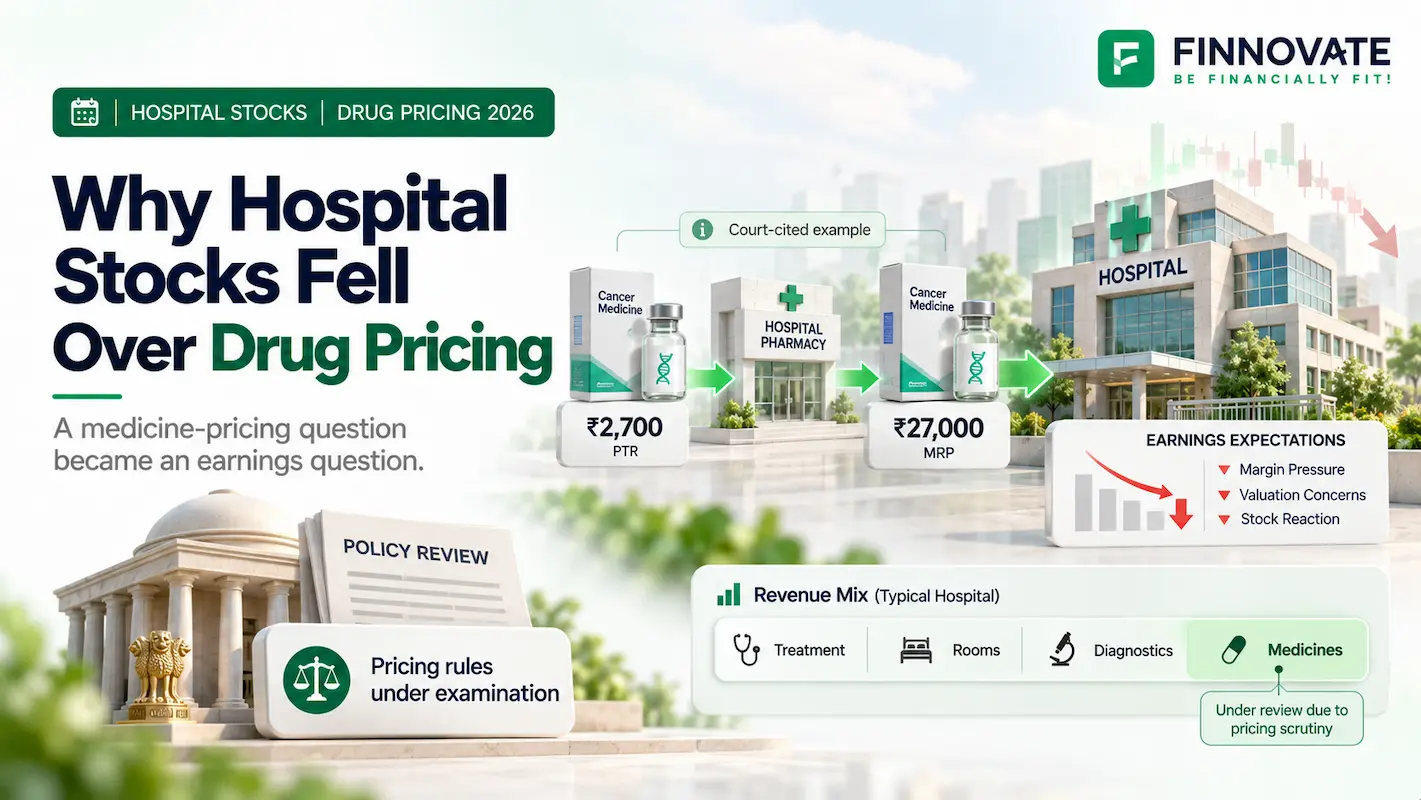
A cancer medicine reaches a retailer at around ₹2,700. Its printed maximum retail price is ₹27,000.
That gap became a focus of the Supreme Court’s scrutiny of medicine pricing. At its September 29 hearing, the court questioned why such a wide difference should exist and asked the government to examine broader restrictions on medicine margins.
The following day, hospital shares fell sharply. Apollo Hospitals, Fortis Healthcare and Max Healthcare were among the companies caught in the selling.
The connection runs through the hospital bill. What a patient pays for a medicine can contribute to a hospital’s revenue and profits. The possibility of changing that price makes investors reconsider the earnings they expect.
To understand the reaction, we need to follow how a medicine reaches the patient and how its price is set.
A medicine can pass through a manufacturer, distributors and stockists before reaching a retail or hospital pharmacy. Hospitals may also negotiate their own supply arrangements.
Along that journey, the purchase price and the final selling price can differ.
Two terms sit at the centre of this case. The price to retailer, or PTR, is the price at which the medicine is supplied to the retailer. The maximum retail price, or MRP, is the upper price printed on the pack for sale to the consumer, including applicable taxes.
A pharmacy may sell below MRP. But a high printed price can leave considerable room between what the pharmacy pays and what the patient is charged.
In the example discussed in court, the MRP was ten times the reported retailer price.
That comparison needs care. ₹2,700 was the reported price to the retailer, not the cost of manufacturing the medicine. Nor does the difference automatically become a hospital’s net profit. Actual selling prices, purchase terms and the costs of supplying and handling medicines matter.
Still, the gap raises an obvious question: how much of the benefit of a lower purchase price reaches the patient?
A person buying medicine from a neighbourhood pharmacy may be able to compare prices or seek a discount.
An admitted patient can face a different situation. Treatment is already underway, time may be limited, and the hospital is coordinating the medicines being administered.
The petitions raised allegations that some hospitals require patients to buy from their own pharmacies, limiting their ability to obtain the same medicines elsewhere. The court asked the Centre to examine these practices. These remain allegations under scrutiny, rather than findings against every hospital.
Where a patient has little practical choice over the seller, a discount available outside the hospital may offer little relief.
This brings the discussion beyond the printed price. It also concerns the patient’s ability to choose where to buy.
India has a drug-pricing framework administered by the National Pharmaceutical Pricing Authority, or NPPA.
Under the Drugs (Prices Control) Order, scheduled formulations have government-fixed ceiling prices. The calculation uses average eligible retailer prices and adds a 16% retailer-margin component.
For non-scheduled formulations, the framework generally limits MRP increases to 10% over the preceding 12 months. A restriction on annual increases, however, addresses a different question from the level at which a medicine is initially priced.
The court’s scrutiny concerns the room that remains for large differences between supply prices and patient prices.
At the September 29 hearing, it questioned whether a uniform restriction of 16% above retailer prices should be considered more broadly. The government sought time for consultations. The existing 16% component in the ceiling-price formula should therefore be distinguished from the broader restriction discussed in court.
There is precedent for targeted action. In 2019, NPPA brought 42 non-scheduled anti-cancer medicines under trade-margin regulation. That intervention used a different formula, with a 30% trade margin on the selling price.
Medicine pricing has faced intervention before. The present question is how much further the framework might go.
Hospital businesses earn money through several activities. Treatment, rooms, diagnostics, medicines and other services can all contribute to the overall bill.
If a new rule reduces the contribution from affected medicine sales, the hospital may retain less money from those sales, even if patient numbers remain unchanged.
Investors therefore have to reconsider two things.
First, how much could future earnings change?
Second, how much should they pay today for earnings whose future has become less predictable?
That second question helps explain why shares can react before a policy is final. Investors price expectations. They do not have to wait for a lower profit figure to appear in the accounts.
A company may continue to grow while investors become less willing to pay the same valuation for that growth.
Current market commentary reflects both concerns: possible pressure on earnings and uncertainty over the valuations investors assign to hospital companies. Estimates of the financial effect remain dependent on assumptions about any eventual restrictions.
The sell-off itself cannot tell us how large the eventual impact will be.
The answer depends on what a final rule covers and how each business operates.
Relevant differences include the medicines used, purchase arrangements, the treatments offered and the way patients or insurers are billed.
There is also a distinction between charging separately for each item and agreeing on a package price for treatment.
With separate billing, a change in a medicine charge may be visible directly. Within a package, its effect depends on how the package is priced and whether those terms change.
Analysts have discussed package billing, cost management and other service charges as possible ways hospitals might absorb some pressure. These are potential responses, not assured offsets. Their feasibility would depend on contracts, competition and the final rules.
That makes a blanket estimate for the entire hospital sector difficult to justify.
A reduction in a medicine’s billed price can help a patient paying for that item separately, provided other charges stay unchanged.
For a bundled treatment, the result depends on whether the package price also changes. The medicine component and the total treatment bill are related, but they are not interchangeable.
This is why the design of any intervention matters. Which products would it cover? At which stage would the margin be measured? How would compliance be checked?
Those details would influence both patient savings and business earnings.
As of October 1, 2026, the matter remains under examination, with the government having sought time for consultations. A broader 16% restriction has been discussed in court; its scope and implementation remain unresolved.
The next hearing is listed for October 12.
For investors, the episode shows why demand is only one part of understanding a business. People may continue to need its services while the rules governing what it can charge come under review.
The need for treatment can remain steady while expectations about hospital profits change. That is the link between the medicine-price question and the stock-market reaction.
Disclaimer: This article is for educational purposes and is not an investment recommendation. Legal proceedings and pricing policies may change.
No spam. Only new posts, simple explainers, and practical money checklists for busy professionals.
Finnovate is a SEBI-registered financial planning firm that helps professionals bring structure and purpose to their money. Over 3,500+ families have trusted our disciplined process to plan their goals - safely, surely, and swiftly.
Our team constantly tracks market trends, policy changes, and investment opportunities like the ones featured in this Weekly Capsule - to help you make informed, confident financial decisions.
Learn more about our approach and how we work with you:
No comments yet. Start the conversation. What would you add?
No spam. Only new posts, simple explainers, and practical money checklists.
You may also like
Nifty Smallcap 100 rose 3.16% in August 2026. See which small-cap stocks led, what drove t...

Nifty Midcap 100 rose 2.15% in August 2026. See which mid-cap stocks led the rally, key se...

See the best-performing Nifty 50 stocks in August 2026, which sectors led the market, and ...

Nifty Midcap 100 gained 1.81% in July 2026 and moved near its yearly high. See the top mid...
Popular now

Learn how to easily download your NSDL CAS Statement in PDF format with our step-by-step g...

Looking for the best financial freedom books? Here’s a handpicked 2026 reading list with...

Learn what SIF investment means in India, SEBI rules, Rs 10 lakh minimum investment, avail...

Clear guide to mutual fund taxation in India for FY 2025–26 after July 2024 changes: equ...