Can You Really Retire in Your 30s?

Finnovate’s editorial team researches and creates financial content using trusted sources, regulatory references and inputs from subject experts.

Retiring in your 30s is possible. But the hard part is not choosing age 35 as your target. It is building enough accessible wealth to support a life that could continue for another 50 or 60 years.
The answer depends on what your life will cost, how much of your wealth is actually available to fund it, how long the money may need to last, and whether the plan still works when returns, inflation or life itself turn out differently from the spreadsheet.
Early retirement creates two pressures at the same time: you have fewer working years to build the corpus, and the corpus may need to support you for much longer.
That is the real challenge behind FIRE, or Financial Independence, Retire Early.
First, What Does “Retiring at 35” Mean for You?
Retirement does not have to mean never earning another rupee.
Suppose your post-work lifestyle costs ₹70,000 a month.
If your investments need to provide the full ₹70,000, the portfolio carries the entire burden. If you reliably earn ₹30,000 from another source, the portfolio initially needs to provide the remaining ₹40,000.
The important distinction is whether your lifestyle still depends on your salary.
Why Retiring at 35 Is Very Different From Retiring at 60
Imagine two people who want the same lifestyle after retirement. One stops working at 60. The other stops at 35.
Start With the Life Your Corpus Has to Fund
A FIRE plan should not begin with “₹3 crore sounds like enough”. It should begin with your spending.
You cannot predict every rupee you will spend between 35 and 85. But you can avoid building a 50-year plan around one narrow monthly number.
What Will That Lifestyle Cost at Your FIRE Age?
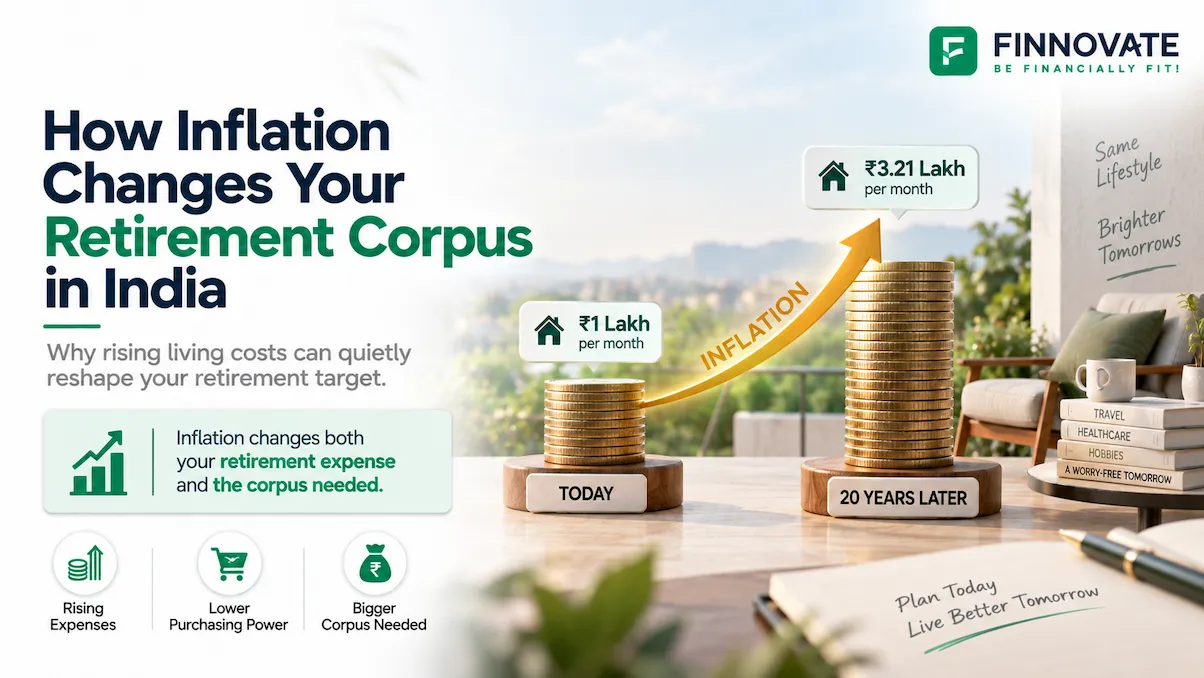
Suppose your lifestyle costs ₹1 lakh a month today.
Using 6% annual inflation as an illustrative planning assumption:
| Time from today | Cost of today's ₹1 lakh lifestyle |
|---|---|
| Today | ₹1.00 lakh/month |
| 10 years | ₹1.79 lakh/month |
| 20 years | ₹3.21 lakh/month |
| 30 years | ₹5.74 lakh/month |
Formula: Future expense = Current expense × (1 + inflation rate)years. The 6% rate is a planning assumption, not a forecast.
Inflation also continues after retirement. So the corpus may need to support decades of progressively higher withdrawals, not just the first year's expense.
See Finnovate's How Inflation Changes Your Retirement Corpus for a deeper 6% vs 7% analysis.
Is 25x Expenses Enough to Retire in Your 30s?
A popular FIRE shortcut is:
If first-year expenses are ₹10 lakh, 25x gives a corpus of ₹2.5 crore. That corresponds to an initial withdrawal of 4%.
The historical research behind the well-known 4% framework was built around US market history. William Bengen's original work found that an initial withdrawal of about 4.15%, subsequently adjusted for inflation, had survived at least 30 years across the historical periods he studied.
Source: William Bengen, The 4% Rule
A 35-year-old may be planning for 50 years or more.
Morningstar's September 2026 research estimated a 2.9% starting withdrawal rate for a 50-year horizon under its specific 40% equity, 60% fixed-income portfolio and 90% success criterion. That is not an Indian FIRE rule, but it shows why the withdrawal horizon matters.
Source: Morningstar, early-retirement withdrawal research, September 2026
What Would Retiring at 35 Actually Look Like?
Consider someone who is 30 years old today, spends ₹50,000 a month and wants to stop depending on a salary at 35.
Assume:
- 6% annual inflation
- expenses need to continue until age 90
- an illustrative 8% annual portfolio return after retirement
- retirement withdrawals increase by 6% each year
The 55-year model assumes the first-year annual withdrawal of approximately ₹8.03 lakh grows by 6% every year while the remaining corpus earns a smooth illustrative 8% annually.
Under those assumptions, the modelled starting corpus is approximately ₹2.58 crore.
Real returns do not arrive smoothly every year, and taxes, investment costs, changing expenses and the order of market returns can change the outcome.
How Sensitive Is the ₹2.58 Crore Number?
Keep the same ₹8.03 lakh first-year expense, 6% annual increase in withdrawals and 55-year horizon. Now change only the assumed annual portfolio return.
Your Spreadsheet Return Is Not Always Your Spendable Return
A FIRE spreadsheet may say the portfolio earns 8%. What ultimately matters is how much remains available to fund your life.
Aon's 2026 India research projects an 11.5% medical trend rate for employer medical-plan costs. That figure is not household healthcare inflation, but it shows why healthcare deserves separate attention rather than automatically following the same inflation assumption as every other expense.
Source: Aon, India 2026 Medical Trend
Reaching the FIRE Corpus Is Not the Same as Surviving Retirement
Suppose your spreadsheet assumes an average 8% annual return. Real markets could instead deliver a sequence such as +18%, -20%, +7%, -8% and +24%.
If the large fall happens soon after retirement, you may be withdrawing and selling investments while the portfolio is already down. Less capital is then left to participate in the recovery.
Two portfolios can eventually experience similar average returns but produce very different retirement outcomes because the returns arrived in a different order.
For someone retiring at 35, the impact can compound over many more years.
Finnovate's Sequence-of-Returns Risk Explained shows how the order of returns can affect a portfolio that is already funding regular withdrawals.
What Could an Early-Retirement Portfolio Look Like in Practice?
There is no universal FIRE asset allocation. But the same age-35 example can show how one retiree might separate near-term spending from money intended to grow for much later years.
Start with the same modelled corpus of approximately ₹2.58 crore and first-year spending of about ₹8.03 lakh.
Projected nominal spending: years 1–2 ≈ ₹16.54 lakh; years 3–7 ≈ ₹50.86 lakh, assuming expenses rise 6% annually. These are spending sums, not recommended asset-allocation targets.
Another retiree may use a different number of years, different instruments or a different equity-debt mix depending on risk capacity, taxes, other income and withdrawal strategy.
Can You Actually Build ₹2.58 Crore by 35?
Calculating the FIRE number is only one side of the problem. Reaching it can be much harder.
Suppose our 30-year-old has five years to reach approximately ₹2.58 crore.
| Existing investments at age 30 | At illustrative 10% p.a. | At illustrative 12% p.a. |
|---|---|---|
| ₹0 | ~₹3.33L/month | ~₹3.16L/month |
| ₹50 lakh | ~₹2.27L/month | ~₹2.05L/month |
| ₹1 crore | ~₹1.21L/month | ~₹93,000/month |
Monthly-investment estimates use a five-year horizon, month-end contributions and monthly compounding based on the stated illustrative annual return. Actual market returns can be materially different, especially over only five years.
Increasing the assumed return from 10% to 12% helps, but it does not turn a difficult five-year target into an easy one.
Very early FIRE is therefore usually a wealth, income, spending and time problem before it is an investment-return problem.
What Do ₹2 Crore, ₹3 Crore and ₹5 Crore Actually Mean?
Instead of asking whether a particular corpus is “enough”, look at the first-year withdrawal it implies.
| Corpus | 4% starting withdrawal | 3.5% | 3% |
|---|---|---|---|
| ₹2 crore | ₹66,667/month | ₹58,333/month | ₹50,000/month |
| ₹3 crore | ₹1,00,000/month | ₹87,500/month | ₹75,000/month |
| ₹5 crore | ₹1,66,667/month | ₹1,45,833/month | ₹1,25,000/month |
These are gross first-year portfolio-withdrawal equivalents. Tax depends on what is sold, the embedded gains and the tax rules applicable at the time.
₹3 crore may look substantial for someone planning to spend ₹60,000 a month. The same corpus can look much tighter for a lifestyle requiring ₹1.5 lakh.
Your FIRE Corpus Is Not the Same as Your Net Worth
Suppose someone says, “My net worth is ₹4 crore.”
Now look at what that ₹4 crore contains.
A self-occupied home can reduce housing costs and may later be rented, downsized or sold. But if you intend to live in it permanently, its full market value does not automatically behave like a liquid withdrawal portfolio.
Retirement-focused accounts need similar attention.
Under current PFRDA rules for the NPS All Citizen Model, a subscriber who joined before 60 can become eligible for normal exit after 15 years of subscription or at age 60, whichever is earlier. The amount available as lump sum and the annuity requirement depend on the corpus and exit route.
Source: PFRDA, NPS All Citizen Model
For the detailed 2026 rules, see Finnovate's NPS Withdrawal Rules 2026.
Before You Leave Your Job, Turn the FIRE Number Into a Withdrawal Plan
A corpus target becomes a retirement plan only when you know how life will actually be funded after the salary stops.
You should not need to make this decision for the first time after markets fall.
Know which assets can fund spending without forcing an unnecessary sale of growth assets at depressed prices.
Leaving a job can also mean losing or changing the corporate health cover you previously relied on.
A large unexpected expense should not automatically force you to sell long-term investments.
Property, NPS and other restricted or illiquid assets may need different treatment in the transition plan.
The portfolio ultimately has to fund the money you can actually spend.
What Can Break an Early-Retirement Plan That Looked Fine on Paper?
See how lifestyle alone changes the age-35 example
| Current monthly spending at age 30 | Illustrative corpus required at age 35 |
|---|---|
| ₹50,000 | ~₹2.58 crore |
| ₹75,000 | ~₹3.87 crore |
| ₹1,00,000 | ~₹5.16 crore |
Same assumptions as the main example: five years to retirement, 6% pre-retirement inflation, 55-year retirement horizon, 8% illustrative post-retirement return and withdrawals growing 6% annually.
Does Some Income After FIRE Change the Answer?
Yes, potentially by a lot.
Return to the retiree whose lifestyle costs approximately ₹66,911 a month at age 35.
Dependable consulting, rental or business income belongs in the calculation. Income that is uncertain should not be assumed merely to make an inadequate corpus look sufficient.
This is one reason financial independence can be more flexible than the idea of never working again.
How Do You Know If You Are Actually Ready to Retire in Your 30s?
Do not build FIRE around an expense level you are unlikely to maintain.
Today's ₹50,000 is not automatically ₹50,000 five or ten years later.
Run a long-horizon cash-flow calculation and see how the result changes at lower return or withdrawal assumptions.
Healthcare, family commitments and large purchases need room outside an artificially narrow monthly budget.
A FIRE plan needs an operating strategy, not only a corpus target.
Ask which assets can genuinely help fund life from your chosen FIRE age.
A 50-year plan should not require every inflation, return and spending assumption to turn out exactly as expected.
Find Your FIRE Number
Your number depends on your age, current expenses, target FIRE age, inflation assumptions, existing investments and planning horizon.
Use the FIRE CalculatorOnce you have the number, test whether the assumptions behind it are realistic enough for the life you actually want to fund.
So, Can You Really Retire in Your 30s?
Yes, some people can. But very early retirement is usually a wealth-and-spending problem before it is an investment-return problem.
Someone retiring at 35 has fewer years to accumulate the corpus and may need that corpus to support five decades or more of withdrawals.
Inflation raises the cost of the lifestyle. Markets will not deliver smooth returns. Taxes, investment costs and healthcare can reduce the margin in the plan. And some assets included in net worth may not actually be available to pay everyday expenses.
That is why ₹2 crore, ₹3 crore or ₹5 crore cannot answer the question by themselves.
If those pieces work together, retiring in your 30s can be financially realistic.
If they do not, working even a few additional years can improve both sides of the calculation: more time to build wealth and fewer years for the corpus to fund.
FAQs
1. Can I retire at 35 with ₹2 crore?
Possibly, depending on your expenses and other income. ₹2 crore corresponds to about ₹8 lakh of first-year withdrawals at a 4% starting rate, or roughly ₹66,667 a month. At 3%, it corresponds to ₹6 lakh a year, or ₹50,000 a month. A retirement that may last 50 years or more should also be tested beyond the first-year withdrawal.
2. Is ₹5 crore enough to retire in your 30s?
It can support a considerably higher starting withdrawal than ₹2 crore, but there is no universal answer. At a 3% starting withdrawal, ₹5 crore corresponds to ₹15 lakh in the first year. At 4%, it corresponds to ₹20 lakh. The retirement horizon, lifestyle, portfolio, inflation, taxes, other income and major expenses determine whether the plan is sustainable.
3. Is 25x annual expenses enough for FIRE?
It is a useful screening shortcut. The historical research associated with the 4% framework focused on approximately 30-year retirement periods, while someone retiring in their 30s may need the portfolio to support 50 years or more. Very early retirement should therefore also be tested over longer horizons.
4. Do I need 35x or 40x annual expenses to retire early?
Not automatically. A higher multiple means a lower initial withdrawal relative to the portfolio, but no single multiple is suitable for every retiree. Spending, horizon, investment returns, taxes, other income and flexibility all affect the result.
5. Does my house count towards my FIRE corpus?
Your house counts towards net worth. If you plan to keep living in it and do not intend to sell, rent or otherwise use its value, however, it does not directly fund regular portfolio withdrawals.
6. Should NPS and EPF count towards my FIRE corpus?
They can form part of retirement wealth, but accessibility matters. Someone retiring very early should distinguish assets that can fund life immediately from assets whose withdrawal rules or intended use make them more suitable for later years.
7. What if my spouse continues working?
Continuing household income can materially reduce how much the investment portfolio needs to provide. The calculation should use the portion of household expenses that genuinely needs to come from the FIRE corpus.
8. Can I earn money after FIRE?
Yes. Financial independence means employment income is no longer required to sustain your planned lifestyle. You may still consult, freelance, run a business or earn other income if you choose.
9. What asset allocation should someone use after FIRE?
There is no universal equity, debt or gold allocation. The portfolio needs to balance near-term withdrawals with long-term growth, and the appropriate mix depends on the retirement horizon, risk capacity, other income, tax position and withdrawal strategy.
10. How much cash should I keep when retiring early?
There is no fixed number of years that everyone should hold in cash. The appropriate near-term reserve depends on your withdrawal strategy, other income, risk capacity and how the rest of the portfolio is structured.
11. Is 6% inflation guaranteed?
No. It is an illustrative planning assumption. Actual inflation changes over time, and different expense categories can rise at different rates.
12. What is the hardest part of retiring in your 30s?
For many people, the hardest part is accumulating a sufficiently large, accessible corpus within a relatively short working period while keeping recurring lifestyle expenses under control. Calculating a FIRE number is much easier than building it and making it survive for decades.