

Retirement Income During a Bear Market: What Should You Do?
Learn how to manage retirement income during a bear market in India, including SWP withdra...
09 October 2026


Finnovate’s editorial team researches and creates financial content using trusted sources, regulatory references and inputs from subject experts.
Two people retire with the same corpus. They withdraw the same amount every year and receive the same set of investment returns.
Yet one finishes with considerably more money.
The difference is not the average return. It is the order in which the good and bad returns arrive.
Sequence-of-returns risk is the possibility that poor market returns occur during the early years of retirement, when you are already withdrawing money. The combination of losses and withdrawals can leave the portfolio with less money to recover when markets improve.
Sequence-of-returns risk, also called sequence risk, is the risk created by the timing of investment gains and losses while money is being withdrawn from a portfolio.
A market fall is uncomfortable for any investor. But it becomes more damaging when the investor must also sell investments to meet regular expenses.
This risk is most relevant to people who have:
A complete retirement planning strategy should therefore cover two connected stages: building the corpus and drawing income from it after retirement. Treating these stages as separate exercises can leave the withdrawal plan exposed to risks that were not visible during accumulation.
Consider two retirees, Investor A and Investor B.
Both investors receive the same five annual returns. Investor A receives the positive returns first. Investor B receives the negative returns first.
The withdrawal is made at the end of each year.
| Year | Investor A return | Investor A year-end balance | Investor B return | Investor B year-end balance |
|---|---|---|---|---|
| Year 1 | 20% | ₹1.14 crore | -20% | ₹74 lakh |
| Year 2 | 15% | ₹1.25 crore | -10% | ₹60.60 lakh |
| Year 3 | 10% | ₹1.32 crore | 10% | ₹60.66 lakh |
| Year 4 | -10% | ₹1.12 crore | 15% | ₹63.76 lakh |
| Year 5 | -20% | ₹83.96 lakh | 20% | ₹70.51 lakh |
Both investors started with the same corpus, withdrew the same amount and received the same set of returns. Only the order of the returns changed.
This gap may become much larger over a longer retirement period, particularly when withdrawals rise with inflation.
Investor B faced a 20% loss in the first year.
The ₹1 crore portfolio first fell to ₹80 lakh. After the ₹6 lakh withdrawal, only ₹74 lakh remained invested.
A second negative year followed. This reduced the corpus further, before the stronger returns had a chance to arrive.
When positive returns finally came, they were earned on a much smaller amount.
A 20% gain on ₹1 crore adds ₹20 lakh. A 20% gain on ₹60 lakh adds only ₹12 lakh. The return percentage is the same, but the rupee gain is not.
Investor A had the opposite experience. The early gains increased the portfolio before the negative years arrived. This gave the portfolio a larger base and a better ability to absorb the later losses.
Retirement projections often assume that a portfolio will earn a steady return, such as 8% or 10% every year.
This is useful for making an estimate. But real investment returns do not arrive in a straight line.
A portfolio may earn:
The long-term average may look reasonable. But the retirement outcome can still change depending on when the negative years occur.
This is why retirement planning should consider poor early returns, high inflation and longer life expectancy, instead of relying only on one average-return assumption.
The effect of market volatility changes when an investor moves from adding money to withdrawing money.
A Systematic Withdrawal Plan provides regular income by redeeming enough mutual fund units to meet the chosen withdrawal amount.
Suppose you need to withdraw ₹50,000 from a mutual fund.
| Mutual fund NAV | Withdrawal amount | Units that must be redeemed |
|---|---|---|
| ₹50 | ₹50,000 | 1,000 units |
| ₹40 | ₹50,000 | 1,250 units |
You receive ₹50,000 in both cases. But at the lower NAV, 250 additional units are sold.
Those units will no longer benefit if the fund later recovers.
This does not mean every SWP is unsuitable. It means the withdrawal amount, asset allocation, time horizon and source of the withdrawal must be planned together. Our guide to common SWP mistakes and their practical fixes explains why an SWP should not be started using the payout amount alone.
You can use Finnovate's SWP Calculator with Inflation to understand how withdrawals and rising expenses may affect a corpus under an assumed rate of return. The result is an illustration, not a guaranteed outcome.
Sequence risk is generally most important during the period close to retirement, particularly the final years before retirement and the early years after withdrawals begin.
The risk can be higher when:
There is no fixed year after which sequence risk disappears. Its effect depends on the remaining corpus, withdrawal rate, portfolio structure, inflation and other sources of income.
A higher withdrawal leaves less money invested. If this happens during a falling market, the portfolio may shrink more quickly than expected.
Equity can support long-term growth, but it can also fall sharply over shorter periods. Depending entirely on equity for immediate expenses may force an investor to sell during a correction.
Medical costs, family requirements or home repairs may lead to additional withdrawals. Unplanned withdrawals during a weak market can place further pressure on the portfolio.
Retirement income must keep pace with inflation. But increasing withdrawals mechanically after a severe market fall may weaken an already reduced portfolio.
A projection may work when returns, inflation and expenses behave exactly as assumed. Real retirement rarely follows one fixed path.
Future market returns cannot be predicted. The aim is therefore not to avoid every fall. It is to reduce the chance that a temporary fall creates permanent damage.
Money needed soon should not depend entirely on short-term equity performance. A separate reserve may reduce the need to sell growth assets during a fall.
Essential expenses may continue, while some discretionary expenses can be delayed or reduced temporarily after a severe market decline.
The portfolio may need stable assets for near-term needs and growth assets for a retirement that could last several decades.
During strong market periods, rebalancing may help move some gains towards the assets used for upcoming withdrawals.
Pension, rent, annuity income or consulting income may cover part of the expenses and reduce dependence on portfolio withdrawals.
The withdrawal structure should ideally be tested before the salary stops, not after the first major market correction.
Money required for regular expenses in the near future should not depend entirely on short-term equity-market performance.
A separate cash or low-volatility reserve can help regular withdrawals continue during a weak market without immediately selling long-term growth assets. The amount should be based on expenses, regular income, portfolio size and the investor's ability to adjust spending.
A bucket strategy divides retirement assets according to when the money may be required.
For immediate and near-term expenses, using suitable liquid or relatively stable options.
For expenses expected over the following few years, using suitable fixed-income investments.
For expenses many years away, using growth-oriented assets based on suitability and risk capacity.
The objective is not to create three unrelated portfolios. It is to avoid selling long-term investments each time a monthly expense arises.
Our detailed guide to the bucket retirement strategy in India explains how cash, income and growth buckets can work together during retirement.
Not all retirement expenses are equally urgent.
Essential expenses may include food, housing, medical costs, insurance and utilities. Discretionary expenses may include expensive holidays, major gifts, luxury purchases or non-urgent renovations.
During a severe market fall, reducing or delaying discretionary withdrawals can lower pressure on the portfolio.
Moving the entire retirement corpus into low-growth investments can create another problem. Retirement may last for several decades, and inflation can steadily reduce purchasing power.
The portfolio may therefore need both stable assets for near-term requirements and growth assets for long-term expenses.
The suitable mix depends on the retiree's income sources, required withdrawals, age, health, liabilities, dependants, time horizon and risk capacity. Read our guide to asset allocation in India for a broader explanation of how equity, debt and other asset classes play different roles.
Suppose strong equity returns increase the equity portion of the portfolio beyond the planned level.
Rebalancing may involve moving part of those gains towards the short-term or fixed-income bucket. This can help refill the spending reserve during stronger market periods.
Rebalancing should follow a planned allocation rather than a prediction about where markets may move next.
Some retirees receive income from pensions, annuities, rent, interest, consulting or a family business.
These sources may cover part of the essential expenses. The investment portfolio then needs to fund only the remaining gap, reducing the pressure created by regular redemptions.
However, each income source carries its own risks, including inflation, vacancy, credit risk, liquidity and taxation.
Sequence risk should ideally be considered before the first withdrawal.
A pre-retirement financial audit can help examine expenses, healthcare requirements, existing income, liquidity, asset allocation, taxation and estate arrangements before regular portfolio withdrawals begin.
A retirement corpus is only one part of the plan. The system used to withdraw from that corpus is equally important.
The 4% rule is a retirement-planning guideline that is often discussed online.
In its basic form, it suggests withdrawing 4% of the initial retirement corpus during the first year and increasing that rupee amount with inflation in later years.
But it is not a guaranteed or universal withdrawal rate.
Its suitability can change based on:
A fixed withdrawal percentage does not automatically remove sequence risk. Poor early returns can still place pressure on the portfolio.
For an Indian retiree, the withdrawal rate should be based on actual expenses, expected inflation, taxation, asset allocation, income sources and the likely retirement period.
Dividend and interest income may reduce the need to sell investments. But they do not remove sequence risk completely.
Dividends are not guaranteed and may change. Dividend-paying investments can also lose market value.
Interest income may not always keep pace with inflation. Fixed-income investments can also carry credit risk, reinvestment risk, liquidity risk and interest-rate risk.
The useful question is not simply whether an investment produces regular income.
No strategy can guarantee that markets will not fall soon after retirement.
Sequence risk cannot be completely eliminated because future returns and their order are unknown.
Its impact can, however, be reduced through:
The aim is not to predict the next market fall. It is to avoid being forced into damaging decisions when the fall occurs.
Two retirees can start with the same amount, receive the same set of returns and withdraw the same amount, yet experience very different results.
The difference may simply be the order in which market returns arrive.
This is why retirement planning should not rely only on an average return or a target corpus. It should also define how near-term expenses will be funded, how withdrawals will respond to weak markets and how the portfolio will be rebalanced over time.
In retirement, earning a good long-term return matters. But having a plan for the difficult early years may matter just as much.
A retirement plan should consider expenses, inflation, asset allocation, taxes, income sources and the order in which returns may arrive.
It is the risk that poor investment returns occur early in retirement while money is being withdrawn. The combination of losses and withdrawals can permanently reduce the portfolio.
When negative returns arrive first, withdrawals are made from an already falling portfolio. This leaves less money invested and reduces the amount available to benefit from a later recovery.
The effect is generally much lower when no money is added or removed. If the same returns occur over the same period, changing their order does not change the final compounded outcome before withdrawals, fees and taxes.
No. Market risk is the possibility that investments may lose value. Sequence risk is the additional impact created by the timing of those losses while money is being withdrawn.
When a mutual fund's NAV falls, more units must be redeemed to provide the same withdrawal amount. Fewer units then remain available to benefit from a future market recovery.
There is no fixed period. The early retirement years are generally more sensitive, but the risk depends on the remaining corpus, withdrawal rate, inflation, asset allocation and retirement duration.
Not necessarily. Equity may support long-term growth and help the portfolio deal with inflation. However, money required for immediate expenses should not depend entirely on short-term equity performance.
A larger corpus may provide a better margin for error, but the withdrawal rate and portfolio structure still matter. Poorly planned withdrawals can weaken even a large portfolio.
No. Future market returns cannot be known in advance. The impact may be reduced through suitable liquidity, asset allocation, reasonable withdrawals, flexible spending and regular reviews. Please consult a SEBI-registered investment adviser before making any retirement withdrawal or investment decision.
Disclaimer: This article is for educational purposes only and does not constitute investment, tax or legal advice. Investment returns are market-linked and cannot be guaranteed. Retirement and withdrawal strategies should be selected based on individual goals, expenses, risk capacity, time horizon, taxation and other sources of income. Please consult a SEBI-registered investment adviser before making any investment decision.
No spam. Only new posts, simple explainers, and practical money checklists for busy professionals.
Finnovate is a SEBI-registered financial planning firm that helps professionals bring structure and purpose to their money. Over 3,500+ families have trusted our disciplined process to plan their goals - safely, surely, and swiftly.
Our team constantly tracks market trends, policy changes, and investment opportunities like the ones featured in this Weekly Capsule - to help you make informed, confident financial decisions.
Learn more about our approach and how we work with you:
No comments yet. Start the conversation. What would you add?
No spam. Only new posts, simple explainers, and practical money checklists.
You may also like
Learn how to manage retirement income during a bear market in India, including SWP withdra...

Want ₹2 lakh per month after retirement? See the corpus needed today and after 10, 20 or...
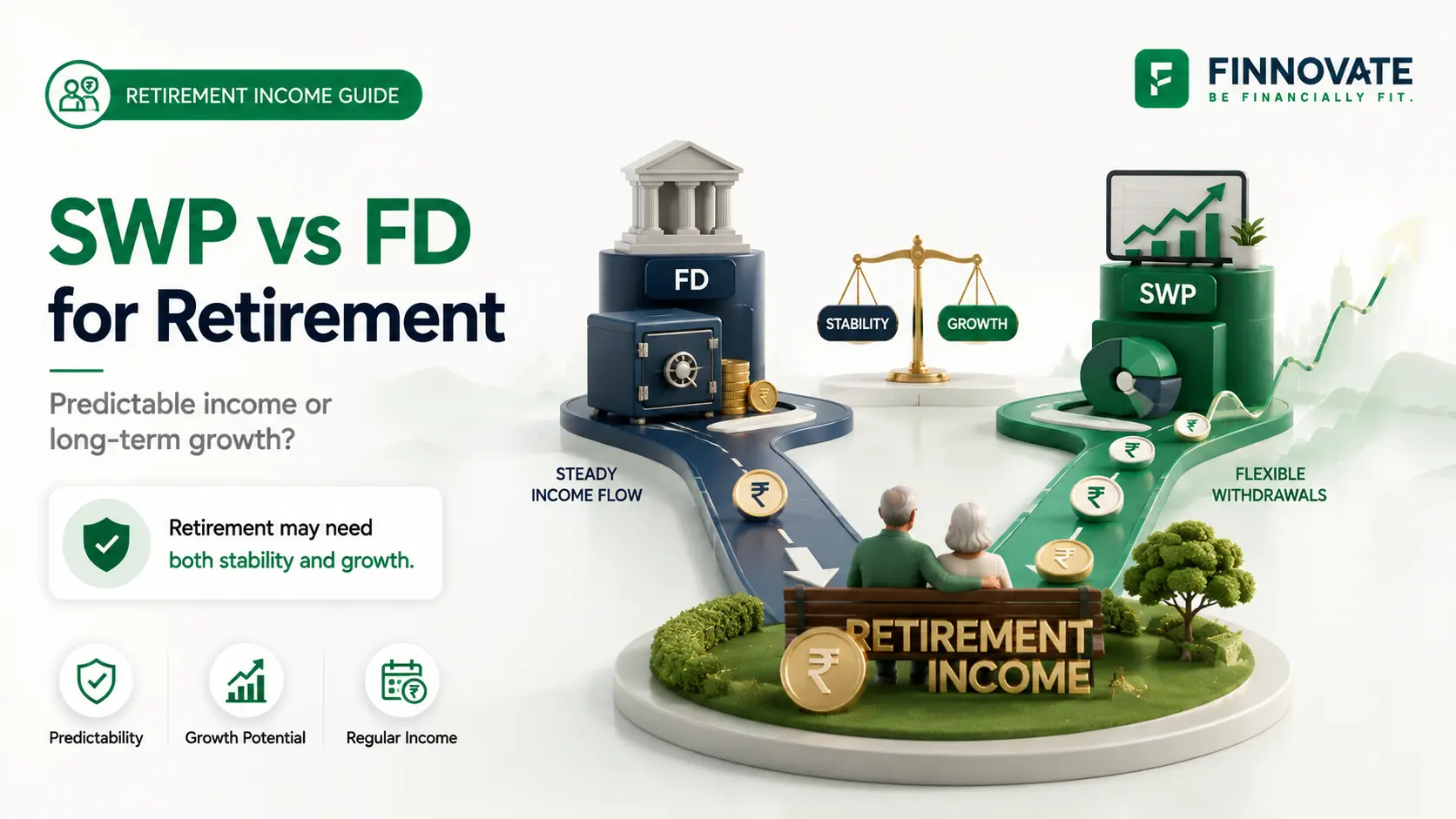
SWP vs FD for retirement: compare income, risk, inflation, tax, liquidity and corpus susta...

NPS vs mutual funds for retirement: compare liquidity, tax, lock-in, asset allocation, ann...
Popular now

Learn how to easily download your NSDL CAS Statement in PDF format with our step-by-step g...

Looking for the best financial freedom books? Here’s a handpicked 2026 reading list with...
Learn what SIF investment means in India, SEBI rules, Rs 10 lakh minimum investment, avail...
Clear guide to mutual fund taxation in India for FY 2025–26 after July 2024 changes: equ...