Is ₹1 Crore Enough for Retirement in India? The Real Math Behind the Number

Finnovate’s editorial team researches and creates financial content using trusted sources, regulatory references and inputs from subject experts.
₹1 crore still feels like an important retirement milestone.
Reach it, and it is easy to think:
But for most people who expect ₹1 crore alone to fund their full lifestyle for the next 25 to 30 years, it is unlikely to be enough.
The reason is not that ₹1 crore is a small amount.
The problem is that retirement can last several decades, expenses keep rising, and the same corpus has to continue producing income even after your salary stops.
Axis Max Life Insurance's 2026 India Retirement Index Study, conducted with Kantar, found that 70% of urban respondents believed ₹1 crore or less would be enough for a comfortable retirement. A year earlier, that figure was 77%. Among households earning more than ₹15 lakh annually, only 51% considered ₹1 crore or less sufficient.
Source: Axis Max Life India Retirement Index Study 6.0, conducted with Kantar.
The question, therefore, is not whether ₹1 crore sounds large.
It is:
Verdict: Is ₹1 Crore Enough for Retirement?
It can still work when expenses are relatively low, your home is already paid for, healthcare is adequately provided for, and pension, rent or another income source covers part of your monthly spending.
These figures use an illustrative model where the remaining portfolio earns 8% annually and withdrawals increase by 6% every year.
And even this assumes a smooth 8% return each year. Real investment returns will fluctuate.
What Will ₹1 Crore Actually Be Worth When You Retire?
A fixed retirement target creates another problem.
₹1 crore 20 years from now will not buy what ₹1 crore buys today.
If your retirement target remains ₹1 crore regardless of how far away retirement is, inflation gradually reduces what that future amount can purchase.
The table below shows what ₹1 crore received in the future would be worth in today's purchasing power at 6% and 7% annual inflation.
| Years from today | At 6% inflation | At 7% inflation |
|---|---|---|
| 10 years | ₹55.8 lakh | ₹50.8 lakh |
| 20 years | ₹31.2 lakh | ₹25.8 lakh |
| 25 years | ₹23.3 lakh | ₹18.4 lakh |
| 30 years | ₹17.4 lakh | ₹13.1 lakh |
These figures show the today-equivalent purchasing power of ₹1 crore received in the future. They are illustrations, not inflation forecasts.
For example, if retirement is 20 years away and inflation averages 6%, a ₹1 crore corpus at that point would have purchasing power similar to roughly ₹31.2 lakh today.
At 7% inflation, the same ₹1 crore after 20 years would have purchasing power similar to only about ₹25.8 lakh today.
Viewed in reverse, if you want your retirement corpus 20 years from now to have the same purchasing power as ₹1 crore today, you would need approximately ₹3.21 crore at 6% inflation or ₹3.87 crore at 7% inflation.
You can test your own amount, time period and inflation assumption using Finnovate's Inflation Calculator.
How Much Monthly Spending Can ₹1 Crore Actually Support?
A common shortcut is to calculate a percentage of the corpus.
At a 4% starting withdrawal, ₹1 crore gives you ₹4 lakh in the first year, or about ₹33,333 per month.
At 6%, it gives you ₹50,000 per month.
But neither figure tells you whether the money will last because retirement expenses do not remain fixed.
Instead, assume:
- Starting corpus: ₹1 crore
- Illustrative portfolio return: 8% a year
- Annual increase in withdrawals: 6%
These figures use an annual cash-flow model. The first-year withdrawal is shown as a monthly equivalent, then increases by 6% each year while the remaining corpus earns an assumed 8% annually.
Taxes, investment costs and actual market volatility are not included.
What If You Need ₹50,000 Per Month?
₹50,000 per month means ₹6 lakh in the first year.
On a ₹1 crore corpus, that is a 6% initial withdrawal.
But ₹50,000 is only your starting expense.
So if you retire at 60, the smooth-return calculation runs out at roughly age 81–82.
If you retire at 50, the same corpus would run out around age 71–72 under those assumptions.
The corpus required for a ₹50,000 starting monthly lifestyle is approximately ₹1.12 crore for 25 years, ₹1.29 crore for 30 years and ₹1.58 crore for 40 years.
When Could ₹1 Crore Actually Be Enough?
The most useful way to answer this is to look at how much your portfolio itself needs to provide.
Assume you retire at 60 and plan until age 85, giving the corpus a 25-year horizon. We continue with the same illustrative 8% annual return and 6% annual increase in withdrawals.
This gives a more useful answer than simply saying ₹1 crore is enough or not enough.
₹1 crore becomes more workable when the portfolio itself only needs to fund a relatively modest part of your retirement lifestyle.
Retiring Earlier Changes the Answer Completely
₹1 crore at 60 and ₹1 crore at 40 are not the same retirement position.
Suppose the plan needs to last until age 85.
This is why early retirement cannot be planned around a corpus number alone.
The earlier you retire, the longer the portfolio has to pay you.
Someone considering FIRE should therefore start with expenses, retirement age and longevity rather than asking whether ₹1 crore, ₹2 crore or another round number is enough.
You can test different retirement ages, expenses and existing investments using Finnovate's FIRE Calculator.
Why an 8% Return Does Not Mean You Can Withdraw 8%
There is an important limitation to every calculation above.
The illustrations assume the portfolio earns exactly 8% every year.
Real markets do not work like that.
A portfolio may average around 8% over several years while individual annual returns vary sharply.
If weak returns arrive during the first few years of retirement while you are also withdrawing money, you may have to sell more investments while portfolio values are depressed.
This is called sequence-of-returns risk.
Finnovate's guide on sequence-of-returns risk in retirement explains why the order of market returns can materially affect retirement outcomes even when the long-term average return looks similar.
Your Net Worth Is Not Always Your Retirement Corpus
Suppose someone says:
That does not necessarily mean ₹1 crore can fund retirement.
Your net worth may still be ₹1 crore, but your investible retirement corpus in this example is ₹50 lakh.
The house still matters because it removes the need to pay rent.
But unless you plan to sell it, rent it, downsize or otherwise monetise it, the property does not automatically create spendable monthly income.
Other Income Can Make ₹1 Crore Much More Workable
Suppose your retirement lifestyle costs ₹75,000 per month.
If your investments are your only source of money, the portfolio must provide the entire ₹75,000.
Now suppose you receive ₹30,000 every month through pension or reliable rental income.
That changes the retirement calculation substantially.
This is why ₹1 crore can work for one household but fall short for another with exactly the same lifestyle expenses.
Healthcare and One-Time Costs Need Their Own Place
Regular medical spending can form part of the monthly retirement budget.
Large healthcare expenses are different.
Hospitalisation, major procedures, long-term care and recurring chronic-care requirements can arrive unpredictably.
If the entire ₹1 crore is already required to produce regular retirement income, one large medical expense can shorten the life of the corpus significantly.
Retirement also does not consist only of monthly bills.
You may need money for home renovation, replacing a vehicle, family functions, international travel, helping children or major repairs.
Finnovate's Retirement Calculator allows healthcare and emergency reserves to be considered separately while estimating the overall retirement requirement.
What If ₹1 Crore Is Not Enough?
Finding that ₹1 crore falls short is useful information.
It tells you there is a retirement gap while there may still be time to change it.
Usually the answer is a combination rather than one dramatic change.
Someone approaching retirement may increase savings while clearing a home loan.
Another household may find that pension income significantly reduces the amount required from investments.
Someone targeting FIRE may discover that working three or five additional years changes the result more than chasing a higher investment return.
Find Out What Your Retirement Number Actually Is
Your retirement requirement depends on your expenses, retirement age, existing investments, other income, healthcare reserve and how long the corpus needs to last.
Use the Retirement CalculatorFor a broader strategy, you can also explore Finnovate's Retirement Planning approach.
Finally, Is ₹1 Crore Enough for Retirement in India?
For most people expecting ₹1 crore alone to fund their complete retirement lifestyle for 25 to 30 years, it is likely to be insufficient or, at best, quite tight.
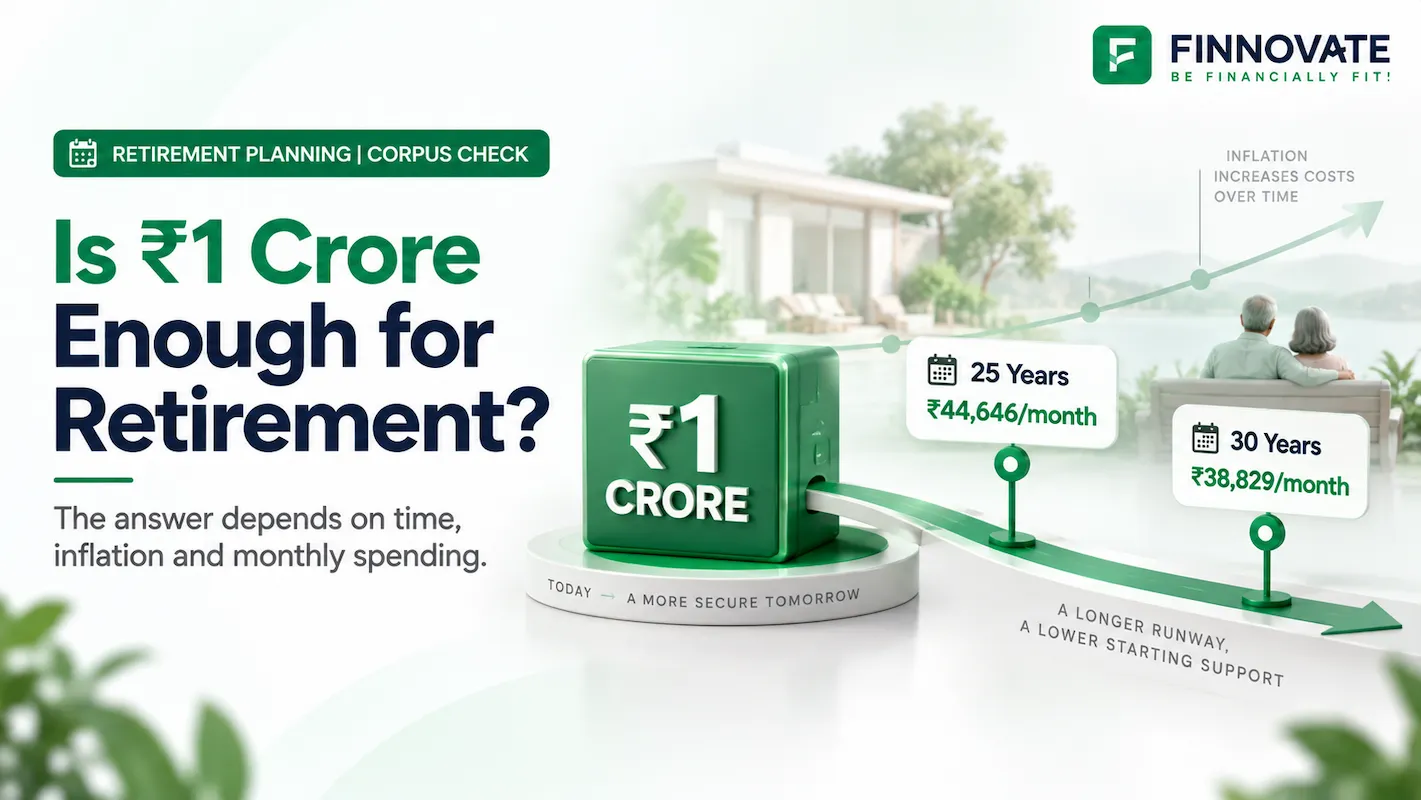
Under the illustration used throughout this article, ₹1 crore supports roughly ₹44,600 per month initially over 25 years.
Over 30 years, that falls to roughly ₹38,800.
Retiring earlier reduces the starting amount further.
And the model still assumes a smooth 8% portfolio return.
₹1 crore becomes more workable when your home is paid for, lifestyle expenses are modest, healthcare is separately provided for and pension, rent or another source of income covers part of your expenses.
That is why retirement should not be planned around one impressive-looking number.
It should be planned around the lifestyle that number actually needs to fund.
FAQs
1. Is ₹1 crore enough to retire at 60 in India?
₹1 crore may work for someone retiring at 60 if monthly expenses are modest and other income covers part of the retirement budget. Under the illustrative model used in this article, ₹1 crore supports starting spending of approximately ₹49,453 per month for a 25-year retirement, assuming an 8% annual return and 5% annual increase in withdrawals.
2. How much monthly income can ₹1 crore provide after retirement?
The amount depends on how long the corpus needs to last and how withdrawals increase. Under the illustration used here, ₹1 crore supports approximately ₹44,646 per month initially over 25 years and ₹38,829 per month over 30 years.
3. Can ₹1 crore provide ₹50,000 per month after retirement?
Under the 8% annual-return and 6% annual-withdrawal-growth assumptions used here, ₹1 crore supports a ₹50,000 starting monthly lifestyle for approximately 21.7 years. A 30-year horizon requires approximately ₹1.29 crore under the same assumptions.
4. Is ₹1 crore enough to retire at 50?
If the corpus needs to last until age 85, retiring at 50 creates a 35-year retirement. Under the illustration used in this article, ₹1 crore supports starting monthly spending of approximately ₹34,711.
5. Is ₹1 crore enough for FIRE in India?
It depends primarily on annual expenses and the number of years the portfolio must support them. Someone retiring in their 40s may need the corpus to last 40 years or more, so ₹1 crore supports a much lower starting withdrawal than it does for someone retiring at 60.
6. How much corpus is required for ₹50,000 per month after retirement?
Under the assumptions used in this article, ₹50,000 of starting monthly spending requires approximately ₹1.12 crore for 25 years, ₹1.29 crore for 30 years and ₹1.58 crore for 40 years.
7. Should I include my house in my ₹1 crore retirement corpus?
Your house forms part of your net worth and can reduce expenses by removing rent. However, unless you plan to monetise the property, it does not directly provide money for regular retirement spending. Investible retirement assets and total net worth should therefore be considered separately.
8. Does pension income reduce the retirement corpus I need?
Yes. If pension, rental income or another reliable source covers part of your expenses, the investment portfolio only needs to fund the remaining gap.
9. What return should I assume after retirement?
There is no guaranteed rate. The 8% return used in this article is an illustration only. Actual returns depend on asset allocation and market conditions and will fluctuate from year to year.
10. Should healthcare be kept separate from the ₹1 crore corpus?
Major healthcare and emergency costs should be considered separately from normal monthly lifestyle expenses. If the full ₹1 crore is already needed to fund regular spending, unexpected healthcare costs can materially shorten the life of the corpus.