
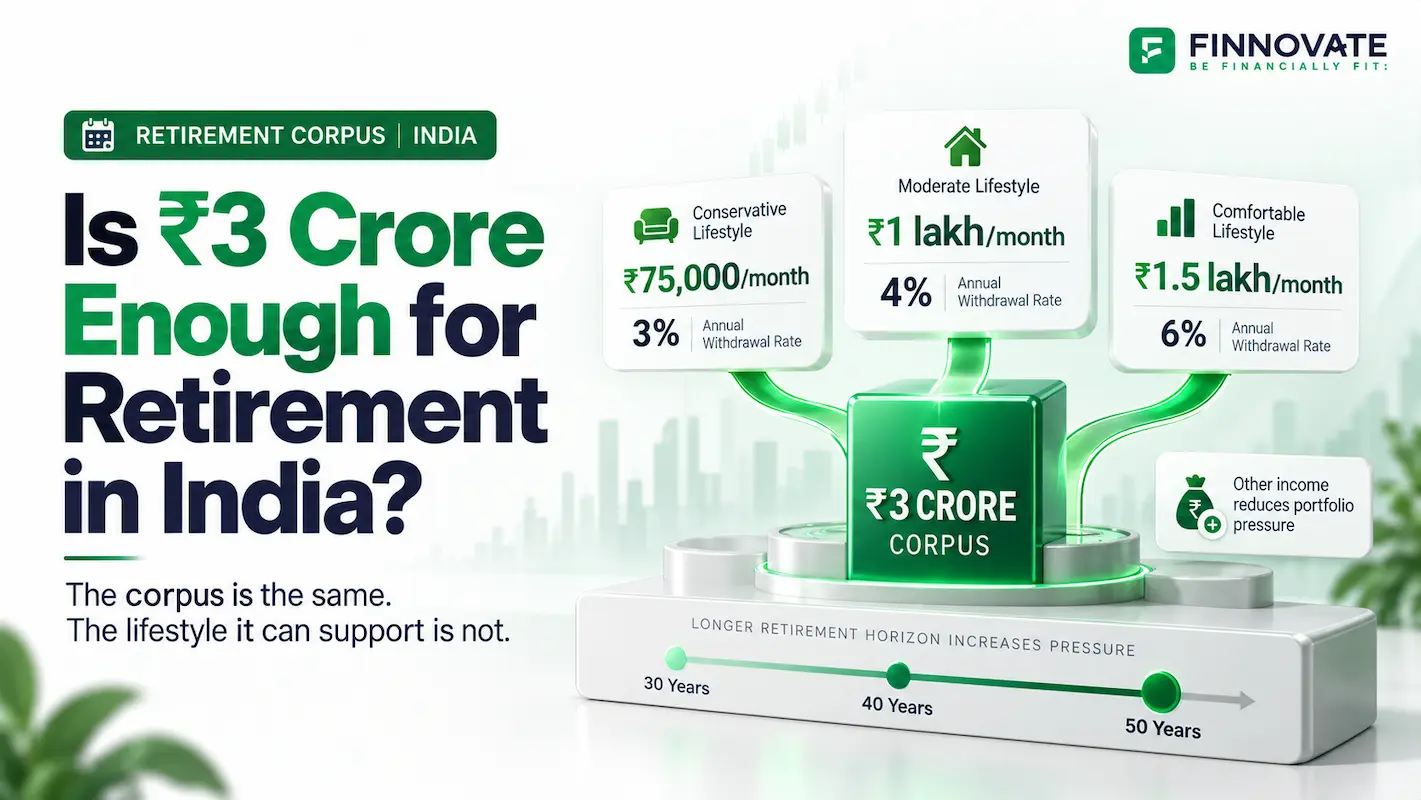
Is ₹3 Crore Enough for Retirement in India?
Is ₹3 crore enough for retirement in India? See what monthly lifestyle it may support, h...
01 October 2026


Finnovate’s editorial team researches and creates financial content using trusted sources, regulatory references and inputs from subject experts.
A retirement corpus can look large today and still fall short of what you need decades later.
If your household spends ₹1 lakh per month today, maintaining roughly the same lifestyle would cost about ₹3.21 lakh per month after 20 years if inflation averages 6% a year. At 7%, that rises to nearly ₹3.87 lakh per month.
This is why inflation does more than reduce the purchasing power of your savings. It changes the expense your retirement corpus must fund, the corpus you need before you retire, and the income you may need to draw from it for the rest of your retirement.
And inflation does not stop when your salary does. If retirement lasts another 25 or 30 years, living expenses can continue rising throughout that period.
Table of Contents
Inflation affects retirement planning at two different stages.
Before retirement, it increases the future cost of the lifestyle you want to maintain. After retirement, it continues increasing your living expenses while you are withdrawing money from the corpus.
For example, ₹1 lakh of monthly expenses today would become approximately ₹3.21 lakh after 20 years at 6% inflation. Using a simple 4% initial withdrawal assumption for illustration, annual expenses of about ₹38.49 lakh would point to an indicative retirement corpus of roughly ₹9.62 crore.
The sequence is therefore:
A retirement target should ideally begin with the lifestyle it needs to fund, rather than starting with a round number such as ₹2 crore, ₹5 crore or ₹10 crore.
One of the simplest ways to understand inflation is to look at purchasing power.
If inflation averages 6% a year, the purchasing power of ₹1 crore changes substantially over time.
| Time | Purchasing Power of ₹1 Crore in Today's Money |
|---|---|
| Today | ₹1.00 crore |
| After 10 years | ₹55.8 lakh |
| After 15 years | ₹41.7 lakh |
| After 20 years | ₹31.2 lakh |
| After 25 years | ₹23.3 lakh |
| After 30 years | ₹17.4 lakh |
This does not mean ₹1 crore literally becomes ₹31.2 lakh after 20 years. It means ₹1 crore twenty years later would buy roughly what ₹31.2 lakh buys today if inflation averaged 6%. You can calculate how inflation affects your money using your own amount, timeline and inflation assumption.
A retirement corpus would normally remain invested and may also be funding regular withdrawals. The table above is therefore a purchasing-power illustration, not a projection of how an actual retirement portfolio will behave.
Instead of asking, “How many crores do I need to retire?”, start by estimating how much your desired retirement lifestyle costs today.
The basic calculation is:
Suppose your household spends ₹1 lakh per month today.
| Retirement Is | At 6% Inflation | At 7% Inflation |
|---|---|---|
| 10 years away | ₹1.79 lakh | ₹1.97 lakh |
| 20 years away | ₹3.21 lakh | ₹3.87 lakh |
| 30 years away | ₹5.74 lakh | ₹7.61 lakh |
The longer the time until retirement, the more significant the difference becomes.
At 6%, ₹1 lakh of today's monthly spending becomes approximately ₹5.74 lakh after 30 years. If inflation averages one percentage point higher at 7%, the same lifestyle could cost approximately ₹7.61 lakh.
This is also why two people spending the same amount today may need very different retirement corpuses. Someone retiring five years from now has much less pre-retirement inflation to absorb than someone retiring 20 or 30 years later.
A difference of one percentage point may not sound significant. Over 20 years, it can change the retirement requirement by crores.
Consider a simple illustration:
| Inflation Assumption | Monthly Expense at Retirement | Annual Expense at Retirement | Indicative Corpus at 4% |
|---|---|---|---|
| 6% base case | ₹3.21 lakh | ₹38.49 lakh | ₹9.62 crore |
| 7% higher-inflation case | ₹3.87 lakh | ₹46.44 lakh | ₹11.61 crore |
The reason is compounding. The extra 1% does not affect only one year's expenses. It compounds for every year until retirement, progressively increasing the income the corpus must eventually provide.
Want to see how inflation changes the target using your own age and expenses? Finnovate's Retirement Calculator can help you estimate the requirement using your own assumptions.
Calculate Your Retirement CorpusFor long-term retirement planning in India, 6% is a practical base assumption. Inflation can move above or below this level in individual years, but retirement planning needs a long-term estimate rather than the latest inflation print.
We therefore use 6% as the base case and 7% as a higher-inflation safety case to test whether the retirement corpus can still work if expenses rise slightly faster than expected.
Suppose ₹1 lakh of expenses today becomes approximately ₹3.21 lakh per month when you retire 20 years later.
₹3.21 lakh is only the starting retirement expense.
If expenses then continue growing at 6%, the same lifestyle would cost approximately:
| Years Into Retirement | Monthly Expense at 6% Inflation |
|---|---|
| At retirement | ₹3.21 lakh |
| After 5 years | ₹4.29 lakh |
| After 10 years | ₹5.74 lakh |
| After 15 years | ₹7.68 lakh |
| After 20 years | ₹10.29 lakh |
This is one of the most important parts of retirement planning.
A retirement-income plan that starts by providing ₹3.21 lakh per month but assumes that the same amount will remain sufficient forever ignores what could happen to living costs over a 20 or 30-year retirement.
This is also why evaluating retirement income based only on the first year's withdrawal can be misleading. The corpus must support both withdrawals and their gradual increase over time.
General consumer inflation is a useful reference point, but every household has a different spending basket.
Before retirement, a large part of your budget might go towards children's education, home loan EMIs, commuting, work-related expenses or other costs that may reduce or disappear later.
At the same time, retirement can increase the importance of other expenses, including:
Your retirement lifestyle may therefore experience inflation differently from the broader consumer basket.
This does not mean you need to calculate a separate inflation rate for every item in your budget. It means the starting expense itself deserves some thought.
Instead of simply taking your current total monthly spending and inflating the entire number for 30 years, identify which expenses are likely to continue into retirement and which may change substantially.
Healthcare deserves particular attention because the amount you spend on healthcare can change for reasons beyond ordinary price inflation.
As you grow older, you may use medical services more frequently, require different treatments, pay different insurance premiums or face healthcare expenses that were not part of your regular household budget during your working years.
This makes it risky to treat healthcare exactly like food, utilities or entertainment.
At the same time, simply applying a very high “medical inflation” percentage to your entire retirement budget can also overstate the requirement.
A better approach is to estimate regular lifestyle expenses using your main inflation assumption, then maintain a separate healthcare provision or stress test based on your age, insurance cover, family medical history and expected needs.
The objective is not to predict every future hospital bill. It is to prevent healthcare from being hidden inside a general household-expense assumption.
Rising expenses do not always mean prices themselves have risen by the same amount.
Suppose a regular restaurant meal costs ₹1,000 today and ₹1,060 next year. That increase can largely be explained by inflation.
But suppose you start choosing restaurants where you spend ₹2,500 instead. Most of that increase comes from a change in lifestyle rather than general inflation.
The same can happen with housing, holidays, cars, entertainment or other discretionary expenses.
So if your household spending has grown by 10% a year, it does not automatically mean your personal inflation rate was 10%. Part of that increase may have come from higher income and a better lifestyle.
This distinction matters when estimating retirement expenses because the goal is not necessarily to reproduce every spending upgrade you made during your working years. It is to estimate the lifestyle you actually want to fund after retirement.
Retirement planning should not look at investment return in isolation.
Suppose a portfolio earns 8% while inflation averages 6%.
A quick calculation may suggest:
This is a useful shortcut, but the mathematically correct calculation is:
In this example:
1.08 ÷ 1.06 − 1 = approximately 1.89%
So an 8% portfolio return does not mean purchasing power is growing at 8%. After accounting for 6% inflation, the real growth is much smaller.
Taxes and investment costs can reduce the return retained by the investor further.
This is why the aim of retirement investing is not simply to find the investment offering the highest quoted return. The portfolio needs to balance near-term income needs, stability, long-term growth and the effect of inflation.
Not automatically.
A retirement corpus usually needs to perform several jobs at the same time. Some money may be required in the next few months, some over the next five years, and some may not be required for another 15 or 20 years.
Money required soon generally needs more stability and easy access. Money that may not be needed for many years has more time to absorb market movements and may require growth to help the portfolio deal with inflation.
The suitable mix depends on factors such as:
The answer is therefore not simply “invest more in equity”.
A retirement portfolio may need both relatively stable assets for near-term spending and suitable growth assets for expenses that are many years away.
Even if your inflation assumption proves reasonably accurate, your retirement outcome can still differ from the original calculation.
A corpus may also be affected by:
The timing of market returns becomes especially important once withdrawals begin.
Two retirees can start with the same corpus and receive the same average investment return, yet end up with different outcomes if one experiences major market declines during the first few years of retirement.
This is known as sequence-of-returns risk. Finnovate's detailed guide explains why early losses can have a larger impact once the portfolio is already funding regular withdrawals.
Inflation should therefore be treated as one major retirement risk, not the only assumption that matters.
A retirement calculation becomes more useful when you test what happens if the future turns out differently from the base case.
Look at your current household expenses and identify which ones are likely to continue after retirement. Remove expenses that may disappear and add costs that could become more relevant later.
If you use 6% as your base assumption, calculate what today's lifestyle could cost when retirement actually begins.
Do not start by deciding, “₹5 crore should be enough.”
Start with the expense and work backwards to the corpus.
Once the plan has been calculated at 6%, check it again at 7%.
As our earlier example showed, ₹1 lakh of monthly expenses today becomes approximately ₹3.21 lakh after 20 years at 6%, but about ₹3.87 lakh at 7%.
That difference can change the retirement target by crores.
Do not assume general household inflation captures every future healthcare requirement. Maintain a separate provision based on your situation and review it as retirement gets closer.
A corpus designed to last 20 years has a very different requirement from one that may need to fund 30 years.
Living longer is a good outcome, but the retirement plan needs to be able to fund it.
A projection should not depend entirely on one expected rate of return. Check how the outcome changes if long-term portfolio returns are lower than assumed.
Do not stop the calculation at the first year's retirement expense. Check whether the corpus can support spending that increases over time.
Retirement planning is not a one-time calculation. Income, lifestyle, investments, retirement age and future responsibilities can all change.
The assumptions should change with them.
A retirement target can change materially when inflation, expenses, retirement age, lifespan or expected investment returns change.
This is why the better question is not simply:
“How much corpus do I need?”
It is:
“How much corpus do I need under a reasonable base case, and will my plan still work if inflation or other assumptions turn out slightly worse?”
If you want to go beyond a calculator, Finnovate's Retirement Planning Advisory brings together corpus calculation, existing EPF and NPS assets, investment planning, healthcare provision and the post-retirement withdrawal strategy.
Explore Retirement Planning at FinnovateInflation does not simply make ₹1 crore less valuable in the future. It changes the expense your retirement corpus must support and continues affecting those expenses long after you stop working.
At a 6% base assumption, ₹1 lakh of monthly expenses today becomes approximately ₹3.21 lakh after 20 years. At a 7% higher-inflation safety case, the same lifestyle reaches about ₹3.87 lakh. That seemingly small difference can materially change the corpus required.
This is why retirement planning should not revolve around one impressive-looking corpus number. Start with the lifestyle you want to fund, account for inflation until retirement, test a higher-inflation case and then check whether the corpus can continue supporting rising expenses after retirement.
Inflation increases the future cost of the lifestyle your retirement corpus needs to support. It also continues after retirement, which means your withdrawals may need to rise over time. The longer the period until retirement and the longer retirement itself lasts, the larger the effect of compounding inflation can become.
At 6% annual inflation, ₹1 crore after 20 years would have purchasing power equivalent to approximately ₹31.2 lakh today. This does not mean the nominal ₹1 crore becomes ₹31.2 lakh. It means it would buy roughly what ₹31.2 lakh buys today.
At 6% annual inflation, ₹1 lakh per month today would become approximately ₹3.21 lakh per month after 20 years. At a 7% higher-inflation assumption, the same expense would become approximately ₹3.87 lakh per month.
A 6% assumption is commonly used as a practical base case for long-term retirement calculations in India. Long-term CPI data have broadly been around the mid-5% range on an annualised basis, although individual years can be considerably higher or lower. Using 7% as an additional safety case can show how sensitive the plan is to higher inflation.
The 7% case is not a forecast. It is a stress test. Over long periods, even one additional percentage point of inflation can substantially increase future expenses and the required retirement corpus. Testing both 6% and 7% reduces dependence on one exact assumption.
Yes. Living expenses can continue rising throughout retirement. If you retire with monthly expenses of ₹3.21 lakh and inflation then averages 6%, the same lifestyle could cost about ₹5.74 lakh per month ten years later. A retirement plan should therefore consider rising withdrawals, not only the income required in the first year.
There is no single investment that removes inflation risk. A retirement portfolio may need stable and accessible assets for near-term expenses, alongside suitable growth assets for money required much later. The appropriate mix depends on the corpus, withdrawal requirement, other income, retirement horizon and the investor's ability to take risk.
Historical inflation data is used only to support the long-term planning assumption. The 6% and 7% inflation rates used throughout the article are illustrative retirement-planning assumptions, not forecasts of future inflation.
Disclaimer: The calculations, inflation rates, withdrawal assumptions and investment-return examples in this article are illustrative and intended for educational purposes only. They are not forecasts, guarantees or personalised investment recommendations. Actual retirement requirements depend on individual expenses, taxes, portfolio returns, market conditions, healthcare needs, lifespan, other income and personal circumstances. Please consult a SEBI-registered investment adviser before making investment decisions.
No spam. Only new posts, simple explainers, and practical money checklists for busy professionals.
Finnovate is a SEBI-registered financial planning firm that helps professionals bring structure and purpose to their money. Over 3,500+ families have trusted our disciplined process to plan their goals - safely, surely, and swiftly.
Our team constantly tracks market trends, policy changes, and investment opportunities like the ones featured in this Weekly Capsule - to help you make informed, confident financial decisions.
Learn more about our approach and how we work with you:
No comments yet. Start the conversation. What would you add?
No spam. Only new posts, simple explainers, and practical money checklists.
You may also like
Is ₹3 crore enough for retirement in India? See what monthly lifestyle it may support, h...

Can you retire in your 30s in India? See the FIRE math, withdrawal rates, corpus examples,...

Is ₹1 crore enough for retirement in India? See how much monthly income it can support, ...

Is ₹2 crore enough for retirement in India? See how expenses, inflation, retirement age,...
Popular now

Learn how to easily download your NSDL CAS Statement in PDF format with our step-by-step g...

Looking for the best financial freedom books? Here’s a handpicked 2026 reading list with...
Learn what SIF investment means in India, SEBI rules, Rs 10 lakh minimum investment, avail...
Clear guide to mutual fund taxation in India for FY 2025–26 after July 2024 changes: equ...