

FPI Flows First Half October 2026: ₹47,955 Crore Outflow
Explore FPI equity flows for October First Half, 2026: ₹47,955 crore in net outflows, th...
23 October 2026
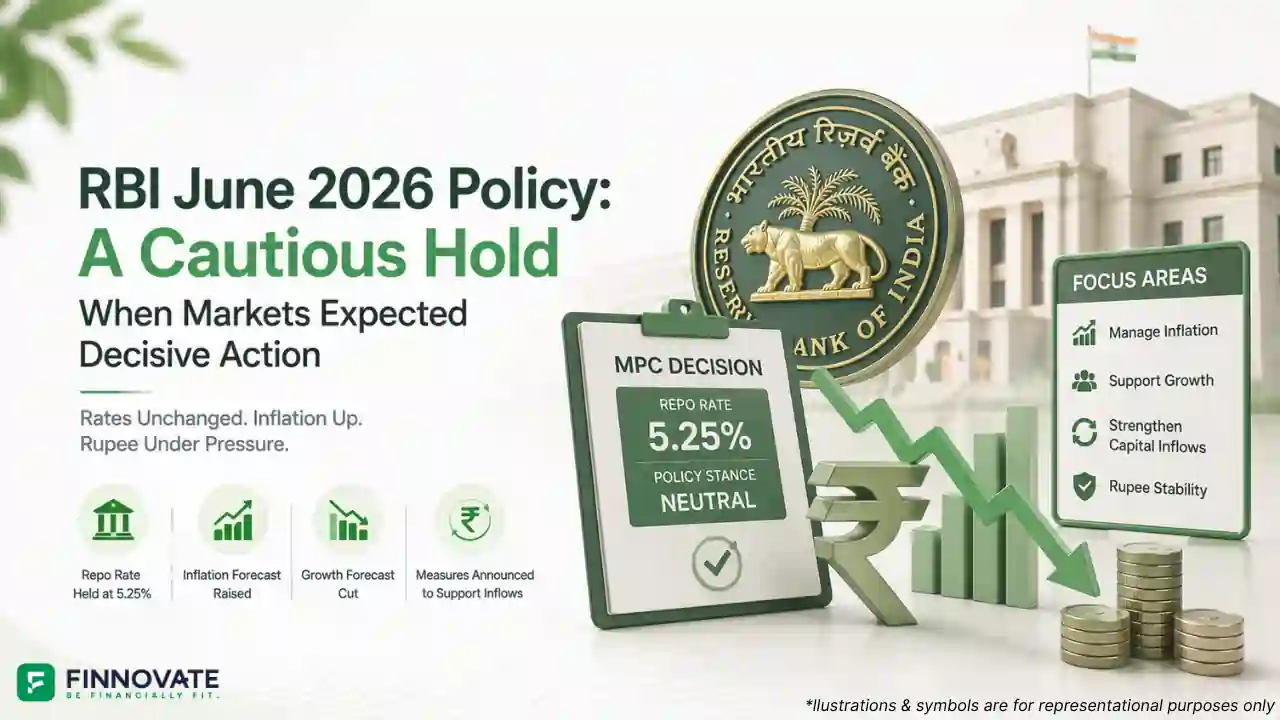
Policy date: June 5, 2026 | Source: RBI MPC statement, Governor's address
The Monetary Policy Committee of the Reserve Bank of India met on June 3 to 5, 2026, and unanimously decided to keep the repo rate unchanged at 5.25% with a Neutral policy stance. Governor Sanjay Malhotra cited a supply-driven inflation shock from elevated energy prices, flagged slowing growth, and announced a package of capital inflow measures aimed at supporting the rupee. What was missing from the statement, and from the action, was the decisive signal markets were looking for on currency stability.
The rupee had fallen from approximately ₹90 per dollar to a record low near ₹97 per dollar in under 13 months. That is not a routine depreciation. It is the sharpest fall in the rupee in a decade, representing a structural question about external balance that a hold-and-wait monetary policy does not fully answer.
Quick read: The RBI held rates at 5.25% and maintained its Neutral stance on June 5, 2026. Inflation forecasts were raised, GDP forecasts were cut, and a package of capital inflow measures was announced. The measures are directionally correct but incremental. The case for at least signalling rate hawkishness, to reinforce rupee credibility and stem capital outflows, was not acted on.
The RBI faced a genuine policy dilemma at the June meeting, and the hold decision reflects that tension rather than indecision alone.
Alongside the rate hold, the RBI announced several measures targeted at improving capital flows and supporting the rupee through the supply side. The Finance Ministry separately announced an exemption for FPIs from capital gains tax on G-Sec investments, effective April 1, 2026.
| Measure | Mechanism | What It Targets | Assessment |
|---|---|---|---|
| FPI restrictions on G-Secs removed | Short-term investment limits, concentration limits, and individual securities restrictions all removed for FPIs via General Route | Broadens access for foreign bond buyers; deepens the G-Sec market | Positive: removes structural barriers |
| NRI/OCI equity investment limits raised | Investment limits in listed Indian shares raised without requiring SEBI registration; extended to all individual Persons Resident Outside India | Increases NRI participation in equity markets | Moderate: NRI equity flows are small relative to FPI outflows |
| FCNR(B) hedging cost borne by banks | Authorised Dealer banks to bear full hedging costs on fresh 3 to 5-year FCNR(B) deposits until September 30, 2026 | Encourages NRI dollar deposits by removing forex risk for depositors | Positive: removes a structural deterrent for NRI depositors |
| Export proceeds timeline restored | Export proceeds realisation period restored to 9 months from 15 months | Improves dollar inflow timing from exporters | Moderate: timing improvement, not new flows |
| FPI capital gains tax exemption (Finance Ministry) | FPIs exempt from capital gains tax on income from G-Sec investments, effective April 1, 2026 | Improves post-tax return on Indian bonds for foreign holders | Positive: improves yield attractiveness |
The measures are structurally sound and address real gaps. The question is whether they are sufficient to reverse the capital outflow trend that has pushed the rupee to near-record lows.
The effectiveness of the G-Sec access liberalisation depends on whether the yield premium over US Treasuries is attractive enough to pull foreign fixed income capital. With the US 10-year benchmark elevated and India's rate held at 5.25%, the yield spread between Indian government bonds and US Treasuries has narrowed materially. When the spread is insufficient to compensate for rupee depreciation risk and currency hedging costs, foreign bond buyers have limited incentive to increase India exposure regardless of access restrictions being lifted.
Bearing the full hedging cost on FCNR(B) deposits is a targeted and potentially effective measure to attract NRI dollar deposits. However, it creates a contingent liability for the RBI or the banking system depending on how the facility is structured. The RBI's forward book is already substantial. If the rupee depreciates further during the deposit tenure, the hedging cost borne by Authorised Dealer banks becomes a real financial exposure that the system must absorb. The 2022 version of a similar facility worked well in a calmer currency environment. The current environment is structurally more stressful.
There is a real possibility that liberalising G-Sec access at a time of rupee weakness and compressed spreads allows existing bondholders to exit more easily rather than attracting net new inflows. When the window for exit is widened, it can facilitate outflows as much as inflows depending on the direction of market sentiment.
The 2013 rupee crisis offers the most relevant historical parallel for the current situation. In mid-2013, the rupee fell from approximately ₹55 to ₹68 per dollar in a matter of months as global capital fled emerging markets following the US Fed's "taper tantrum." India was then classified as one of the "Fragile Five" emerging economies with structural current account vulnerability.
In 2013, India's macroeconomic fundamentals were genuinely fragile. The current account deficit was large, fiscal deficit was high, and inflation was running above 9%. The rupee recovered only after the RBI under Governor Raghuram Rajan announced a decisive FCNR(B) swap window that raised $34 billion in a single scheme. Today, India's fundamentals are comparatively stronger: forex reserves at approximately $681 billion, fiscal deficit more controlled, and services exports providing structural support. India is not in the Fragile Five in 2026. That stronger position gave the RBI more space for a credibility signal than it chose to use.
The lesson from 2013 is not that India should replicate the exact tool. It is that in a currency crisis, the scale and decisiveness of the response matters as much as the specific instrument. Incremental measures signal that the central bank is managing the situation; a decisive response signals that the central bank is in control of it. The June 2026 policy landed closer to the former than the latter.
The case for a 25 bps hike at this meeting was never primarily about the mechanical impact on growth or inflation. A quarter-point move would not have materially changed borrowing costs, meaningfully slowed consumption, or cured a supply-driven inflation shock. The case was about credibility and signalling.
Higher rates narrow the interest rate differential that makes it attractive for capital to leave India for better-yielding markets. More importantly, a hike would have demonstrated that the RBI is willing to accept short-term growth discomfort to protect currency stability. That demonstration has independent value. Currency markets respond to perceived central bank resolve. A unanimous hold, while internally logical, does not project resolve on the rupee question.
The policy announcement could have also been accompanied by a change in stance from Neutral to a more clearly hawkish formulation, even without a rate action. A stance change costs nothing in growth terms but sends a directional signal that the next move, if warranted, is more likely to be up than down. That too was not chosen.
Interest rates, rupee movements, and inflation directly affect returns on deposits, loans, and investments. The FinnFit Financial Fitness Test takes 3 minutes and shows you how your portfolio is positioned for the current monetary environment.
Take the FinnFit TestThe MPC unanimously decided to keep the repo rate unchanged at 5.25% with a Neutral policy stance. The RBI Governor cited a supply-driven inflation shock from elevated energy prices, flagged slowing growth, and raised inflation forecasts while cutting GDP projections for FY27. Several measures to attract capital inflows and support the rupee were also announced alongside the rate decision.
The RBI's stated rationale is that the inflation shock is supply-driven (from energy prices linked to the Middle East conflict), not demand-driven. Core inflation remains around 2%. Rate hikes address demand-side inflation; they are a less effective tool for supply-driven price pressures. Additionally, growth is already slowing, and the MPC had cut rates by a cumulative 100 bps in FY26 that has not yet fully transmitted through the economy.
FCNR(B) (Foreign Currency Non-Resident Bank) deposits are term deposits that non-resident Indians open with Indian banks in foreign currency, removing exchange rate risk for the depositor. By allowing Authorised Dealer banks to bear the full hedging cost on fresh 3 to 5-year deposits until September 30, 2026, the RBI has made these deposits more attractive for NRIs. The RBI used a similar tool successfully in 2013 and 2022 to attract dollar inflows during periods of rupee pressure.
The attractiveness of Indian government bonds to foreign investors depends on the yield premium over comparable benchmarks like US Treasuries, after adjusting for currency hedging costs. With India's rate held at 5.25% and the US benchmark elevated, the yield spread has narrowed. When the spread is insufficient to compensate for rupee depreciation risk, removing access restrictions improves the technical ease of investment but does not create the economic incentive for large-scale inflows.
In mid-2013, the rupee fell sharply from approximately ₹55 to near ₹68 per dollar as global capital fled emerging markets after the US Fed's "taper tantrum." India was classified as one of the "Fragile Five" economies. The RBI eventually arrested the fall through a decisive $34 billion FCNR(B) swap window under Governor Raghuram Rajan. In 2026, India's fundamentals are stronger (higher reserves, better fiscal position) but the rupee depreciation pace is comparable. The parallel is relevant because it illustrates that currency markets reward decisive central bank signalling, not just incremental measures.
Disclaimer: This article is for general information and educational purposes only. It does not constitute investment advice, a recommendation, or an offer to buy or sell any securities or financial instruments. All data on RBI policy decisions, inflation and GDP projections, and capital inflow measures referenced in this article are sourced from the RBI MPC statement and Governor's address of June 5, 2026, and publicly available news reporting. Views expressed in the analytical sections represent independent analysis of publicly available information. Please consult a SEBI-registered investment adviser before making any investment decision based on monetary policy developments.
No spam. Only new posts, simple explainers, and practical money checklists for busy professionals.
Finnovate is a SEBI-registered financial planning firm that helps professionals bring structure and purpose to their money. Over 3,500+ families have trusted our disciplined process to plan their goals - safely, surely, and swiftly.
Our team constantly tracks market trends, policy changes, and investment opportunities like the ones featured in this Weekly Capsule - to help you make informed, confident financial decisions.
Learn more about our approach and how we work with you:
No comments yet. Start the conversation. What would you add?
No spam. Only new posts, simple explainers, and practical money checklists.
You may also like
Explore FPI equity flows for October First Half, 2026: ₹47,955 crore in net outflows, th...

Understand the India–Mauritius tax treaty’s Principal Purpose Test, its August 2026 ef...

Explore India’s AI hardware opportunity through the proposed Adani–Jabil venture, from...
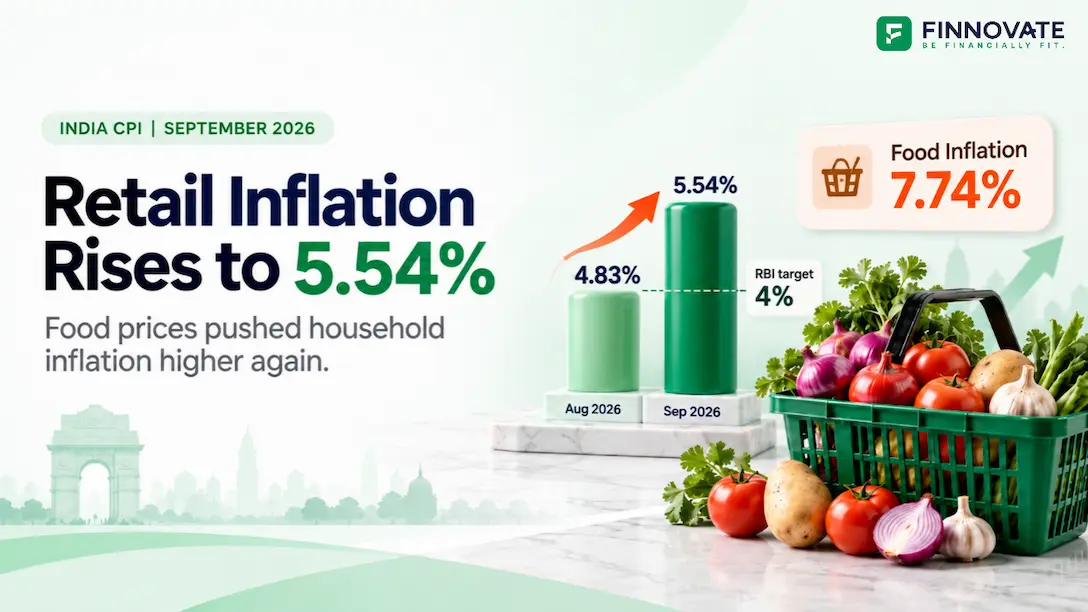
India’s CPI inflation rose to 5.54% in September 2026. Compare monthly trends, food pric...
Popular now

Learn how to easily download your NSDL CAS Statement in PDF format with our step-by-step g...

Looking for the best financial freedom books? Here’s a handpicked 2026 reading list with...
Learn what SIF investment means in India, SEBI rules, Rs 10 lakh minimum investment, avail...

Clear guide to mutual fund taxation in India for FY 2025–26 after July 2024 changes: equ...