Buying Gold on Dhanteras: Is It Really Building Wealth?

Finnovate’s editorial team researches and creates financial content using trusted sources, regulatory references and inputs from subject experts.
On Dhanteras evening, jewellery shops look the same in every city. There is a queue at the door and a family crowded around the counter. Someone's mother says, “Just a small piece, for shagun.”
This year, Dhanteras falls on Friday, 6 November. Last year the shops were packed too. But reports said record prices meant buyers took home about 15% less gold by weight than the year before, even as total spending hit a record. People spent more and got less.
So here is the honest question. When you buy gold on Dhanteras, are you building wealth, or buying good luck with a very expensive receipt?
The answer sits in the middle. Gold has been very good to Indian families. But the way most of us buy it on Dhanteras is not how wealth usually gets built. "Gold does not generate wealth; it protects it"
First, the Part That Favours Gold
On Dhanteras 2018, 10 grams of gold cost about ₹32,700. Today, 24K gold is around ₹1.4 lakh per 10 grams in Mumbai, and 22K is around ₹1.28 lakh. Rate cards differ by a few thousand rupees, but the picture is clear. That is more than four times in eight years.
Anyone who bought a coin that Dhanteras has a good reason to say “gold never fails.” Here is how gold has compared with the Nifty 50 over longer periods (CAGR in rupees, as of early 2026):
| Period | Gold | Nifty 50 (TRI) |
|---|---|---|
| 3 years | 38.4% | 10.0% |
| 5 years | 28.4% | 10.0% |
| 10 years | 18.1% | 12.5% |
| 15 years | 13.5% | 10.7% |
| 20 years | 15.1% | 11.2% |
On average, gold trailed the Nifty 50 TRI by around 2 percentage points a year across those windows. Both statements are true. Which one you see depends on the window you pick, and the last three years have been unusual.
Gold is also bumpy:
- Gold has seen temporary falls of 10% to 15% in almost every year, though it ended about 78% of years with a gain.
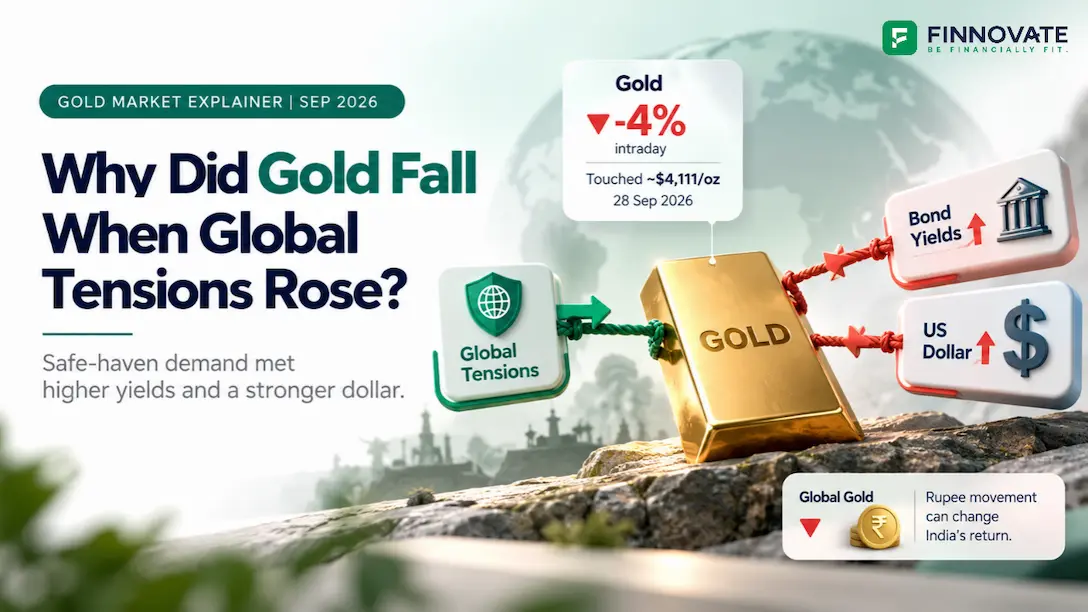
- On 28 September 2026, gold fell as much as 4% in a single session, even while global tensions were rising. We explained why in Why Did Gold Fall When Global Tensions Rose?
- From one Diwali to the next, gold gave just 1.5% in 2016-17 while the Nifty gave 16.6%. In 2020-21 gold fell 4.2% while the Nifty rose 38.5%. (Source: our Muhurat Trading study)
Why Dhanteras Gold Feels Like Wealth
Gold is something you can hold. It is easy to understand, it can be passed on, and the whole family can see it. A tradition that tells you to buy something valuable also feels responsible.
There is nothing wrong with that.
Wealth gets built when money has a purpose, a limit and a low cost. A Dhanteras purchase often has none of the three. It happens on one day, in a rush, with whatever budget the family decides on the spot.
The Bill Nobody Reads
Take a simple jewellery purchase. Say you buy 10 grams of 22K gold at about ₹12,800 per gram, with a 12% making charge. (Making charges vary by design and jeweller, and 12% is a common example used to explain the bill.)
| Item | Amount |
|---|---|
| Gold value (10 g at ₹12,800) | ₹1,28,000 |
| Making charge (12%) | ₹15,360 |
| GST on gold (3%) | ₹3,840 |
| GST on making charge (5%) | ₹768 |
| Final bill | ₹1,47,968 |
GST is 3% on the gold value and 5% on making charges for jewellery. So of every ₹1 lakh you spend on this kind of jewellery, only about ₹86,500 is actual gold. The remaining ₹13,500 or so goes to making charges and tax.
The effect is simple. The gold price has to rise about 15.6% before your gold is simply worth what you paid. And that is the best case, where you sell at the plain gold value.
One more thing to keep in mind. Prices often get a push from festive demand just before Dhanteras. Last year, gold rose sharply on heavy buying by jewellers and retailers ahead of the festival, and analysts note that festive-season gains are not guaranteed. Buying on the day is not a bargain by default.
Four Ways to Buy Gold, Compared
| Jewellery | Coins and bars | Digital gold | Gold ETF | |
|---|---|---|---|---|
| Extra cost | Making charge plus GST | GST, small premium | GST | No GST, small fund and trading costs |
| Best for | Wearing and gifting | Small physical holding | Small, easy purchases | Investing |
| Main watch-out | Highest cost to buy | Storage, purity proof | Not regulated by SEBI | Needs a demat account |
A few points behind the table:
- Gold ETFs and Sovereign Gold Bonds carry no GST.
- SEBI has cautioned that digital gold products sit outside its regulation, and that the usual investor protections for securities do not apply to them. The regulator pointed to gold ETFs, electronic gold receipts and exchange-traded commodity derivatives as the regulated alternatives.
- No fresh Sovereign Gold Bond has been issued since February 2024. The government has linked the pause to how expensive borrowing through these bonds became as gold prices rose. So new SGBs are not available this Dhanteras.
- On tax, physical gold becomes long-term after 24 months, while listed gold ETFs need 12 months. Neither gets indexation. Long-term gains are taxed at 12.5%, and shorter holdings are taxed at your slab rate.
The Part Most Families Miss: How Much Gold Do You Already Own?
Here is an example.
Dr. Meera and Rahul, both in their mid-40s, live in Pune. They buy a small gold coin every Dhanteras. When they review their investments, they see about 60 grams of coins, worth around ₹8.4 lakh at today's price. Their other financial assets are about ₹1.05 crore across equity mutual funds, EPF and PPF, and fixed deposits.
On paper, gold is about 7% of their total. That feels modest.
Then Meera mentions the jewellery. There is a necklace from her mother, bangles from the wedding, and the pieces they bought over the years, about 150 grams in all. At today's price, that is around ₹19.2 lakh.
Counted together, their gold is about ₹27.6 lakh. That is roughly one fifth of everything they own, outside the house.
They never decided to hold one fifth in gold. The price decided for them, because gold rose faster than their other assets. This is true for many households. The real question is rarely “should I buy gold this Dhanteras?” It is “how much do I already have, and is that what I want?”
The Dhanteras Check
Before you buy this Friday, ask yourself five simple questions:
If gold is meant to be part of your investments, many families keep the two things apart. They buy a small token for the ritual, and decide any larger gold holding separately, as a planned part of their portfolio. There is no single right amount. It depends on your goals, your income and what else you own.
So, Is It Building Wealth?
Sometimes. When gold is a planned slice of your money, bought at a low cost and held for years, it can play a real role. When it is ₹1.5 lakh of jewellery bought in a rush, it is mostly a tradition. That is perfectly fine, as long as you call it by its name.
So enjoy Dhanteras. Buy the coin or the piece that makes your family happy. And find a quiet hour this Diwali to look at your whole financial picture, not just the shiny part.
Sources and Further References
- Indian Equity Returns vs Gold: What 20-Year Data Reveals
- Finnovate: Why Did Gold Fall When Global Tensions Rose?
- Finnovate: 20 Years of Muhurat Trading
- NiftyTrader: Gold vs equities, rolling returns
- Business Standard (PTI): Gold on Dhanteras 2018
- IANS
- Business Today: Why no new Sovereign Gold Bonds