
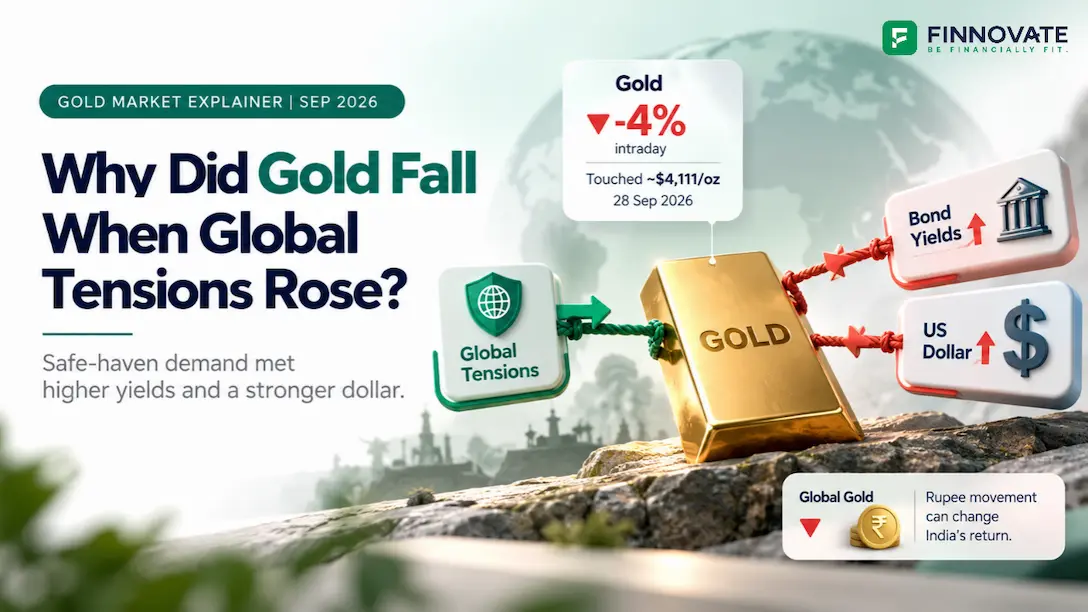
Why Did Gold Fall When Global Tensions Rose?
Why can gold prices fall during global tensions? Understand how bond yields, interest rate...
30 September 2026
Last reviewed: May 2026
NSE officially launched its Electronic Gold Receipt segment on May 4, 2026, bringing EGR trading to India's largest exchange for the first time. What most coverage does not mention: BSE had already launched India's first EGR segment during Muhurat trading in October 2022. The product existed on BSE for over three years before NSE joined. But retail adoption remained limited.
That context matters more than the launch headlines. EGRs are a structurally sound product sitting behind a liquidity and broker access problem that BSE's experience made visible. NSE's network changes the equation, but does not automatically solve it. The question investors need answered is whether EGRs genuinely improve on what gold ETFs already offer, for their specific situation, at this specific stage of the product's development.
This article explains the EGR structure from scratch, compares EGRs directly against gold ETFs and other gold investment options, examines the tax treatment in detail, and gives an honest assessment of costs, liquidity, and who EGRs are actually built for.
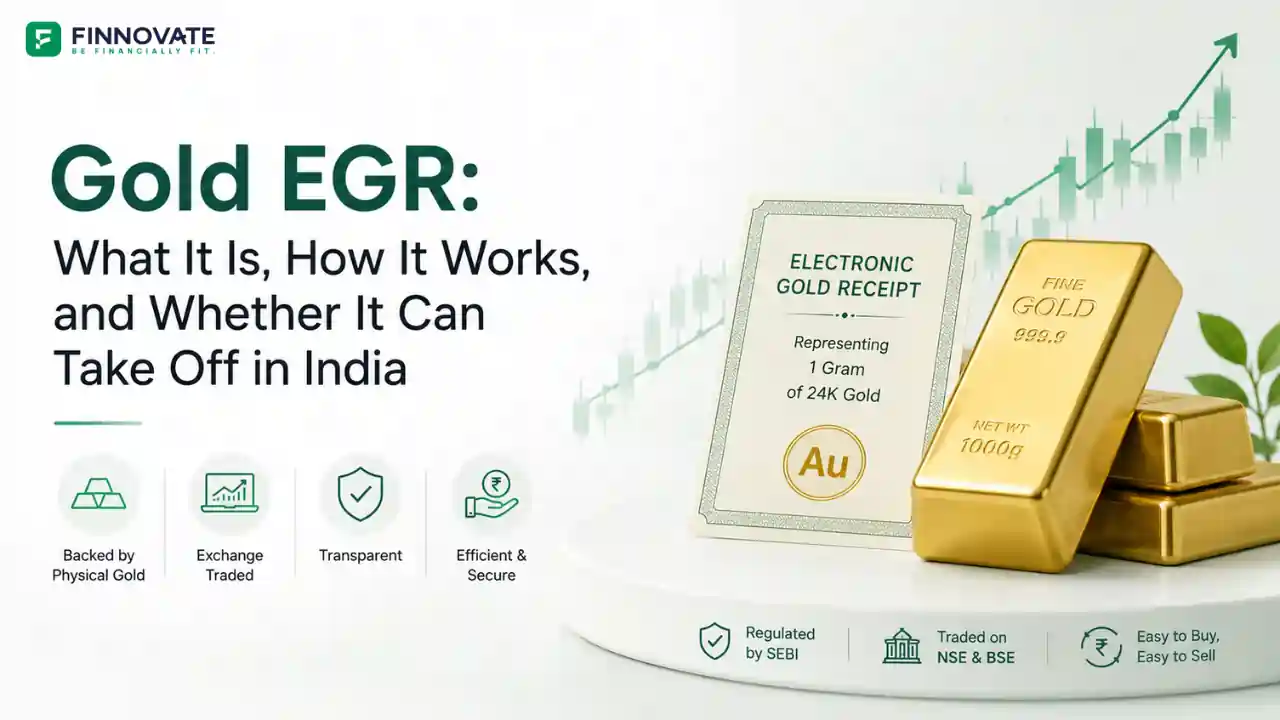
An EGR is a dematerialised security that represents direct ownership of physical gold stored in a SEBI-accredited vault. Think of it as demat gold: the same way shares of a company sit in your demat account as an electronic record, an EGR sits in your demat account as an electronic record of gold ownership. The underlying gold is physically present in a vault, fully backing each receipt one-to-one.
The critical distinction from a gold ETF is at stage three. A gold ETF investor cannot take physical delivery of the gold underlying their units. An EGR holder can. The physical gold is always there, vaulted and certified, ready to be redeemed.
At launch, NSE demonstrated the conversion of a 1,000-gram gold bar into an EGR. This was the first such conversion under the NSE EGR segment. The demonstration confirmed that the infrastructure for deposit, dematerialisation, and trading is operational. EGRs can be held in denominations ranging from 100 milligrams to 1 kilogram, making smaller quantities accessible to retail investors.
An important context point: EGRs are not a concept introduced in May 2026. BSE had already launched India's first EGR segment during Muhurat trading in October 2022, after SEBI approved the framework for spot gold trading and the creation of a gold exchange. The product existed on BSE for over three years before NSE's launch.
The reason most investors have never heard of EGRs despite the BSE launch is directly relevant to understanding what NSE's entry means. BSE's EGR segment attracted minimal retail participation because broker support was thin and liquidity was weak. Without the broker network and investor participation to support active trading, retail adoption remained limited.
Whether that potential translates into actual participation depends on the major discount brokers enabling EGR access and investors finding a genuine reason to prefer EGRs over the gold ETFs they already use. That question is open as of the launch date.
Three specific developments in the gold investment landscape have created an opening for EGRs that did not exist at the time of the BSE launch in 2022.
SEBI issued warnings on digital gold in late 2025, raising concerns about the regulatory oversight of fintech platforms offering digital gold balances. This created uncertainty among digital gold investors about the safety of their holdings and the regulatory standing of the platforms. Investors who had been using digital gold for its convenience now have a regulatory reason to consider an exchange-regulated alternative.
Fresh SGB issuances have not been announced since February 2024, when the last tranche (SGB 2023-24 Series IV) was issued. The Finance Minister and the Department of Economic Affairs Secretary have both indicated the scheme has been discontinued due to high borrowing costs for the government. No new issuance calendar has been released for FY 2026-27. That product is effectively unavailable to new investors today.
With digital gold facing regulatory uncertainty and SGBs no longer being issued, EGRs step into a gap that did not exist at the time of the BSE launch. Investors looking for regulated, exchange-traded gold exposure with physical delivery optionality now have fewer alternatives. EGRs are positioned as the structured answer to that specific gap.
Each gold investment option in India is built on a different mechanism, regulated by different bodies, and carries different cost, tax, and liquidity profiles. The table below maps all four options across the features that matter most to investors making an allocation decision.
| Feature | EGR | Gold ETF | Physical Gold | Digital Gold |
|---|---|---|---|---|
| Physical delivery option | Yes | No | Already physical | Varies by platform |
| SEBI regulated | Yes | Yes | No exchange regulation | No |
| Exchange traded | Yes (NSE, BSE) | Yes | No | No |
| Demat holding | Yes | Yes (MF units) | No | No |
| Storage arranged by | SEBI vault manager | Fund house | Investor | Platform |
| LTCG holding period | 12 months | 12 months | 24 months | 24 months |
| GST on purchase | None | None | 3% | 3% on every purchase |
| GST on physical withdrawal | Applicable GST (currently 3%) at delivery | Not applicable | Already physical | Applicable GST (currently 3%) at delivery |
| Conversion to/from physical (tax) | No capital gains (Sec 47(viid)) | Not applicable | Not applicable | Not applicable |
| Interest income | None | None | None | None |
| Liquidity (May 2026) | Building; thin | High | Low | Medium |
| SIP available | No | Yes | No | Some platforms |
| Broker availability | Limited in 2026 | Universal | Universal | Universal |
The tax treatment of EGRs has two genuinely investor-friendly features that are worth understanding clearly before evaluating whether the instrument fits a portfolio.
EGRs were notified as securities under the Securities Contracts (Regulation) Act, which sets the LTCG holding period at 12 months. The practical implications:
Converting physical gold into an EGR, or converting an EGR back into physical gold, is not treated as a transfer for capital gains purposes under Section 47(viid) of the Income Tax Act. This has four practical consequences:
No other gold instrument offers this two-way conversion without a capital gains consequence.
GST is not applicable on buying or selling EGRs on the exchange. Applicable GST, currently 3% on gold, applies only when physical gold is withdrawn. This compares favourably to digital gold from fintech apps, where 3% GST is charged on every single purchase, creating a recurring cost drag that compounds over time.
The comparison between EGR costs and gold ETF costs is often oversimplified. A gold ETF has one visible annual expense ratio, while an EGR has multiple cost components that depend on how the investor uses the product.
Gold ETFs charge a Total Expense Ratio that covers scheme-level costs such as fund management, custody, storage, and operations. For low-cost gold ETFs in India, recent public disclosures show TERs in the range of approximately 0.35% to 0.60% per annum. Checking the latest TER on the AMC website before comparing is advisable. Apart from TER, investors may also face brokerage, bid-ask spread, demat or DP charges, and applicable taxes when buying or selling ETF units.
Unlike gold ETFs, EGRs have no single bundled cost figure. Investors need to calculate each component based on their holding pattern:
For investors who hold EGRs only as a financial instrument and never take physical delivery, the relevant comparison is EGR storage plus transaction costs versus the ETF's TER plus market-related costs. For investors who eventually plan to take physical delivery, GST and withdrawal-related charges can materially increase the total cost.
The practical conclusion is straightforward: EGRs should not be assumed to be cheaper than gold ETFs. They may work well for investors who specifically need physical delivery optionality or hold meaningful quantities, but for most retail investors seeking simple gold exposure, gold ETFs remain easier to understand, easier to access, and more liquid.
Liquidity is the central issue that will determine whether EGRs take off for retail investors. This is not a theoretical concern. BSE's three-year EGR experience makes the risk concrete.
As of May 2026, major discount brokers including Zerodha have not yet fully enabled EGR trading. Groww and Upstox had not published EGR price lists at the time of NSE's launch. The brokers handling over 80% of retail demat accounts in India had not yet made EGRs accessible in a simple, one-click manner comparable to buying a gold ETF.
Thin liquidity creates a practical problem: wide bid-ask spreads. An investor buying an EGR in a thinly traded market may pay meaningfully more than the gold spot price, and sell for meaningfully less. That spread is an invisible cost that does not appear in any fee schedule but directly erodes returns. Until broker rollout is universal and trading volumes build, this spread risk is real.
Observers familiar with the product recommend using limit orders when trading EGRs, setting the price within a narrow range of the last traded price, rather than market orders that can result in poor fills in a thin order book.
EGRs in their current form are primarily designed for bullion traders, jewellers, and refiners who move large quantities of physical gold. Two use cases illustrate this clearly:
The potential for EGRs to attract retail investors in meaningful volumes depends on two developments. First, the major broker platforms making EGR buying as simple as buying a gold ETF. Second, liquidity building to a point where bid-ask spreads compress to levels competitive with gold ETFs.
The one catalyst that could significantly accelerate EGR adoption beyond institutional participants is banks accepting EGRs as collateral for gold loans. Gold loans are a large and growing business in India. If EGRs become widely accepted as collateral, the benefits are concrete:
That use case has not yet been operationalised, but it is widely identified as the highest-value catalyst for broader EGR adoption in India.
Whether you hold physical gold, gold ETFs, or are evaluating EGRs, the more important question is what role gold plays in your specific financial plan. We can help you think through the allocation, instrument choice, and tax implications in a free call.
Book a free callAn EGR is a SEBI-regulated, exchange-traded security backed one-to-one by physical gold stored in an accredited vault. The key difference from a gold ETF is physical delivery: EGR holders can redeem their holdings for actual physical gold. Gold ETF investors cannot take physical delivery of the underlying gold. Both are held in demat accounts and traded on exchanges.
EGRs are held in demat accounts and traded on the NSE. However, as of May 2026, not all brokers have enabled EGR trading. Major discount brokers are at various stages of implementing the segment. Check with your specific broker on whether the EGR segment is available on your trading platform before attempting to transact.
EGRs are treated as listed securities with a 12-month LTCG holding period, compared to 24 months for physical gold. Converting physical gold into an EGR, or an EGR into physical gold, does not attract capital gains tax under Section 47(viid) of the Income Tax Act. No GST applies on exchange trading; 3% GST applies when physical gold is withdrawn. Please consult a SEBI-registered investment adviser or qualified tax professional for advice specific to your situation.
EGRs are regulated by SEBI as exchange-traded securities with physical gold stored in SEBI-accredited vaults managed by registered Vault Managers. Digital gold from fintech apps operates under varying arrangements with different levels of regulatory oversight. The EGR framework is structurally more regulated, with SEBI overseeing both the exchange segment and the vault managers.
Gold ETFs charge a single annual TER covering scheme-level costs, typically in the range of 0.35% to 0.60% per annum for major schemes, plus brokerage, bid-ask spread, and DP charges. EGR investors must calculate vault storage charges, brokerage and depository fees, bid-ask spread in thin markets, delivery logistics if physical gold is taken, and applicable GST on physical withdrawal separately. The all-in cost comparison depends on holding pattern, quantity, and whether physical delivery is intended. Please consult a SEBI-registered investment adviser before making any investment decision.
That outcome depends on two developments: major brokers enabling EGR access universally, and liquidity building to levels competitive with gold ETFs. For investors who specifically want the physical delivery option, EGRs offer something gold ETFs cannot. For investors who prioritise simplicity, low spread, and SIP functionality, gold ETFs remain the more practical instrument in 2026. Past investment patterns are not indicative of future outcomes. Please consult a SEBI-registered investment adviser before making any investment decision.
Taxation of gold in India: ETF, SGB, physical gold and digital gold explained
Mutual fund taxation in India: FY 2025-26 complete guide
Disclaimer: This article is for general information and educational purposes only. It does not constitute investment advice, a recommendation, or an offer to buy or sell any securities or financial instruments. Information on the EGR framework is sourced from the NSE official press release dated May 4, 2026, SEBI circulars, and publicly available data. Tax treatment is referenced to Section 47(viid) of the Income Tax Act and incometaxindia.gov.in. Gold ETF TER figures are indicative and based on publicly available fund information as of May 2026. Past market behaviour and investment patterns are not indicative of future outcomes. No investment decision should be made based solely on the contents of this article. Please consult a SEBI-registered investment adviser or qualified financial professional before making any investment decision. Gold and related investments are subject to market risks.
No spam. Only new posts, simple explainers, and practical money checklists for busy professionals.
Finnovate is a SEBI-registered financial planning firm that helps professionals bring structure and purpose to their money. Over 3,500+ families have trusted our disciplined process to plan their goals - safely, surely, and swiftly.
Our team constantly tracks market trends, policy changes, and investment opportunities like the ones featured in this Weekly Capsule - to help you make informed, confident financial decisions.
Learn more about our approach and how we work with you:
No comments yet. Start the conversation. What would you add?
No spam. Only new posts, simple explainers, and practical money checklists.
You may also like
Why can gold prices fall during global tensions? Understand how bond yields, interest rate...

Global gold has fallen ~27% from its January 2026 peak. India's gold loan market is estima...
January 2026 gold ETF inflows hit ₹24,040 crore, nearly matching active equity inflows. ...

Silver ETFs traded at steep premiums over spot prices, leading to a sharp correction. Here...
Popular now

Learn how to easily download your NSDL CAS Statement in PDF format with our step-by-step g...

Looking for the best financial freedom books? Here’s a handpicked 2026 reading list with...
Learn what SIF investment means in India, SEBI rules, Rs 10 lakh minimum investment, avail...
Clear guide to mutual fund taxation in India for FY 2025–26 after July 2024 changes: equ...