
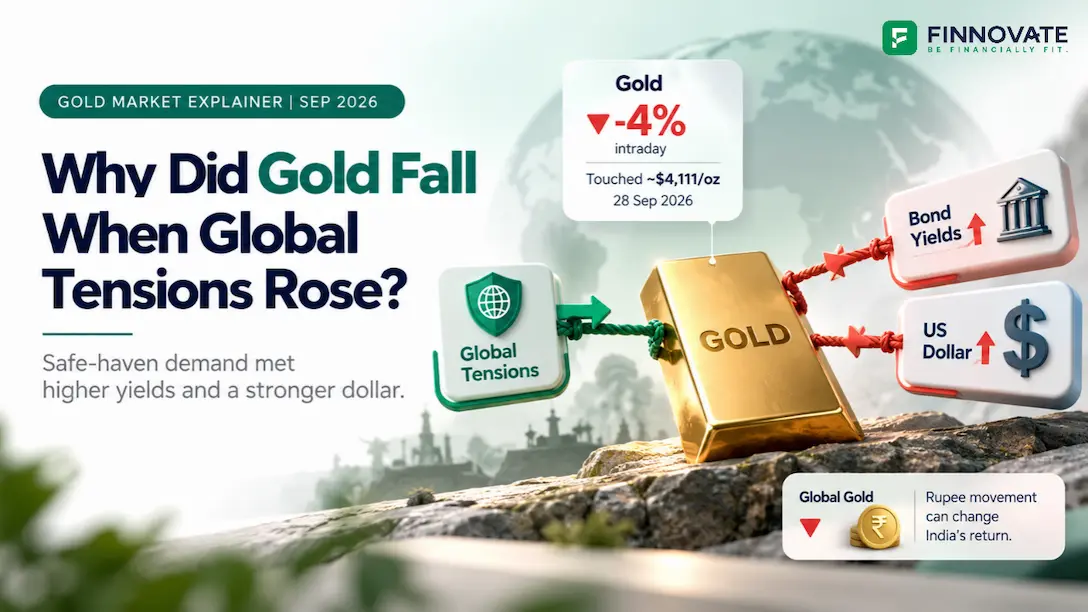
Why Did Gold Fall When Global Tensions Rose?
Why can gold prices fall during global tensions? Understand how bond yields, interest rate...
30 September 2026
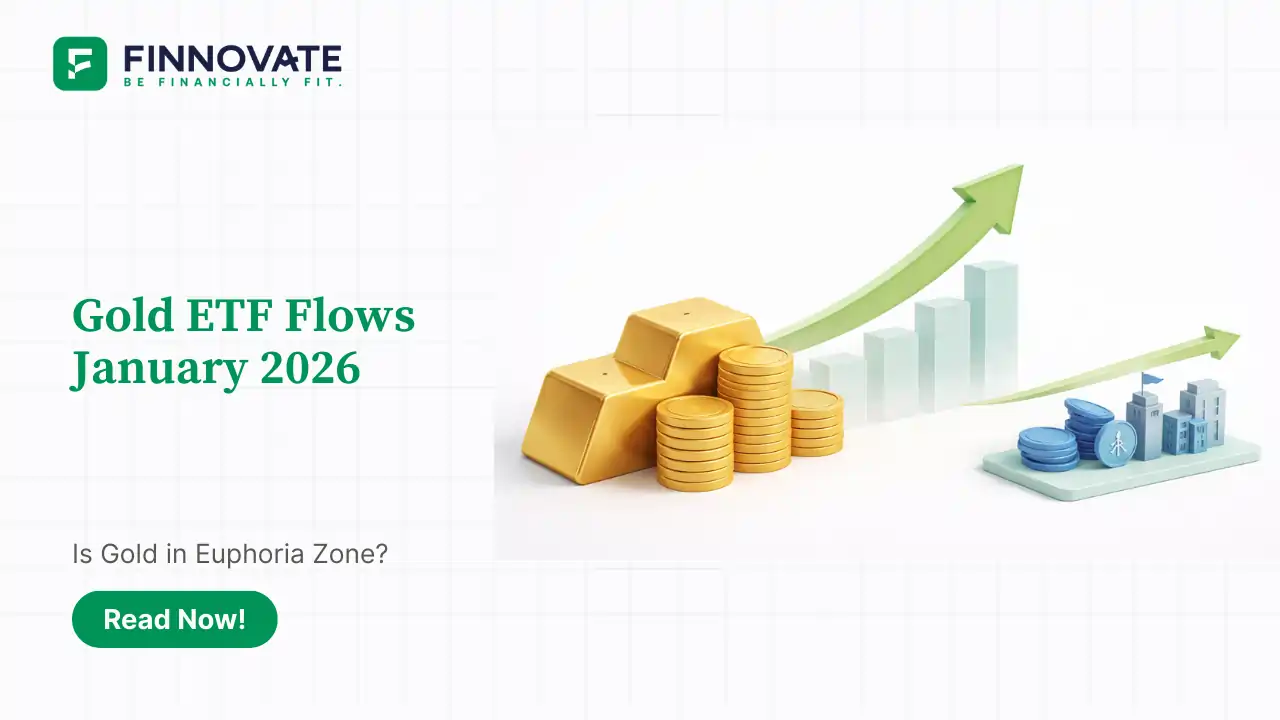
Euphoria is difficult to identify in real time. It often feels rational while it is building. Investors tend to move toward assets that have delivered the strongest recent returns. That behaviour appears logical until valuations and positioning are examined more closely.
The January 2026 mutual fund flow data suggests that gold may be entering such a phase. Gold ETF inflows have reached unprecedented levels, raising an important question: are investors responding to genuine risk factors, or are they chasing momentum?
For years, gold ETFs in India typically attracted average monthly inflows of under ₹1,000 crore. Even when gold demand strengthened globally, inflows increased gradually.
January 2026 was different.
This means that gold ETF inflows alone exceeded active equity inflows. If silver ETF inflows are included, precious metal ETF allocations significantly outpaced equity allocations.
This shift is not marginal. It marks a structural change in investor positioning. When a traditionally defensive asset attracts flows comparable to equity funds, it warrants closer examination.
The most common explanation offered for the gold rally is geopolitical uncertainty. Gold has historically been treated as a hedge during periods of instability.
However, the current global backdrop raises questions.
Historically, one of the most significant geopolitical peaks occurred in 1979, when gold touched a major price high. Importantly, today’s gold price is well above the inflation-adjusted peak of 1979.
If geopolitical tension is not at an extreme historical high, then the current price levels must be explained through other forces.
Another narrative driving gold enthusiasm is de-dollarisation. Yet, the US dollar continues to play a dominant role in global trade and reserves. If the dollar were to strengthen meaningfully, the sustainability of the gold rally could face challenges.
This does not invalidate gold’s hedge role, but it suggests that the current rally may be supported by broader behavioural factors.
Strong bull markets are often built on three pillars. When all three align, euphoria tends to develop.
Valuation metrics for gold are difficult to define compared to equities. Gold does not generate earnings or cash flows. However, one data point stands out.
Over the last 14 years, gold prices have risen almost five-fold. Such a sustained rally naturally raises questions about forward return potential.
Unlike productive assets, gold does not generate income. Its value depends primarily on price appreciation and hedge characteristics. When price appreciation becomes the dominant narrative, valuation discipline often weakens.
The second pillar is liquidity and flows.
January 2026 gold ETF inflows of ₹24,040 crore indicate that investor participation is expanding rapidly. The fact that these flows matched active equity inflows signals a broad-based shift in preference.
In addition:
Strong flows can sustain rallies. However, they can also amplify volatility when sentiment changes.
The third pillar is the disappearance of doubt.
Legendary investor Peter Lynch once remarked that when even non-market participants begin offering investment tips, caution is warranted. While this is anecdotal, the principle is relevant.
Healthy bull markets require scepticism. When almost every participant believes an asset can only rise, the risk-reward balance becomes asymmetric.
In the case of gold:
The combination suggests that scepticism may be diminishing.
Traditionally, gold has been positioned as a portfolio hedge.
A disciplined allocation framework generally suggests:
The rationale is straightforward:
However, the current environment complicates this narrative.
Gold has become more volatile in recent periods. At times, it has moved in tandem with other risk assets rather than providing diversification benefits. When an asset’s volatility rises and correlation patterns shift, its hedge characteristics can weaken.
If gold begins to behave like a momentum-driven asset rather than a stabiliser, the risk profile changes.
The surge in gold ETF flows does not automatically imply that gold is in a bubble. Record inflows alone do not define euphoria.
However, several factors deserve attention:
The key distinction lies between strategic allocation and tactical chasing.
Gold’s role in a portfolio is primarily to:
It is not designed to compete with equities in long-term return generation.
When investors increase exposure beyond disciplined allocation ranges solely because recent returns have been strong, risk increases.
Gold’s long-term role remains intact as a diversification tool. Central banks continue to hold it. Investors value it during uncertainty. It has historically preserved purchasing power over long horizons.
The concern arises when:
Markets do not signal the exact moment when euphoria peaks. They often look strongest just before momentum slows.
Disclaimer: This article is for general information and educational purposes only. It does not constitute investment advice, a recommendation, or an offer to buy or sell any securities or mutual fund schemes. Mutual fund investments are subject to market risks. Please read all scheme-related documents carefully and consider consulting a qualified professional before taking any financial decision.
No spam. Only new posts, simple explainers, and practical money checklists for busy professionals.
Finnovate is a SEBI-registered financial planning firm that helps professionals bring structure and purpose to their money. Over 3,500+ families have trusted our disciplined process to plan their goals - safely, surely, and swiftly.
Our team constantly tracks market trends, policy changes, and investment opportunities like the ones featured in this Weekly Capsule - to help you make informed, confident financial decisions.
Learn more about our approach and how we work with you:
No comments yet. Start the conversation. What would you add?
No spam. Only new posts, simple explainers, and practical money checklists.
You may also like
Why can gold prices fall during global tensions? Understand how bond yields, interest rate...

Global gold has fallen ~27% from its January 2026 peak. India's gold loan market is estima...

NSE launched Electronic Gold Receipts on May 4, 2026. EGRs offer physical delivery and a 1...

Silver ETFs traded at steep premiums over spot prices, leading to a sharp correction. Here...
Popular now

Learn how to easily download your NSDL CAS Statement in PDF format with our step-by-step g...

Looking for the best financial freedom books? Here’s a handpicked 2026 reading list with...
Learn what SIF investment means in India, SEBI rules, Rs 10 lakh minimum investment, avail...
Clear guide to mutual fund taxation in India for FY 2025–26 after July 2024 changes: equ...