

How Much Corpus for ₹2 Lakh/Month Retirement in India?
Want ₹2 lakh per month after retirement? See the corpus needed today and after 10, 20 or...
16 September 2026

Finnovate’s editorial team researches and creates financial content using trusted sources, regulatory references and inputs from subject experts.
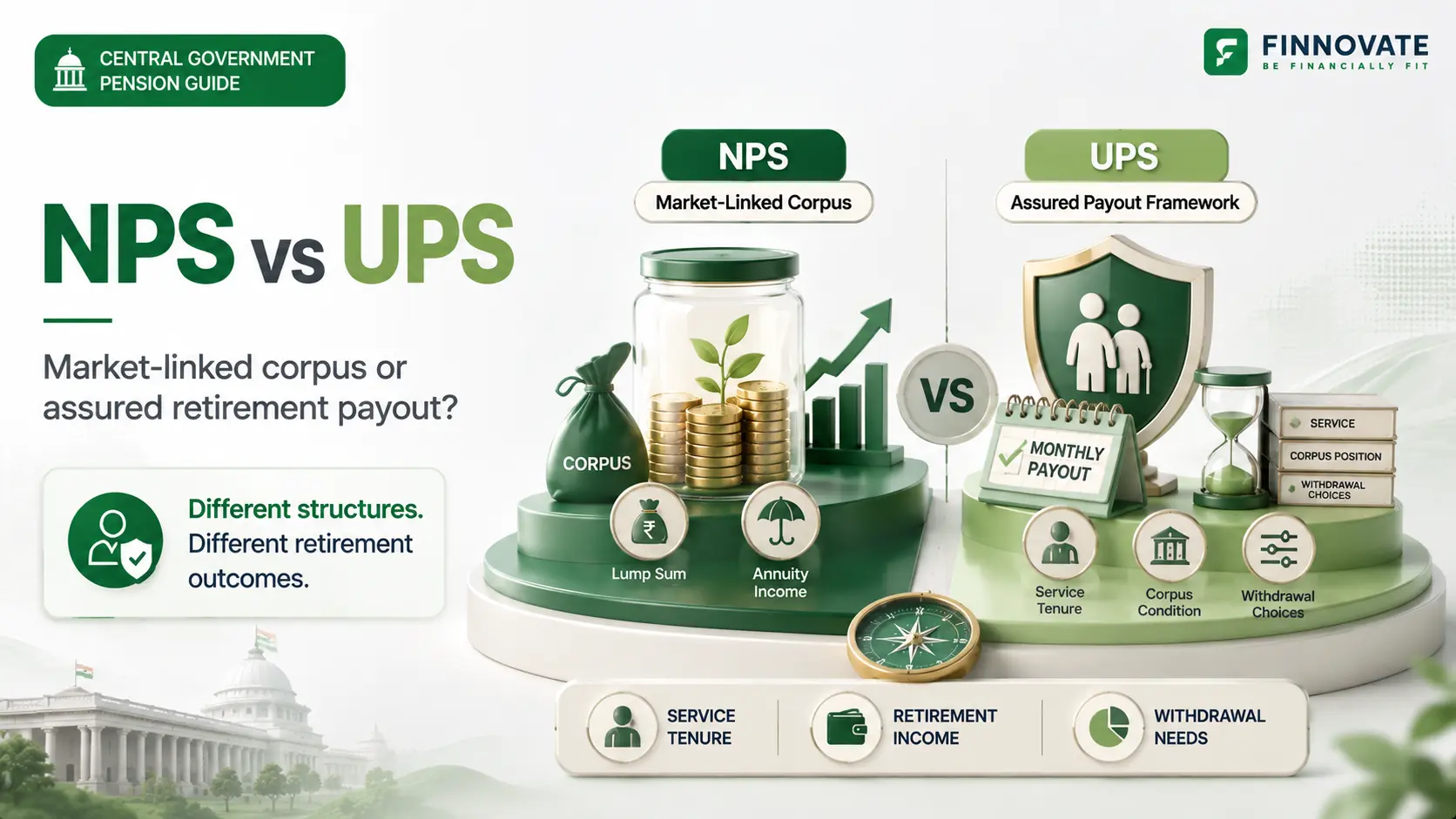
For an eligible Central Government employee, choosing between NPS and UPS changes more than the way pension is calculated. It affects how government contributions are used, how retirement income is determined, how much can be withdrawn and what happens if the employee resigns or retires early.
NPS builds a market-linked retirement corpus. UPS provides an assured-payout framework, but the final amount depends on qualifying service, the individual corpus, the benchmark corpus and the withdrawal selected.
Table of Contents
| Factor | NPS | UPS |
|---|---|---|
| Availability | Applies under the wider NPS framework, including covered Central Government employees | Option for eligible Central Government employees under notified rules |
| Employee contribution | 10% of Basic Pay plus DA | 10% of Basic Pay plus DA |
| Government funding | 14% of Basic Pay plus DA under the Central Government NPS structure | Matching 10% into the individual corpus plus an estimated 8.5% into a common pool corpus |
| Retirement structure | Market-linked corpus and annuity | Assured payout subject to conditions |
| Full payout condition | Not applicable | At least 25 years of qualifying service |
| Service below 25 years | Outcome depends on corpus and annuity | Proportionate payout after at least 10 years |
| Minimum scheme payout | None | ₹10,000 per month after at least 10 years, subject to conditions |
| Dearness Relief | Not part of the standard NPS annuity framework | Applicable to admissible and family payout |
| Final withdrawal | Up to the limit allowed under NPS exit rules | Up to 60% of the individual corpus or benchmark corpus, whichever is lower |
| Effect of final withdrawal | Reduces the corpus available for annuity | Directly reduces the monthly admissible payout |
| Family income | Depends on the annuity option selected | 60% of the admissible payout for the eligible spouse |
| Ordinary resignation | NPS continuation or exit rules apply | Assured payout is generally lost; individual corpus is payable under applicable rules |
| Switching | Not applicable | One-time, one-way switch back to NPS under prescribed conditions |
The official comparison shows the same employee contribution under both structures, but a different government-funding and retirement-payout arrangement.
UPS became effective from April 1, 2025 as an option under the NPS architecture for eligible Central Government employees.
The eligible group broadly includes:
An eligible employee who does not exercise the UPS option within the applicable timeline continues under NPS.
UPS should not automatically be treated as an option for:
For a covered Central Government employee:
The contributions form part of the employee’s market-linked NPS retirement corpus.
The contribution structure is:
The additional estimated 8.5% is not credited directly to the employee’s individual corpus. It supports the common pool used for the assured-payout structure.
NPS does not promise a fixed pension.
The retirement outcome depends on:
UPS uses an assured-payout formula.
The full assured payout is generally:
This applies after at least 25 years, or 300 months, of qualifying service.
For qualifying service between 10 and 25 years, a proportionate payout applies. A minimum guaranteed payout of ₹10,000 per month applies after at least 10 years, subject to the prescribed conditions.
The 50% figure is not an unconditional pension promise. The admissible payout may reduce because of:
Assume:
The starting assured payout would be:
Applicable Dearness Relief may be added according to notified rules.
These two terms are central to understanding UPS.
| Term | Meaning |
|---|---|
| Individual Corpus | Actual corpus created from the employee contribution, matching government contribution and investment performance |
| Benchmark Corpus | A notional reference corpus based on the prescribed default investment pattern and regular, timely contributions |
The benchmark corpus assumes the required contribution pattern and other prescribed conditions.
Where the individual corpus is lower than the benchmark corpus, the assured payout may reduce proportionately.
The official admissible-payout calculation also adjusts for the percentage taken as final withdrawal.
Assume the employee’s assured payout before corpus adjustment is ₹50,000 per month, with:
Because the Individual Corpus is 90% of the Benchmark Corpus, the admissible payout would be:
| Feature | NPS | UPS |
|---|---|---|
| Final withdrawal | Up to the permitted limit under NPS exit rules | Up to 60% of the individual corpus or benchmark corpus, whichever is lower |
| Effect on monthly income | Leaves a smaller amount for annuity purchase | Reduces the admissible payout proportionately |
| Separate service-based lump sum | No equivalent UPS formula | Available under a separate prescribed formula |
| Inflation adjustment | Depends on the annuity product | Dearness Relief applies to the admissible payout |
UPS also provides a separate lump-sum payment calculated as:
This service-based payment is different from the final withdrawal taken from the individual or benchmark corpus.
Under NPS, family income depends on the annuity option selected and the applicable exit or death rules.
Under UPS, the eligible legally wedded spouse can receive a family payout equal to 60% of the admissible payout or eligible top-up amount drawn by the subscriber immediately before death.
Dearness Relief applies to the family payout according to the notified framework.
Under ordinary resignation from Central Government service:
Different treatment may apply where the employee resigns with proper permission to join another eligible government role or is absorbed into a specified organisation.
UPS treatment depends on the type of voluntary retirement and qualifying service.
For specified voluntary-retirement cases after at least 25 years of qualifying service, the assured payout may begin from the date on which the employee would otherwise have superannuated.
The final withdrawal and applicable lump-sum payment may be available earlier under the prescribed rules.
Voluntary retirement should not be treated as identical to normal superannuation or ordinary resignation.
Yes, but this is not a repeated switching facility.
A UPS subscriber may use a one-time, one-way switch back to NPS within the prescribed timelines and conditions.
After the switch:
The employee cannot freely move back and forth between NPS and UPS.
There is no universal answer. The employee’s service path and retirement priorities matter.
| Employee priority or situation | Structure to examine more closely | Reason |
|---|---|---|
| Preference for an assured, inflation-linked payout | UPS | Provides an assured-payout framework and Dearness Relief, subject to conditions |
| Preference for a personal market-linked corpus | NPS | Retirement outcome is driven by accumulated investments |
| Strong likelihood of completing 25 years of qualifying service | UPS | Full assured-payout formula depends on 25 years |
| Possibility of resignation or leaving government service | NPS or detailed UPS-rule review | UPS benefits may be affected by the nature of exit |
| Need for a large retirement withdrawal | Compare carefully | UPS final withdrawal reduces the monthly payout |
| Shorter remaining government service | Individual calculation required | UPS payout is proportionate below 25 years |
| Preference for family payout linked to the employee’s pension | UPS | Provides a defined spouse payout under applicable rules |
| Desire for control over annuity and accumulated corpus | NPS | Corpus allocation and annuity selection shape the outcome |
Whether the employee remains under NPS or chooses UPS, the expected retirement income should be compared with the household’s future expenses.
Finnovate’s retirement calculator can estimate the corpus required after considering inflation, while Retirement Planning Advisory can connect the pension choice with EPF, investments, healthcare costs and family goals.
NPS and UPS determine how retirement benefits are structured. A complete retirement plan also needs to account for future expenses, inflation, healthcare costs, other investments and family responsibilities.
Explore Finnovate Retirement PlanningThe decision is not only about whether one system offers higher potential returns and the other offers an assured payout.
A Central Government employee should review:
NPS builds a market-linked retirement corpus, with retirement income depending on the corpus and annuity selected. UPS provides an assured-payout framework for eligible Central Government employees, subject to qualifying service, corpus and withdrawal conditions.
UPS is available to eligible Central Government employees covered under the notified NPS framework, including eligible existing employees and new recruits. It is not automatically available to every NPS subscriber or State Government employee.
Not exactly. The full assured payout is 50% of the average Basic Pay over the final 12 months after at least 25 years of qualifying service. It can reduce because of shorter service, corpus shortfall or final withdrawal.
UPS provides a minimum guaranteed payout of ₹10,000 per month after at least 10 years of qualifying service, subject to the prescribed conditions.
Yes. A UPS final withdrawal can be up to 60% of the individual corpus or benchmark corpus, whichever is lower. The admissible monthly payout is reduced proportionately.
The treatment follows the UPS corpus framework and applicable migration rules. The employee’s individual corpus and the prescribed benchmark corpus are then used for determining UPS benefits.
A one-time, one-way switch back to NPS is permitted within prescribed timelines and conditions. After switching, UPS assured-payout benefits cease and NPS rules apply.
Under ordinary resignation, the assured payout is generally not available. The individual corpus is payable under the applicable rules. Different treatment may apply to specified government-service transfers or absorption cases.
Dearness Relief is not a standard feature of an NPS annuity. Under UPS, Dearness Relief applies to the admissible payout and eligible family payout according to notified rules.
Disclaimer: This article is for general information and education only. It does not constitute investment, tax, legal or government-service advice. UPS eligibility, option timelines and benefits depend on the applicable rules, qualifying service, corpus position, employment status and circumstances of exit. NPS investments are market-linked and returns are not guaranteed. Employees should review the latest PFRDA, NPS Trust and government notifications and obtain appropriate professional or departmental guidance before making a decision.
No spam. Only new posts, simple explainers, and practical money checklists for busy professionals.
Finnovate is a SEBI-registered financial planning firm that helps professionals bring structure and purpose to their money. Over 3,500+ families have trusted our disciplined process to plan their goals - safely, surely, and swiftly.
Our team constantly tracks market trends, policy changes, and investment opportunities like the ones featured in this Weekly Capsule - to help you make informed, confident financial decisions.
Learn more about our approach and how we work with you:
No comments yet. Start the conversation. What would you add?
No spam. Only new posts, simple explainers, and practical money checklists.
You may also like
Want ₹2 lakh per month after retirement? See the corpus needed today and after 10, 20 or...

SWP vs FD for retirement: compare income, risk, inflation, tax, liquidity and corpus susta...

NPS vs mutual funds for retirement: compare liquidity, tax, lock-in, asset allocation, ann...

Understand NPS for government employees, including Central Government contributions, tax b...
Popular now

Learn how to easily download your NSDL CAS Statement in PDF format with our step-by-step g...

Looking for the best financial freedom books? Here’s a handpicked 2026 reading list with...
Learn what SIF investment means in India, SEBI rules, Rs 10 lakh minimum investment, avail...
Clear guide to mutual fund taxation in India for FY 2025–26 after July 2024 changes: equ...