

How Much Corpus for ₹2 Lakh/Month Retirement in India?
Want ₹2 lakh per month after retirement? See the corpus needed today and after 10, 20 or...
16 September 2026

Finnovate’s editorial team researches and creates financial content using trusted sources, regulatory references and inputs from subject experts.
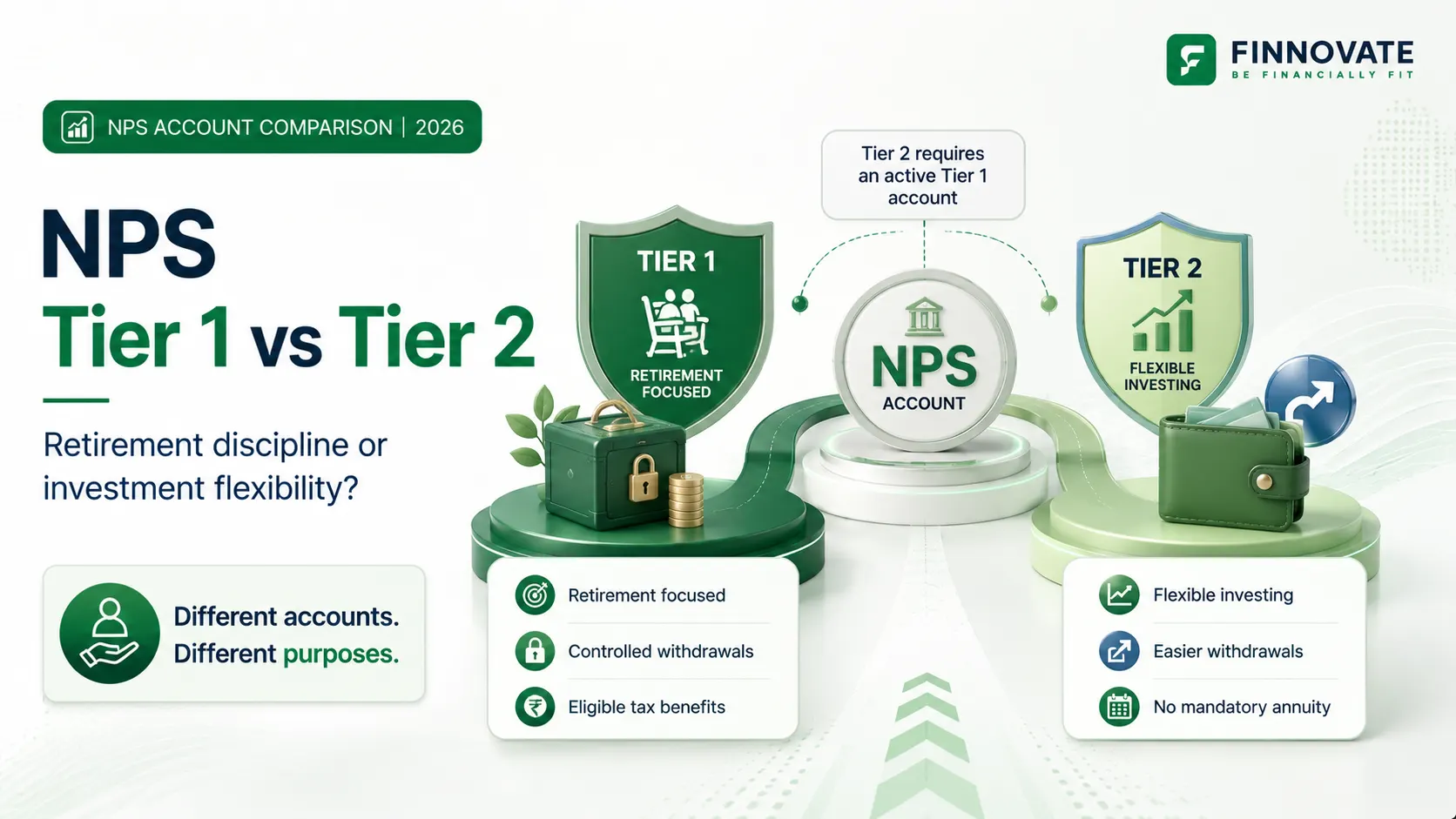
NPS Tier 1 is the primary pension account under the National Pension System. It is built for retirement, offers eligible tax benefits and follows regulated withdrawal rules. NPS Tier 2 is an optional investment account linked to an active Tier 1 account. It generally allows withdrawals at any time but does not ordinarily offer the same tax deductions.
Table of Contents
| Feature | NPS Tier 1 | NPS Tier 2 |
|---|---|---|
| Account type | Individual pension account | Optional investment account |
| Main purpose | Long-term retirement accumulation | Additional flexible investment |
| Can it exist independently? | Yes | Requires an active Tier 1 account |
| Withdrawals | Governed by NPS withdrawal and exit rules | Generally unrestricted |
| General tax deduction | Available subject to applicable tax provisions | Normally unavailable |
| Minimum contribution to open | ₹500 | ₹1000 |
| Minimum subsequent contribution | ₹500 | ₹250 |
| Minimum annual contribution | ₹1,000 | No prescribed annual minimum |
| Maximum equity allocation | Up to 75% under regular Active Choice; up to 100% through eligible high-risk MSF schemes for non-government subscribers | Up to 100%, subject to the selected scheme and applicable framework |
| Annuity requirement | May apply at exit | No annuity requirement |
| Transfer between accounts | Not applicable | Transfer from Tier 2 to Tier 1 is permitted |
PFRDA’s All Citizen Model FAQ classifies Tier 1 as an individual pension account and Tier 2 as an optional account requiring an active Tier 1 account. It currently states a minimum opening contribution of ₹500 for Tier 1 and ₹1,000 for Tier 2. The minimum subsequent Tier 2 contribution is ₹250.
Tier 1 is the main retirement account under NPS. Contributions are invested in market-linked assets based on the investment option and pension fund selected by the subscriber.
The account is designed to preserve money for retirement. Withdrawals, premature exits and final exits are therefore subject to NPS regulations. Depending on the type and timing of exit, part of the corpus may need to be used to purchase an annuity.
Tier 1 contributions may qualify for deductions under the applicable income-tax provisions. However, the available deduction depends on factors such as the subscriber’s tax regime, employment status, contribution type and applicable limits.
Tier 2 is an optional investment account available to an eligible subscriber who has an active Tier 1 account. It operates under the same PRAN but is separate from the subscriber’s retirement corpus.
Unlike Tier 1, Tier 2 generally allows the subscriber to withdraw money without NPS exit restrictions. It also does not require the corpus to be used for purchasing an annuity.
Subscribers can select an investment option and pension fund for Tier 2 that may differ from their Tier 1 choices. NPS Trust also states that Tier 2 does not carry a separate annual maintenance charge and permits transfers into Tier 1.
Tier 1 is structured to support long-term retirement accumulation. Its withdrawal restrictions can prevent retirement money from being used for routine expenses.
Tier 2 prioritises flexibility. The subscriber can generally access the money when required, but this also makes it easier to interrupt long-term compounding.
Liquidity is useful, but it does not automatically make Tier 2 suitable for every financial goal.
Tier 1 withdrawals are governed by NPS regulations. Partial withdrawals are permitted only under specified conditions, while premature and normal exits follow separate rules.
Tier 2 generally permits unrestricted withdrawals. There is no mandatory annuity purchase when money is withdrawn from the account.
Anyone considering Tier 1 should review the current exit rules rather than assuming that the complete balance will always be freely available.
Under the old tax regime, eligible personal contributions to Tier 1 may be claimed under Section 80CCD(1), subject to the applicable limits and the overall ceiling under Section 80CCE. An additional deduction of up to ₹50,000 may be available under Section 80CCD(1B).
These personal contribution deductions are not available under the new tax regime. Current Income Tax Department validation rules for Assessment Year 2026–27 do not permit deductions under Sections 80CCD(1) and 80CCD(1B) where the new tax regime is selected.
Employer contributions to a Tier 1 NPS account may qualify separately under Section 80CCD(2). The Income Tax Department currently states that the deductible limit is up to 10% of salary under the old tax regime and up to 14% under the new tax regime, subject to applicable provisions.
Ordinary Tier 2 contributions do not receive the same deductions.
The current minimum contribution to open Tier 1 is ₹500, with a minimum annual contribution of ₹1,000.
Tier 2 can be opened with a minimum contribution of ₹1,000. Subsequent contributions can be made with a minimum of ₹250, and no minimum annual contribution is prescribed for the account.
These are account-operating minimums. They should not be treated as recommended retirement contributions. The required amount should be based on the retirement corpus and income the subscriber expects to need.
Under the regular NPS Active Choice framework, equity allocation in Tier 1 can be up to 75%, while Tier 2 can permit up to 100% equity. In addition, eligible non-government subscribers may now choose designated high-risk schemes under the Multiple Scheme Framework, or MSF, that allow Tier 1 equity exposure of up to 100%.
The availability of a 100% equity option does not make a scheme automatically more suitable. A fully equity-oriented allocation can experience substantial short-term fluctuations and may not suit money required in the near future.
Investment choice should be based on the goal, holding period, risk capacity, scheme conditions and total portfolio, rather than only the maximum permitted equity allocation.
| Your requirement | Possible starting point | Why |
|---|---|---|
| Building a dedicated retirement corpus | Tier 1 | Designed as a pension account with controlled access |
| Claiming eligible personal NPS deductions under the old tax regime | Tier 1 | Personal contribution deductions apply subject to tax provisions |
| Receiving an employer NPS contribution | Tier 1 | Employer contributions are made to the pension account |
| Investing money needed within one or two years | Usually neither by default | Flexible withdrawal does not remove market risk |
| Adding a flexible account to an existing NPS structure | Compare Tier 2 | Allows separate investments under the same PRAN |
| Seeking a flexible equity investment | Compare Tier 2 with mutual funds | Investment choices, taxation and account structures differ |
| Building an emergency fund | Usually not the first choice | Emergency funds generally need stable and predictable access |
| Investing as an NRI or OCI | Check eligibility first | PFRDA currently does not permit Tier 2 activation for NRIs and OCIs under the All Citizen model |
The decision should begin with the purpose of the money. Tax benefits, costs and flexibility should be evaluated after that.
Neither is universally better.
Tier 2 may be considered by an existing NPS subscriber who wants an additional market-linked account within the NPS system. It offers flexible withdrawals, permits a separate pension fund and asset allocation, and may allow equity exposure of up to 100%, subject to the selected scheme and applicable framework.
Mutual funds operate independently of NPS and offer a wider range of fund houses, investment categories, strategies and goal-based options.
| Factor | NPS Tier 2 | Mutual funds |
|---|---|---|
| Structure | Linked to an active NPS Tier 1 account | Independent investment product |
| Investment range | NPS pension funds and permitted asset classes | Wider scheme and category range |
| Liquidity | Generally unrestricted | Depends on the scheme and exit conditions |
| Tax treatment | Must be assessed under applicable tax law | Depends on fund category and holding period |
| Suitable use | Additional NPS-linked investment | Wider range of short- and long-term goals |
NPS is usually one part of retirement wealth. A retirement plan can connect it with EPF, investments, future expenses, healthcare needs, taxes and the income required after retirement.
Explore Finnovate Retirement PlanningTier 1 and Tier 2 solve different financial needs.
Tier 1 is primarily a retirement account with regulated access and eligible tax benefits. Tier 2 is a flexible investment account linked to Tier 1, but it does not ordinarily offer the same deductions or retirement safeguards.
Before choosing, consider the purpose of the money, time horizon, withdrawal needs, tax regime, risk capacity and other available investment options. For retirement contributions, use the NPS calculator to check whether the projected corpus is aligned with the income you may need after retirement.
Tier 1 is an individual pension account designed for retirement and governed by NPS withdrawal rules. Tier 2 is an optional investment account linked to an active Tier 1 account and generally permits withdrawals at any time.
No. An active Tier 1 account is required before an eligible subscriber can activate Tier 2.
Tier 2 generally permits unrestricted withdrawals and does not require annuity purchase. The tax consequences of a withdrawal should be assessed separately under the law applicable at that time.
Ordinary Tier 2 contributions do not receive the tax deductions generally associated with Tier 1. A limited Tier II Tax Saver Scheme is available to eligible Central Government NPS subscribers and has a three-year lock-in.
Yes. NPS Trust states that switching funds from Tier 2 to Tier 1 is permitted. A transfer in the opposite direction is not presented as an equivalent withdrawal facility.
It depends on the investor’s goal, tax position, required investment range and holding period. Tier 2 provides an NPS-linked structure, while mutual funds generally offer a wider range of schemes and strategies.
PFRDA currently states that NRIs and OCIs are not permitted to activate Tier 2 accounts under the All Citizen model, even where they hold an eligible Tier 1 account.
Disclaimer: This article is for general information and education only. It does not constitute investment, tax or legal advice or a recommendation to open, close or invest through any NPS account. NPS investments are market-linked and returns are not guaranteed. Tax treatment depends on the applicable law, tax regime and individual circumstances. Review the latest PFRDA, NPS Trust and Income Tax Department provisions and consult a qualified professional before acting.
No spam. Only new posts, simple explainers, and practical money checklists for busy professionals.
Finnovate is a SEBI-registered financial planning firm that helps professionals bring structure and purpose to their money. Over 3,500+ families have trusted our disciplined process to plan their goals - safely, surely, and swiftly.
Our team constantly tracks market trends, policy changes, and investment opportunities like the ones featured in this Weekly Capsule - to help you make informed, confident financial decisions.
Learn more about our approach and how we work with you:
No comments yet. Start the conversation. What would you add?
No spam. Only new posts, simple explainers, and practical money checklists.
You may also like
Want ₹2 lakh per month after retirement? See the corpus needed today and after 10, 20 or...

SWP vs FD for retirement: compare income, risk, inflation, tax, liquidity and corpus susta...

NPS vs mutual funds for retirement: compare liquidity, tax, lock-in, asset allocation, ann...
Compare NPS and UPS for Central Government employees, including contributions, pension cal...
Popular now

Learn how to easily download your NSDL CAS Statement in PDF format with our step-by-step g...

Looking for the best financial freedom books? Here’s a handpicked 2026 reading list with...

Learn what SIF investment means in India, SEBI rules, Rs 10 lakh minimum investment, avail...

Clear guide to mutual fund taxation in India for FY 2025–26 after July 2024 changes: equ...