

EU Scrap Export Curbs: India’s Raw-Material Risk Explained
Proposed EU scrap export curbs could affect India’s metal supply and manufacturing costs...
24 September 2026

Finnovate’s editorial team researches and creates financial content using trusted sources, regulatory references and inputs from subject experts.
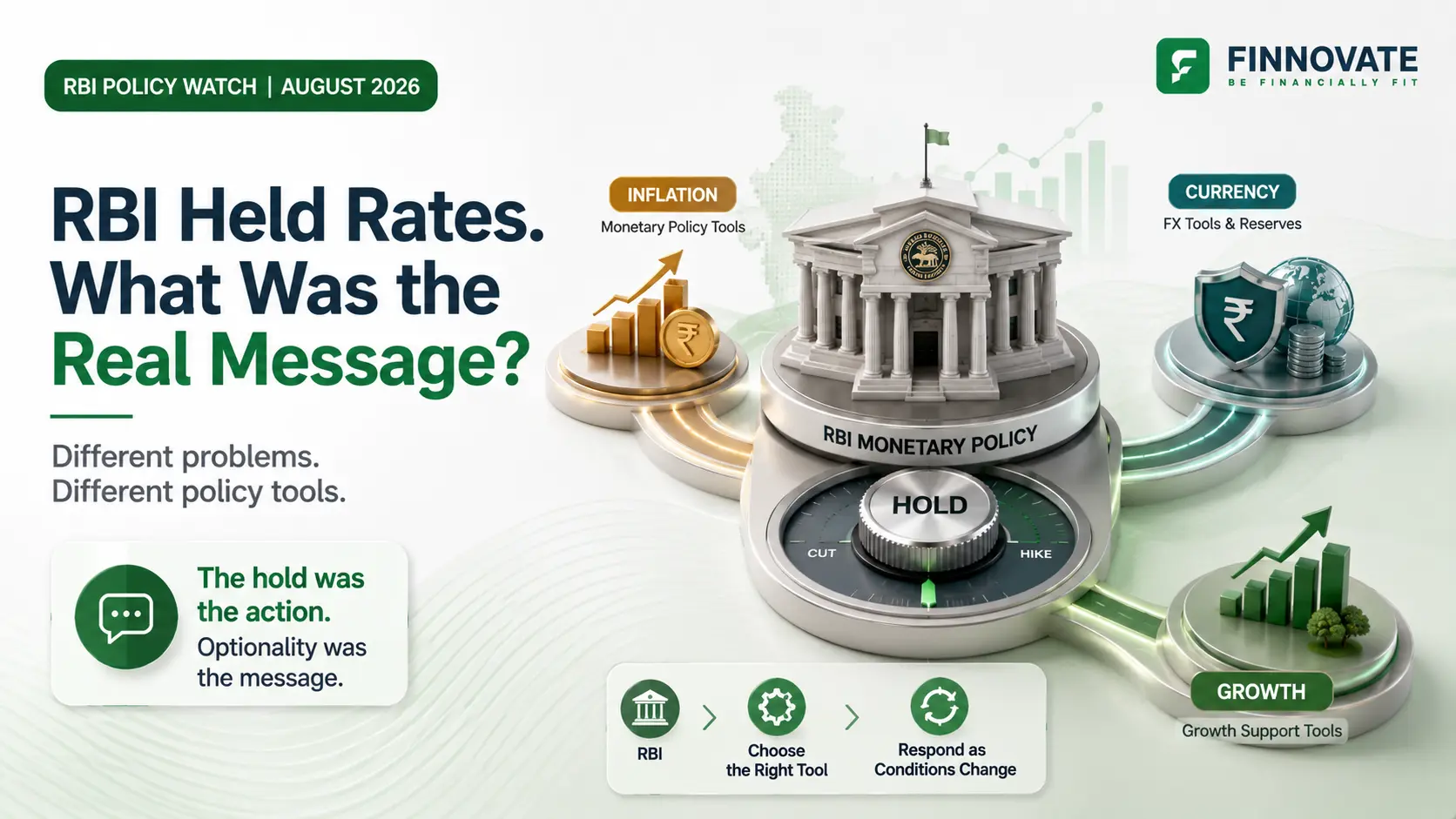
The RBI’s August 2026 monetary policy looked uneventful at first glance.
The repo rate stayed unchanged at 5.25%. The policy stance remained neutral. All six Monetary Policy Committee members voted to hold rates. The RBI also raised its FY27 GDP growth forecast slightly to 6.7% and lowered its inflation estimate to 5.0%.
So, no rate hike. No rate cut. No change in stance.
Table of Contents
| Indicator | August 2026 decision |
|---|---|
| Repo rate | 5.25% |
| Policy stance | Neutral |
| SDF rate | 5.00% |
| MSF rate | 5.50% |
| Bank Rate | 5.50% |
| FY27 GDP growth forecast | 6.7% |
| FY27 inflation forecast | 5.0% |
| Core inflation projection | 4.3% |
| MPC vote | Unanimous hold |
The RBI raised its growth estimate from 6.6% to 6.7%, while cutting its inflation estimate by 10 basis points. It also projected core inflation at 4.3%.
Governor Sanjay Malhotra indicated that the central bank wanted a clearer inflation signal before changing monetary policy.
That is what a data-dependent approach really means. It does not mean the RBI ignores forecasts and only reacts to old numbers.
The MPC still studies:
A more data-dependent RBI means investors should focus less on predicting a fixed rate path and more on identifying which inflation and growth indicators could actually trigger the next move.
India’s headline inflation has moved higher, but the RBI still lowered its FY27 inflation forecast to 5.0%. Core inflation was projected at 4.3%.
India’s flexible inflation-targeting framework aims for CPI inflation of 4% with a tolerance band of 2% to 6%. But approaching 6% does not mechanically force the RBI to raise rates.
The MPC also needs to assess whether inflation is temporary or persistent, whether it is concentrated in food and fuel, whether core inflation is rising, and whether inflation expectations are becoming unanchored.
The RBI simultaneously raised FY27 GDP growth to 6.7% and lowered FY27 inflation to 5.0%.
That combination gave the MPC more room to stay on hold.
A premature hike could weaken housing demand, corporate borrowing, private capital expenditure, consumer credit and investment activity.
A premature cut could become problematic if inflation accelerates again.
The rupee had faced substantial pressure earlier in 2026. One possible response would have been to raise interest rates, but a defensive hike also raises borrowing costs across the domestic economy.
Instead, the RBI has increasingly relied on a broader toolkit.
| Problem | Possible RBI tool |
|---|---|
| Short-term rupee volatility | Direct FX intervention |
| Foreign-currency funding shortage | FCNR(B), ECB and overseas borrowing measures |
| Reserve adequacy | Foreign-currency inflows and swaps |
| Persistent domestic inflation | Repo-rate action |
| Market liquidity | Liquidity-management operations |
The RBI introduced special measures in June to encourage foreign-currency inflows, including a concessional swap facility linked to FCNR(B) deposits.
By July 31, the programme had mobilised about $36.7 billion. Broader measures, including overseas borrowing incentives, had helped attract more than $41 billion of capital inflows by the time of the August policy.
It encouraged foreign-currency deposits into the Indian banking system and strengthened foreign-currency liquidity.
It gave the RBI more room to address currency pressure without immediately raising domestic interest rates.
India’s foreign-exchange reserves rose by about $10.5 billion in one week to $692.9 billion as of July 31, their highest level in nearly three months.
The rupee also appreciated about 1.2% during that week, its strongest weekly gain in four months.
The RBI said reserves provided more than ten months of import cover and covered about 90.8% of external debt.
No. The August policy should not be interpreted as a promise that the next move cannot be a hike.
A rate hike could become more likely if:
Persistently expensive oil can raise inflation, weaken the current account and put pressure on the rupee.
Repeated supply disruptions could keep headline inflation high and affect household inflation expectations.
A sustained increase would indicate that price pressure is spreading beyond volatile food and fuel categories.
Persistent depreciation can eventually raise imported costs enough to affect monetary policy.
Higher developed-market yields can alter foreign capital flows, bond demand and currency conditions.
For borrowers, the immediate message is straightforward: there was no additional repo-rate increase in August.
For home-loan and other floating-rate borrowers, the direction of inflation over the next few months matters more than speculation around a particular policy date.
The August hold removes the immediate risk of a surprise rate hike, but the neutral stance also limits how aggressively markets can price future rate cuts.
Bond investors should watch headline CPI, core CPI, crude oil, government borrowing, the rupee, US Treasury yields and RBI liquidity operations.
Bond yields can still move because of inflation expectations, fiscal supply, currency movements and global interest rates.
For equities, the policy offered a relatively supportive combination:
Real estate, automobiles, banks and consumer discretionary businesses generally benefit when borrowing costs are stable.
A more stable rupee can help import-dependent businesses but may have a different effect on companies that earn a large share of revenue overseas.
There is therefore no single “RBI policy trade”.
Use the repo rate when inflation becomes persistent enough to justify economy-wide monetary tightening.
Use reserves, FX intervention and foreign-currency funding tools when exchange-rate pressure is primarily an external-flow problem.
Avoid unnecessary tightening when domestic activity still benefits from stable financing conditions.
Neither description fits particularly well.
The RBI did not signal that rate cuts were imminent.
The RBI acknowledged inflation risks but did not tighten policy.
| Indicator | Why it matters |
|---|---|
| Headline inflation | Shows the immediate price trend |
| Core inflation | Helps identify persistent underlying pressure |
| Crude oil | Major source of imported inflation |
| Food prices | Can materially move Indian CPI |
| Rupee | Influences imported costs and capital flows |
| Forex reserves | Shows RBI’s external buffer |
| FCNR(B) flows | Indicates effectiveness of foreign-currency measures |
| Credit growth | Signals domestic demand and financial conditions |
| GDP growth | Determines how much tightening the economy can absorb |
| Global yields | Affect Indian bond and currency flows |
The August 2026 policy did not deliver a dramatic rate decision. That was precisely why its messaging mattered.
The RBI kept the repo rate at 5.25%, raised its growth forecast and lowered its inflation estimate. At the same time, large foreign-currency inflows gave it more room to manage the rupee without immediately turning to higher domestic interest rates.
The RBI kept the repo rate unchanged at 5.25% and retained a neutral policy stance.
The RBI raised its FY27 GDP growth forecast to 6.7% from 6.6%.
The RBI lowered its FY27 inflation forecast to 5.0%, while core inflation was projected at 4.3%.
No. The RBI also looks at persistence, core inflation, inflation expectations, the source of the price increase and overall growth conditions.
The August policy suggests the repo rate is not currently the first line of defence for currency pressure. The RBI has also used FX intervention, FCNR(B) measures and other foreign-currency funding tools.
They strengthened foreign-currency liquidity and reserves, giving the RBI more room to manage currency pressure without immediately raising domestic interest rates.
It was better described as cautiously neutral. The RBI neither signalled imminent cuts nor reacted to inflation risks with a rate hike.
Disclaimer: This article is for general information and educational purposes only. It does not constitute investment advice, interest-rate advice or a recommendation regarding any security, loan or financial product. Monetary-policy expectations can change as inflation, growth, currency and global financial conditions evolve.
No spam. Only new posts, simple explainers, and practical money checklists for busy professionals.
Finnovate is a SEBI-registered financial planning firm that helps professionals bring structure and purpose to their money. Over 3,500+ families have trusted our disciplined process to plan their goals - safely, surely, and swiftly.
Our team constantly tracks market trends, policy changes, and investment opportunities like the ones featured in this Weekly Capsule - to help you make informed, confident financial decisions.
Learn more about our approach and how we work with you:
No comments yet. Start the conversation. What would you add?
No spam. Only new posts, simple explainers, and practical money checklists.
You may also like
Proposed EU scrap export curbs could affect India’s metal supply and manufacturing costs...

FPIs net sold $1.47 billion in Indian equities during September 1–15, 2026. Explore sect...

Nearly 39% of India’s monitored coal power plants were critically low on fuel in Septemb...

Tata Sons faces a major governance dispute over N Chandrasekaran’s reappointment, RBI li...
Popular now

Learn how to easily download your NSDL CAS Statement in PDF format with our step-by-step g...

Looking for the best financial freedom books? Here’s a handpicked 2026 reading list with...
Learn what SIF investment means in India, SEBI rules, Rs 10 lakh minimum investment, avail...

Clear guide to mutual fund taxation in India for FY 2025–26 after July 2024 changes: equ...