

How Much Corpus for ₹2 Lakh/Month Retirement in India?
Want ₹2 lakh per month after retirement? See the corpus needed today and after 10, 20 or...
16 September 2026


Finnovate’s editorial team researches and creates financial content using trusted sources, regulatory references and inputs from subject experts.
For a government employee, the monthly NPS deduction is only one part of the retirement picture. What also matters is how much the government contributes, where the money is invested, what tax treatment applies and how the accumulated corpus can be used at retirement.
NPS is a market-linked retirement system in which contributions are credited to the employee’s pension account over the course of service. The applicable contribution structure and service rules can differ between Central Government, State Government and autonomous-body employees.
Table of Contents
| Feature | Government-sector NPS |
|---|---|
| Official name | National Pension System |
| Main account | Tier 1 pension account |
| Central Government employee contribution | 10% of Basic Pay plus DA |
| Central Government contribution | 14% of Basic Pay plus DA |
| State Government contribution | Depends on the applicable state arrangement |
| Nature of returns | Market-linked |
| Guaranteed pension | No |
| Account number | Permanent Retirement Account Number, or PRAN |
| Tax benefits | Depend on contribution type, tax regime and applicable limits |
| Retirement exit | Governed by NPS exit regulations |
| Portability | The PRAN continues within the NPS system, subject to employment and sector updates |
NPS is a defined-contribution system. This means the contribution rates are specified, but the retirement corpus and monthly pension are not guaranteed.
Central Government employees joining service on or after January 1, 2004 are mandatorily covered under NPS, excluding personnel of the armed forces. Contributions are made to the employee’s Tier 1 account through the government payroll system.
Employees of Central Autonomous Bodies may be covered under NPS where the organisation has adopted the applicable framework. The precise contribution and service conditions should be checked through the employer or nodal office.
Several State Governments and Union Territories have adopted NPS from different effective dates. PFRDA currently states that eligible State Government employees contribute 10% of salary and DA, with a matching government contribution under the standard State Government framework. However, individual states may notify revised employer contribution rates or other operational terms.
Coverage depends on whether the body has adopted NPS and the conditions notified by the relevant government or organisation.
After enrolment, the employee receives a Permanent Retirement Account Number (PRAN). The PRAN identifies the subscriber’s NPS account and records contributions and transactions across the account.
For a covered Central Government employee:
For Central Government employees covered under NPS:
Assume an employee has:
The monthly contributions would be:
| Contribution | Calculation | Amount |
|---|---|---|
| Employee contribution | 10% of ₹90,000 | ₹9,000 |
| Central Government contribution | 14% of ₹90,000 | ₹12,600 |
| Combined monthly contribution | ₹9,000 + ₹12,600 | ₹21,600 |
| Combined annual contribution | ₹21,600 × 12 | ₹2,59,200 |
This is an illustration. Actual contributions should be checked against the employee’s salary records and NPS transaction statement.
The tax treatment depends on who makes the contribution and which tax regime the employee selects.
| Contribution | Relevant provision | Broad treatment |
|---|---|---|
| Employee’s regular contribution | Section 80CCD(1) | May qualify under the old tax regime, subject to applicable limits |
| Additional employee contribution | Section 80CCD(1B) | Additional deduction of up to ₹50,000 may be available under the old tax regime |
| Government contribution | Section 80CCD(2) | May qualify separately, subject to the prescribed percentage and overall tax provisions |
Employee deductions under Sections 80CCD(1) and 80CCD(1B) are generally unavailable under the new tax regime.
However, an eligible government contribution under Section 80CCD(2) may continue to qualify under the new tax regime. Current Income Tax Department validation rules for Assessment Year 2026–27 permit the deduction up to 14% of Basic Pay plus DA where the employer category is the Central or State Government.
Government-sector NPS contributions are invested through registered pension funds. The available pension-fund and investment choices depend on the subscriber category and the options permitted under the applicable government-sector framework.
Government subscribers can choose from permitted pension funds, including eligible private-sector pension funds, and may change the pension-fund choice once in a financial year. A combination of public-sector pension funds remains the default arrangement.
Central Government subscribers also have notified investment choices, including the default scheme, a government-securities option and lifecycle-based investment patterns.
The treatment depends on why and when the employee exits NPS.
| Event | General treatment |
|---|---|
| Normal retirement | Lump-sum and annuity rules apply, subject to accumulated-corpus options |
| Premature exit | More restrictive lump-sum and annuity requirements generally apply |
| Partial withdrawal | Available only for permitted purposes and within prescribed limits |
| Death of subscriber | Governed by government-sector death and service rules |
Under the current normal-exit framework, where accumulated pension wealth is up to ₹8 lakh, the subscriber may withdraw the entire amount as a lump sum or choose permitted periodic-payment options. Where the corpus is between ₹8 lakh and ₹12 lakh, separate withdrawal and periodic-payout options apply. For larger corpuses, the standard NPS structure generally involves up to 60% lump-sum withdrawal and at least 40% for annuity purchase.
Partial withdrawals are generally permitted after at least three years of NPS membership, for prescribed purposes, and up to 25% of the subscriber’s own contributions, excluding returns and employer contributions.
No. NPS does not guarantee a fixed pension or fixed retirement corpus.
At retirement, the monthly pension generally depends on:
Two employees with similar salaries may receive different retirement outcomes because their service periods, contribution history, investment performance, withdrawals and annuity decisions may differ.
No. The Unified Pension Scheme has not replaced NPS for every government employee.
UPS became effective from April 1, 2025 as an option under the NPS architecture for eligible Central Government employees. Employees who remain under NPS continue with its defined-contribution and market-linked structure.
The two systems approach retirement benefits differently. Under NPS, the retirement outcome depends on the accumulated corpus, investment performance and annuity selected. UPS provides an assured payout subject to qualifying service, corpus requirements and other applicable conditions.
UPS should not be assumed to apply automatically to State Government employees or every employee covered under NPS, as eligibility and government arrangements may differ.
A government employee should periodically check:
The retirement calculator can help estimate the overall corpus required, while Finnovate’s Retirement Planning Advisory can connect NPS with other retirement assets, expenses and income requirements.
Government contributions strengthen retirement savings, but they do not guarantee that the final corpus will cover future living costs, healthcare expenses and the income required after retirement.
Explore Finnovate Retirement PlanningFor covered Central Government employees, the Central Government contributes 14% of Basic Pay plus Dearness Allowance. The employee generally contributes 10% of the same amount.
No. It is mandatory for Central Government employees joining on or after January 1, 2004, excluding armed-forces personnel. State Government coverage depends on the date and terms under which the respective state or UT adopted NPS.
No universal rate should be assumed. PFRDA’s standard State Government page describes a matching contribution, while some states have separately notified an increase from 10% to 14%. Employees should check the applicable state notification or salary record.
For covered Central Government employees, the mandatory contribution is calculated on Basic Pay plus Dearness Allowance, not on the employee’s complete gross salary.
Voluntary contributions may be permitted under NPS, subject to the applicable account and operational rules. Any additional contribution should be considered in the context of tax limits, liquidity requirements and the employee’s complete retirement plan.
No. The final pension depends on the accumulated corpus, annuity amount, annuity option and the rate available from the annuity provider at retirement.
An eligible employer contribution may qualify under Section 80CCD(2) even under the new tax regime, subject to the applicable percentage and other statutory limits.
Resignation does not automatically make the complete corpus freely withdrawable. The employee may continue within NPS or exit according to the applicable premature-exit, sector-shifting and service rules.
Government subscribers can select from the pension funds permitted under the applicable framework. PFRDA currently permits a change in pension-fund choice once in a financial year.
Disclaimer: This article is for general information and education only. It does not constitute investment, tax, legal or employment-service advice. NPS rules may differ based on the employee category, government notification, service rules, tax regime and circumstances of exit. NPS investments are market-linked and returns are not guaranteed. Employees should review their salary records, CRA statement, employer or nodal-office guidance, current PFRDA rules and applicable tax provisions before making a decision.
No spam. Only new posts, simple explainers, and practical money checklists for busy professionals.
Finnovate is a SEBI-registered financial planning firm that helps professionals bring structure and purpose to their money. Over 3,500+ families have trusted our disciplined process to plan their goals - safely, surely, and swiftly.
Our team constantly tracks market trends, policy changes, and investment opportunities like the ones featured in this Weekly Capsule - to help you make informed, confident financial decisions.
Learn more about our approach and how we work with you:
No comments yet. Start the conversation. What would you add?
No spam. Only new posts, simple explainers, and practical money checklists.
You may also like
Want ₹2 lakh per month after retirement? See the corpus needed today and after 10, 20 or...

SWP vs FD for retirement: compare income, risk, inflation, tax, liquidity and corpus susta...

NPS vs mutual funds for retirement: compare liquidity, tax, lock-in, asset allocation, ann...
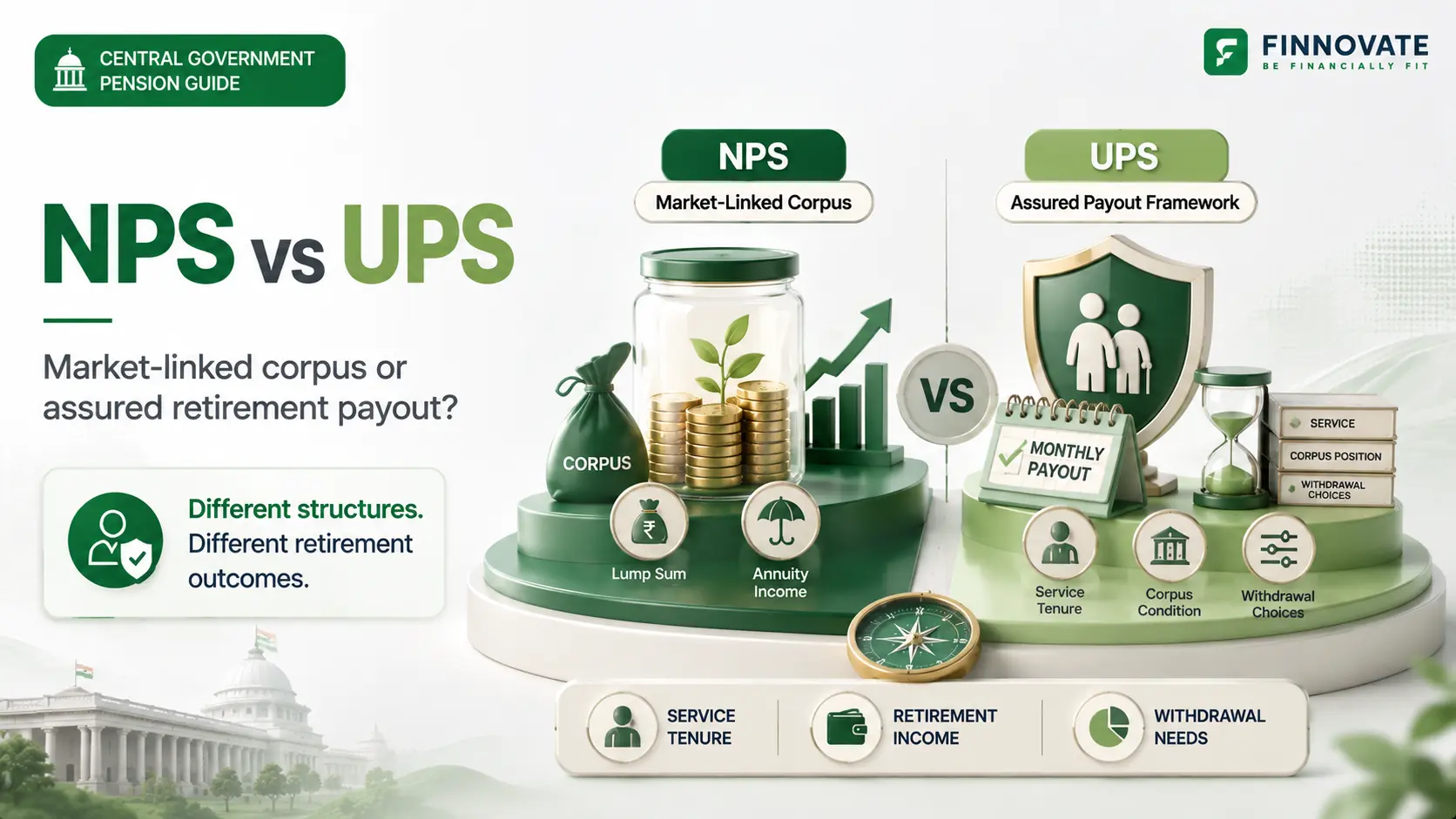
Compare NPS and UPS for Central Government employees, including contributions, pension cal...
Popular now

Learn how to easily download your NSDL CAS Statement in PDF format with our step-by-step g...

Looking for the best financial freedom books? Here’s a handpicked 2026 reading list with...
Learn what SIF investment means in India, SEBI rules, Rs 10 lakh minimum investment, avail...
Clear guide to mutual fund taxation in India for FY 2025–26 after July 2024 changes: equ...