

How Much Corpus for ₹2 Lakh/Month Retirement in India?
Want ₹2 lakh per month after retirement? See the corpus needed today and after 10, 20 or...
16 September 2026

Finnovate’s editorial team researches and creates financial content using trusted sources, regulatory references and inputs from subject experts.
NPS withdrawal rules determine when and how a subscriber can access money accumulated in a National Pension System Tier I account.
A withdrawal may happen at retirement, through a premature exit, as a partial withdrawal while the account remains active, after the subscriber’s death, or through approved systematic payout options.
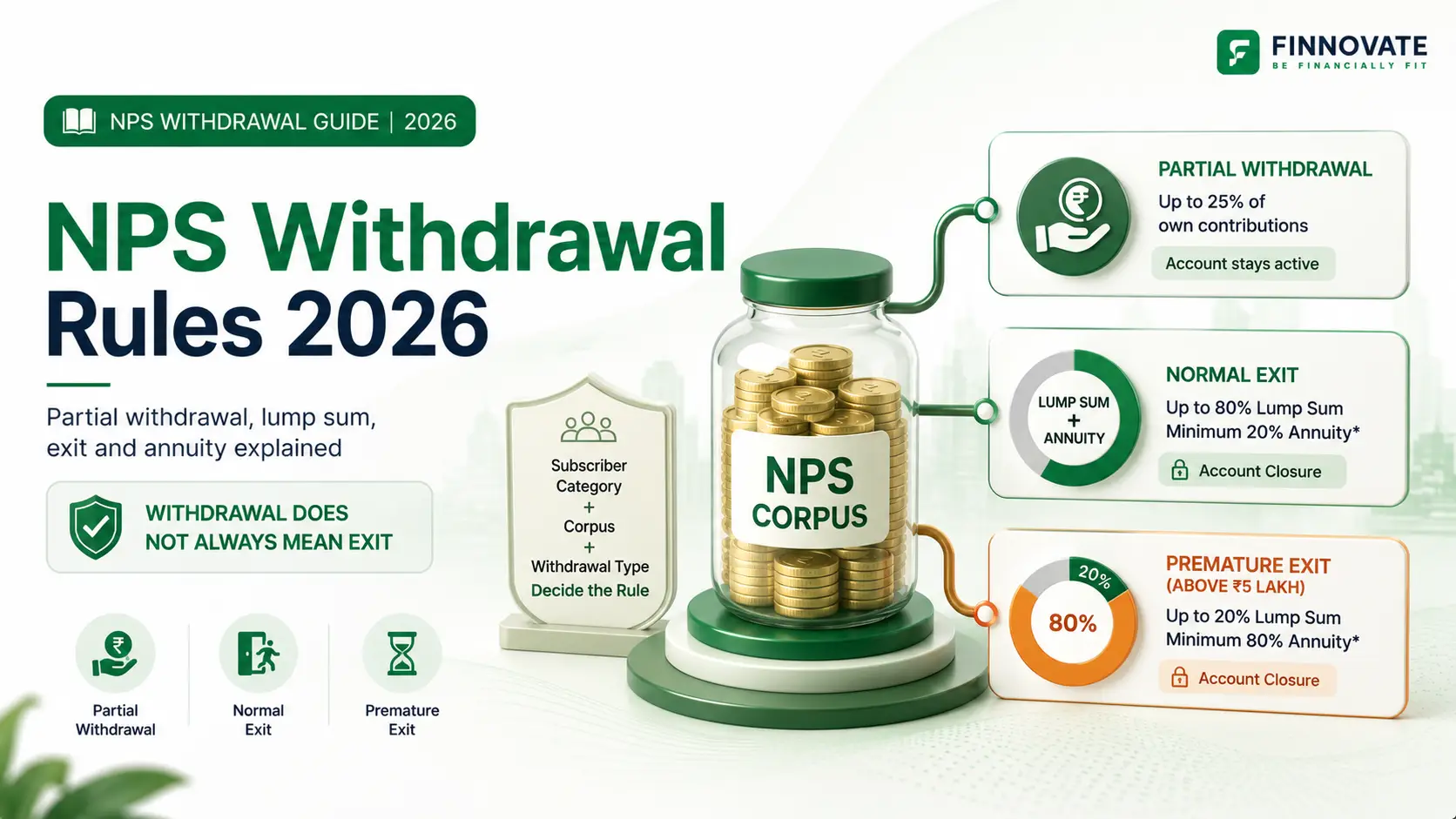
The NPS rules changed significantly after amendments notified by the Pension Fund Regulatory and Development Authority in December 2025. One of the most important changes applies to eligible non-government subscribers, who may now withdraw up to 80% of their accumulated pension wealth at normal exit, subject to the applicable corpus limits and annuity requirements.
Government-sector subscribers continue to follow the 60% lump-sum and 40% annuity structure for larger NPS corpuses.
This article explains the NPS withdrawal rules applicable in 2026, including normal withdrawal, premature exit, partial withdrawal, small-corpus withdrawal, annuity requirements, death claims, systematic payouts, continuation and taxation.
Table of Contents
| Withdrawal or exit situation | Subscriber category | Lump-sum withdrawal | Mandatory annuity |
|---|---|---|---|
| Normal exit with corpus above ₹12 lakh | All Citizen and Corporate | Up to 80% | At least 20% |
| Normal exit with corpus above ₹12 lakh | Government sector | Up to 60% | At least 40% |
| Premature exit with corpus above ₹5 lakh | Government and non-government | Up to 20% | At least 80% |
| Normal exit with corpus up to ₹8 lakh | Government and non-government | Up to 100% | Not compulsory |
| Premature exit with corpus up to ₹5 lakh | Government and non-government | Up to 100% | Not compulsory |
| Death before exit | Non-government subscriber | Up to 100% payable to nominees or legal heirs | Optional |
| Death before exit | Government subscriber | Depends on corpus | Default family annuity may apply |
NPS withdrawal is a broad term. It includes withdrawals that close the Tier I account as well as partial withdrawals that allow the account to remain active.
Withdrawal on becoming eligible for normal exit, generally at retirement, superannuation or after completing the prescribed subscription period.
Withdrawal by closing the NPS account before normal-exit eligibility.
A permitted withdrawal from the subscriber’s own contributions while the NPS account remains active.
Payment of accumulated pension wealth to nominees, legal heirs or eligible family members under the applicable rules.
An NPS exit means closing the subscriber’s Tier I individual pension account and settling the accumulated pension wealth.
The Tier I account is closed after the lump-sum, annuity or periodic-payout options are processed.
A permitted amount is withdrawn while the NPS account remains active.
Where the Tier I account is being closed, the NPS rules broadly recognise three exit situations:
The point at which an exit becomes a normal exit depends on the subscriber category.
For an individual who joined NPS before age 60, normal exit is available on:
whichever happens earlier.
A person joining NPS at age 35 may become eligible for normal exit at age 50 after completing 15 years. The exit need not necessarily wait until age 60.
For Corporate-sector subscribers, normal exit generally applies on reaching the retirement or superannuation age prescribed under the employer’s service rules or employment terms.
Normal exit ordinarily applies when a Government subscriber reaches the applicable superannuation age.
Normal-exit treatment may also apply in certain cases of invalidation, disability or premature retirement when certified under the relevant service rules. Additional provisions apply to Central Government employees governed by the Central Civil Services NPS Rules.
This category includes:
The amount may be received through:
Withdraw up to ₹6 lakh. The remaining amount must be used for an annuity or paid through Systematic Unit Redemption for at least six years.
Withdraw up to 80% and use at least 20% to purchase an annuity.
The remaining amount, up to 80%, can be received as:
These revised provisions replaced the earlier rule under which non-government subscribers generally had to use at least 40% of the corpus for an annuity.
The basic annuity requirement for Government subscribers has not changed for larger corpuses.
| Corpus at normal exit | Lump-sum option | Annuity or periodic-payout requirement |
|---|---|---|
| Up to ₹8 lakh | Up to 100% | Annuity is not compulsory |
| Above ₹8 lakh and up to ₹12 lakh | Up to ₹6 lakh, or up to 60% | Balance through annuity or SUR for at least six years, or at least 40% annuity under the percentage route |
| Above ₹12 lakh | Up to 60% | At least 40% must purchase an annuity |
Subscribers who join the All Citizen NPS model at age 60 or later can exercise normal exit at any time.
The earlier three-year vesting requirement has been removed. Premature-exit provisions consequently do not apply to this category.
The subscriber can withdraw the full corpus through a lump sum, Systematic Lump-sum Withdrawal or Systematic Unit Redemption. An annuity is optional.
At least 20% must be used to purchase an annuity. Up to 80% may be withdrawn through an eligible payout option.
An exit is treated as premature when a subscriber closes the account before becoming eligible for normal exit.
For a non-government subscriber who joined before age 60, this generally means exiting before:
For Government-sector subscribers, resignation, voluntary closure, dismissal or removal from service may result in premature-exit treatment, subject to the applicable service rules.
The earlier five-year minimum lock-in for premature exit under the All Citizen Model has been removed. However, the premature-exit annuity requirement continues to apply where the corpus exceeds the small-corpus limit.
The subscriber may withdraw the full accumulated pension wealth. An annuity is not compulsory.
Up to 20% can be withdrawn. At least 80% must be used to purchase an annuity.
Maximum withdrawal: ₹4 lakh. Minimum annuity purchase: ₹16 lakh.
A premature exit can therefore provide much less immediate liquidity than a normal exit.
The death-claim provisions differ between Government and non-government subscribers.
For an All Citizen or Corporate-sector subscriber, the entire accumulated pension wealth is payable to the nominee or legal heirs.
They may choose:
An annuity is optional, irrespective of the size of the corpus.
| Corpus | Treatment |
|---|---|
| Up to ₹8 lakh | The entire corpus can be paid to nominees or legal heirs as a lump sum or through periodic payouts. |
| Above ₹8 lakh and up to ₹12 lakh | Up to ₹6 lakh may be withdrawn or paid periodically. The balance must be used for SUR for at least six years or an annuity. |
| Above ₹12 lakh | At least 80% is ordinarily used to purchase the prescribed default annuity for eligible family members. The remaining 20% is payable to nominees or legal heirs. |
For a Government-sector corpus above ₹12 lakh, eligible family members are considered in the following order:
Where none of these eligible family members is alive, the annuity portion may be returned to the surviving children or, in their absence, the legal heirs.
Yes. A subscriber who does not exit at age 60 or superannuation may continue under NPS up to age 85 under the revised framework.
For a non-government subscriber, continuation can happen automatically where no exit request is submitted. A Corporate account connected to an employer may be shifted to the All Citizen Model after the employment relationship ends.
During the continuation period, the subscriber may generally:
The earlier requirement to provide 15 days’ advance notice for continuation or deferment was removed by the amended regulations.
The NPS account remains active and the subscriber can continue contributing.
The subscriber postpones the lump-sum withdrawal, annuity purchase or both. Contributions are not permitted during deferment.
A subscriber may defer:
Once continuation has been selected, the separate deferment options may not remain available in the same manner.
The revised NPS rules provide more ways to receive money instead of taking the entire eligible amount at once.
SLW allows the eligible lump-sum portion to be withdrawn in instalments. It may suit subscribers who want staged cash flows instead of one large payment.
SUR periodically redeems units from the NPS account. Unredeemed units remain invested and may continue to face market movements.
A partial withdrawal does not close the NPS account.
A subscriber becomes eligible after completing at least three years under NPS.
Eligible continuing subscribers may make partial withdrawals with a minimum gap of three years between successive withdrawals.
Permitted purposes include:
The exit regulations and the income-tax exemption are not identical.
Under the current income-tax provisions, an amount of up to 60% of the total NPS corpus payable on closure or opting out is exempt under the applicable NPS withdrawal provision. Eligible partial withdrawals are exempt up to 25% of the subscriber’s contributions, subject to the prescribed conditions.
Therefore, the part of a lump-sum withdrawal exceeding the statutory 60% exemption may have tax implications. Subscribers considering an 80% withdrawal should check the tax treatment applicable in the year of exit instead of assuming that the full 80% will be tax-free.
The amount used directly to purchase the annuity is generally not taxed at the time of annuity purchase.
However, pension received from the annuity is normally taxable in the year of receipt according to the subscriber’s applicable tax provisions.
Tax rules may change independently of PFRDA’s exit regulations. Professional tax advice may be required where the withdrawal exceeds 60%, periodic redemptions are selected or the subscriber is an NRI.
The exact process depends on the subscriber’s CRA, sector and mode of account opening.
A withdrawal or exit request can generally be initiated through:
NPS is usually one part of retirement wealth. A retirement plan can connect the lump sum and annuity with EPF, investments, healthcare needs, taxes and expected monthly expenses.
Explore Finnovate Retirement PlanningGovernment subscribers with a corpus above ₹12 lakh continue to have a minimum 40% annuity requirement.
Permission to withdraw 80% does not automatically mean that the full 80% is exempt from income tax.
A premature exit with a corpus above ₹5 lakh requires at least 80% to be used for an annuity.
The option also affects spouse pension, return of purchase price, inflation protection and benefits after death.
An outdated nomination can delay settlement and may require legal-heir documentation.
The withdrawal should be planned around living costs, healthcare, emergencies, inflation and longevity.
The NPS withdrawal rules applicable in 2026 provide different options depending on whether the subscriber is making a partial withdrawal, taking benefits at normal exit, closing the account prematurely or claiming the corpus after death.
The revised framework provides greater withdrawal flexibility, particularly for eligible All Citizen and Corporate subscribers. However, the amount available as a lump sum, the mandatory annuity allocation and the tax treatment depend on the subscriber category, corpus and reason for withdrawal.
The main changes include:
However, a higher permitted lump-sum withdrawal is not automatically the best retirement decision. It is also not necessarily fully tax-free. Before exiting, subscribers should compare the immediate cash requirement, tax impact, annuity income, investment risk and expected retirement expenses.
Yes, where the corpus falls within the applicable small-corpus limit, such as up to ₹8 lakh at normal exit or up to ₹5 lakh at premature exit.
For Government subscribers with a normal-exit corpus above ₹12 lakh, yes. Eligible non-government subscribers generally need a minimum 20% annuity.
Yes. Normal exit is available after 15 years or at age 60, whichever is earlier.
No. The five-year minimum was removed, but the 80% annuity rule still applies when a premature-exit corpus exceeds ₹5 lakh.
Not necessarily. Current tax provisions specify an exemption up to 60% of the total amount payable on closure or opting out.
Yes. Eligible subscribers may continue the account up to age 85.
For non-government subscribers, generally yes. Government-sector death claims follow separate corpus-based rules.
Disclaimer: This article is for general information and educational purposes only. It does not constitute tax, legal, retirement-planning or investment advice. NPS regulations, tax provisions and operational procedures may change. The correct treatment depends on the subscriber category, corpus, reason for exit, service rules and tax position. Please verify the latest PFRDA, NPS Trust, CRA and Income Tax Department provisions or consult a qualified professional before acting.
No spam. Only new posts, simple explainers, and practical money checklists for busy professionals.
Finnovate is a SEBI-registered financial planning firm that helps professionals bring structure and purpose to their money. Over 3,500+ families have trusted our disciplined process to plan their goals - safely, surely, and swiftly.
Our team constantly tracks market trends, policy changes, and investment opportunities like the ones featured in this Weekly Capsule - to help you make informed, confident financial decisions.
Learn more about our approach and how we work with you:
No comments yet. Start the conversation. What would you add?
No spam. Only new posts, simple explainers, and practical money checklists.
You may also like
Want ₹2 lakh per month after retirement? See the corpus needed today and after 10, 20 or...

SWP vs FD for retirement: compare income, risk, inflation, tax, liquidity and corpus susta...

NPS vs mutual funds for retirement: compare liquidity, tax, lock-in, asset allocation, ann...
Compare NPS and UPS for Central Government employees, including contributions, pension cal...
Popular now

Learn how to easily download your NSDL CAS Statement in PDF format with our step-by-step g...

Looking for the best financial freedom books? Here’s a handpicked 2026 reading list with...

Learn what SIF investment means in India, SEBI rules, Rs 10 lakh minimum investment, avail...
Clear guide to mutual fund taxation in India for FY 2025–26 after July 2024 changes: equ...