
India 10-Year Bond Yield Near 7.1%: Why Rising Yields Matter
India’s 10-year bond yield is near 7.1%. Understand why yields are rising and what it me...
16 September 2026

Finnovate’s editorial team researches and creates financial content using trusted sources, regulatory references and inputs from subject experts.
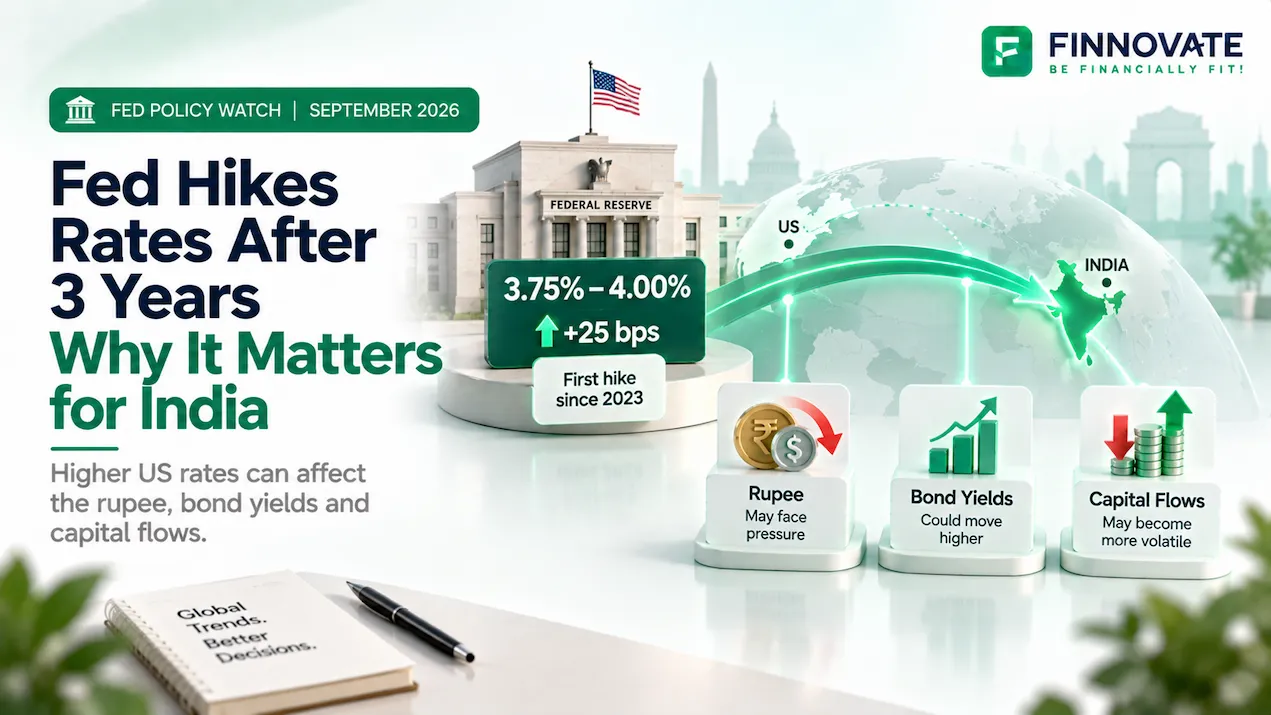
The US Federal Reserve has raised interest rates for the first time in more than three years.
At its September 15-16 meeting, the Federal Open Market Committee increased the federal funds target range by 25 basis points to 3.75%-4.00%. The decision was unanimous, with all 12 voting members supporting the increase.
That matters because the Fed had not raised rates since July 2023.
But the bigger signal is not the September hike itself.
The Fed's latest projections show that 16 of 18 policymakers expect at least one more rate increase before the end of 2026, while markets are also pricing a high probability of further tightening.
For India, the implications can show up through the dollar, rupee, bond yields, foreign flows and the RBI's own policy choices.
Table of Contents
The September decision came after a period in which US inflation remained above target while economic activity continued to hold up better than expected.
The Fed's official statement said economic activity was expanding at a solid pace, domestic spending remained resilient, productivity growth was strong and capital investment was robust. It also said inflation remained elevated.
That combination matters.
If growth had collapsed and unemployment had risen sharply, the Fed would face a much harder trade-off between inflation control and economic weakness.
Instead, the US economy has continued to show resilience.
August non-farm payrolls increased by 162,000, while the unemployment rate remained unchanged at 4.1%.
The Fed therefore had more room to focus on inflation.
The Fed's preferred inflation gauge, the Personal Consumption Expenditures index, was running at 3.7% year-on-year in July.
That is well above the central bank's 2% goal.
More importantly, the September projections suggest policymakers now expect inflation to remain elevated for longer than previously thought.
The Fed's median forecast for headline PCE inflation in 2026 is now 3.7%, while inflation is projected to return to around 2% only by 2029.
This helps explain why policymakers were willing to restart rate hikes.
Energy prices have also complicated the inflation outlook.
Brent crude has moved above $100 per barrel amid geopolitical disruptions in the Middle East. Higher energy prices can feed through to transportation, manufacturing and consumer prices.
But the Fed's concern appears broader than oil alone.
In September, the policy statement removed earlier wording that had linked elevated inflation partly to supply shocks. Fed Chair Kevin Warsh said price pressures no longer appeared confined to oil or tariffs and were becoming broader.
That distinction is important.
A temporary oil shock can sometimes be looked through if policymakers expect it to reverse.
Broader inflation across the economy is much harder to ignore.
In July, the Fed had kept rates unchanged in a 9-3 vote.
Three members had already preferred a 25-bps increase, but the majority still favoured holding rates.
By September, the decision had become unanimous.
That does not mean every policymaker has exactly the same view on how far rates should rise from here.
But it does show that the case for at least one hike had strengthened considerably across the committee.
The dot plot records each policymaker's view of the appropriate federal funds rate at the end of future years.
It is not a promise.
It is a snapshot of where policymakers currently think rates may need to go if the economy evolves broadly as expected.
The September 2026 projections show:
| Fed Projection | September 2026 View |
|---|---|
| Current target range | 3.75%-4.00% |
| Median end-2026 rate | ~4.1% |
| Median end-2027 rate | ~4.1% |
| 2026 GDP growth | 2.3% |
| 2026 unemployment rate | 4.1% |
| 2026 PCE inflation | 3.7% |
The median rate projection is consistent with a 4.00%-4.25% target range by year-end.
And the distribution matters even more.
Only two expect rates to remain where they are now.
That makes a one-and-done September hike less consistent with the current official projections.
That remains uncertain.
As of September 17, futures markets were assigning roughly a 50% probability to another 25-bps hike at the October meeting.
Goldman Sachs also revised its forecast after the September decision and now expects another 25-bps increase in October.
But market probabilities can change quickly with every inflation, employment and growth release.
The more durable signal is the year-end expectation.
Fed funds futures imply around a 90% probability of at least one more hike by the end of 2026.
There is one area that can easily create confusion.
At the same time as raising interest rates, the Fed has said it will continue maintaining ample reserves in the banking system.
Its implementation note allows the New York Fed to purchase Treasury bills and short-dated securities when necessary to maintain an ample level of reserves. Treasury principal payments will also continue to be rolled over, while principal from agency securities will be reinvested into Treasury bills.
At first glance, that can look contradictory.
Why would the Fed raise rates while also buying securities?
Because these actions serve different purposes.
The federal funds rate determines the overall stance of monetary policy. Raising it makes borrowing more expensive and is intended to reduce inflation pressure.
Purchases used to maintain ample reserves ensure that the banking system has enough liquidity for short-term interest rates to function smoothly.
That is operational liquidity management, not necessarily a return to monetary stimulus.
So the Fed can tighten policy through higher rates while still ensuring that the financial system has sufficient reserves.
The September hike had been increasingly expected in the days before the meeting.
The bigger market reaction came from the Fed's signal that more tightening could follow.
The US dollar strengthened, while the yield on the 2-year US Treasury rose to its highest level in more than two years. Longer-dated Treasury yields were relatively steadier, which flattened the yield curve.
That difference between short- and long-term yields is useful.
A Fed hike does not mean every bond yield must rise by exactly the same amount.
Short-term yields are closely linked to expectations for the policy rate.
Longer-term yields also reflect expectations about future inflation, growth and where rates may eventually settle.
If investors believe tighter policy will eventually bring inflation under control, long-term yields can react differently from shorter maturities.
India does not need to match every Fed move.
But US interest rates influence global capital flows, currencies and bond markets.
The September decision therefore reaches India through several channels.
After the Fed decision, the US dollar index moved to its highest level in more than a month.
The Indian rupee had closed around ₹95.96 per dollar, with traders watching whether it could move beyond the ₹96 level.
For India, oil makes this relationship even more important.
Crude prices are already above $100 per barrel. A weaker rupee means India may have to pay more rupees for every dollar of imported oil even if the global oil price itself does not rise further.
That can worsen inflation pressure.
US Treasury yields influence global fixed-income markets.
When US bonds offer higher returns, investors may demand a greater yield premium from emerging-market bonds as well.
India's own 10-year government bond yield has already moved back towards 7.1%.
The Fed's hawkish signal can therefore add another external source of pressure to domestic yields, alongside India's own inflation, oil prices and RBI liquidity tightening.
No.
The RBI does not mechanically follow the Federal Reserve.
Its monetary-policy decisions depend primarily on Indian inflation and growth.
However, the Fed can make the RBI's job more difficult.
India's August CPI inflation has risen to 4.82%, with food inflation at 5.95%. At the same time, high oil prices and rupee weakness add further inflation risk.
A higher US policy rate can strengthen the dollar and tighten global financial conditions.
That means the RBI has to consider:
Higher US rates increase the return available on relatively low-risk dollar assets.
That raises the hurdle for foreign investors considering emerging-market assets.
For Indian equities, investors will compare expected returns with:
For Indian bonds, higher domestic yields can still be attractive.
But an overseas investor ultimately cares about returns after accounting for currency movement and hedging costs.
So higher Fed rates do not automatically mean FPIs will leave India.
They simply make the relative-return calculation more demanding.
Higher global interest rates also affect how equities are valued.
US Treasury yields form an important global benchmark for the risk-free rate.
When that benchmark rises, investors may demand higher returns before taking equity risk.
That can increase discount rates and put pressure on expensive valuations.
The immediate Indian market reaction after the Fed hike, however, was relatively contained.
This is another reminder that the September hike itself was largely anticipated.
The Fed and RBI are facing inflation at the same time that crude oil is above $100.
But the impact is different.
The US is a major oil producer.
India is a major oil importer.
For India, high crude prices can simultaneously affect:
Fuel and transportation costs can filter into the prices of other goods and services.
A higher oil-import bill increases the amount India must spend on imports.
Oil importers need dollars to pay for crude, increasing dollar demand and potentially putting additional pressure on the rupee.
If oil pushes inflation higher, expectations of tighter RBI policy can increase.
That is why the combination of high Fed rates and expensive crude matters more for India than the Fed hike viewed in isolation.
Central banks normally tighten policy when they believe demand is strong enough to sustain inflation.
The September projections reflect exactly that tension.
The Fed raised its 2026 GDP growth forecast to 2.3%, while keeping its unemployment projection at 4.1%. At the same time, it raised its inflation forecast to 3.7%.
That is a combination that gives the Fed more room to tighten policy.
If growth weakens sharply later, that calculation can change.
But as of September, policymakers appear more concerned about inflation remaining too high for too long.
The September Fed decision is only one part of the story.
The next few months will depend heavily on incoming data.
The most important indicators are:
A meaningful fall in US inflation or oil could reduce the need for further tightening.
Persistent inflation could keep both US and Indian yields elevated.
The Federal Reserve's first rate hike in three years is important.
But the bigger change is what it says about the policy debate.
The question earlier in 2026 was whether rates needed to rise again at all.
After September, the question has shifted towards how much more tightening may be required to bring inflation back towards 2%.
The official projections currently point to at least one more increase this year for most policymakers.
For India, the consequences will depend less on the September hike alone and more on what happens next to the dollar, oil, US yields and domestic inflation.
The combination matters.
That is the transmission Indian investors need to watch.
The Fed raised the federal funds target range by 25 basis points to 3.75%-4.00% at its September 15-16 meeting. The decision was unanimous.
Yes. The September 2026 move was the Fed's first rate increase since July 2023.
The Fed has not committed to a specific future move. However, 16 of 18 policymakers currently project at least one additional hike before the end of 2026, while futures markets are also assigning a high probability to further tightening.
It could, but it is not certain. As of September 17, futures markets were pricing roughly a 50% probability of another hike at the October meeting.
Higher US rates can make dollar assets more attractive and strengthen the dollar. This can put pressure on emerging-market currencies such as the rupee, particularly when India is also facing high oil-import costs.
No. The RBI sets policy based primarily on India's own inflation and growth conditions. However, higher US rates can influence the rupee, capital flows and global financial conditions, which the RBI also monitors.
Higher US rates can raise global discount rates, strengthen the dollar and make lower-risk US assets relatively more attractive. The effect on Indian equities also depends on domestic earnings, valuations, oil prices, the rupee and FPI flows.
Disclaimer: This article is for educational and informational purposes only. It should not be treated as investment advice or as a prediction of future Federal Reserve or RBI policy. Interest rates, currencies, bond yields and financial markets can change rapidly based on economic data and policy developments.
No spam. Only new posts, simple explainers, and practical money checklists for busy professionals.
Finnovate is a SEBI-registered financial planning firm that helps professionals bring structure and purpose to their money. Over 3,500+ families have trusted our disciplined process to plan their goals - safely, surely, and swiftly.
Our team constantly tracks market trends, policy changes, and investment opportunities like the ones featured in this Weekly Capsule - to help you make informed, confident financial decisions.
Learn more about our approach and how we work with you:
No comments yet. Start the conversation. What would you add?
No spam. Only new posts, simple explainers, and practical money checklists.
You may also like
India’s 10-year bond yield is near 7.1%. Understand why yields are rising and what it me...
India’s BRICS trade reached $417.5 billion in FY2026, but the deficit widened to $226.1 ...

India’s electric two-wheeler share stayed above 10% in August 2026. See what is driving ...

India is the world’s largest sponge-iron producer, yet prices hit a 2-year high in Augus...
Popular now

Learn how to easily download your NSDL CAS Statement in PDF format with our step-by-step g...

Looking for the best financial freedom books? Here’s a handpicked 2026 reading list with...
Learn what SIF investment means in India, SEBI rules, Rs 10 lakh minimum investment, avail...

Clear guide to mutual fund taxation in India for FY 2025–26 after July 2024 changes: equ...