Migration vs Portability in Health Insurance: What Is the Difference?

Finnovate’s editorial team researches and creates financial content using trusted sources, regulatory references and inputs from subject experts.
If your health insurance policy no longer suits you, you do not always have to start again with a completely fresh history.
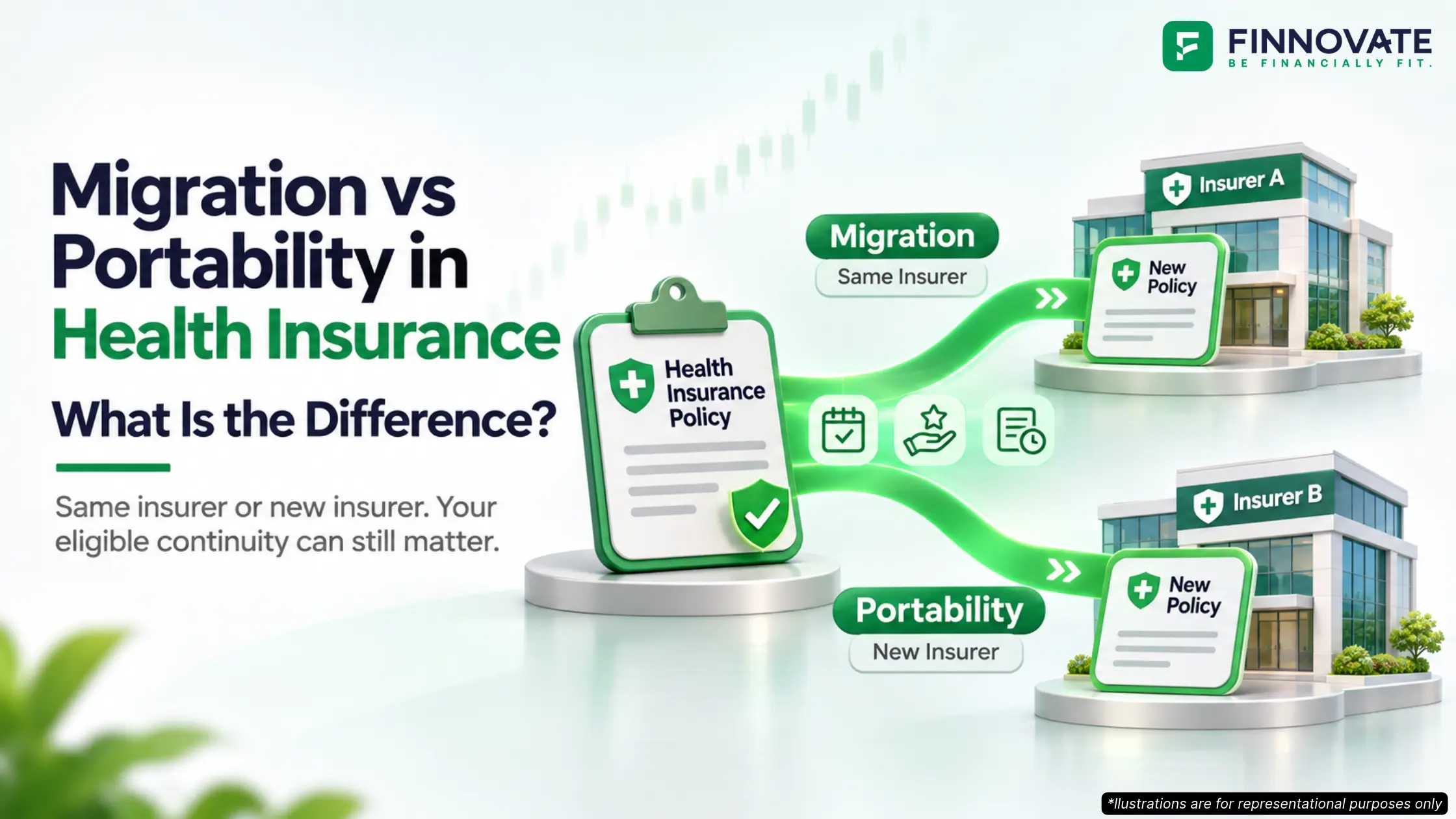
Migration is when you move to another health insurance product with the same insurer. Portability is when you move to a policy offered by another insurer.
In both cases, eligible continuity credits you have already built can travel with you. The important part is to separate those continuity benefits from the terms of the new policy you are moving into.
Migration vs Portability: A Comparison
| Point | Migration | Portability |
|---|---|---|
| Insurer | Stays the same | Changes |
| Policy / product | You move to another product with the same insurer | You move to a product offered by the new insurer |
| Continuity credits | Eligible credits can carry | Eligible credits can carry |
| Premium | Can change | Can change |
| New policy terms | Apply | Apply |
| Underwriting | The insurer may underwrite where continuous cover is below 36 months. Higher cover may also involve underwriting for the increased portion. | The acquiring insurer evaluates the proposal under its board-approved underwriting policy. |
| Timing | Generally around renewal | At renewal, normally within the prescribed portability window |
What Is Migration in Health Insurance?
Migration means changing the health insurance product while staying with the same insurer.
Suppose you have a ₹10 lakh health insurance policy with Insurer A. Over time, the insurer launches another product with a different room category, restoration structure or benefit design that fits your current needs better.
If you move to that product while continuing with Insurer A, you are migrating.
Migration can come up when:
- your existing product is being withdrawn;
- the same insurer has another product that suits your current requirements better;
- your family structure or cover requirement has changed;
- you are comfortable with the insurer but want a different policy structure.
Your eligible continuity history can be recognised in the new product. At the same time, the new product brings its own premium, limits and benefit structure.
Under the current framework, the insurer may underwrite a migration proposal where the insured person has not been continuously covered for 36 months. An increase in sum insured can also lead to underwriting of the increased portion.
What Is Portability in Health Insurance?
Portability takes the change one step further. You move from your existing insurer to another insurer.
For example, suppose you have ₹10 lakh of cover with Insurer A. At renewal, you find that a policy offered by Insurer B is a better fit for the hospitals you use, the policy structure you want and the premium you are willing to pay.
You apply to Insurer B for portability.
If accepted, Insurer B issues its own policy while recognising eligible continuity credits from your previous cover.
The acquiring insurer still assesses the application under its underwriting policy. Your existing policy gives you continuity history, while acceptance into the new product remains subject to the acquiring insurer's assessment.
What Continuity Benefits Can Carry Forward?
This is where migration and portability become valuable.
Eligible continuity credits can include:
- the existing sum insured, to the applicable extent;
- pre-existing disease waiting-period credit;
- specified disease or treatment waiting-period credit;
- No Claim Bonus and other eligible accrued credits;
- time already completed toward the 60-month moratorium.
A 36-month waiting-period example
Suppose your policy has a 36-month waiting period for a pre-existing disease.
You have already completed 30 months of eligible continuous cover.
If you migrate or port with the applicable continuity credit, those 30 months remain relevant. For the eligible existing cover, you are not treated like someone who bought health insurance for the first time that day.
You would still check the issued policy to see exactly how the receiving insurer has recorded that credit.
A 60-month moratorium example
Now assume you have completed 48 months of eligible continuous health insurance.
You switch through migration or portability.
Where the continuity is recognised, those 48 months can count toward the current 60-month moratorium for the eligible existing cover.
So the insurer change itself does not wipe out four years of eligible continuity history.
What happens to No Claim Bonus?
NCB is also part of the continuity framework where applicable.
But its form can change. Your old product may have increased the sum insured for claim-free years, while the receiving product may structure its NCB differently.
Before switching, ask what NCB credit is being recognised and how it will appear in the new policy.
What Changes After Migration or Portability?
This is where many policy comparisons go wrong.
A policyholder may focus heavily on retaining the PED waiting-period credit and forget that several other parts of the cover are being replaced.
The receiving product can have different:
- premium;
- room eligibility;
- co-payment;
- deductible;
- disease or procedure sub-limits;
- restoration rules;
- hospital network;
- add-ons;
- exclusions;
- claim process;
- No Claim Bonus structure.
Take room rent as an example.
Your current policy may allow any eligible room category. The new policy may restrict you to a single private room or another defined category.
Your waiting-period history may carry correctly, while the new room rule still changes how the policy works during a future claim.
What Happens if You Increase the Sum Insured?
Increasing cover while switching is where the continuity calculation becomes more interesting.
₹10 lakh
₹20 lakh
You already have continuity history on the existing ₹10 lakh.
The additional ₹10 lakh is new cover.
Applicable waiting periods can start afresh on that enhanced portion. The 60-month moratorium also runs separately for the enhanced limits.
So if you have held ₹10 lakh of cover for four years and port to ₹20 lakh, the policy should not be read as though the entire ₹20 lakh has four years of history.
- the amount carrying continuity;
- the enhanced amount;
- waiting-period treatment on the enhanced portion;
- moratorium credit on the existing portion.
When and How Should You Port Health Insurance?
Portability is normally done at renewal.
- Apply at least 30 days before the renewal date.
- Apply no earlier than 60 days before the renewal date.
A request made within 15 days of renewal can still be considered by the acquiring insurer. That is discretionary, so leaving the request until the final days adds unnecessary uncertainty.
If such a late proposal is accepted, the acquiring insurer must ensure that there is no break in the policy.
You may still come across older articles referring to a 45-day portability rule. Current policy wordings aligned to the newer framework use the 30-to-60-day window.
What happens after you apply?
Choose the policy you want to move into and submit the portability proposal within the applicable renewal window.
Relevant policy and claim information is exchanged through the prescribed portability process, including the Insurance Information Bureau of India, or IIB, system.
The existing insurer is required to provide the requested information within 72 hours of receiving the request.
After receiving the required information, the acquiring insurer is required to decide and communicate on the proposal within 5 days.
If accepted, check the members covered, sum insured, waiting-period credits, moratorium credit, NCB treatment and any enhanced cover.
There is no separate charge merely for porting in or porting out. The new policy itself can still have a different premium.
When Should You Request Migration?
Migration is also generally handled around renewal.
Current policy documents commonly ask policyholders to request migration at least 30 days before the renewal date. Check the process given by your insurer because migration does not have the same detailed 30-to-60-day universal window used for portability.
There is another situation where migration often comes up: product withdrawal.
If an insurer withdraws an existing health insurance product, customers may be offered the option to move to another suitable product with continuity benefits carried under the applicable rules.
When Might Migration or Portability Make Sense?
- you are comfortable with your existing insurer;
- another product from the same insurer fits your needs better;
- your family or cover requirements have changed;
- your current product is being withdrawn;
- the policy is the issue, rather than the insurer.
- you want to move away from the existing insurer;
- another insurer offers a more suitable policy structure;
- your preferred hospital network matters to the decision;
- your servicing experience has been poor;
- you want to reconsider the insurer, premium and policy terms together.
If the insurer relationship is fine but the policy is no longer suitable, migration is the more natural route to examine.
If the insurer itself is part of what you want to change, portability becomes the relevant route.
In either case, the first-year premium should not make the decision on its own.
A policy that saves ₹3,000 a year but introduces a 20% co-payment could cost far more during a large claim. On an admissible ₹3 lakh claim, a 20% co-payment alone would mean ₹60,000 from your pocket.
A Checklist Before Migrating or Porting
- PED waiting-period credit
- Specified waiting-period credit
- No Claim Bonus
- Moratorium period
- Room eligibility
- Co-pay and deductible
- Sub-limits
- Restoration
- Exclusions
- Hospital network
- Premium
- Claim process
- Relevant add-ons
- Written acceptance
- Members covered
- Issued sum insured
- Continuity shown in policy documents
For a wider comparison of the new policy itself, read 12 Things to Check Before Buying Health Insurance in India .
Migration vs Portability: Which Is Better?
Neither route is automatically better.
Migration is useful when the insurer still works for you but the current product does not.
Portability is relevant when you want to change the insurer as well as the policy.
Before choosing either route, separate the decision into two parts.
What terms am I accepting under the new policy?
A switch only works in your favour when both answers make sense together.
Final Takeaway
Migration and portability let you change health insurance while retaining eligible continuity you have already built.
Migration keeps the insurer and changes the product.
Portability changes the insurer and moves you into a policy offered by the new insurer.
The years already spent completing waiting periods and building moratorium history can be valuable. So can the features of the policy you are moving into.
Check both before you switch.
FAQs
1. Does the PED Waiting Period Restart After Health Insurance Portability?
Eligible waiting-period credit from previous continuous coverage can be recognised when portability is completed under the applicable rules. For example, if you have already completed 30 months of a 36-month PED waiting period, those completed months can be relevant for the eligible existing cover after portability. Higher cover can have separate waiting-period treatment for the increased portion.
2. Can I Port My Health Insurance Policy at Any Time?
Portability is normally done at renewal. The standard window is at least 30 days before renewal and no earlier than 60 days before the renewal date. A request made within 15 days of renewal can still be considered by the acquiring insurer, but acceptance of such a late request is discretionary.
3. Can the New Insurer Reject My Portability Request?
Yes. The acquiring insurer evaluates the portability proposal under its board-approved underwriting policy. Existing continuity gives you credit for eligible prior coverage, while acceptance into the new policy remains subject to the insurer's underwriting decision.
4. Can I Increase the Sum Insured While Porting?
Yes, subject to the new insurer's product and underwriting rules. If you move from ₹10 lakh to ₹20 lakh, eligible continuity can apply to the existing ₹10 lakh, while applicable waiting periods can start afresh for the additional ₹10 lakh. The enhanced portion also has a separate moratorium period.
5. Does the 60-Month Moratorium Continue After Migration or Portability?
Eligible continuity from previous health insurance can count toward the 60-month moratorium for the existing eligible cover. So if 48 months have already been completed and the continuity is recognised, those months remain relevant after the move. An increase in sum insured has a separate moratorium period for the enhanced portion.
6. Can a Family Floater Be Ported to Another Insurer?
Yes. Under the standard portability process, the request is made for the policy along with the covered family members, subject to the acquiring insurer's product and underwriting rules.
7. Is There a Fee for Health Insurance Portability?
No separate charge should be levied merely for porting in or porting out. The premium charged for the new health insurance policy can still be different.