Yes Bank's AT-1 Bonds Are Back. Who Pays?

Finnovate’s editorial team researches and creates financial content using trusted sources, regulatory references and inputs from subject experts.
In March 2020, ₹8,415 crore of Yes Bank bonds went to zero overnight.
On October 15, 2026, the Supreme Court said that should not have happened.
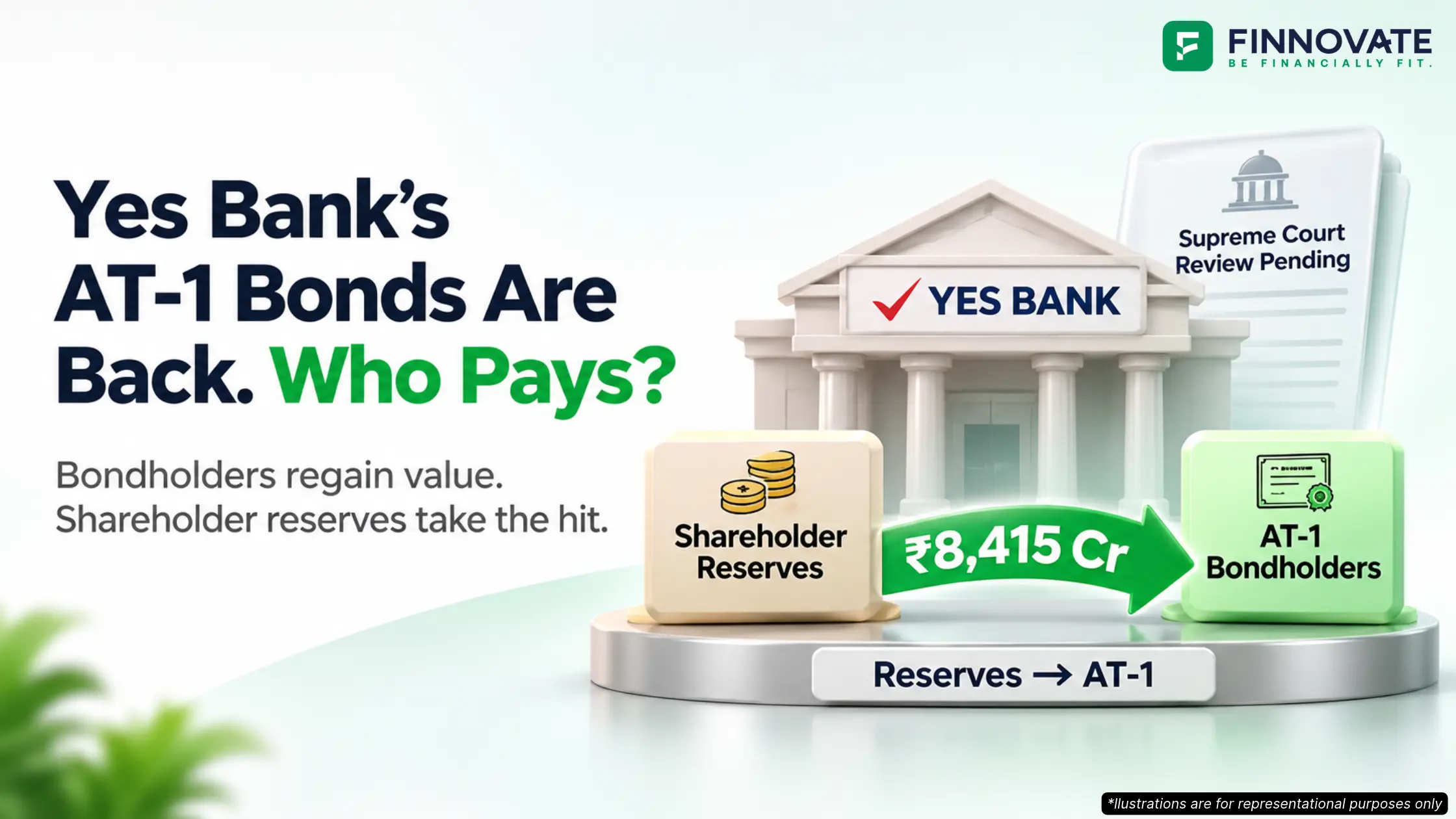
So the money goes back to the bondholders. But nobody is writing a cheque. The bonds will not be repaid in cash. Instead, ₹8,415 crore moves out of the bank's reserves, which belong to its shareholders, and back to the people who held the bonds.
That is only half the story. Yes Bank, the RBI and the Centre have all asked the court to review its ruling, so restoration is on hold until the court decides. And the RBI's concern is bigger than one bank: it is about how the next bank rescue will work.
What AT-1 Bonds Are Designed to Do
AT-1 (Additional Tier-1) bonds came out of the Basel III rules written after the 2008 financial crisis, which the RBI adopted through its Master Circular. They have no maturity date and pay a higher coupon than ordinary bank bonds. In exchange, they are built to absorb losses when a bank fails, through a write-down or conversion into shares. They rank below depositors and Tier 2 bondholders.
Yes Bank raised its AT-1 money in two tranches: ₹3,000 crore in December 2016 and ₹5,415 crore in October 2017.
By March 2020, the bank was in deep trouble. The Supreme Court noted that Yes Bank's core capital (CET1) ratio had fallen to 0.6%, against a requirement of 7.375%.
So the case was never about whether AT-1 bonds can be written down. The court accepted that they can. Its question was whether this particular write-down followed the procedure, timing and authority set out in the RBI's rules and the bond terms.
What the Supreme Court Decided
| Date | What happened |
|---|---|
| March 5, 2020 | Centre places Yes Bank under a moratorium |
| March 6, 2020 | Draft rescue scheme published, including a clause to write down the AT-1 bonds |
| March 13, 2020 | Final scheme notified without that clause |
| March 14, 2020 | Yes Bank's administrator writes down the bonds |
| January 20, 2023 | Bombay High Court sets aside the write-down |
| October 15, 2026 | Supreme Court dismisses appeals by Yes Bank, the RBI and the Centre |
Scroll horizontally to view the full table.
The bench of Justices Dipankar Datta and Augustine George Masih gave three reasons:
- The clause was dropped deliberately. The write-down clause was in the draft scheme but not in the final one. The court read this as the Centre choosing to leave the bonds untouched.
- The timing was wrong. The RBI's rules require AT-1 bonds to be written down "before amalgamation / reconstitution". The court held that "before" means before the scheme takes effect, not at any point during a reconstruction that ran for years.
- The wrong person acted. Once a bank reaches the point of non-viability, the decision to write down belongs to the RBI. The administrator stood in for the bank's board and, in the court's words, "could not have assumed the regulatory role of the RBI".
The court also said the bonds' annual coupons "shall remain unaffected" and must be paid under the bond terms.
Who Pays: Yes Bank's Shareholders
When the bonds were written off in 2020, the ₹8,415 crore Yes Bank owed bondholders became part of its own reserves. Restoring the bonds reverses that entry. The bank's CFO described it as "a balance sheet restatement from reserves to borrowings", with "no repayment and no cash outflow".
No money leaves the bank, but ownership of that capital changes hands. Yes Bank's own filing for the September 2026 quarter shows what that looks like.
| Measure (September 2026 quarter) | As reported | Pro forma, bonds restored |
|---|---|---|
| Net profit / loss for the quarter | Profit of ₹1,080 crore | Loss of ₹5,217 crore |
| Borrowings | ₹77,734 crore | ₹86,149 crore |
| Core capital (CET1) ratio | 13.7% | About 11.4% |
| Total capital adequacy ratio | 14.5% | 14.5% |
Scroll horizontally to view the full table.
The pro forma loss has not been booked. Yes Bank has said no impact from the judgment is recognised in its reported results while its assessment continues.
Total capital stays the same because AT-1 bonds count as regulatory capital too. What changes is who owns it.
The bank does not lose ₹8,415 crore. Its shareholders do, and its bondholders get it back.
Yes Bank shares closed 14.43% lower on October 15, 2026, at ₹18.15. On capital, the CFO called a CET1 ratio of 11% to 11.5% "not ideal", but said there was "no gun to our head" to raise capital immediately.
Bondholders had made the same point from the other side in court. They argued that the write-off reversed the normal order of losses: shareholders kept some value, while AT-1 bondholders, who rank above them, lost everything.
Who Pays: The Way Banks Are Rescued
The RBI's concern goes beyond Yes Bank. In its review petition, the RBI argued that the Supreme Court did not adequately consider its Basel III Master Circular. It said overturning the write-down could weaken the role of AT-1 bonds as "loss-absorbing capital instruments" and affect the banking system's resolution framework.
The appellants had raised that concern before the judgment as well, warning of a "financial avalanche". The bench declined to weigh developments after March 2020 and judged the administrator's action on the facts as they stood at the time.
A similar dispute is running in Switzerland. In March 2023, during UBS's takeover of Credit Suisse, the Swiss regulator FINMA ordered Credit Suisse to write off AT-1 bonds with a face value of about CHF 16 billion. In October 2025, Switzerland's Federal Administrative Court found that the write-off lacked a legal basis and revoked FINMA's order in a partial decision. FINMA has appealed to the Federal Supreme Court.
Both cases turn on the same point. Neither court denied that a regulator can write down AT-1 bonds; both questioned the legal basis on which it was done. For future rescues, the Yes Bank judgment is about process: who orders the write-down, under which document, and at what point.
The Mis-Selling Question
AT-1 bonds were never meant for ordinary savers. Yet, according to SEBI data placed before the Supreme Court, 1,346 retail investors had put about ₹679 crore into Yes Bank's AT-1 bonds. Several individual bondholders were also the bank's depositors.
The Supreme Court criticised Yes Bank for selling the bonds directly to individuals despite their high-risk nature, citing a December 2016 email from a Chennai relationship manager pitching them to individual customers. In 2022, SEBI penalised the bank's former chief executive for the sale of these bonds to retail investors.
The rules changed after the episode. Since an October 2020 SEBI circular, only qualified institutional buyers can take part in new AT-1 issues, and the minimum allotment and trading lot are both ₹1 crore.
What Happens Next
- November 6, 2026: Axis Trustee Services, the bondholders' trustee, filed a contempt petition in the Supreme Court. It said it had not received "any concrete roadmap" from Yes Bank on restoring the bonds.
- November 13, 2026: the RBI and Yes Bank filed separate review petitions.
- November 17, 2026: the Centre filed its own review petition.
A review petition is not a second appeal. Under Article 137 of the Constitution, the Supreme Court can review its own judgment only on limited grounds, such as an error apparent on the face of the record. The RBI has asked for an open-court hearing and a stay.
As of November 20, 2026, the Centre's petition had not been numbered or listed for hearing. Until the review petitions and the contempt proceedings are decided, restoration of the bonds and the question of coupons remain on hold.
What This Means for Investors
For bank shareholders, the case shows that a court ruling can move a bank's capital ratios as sharply as a bad quarter. A liability written off in 2020 came back onto Yes Bank's balance sheet with a single judgment.
For holders of AT-1 bonds, directly or through funds, the ruling does not make the instrument any safer. It confirms that AT-1 bonds can be written down, and sets out how that must be done.
The open questions are how the court rules on the review petitions, how the bonds and their coupons are restored if the judgment stands, and how Yes Bank rebuilds its core capital. Each of those answers decides who finally carries the ₹8,415 crore.
FAQs
1. Has Yes Bank restored its AT-1 bonds?
Not yet. As of November 20, 2026, restoration, reactivation of the bonds and the assessment of coupons were pending the review petitions and the contempt proceedings.
2. Will Yes Bank pay ₹8,415 crore to bondholders in cash?
The bank's CFO said the restoration involves no repayment and no cash outflow. It is an accounting move of ₹8,415 crore from reserves to borrowings. Coupon payments are still being assessed.
3. Why does restoration reduce Yes Bank's CET1 ratio but not its total capital ratio?
AT-1 bonds count as regulatory capital. Restoring them shifts ₹8,415 crore from core equity to AT-1 capital, so the CET1 ratio falls to about 11.4% pro forma while the total capital adequacy ratio stays at 14.5%.
4. Can retail investors buy AT-1 bonds in India?
Not in new issues. Since October 2020, SEBI has allowed only qualified institutional buyers to participate in AT-1 issues, with a minimum allotment and trading lot of ₹1 crore.
5. What is a review petition?
It is a request to the Supreme Court to reconsider its own judgment. Under Article 137 of the Constitution, the court can review a judgment only on limited grounds, such as an error apparent on the face of the record.
Sources
- Business Standard: Bombay High Court order and Supreme Court appeals on Yes Bank AT-1 bonds
- Yes Bank Q2 FY27 earnings call highlights
- Investing.com: Yes Bank Q2 FY27 results presentation
- Business Standard: Individual investors in Yes Bank's AT-1 bonds, March 2020
- Business Standard: Administrator's arguments before the Supreme Court and SEBI penalty
- Business Standard: SEBI restricts retail investors from AT-1 bonds, October 2020
Disclaimer: This article is for information and education only and is not a recommendation to buy, sell or hold any security. The matter discussed is pending before the Supreme Court, and this article does not express a view on its outcome. Figures marked pro forma are the bank's own estimates and have not been booked in its results. Investments are subject to market risks.