Why Is the US Threatening India With a 25% Tariff Again?

Finnovate’s editorial team researches and creates financial content using trusted sources, regulatory references and inputs from subject experts.
In August 2025, most Indian goods faced a combined US tariff of 50%. In February 2026, a trade framework promised to bring it down to 18%. Two weeks later, the US Supreme Court struck down the legal basis for those tariffs. Then in July, a new 10% duty arrived under a different law.
On November 25, 2026, Washington added another number: up to 25%.
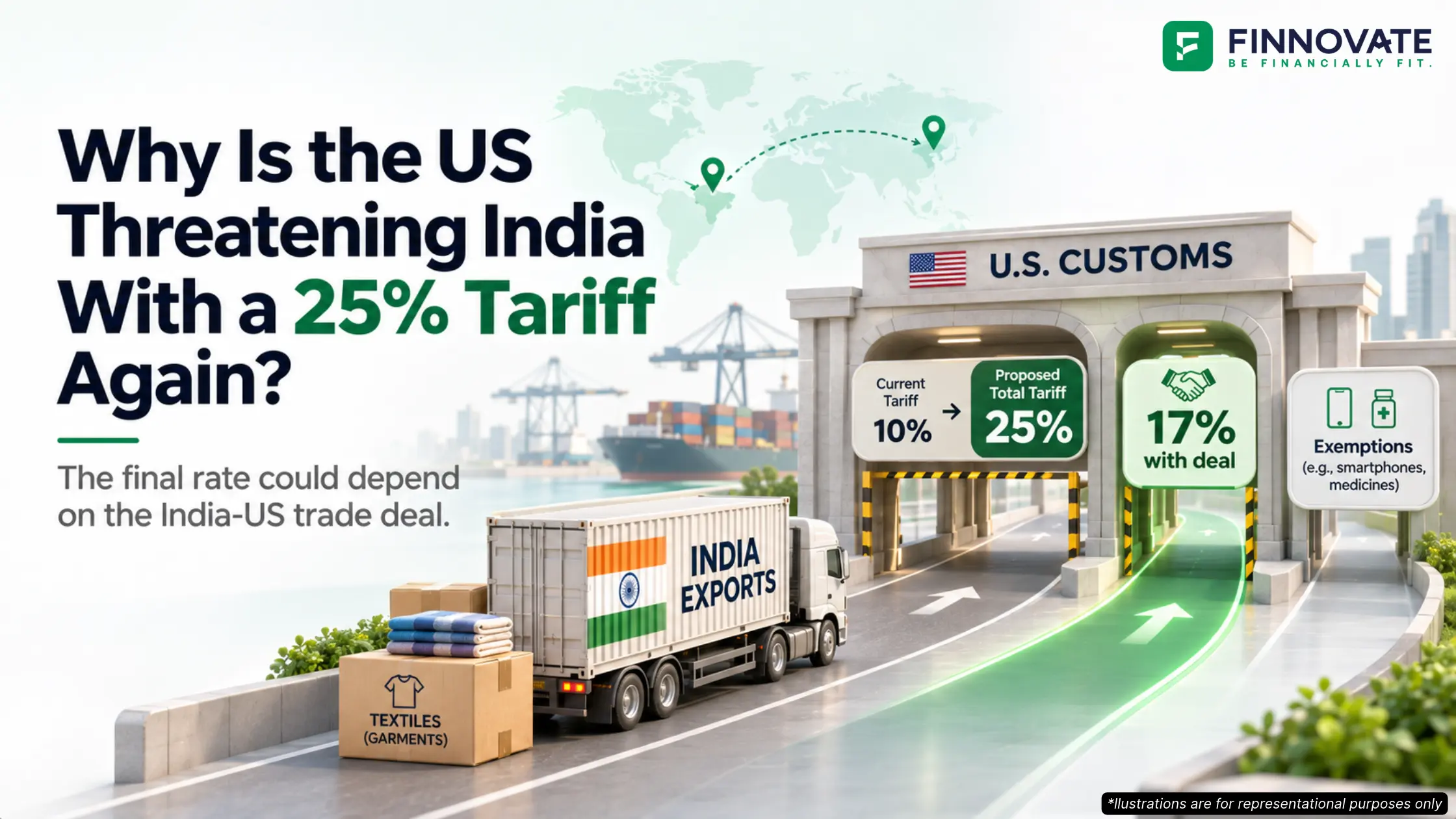
The 25% is not an additional 25%. It includes the 10% most Indian goods already pay, and a trade deal would bring it down to 17%. That makes the proposal as much a negotiating position as a tariff.
What the US Announced
The Office of the US Trade Representative (USTR) said 14 economies, including India, follow policies that create "structural excess capacity" in manufacturing. In USTR's view, these countries produce far more than their own markets need, helped by government support, and sell the surplus into the US at prices American factories struggle to match.
The investigations opened on March 11, 2026, and covered 16 economies. Mexico and Norway are not part of this round.
For India, USTR has proposed a tariff of up to 25% on all goods, with some exemptions. The rate would fall to 17% if India signs an Agreement on Reciprocal Trade that answers the US findings.
The proposed rate is "net of existing Section 301 tariffs", which means it includes the duty Indian goods already pay rather than adding to it.
The 25% Includes the Existing 10%
Since July 24, 2026, most Indian goods entering the US have paid an extra 10% under a separate Section 301 action, which is linked to rules on imports made with forced labour. According to the Commerce Ministry, about 45% of India's exports to the US, including generic medicines and smartphones, were kept out of that duty.
For a garment exporter in Tiruppur already paying the extra 10%, that layer would rise to 25% in total under the proposal, not 35%. With a trade deal, it would be 17%.
For that exporter, the real increase is up to 15 percentage points without a deal and 7 with one.
Wendy Cutler, a former acting Deputy US Trade Representative, said the decision not to combine the two investigations was the "biggest surprise" in the announcement.
US Tariffs on India Since August 2025
| Date | What happened | Extra US duty on most Indian goods |
|---|---|---|
| August 7, 2025 | "Reciprocal" tariff under US emergency powers (IEEPA) | 25% |
| August 27, 2025 | Penalty for buying Russian oil added | 50% |
| February 2 to 7, 2026 | Trade framework announced; oil penalty removed; cut to 18% promised | 25%, with 18% announced |
| February 20, 2026 | Supreme Court rules IEEPA does not allow tariffs | Emergency tariffs end |
| February 24, 2026 | Temporary global tariff under Section 122 | 10% |
| July 24, 2026 | Section 122 expires; forced-labour Section 301 tariff begins | 10%, with about 45% of exports exempt |
| November 25, 2026 | Excess-capacity proposal | Up to 25% in total, or 17% with a deal (proposed) |
Scroll horizontally to view the full table.
Section 122 duties are limited by law to 150 days. Section 301 actions have no built-in expiry date, which is why Indian textile bodies have flagged them as a longer-lasting risk.
In our piece on what the US midterm results mean for Indian markets, we noted that the US president retains significant authority under existing trade laws even with a divided Congress. Section 301 is one of those laws.
The US Case and India's Response
USTR listed five Indian practices it considers unreasonable:
- Industrial plans to expand manufacturing.
- Inadequate labour protections.
- Financial repression policies.
- Sustained barriers to market access.
- A failure to address global excess capacity, including through imports and foreign investment from non-market economies.
It named pharmaceuticals and medical devices, steel, solar and information and communication technology goods as the sectors most affected.
India disagrees. The Commerce Ministry said India "does not have structural excess capacity in any sector", that it engaged constructively throughout the investigation, and that these concerns belong in the ongoing Bilateral Trade Agreement talks.
The Global Trade Research Initiative (GTRI), a Delhi think tank, went further. It argued the proposal recreates the struck-down reciprocal tariff system under a new name.
USTR's India report points to mobile phone manufacturing as an example of policy-driven capacity expansion, yet smartphones are on the proposed exemption list.
Which Indian Exports Are Exempt and Which Are Exposed
India exported goods worth $87.31 billion to the US in FY26, about a fifth of its total goods exports. How much of that is exposed depends on what is being shipped.
Proposed to be spared:
- Smartphones. India's biggest export success in the US market: shipments nearly doubled from $10.6 billion in FY25 to $19.7 billion in FY26.
- Medicines. Patented drugs are exempt, and the annex also lists numerous pharmaceutical products, including medicines packed in measured doses or for retail sale.
- Goods under national-security tariffs. Steel, aluminium, copper, vehicles and parts, wood products and semiconductors already carry separate Section 232 duties, so they are kept out of this one.
Exposed:
- Textiles and garments. Most fabrics and garments are not on the exemption list. India's textile and apparel exports to the US are worth nearly $11 billion a year.
After the 50% tariff, India's textile and apparel exports to the US fell 28.7% in February 2026 to $630 million. In July, India was also left out of the tariff-rate quotas that allow textiles from Bangladesh, Cambodia, Indonesia and Malaysia made with US cotton to enter without the extra duty. The new notice asks for comments on allowing a set volume of textiles in at a reduced rate.
How India's Rate Compares With Its Rivals
For US buyers, India's rate matters relative to competing suppliers.
| Economy | Proposed rate | Rate with a deal |
|---|---|---|
| India | Up to 25% | 17% |
| Vietnam | Up to 35% | 20% |
| China | Up to 20% | Not specified |
| Bangladesh, Cambodia, Indonesia, Malaysia, Thailand | Up to 18% | Not specified |
| EU, Japan, South Korea, Switzerland, Taiwan | 15% (existing cap kept) | Not applicable |
Scroll horizontally to view the full table.
At 25%, India would be one of the costlier Asian sources. At 17%, it would sit just below Bangladesh and below Vietnam's deal rate. In labour-heavy, low-margin goods like apparel, one or two percentage points can decide where the next order goes.
GTRI described the 17% offer as a calculated attempt to give India only a marginal edge over rivals. The final rate is therefore tied to the outcome of the trade talks. On November 13, Commerce Minister Piyush Goyal said an announcement on the India-US trade deal was likely "quite soon", with only a few issues left to resolve.
What Happens Next
The schedule:
- January 5, 2027: written comments and requests to appear are due.
- January 25, 2027: public hearings begin.
- After the hearings: USTR can finalise the rates. No date has been set.
Nothing takes effect before the hearings, and the final numbers can differ from the proposal. The forced-labour action is a precedent: USTR proposed 12.5% for India on June 2, 2026, and settled on 10% in the final measure on July 23.
What This Means for Investors
The Nifty 50 and Sensex closed at nine-month highs on November 25, helped by record foreign inflows. In the first session after the announcement, on November 26, both indices opened higher, led by IT stocks.
The IT move reflects how the tariff is designed. It applies to goods. Services, which made up roughly half of India's total exports in FY26, are outside its scope.
For a listed company, the exposure comes down to three questions. Does it ship physical goods to the US? Is its product on the exemption list? And does it compete directly with Vietnam or Bangladesh?
Unless the final rates change, most exposed Indian exporters face a total Section 301 duty of between 17% and 25%, against the 10% in place since July 24, 2026. Where it settles depends largely on the trade talks before the January 25, 2027 hearings.
FAQs
1. Is the 25% US tariff on Indian goods already in effect?
No. It is a proposal. Public hearings begin on January 25, 2027, and nothing takes effect before then. Final rates may differ.
2. Will the 25% be added on top of the existing 10% Section 301 tariff?
No. The proposal is "net of existing Section 301 tariffs", so the 10% counts towards the 25%. For goods already paying 10%, the increase would be up to 15 percentage points, or 7 with a trade deal.
3. Are Indian smartphones and medicines affected?
Under the proposal, smartphones are exempt. So are patented medicines and numerous other pharmaceutical products listed in the annex, including medicines in measured doses or retail packs.
4. Why would a trade deal reduce the rate to 17%?
USTR has said it would consider 17% if India concludes an Agreement on Reciprocal Trade that responds to its findings. That links the tariff directly to the bilateral trade talks.
5. Does this tariff affect Indian IT services companies?
Not directly. Section 301 tariffs apply to imported goods, not to services such as software and IT outsourcing.
Sources
- USTR: Determinations in 14 Section 301 excess capacity investigations, November 25, 2026
- USTR: India report on structural excess capacity and production
- PIB: Final US Section 301 measures on forced labour, India placed in lower tariff tier at 10%
- PIB: India's foreign trade, FY 2025-26
- White House fact sheet: United States and India trade framework, February 2026
- Congressional Research Service: Legal authority for Section 301 tariffs
Disclaimer: This article is for information and education only and is not a recommendation to buy, sell or hold any security. The tariff rates discussed are proposals and may change before they are finalised. Investments are subject to market and currency risks.