Term Insurance Till Age 60, 70 or 85: How Long Should Your Cover Last?

Finnovate’s editorial team researches and creates financial content using trusted sources, regulatory references and inputs from subject experts.
You are 35 and planning to buy term insurance.
One policy can cover you till age 60. Another till 70. Another till 85.
The longest option may look safer.
But the more useful question is:
Until what age would your death still create a meaningful financial gap for your family?
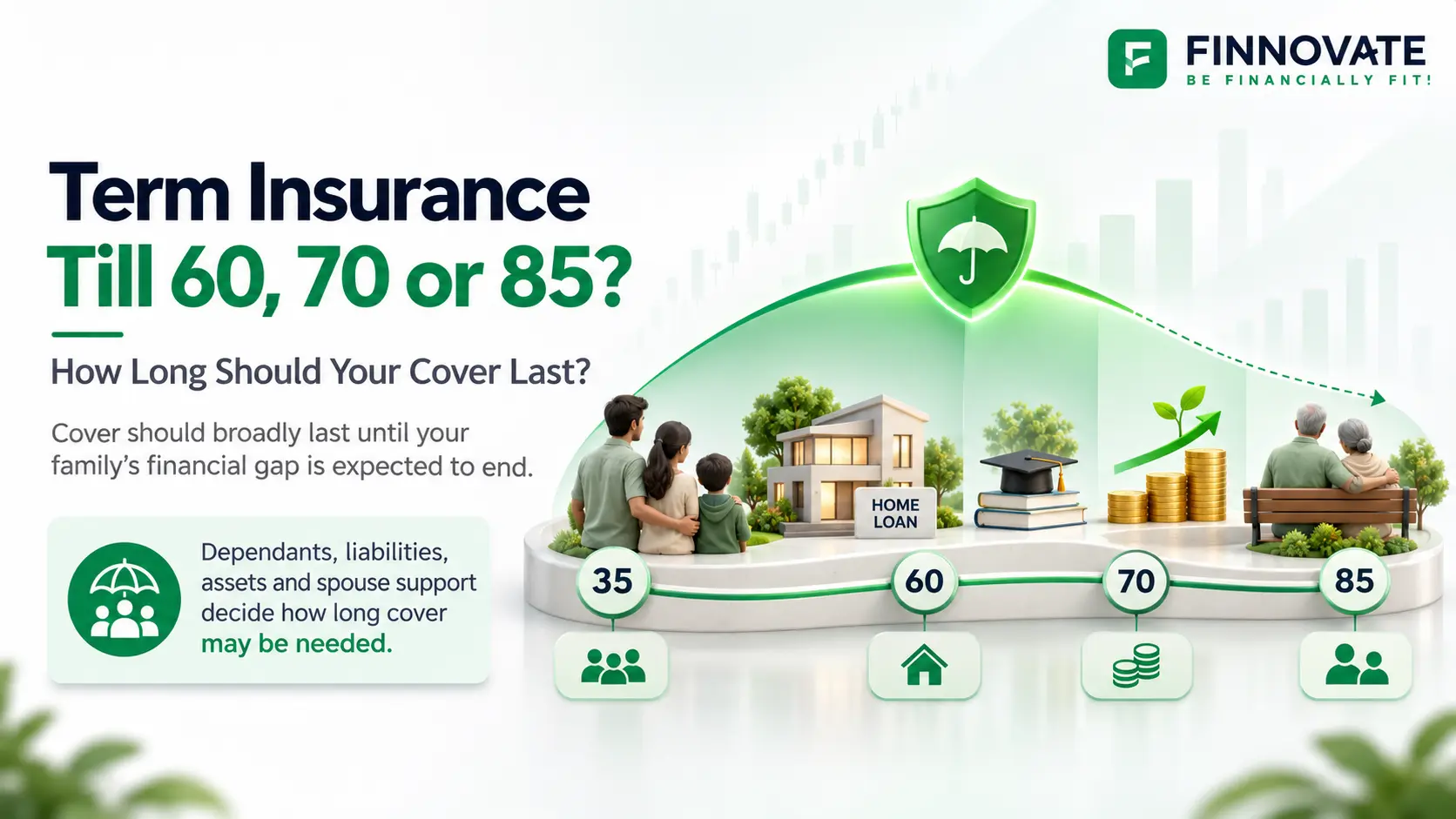
Your cover should broadly continue until the major financial gap created by your death is expected to disappear.
That depends on when your dependants become financially independent, when major liabilities are funded, what assets the family will have and whether your spouse would have enough financial resources without your future income.
What Does Term Insurance Till Age 60, 70 or 85 Mean?
The policy term is the period during which your life cover remains active.
If you buy a policy at age 30:
| Cover Till | Approximate Policy Term |
|---|---|
| Age 60 | 30 years |
| Age 70 | 40 years |
| Age 85 | 55 years |
If the insured person dies while the policy is active and the claim conditions are met, the death benefit is paid according to the policy.
If the insured survives until the end of a standard pure term plan, the cover ends and there is generally no maturity benefit.
The maturity ages available depend on the insurer and product.
Term Insurance Till 60 vs 70 vs 85
| Cover Till | More Relevant When | Main Question | Watch For |
|---|---|---|---|
| 60 | Dependants and major liabilities are expected to be financially covered around retirement | Will the family have enough assets when my employment income stops? | Ending cover too early if dependency continues |
| 70 | Financial dependency may continue through the 60s | What remains financially unfunded after 60? | Paying for extra years without a clear financial need |
| 85 | A specific long-term dependency may continue much later | What financial gap could my death at 75 or 80 still create? | Higher cost and lower real value of a fixed sum assured over time |
Ages around 60 to 65 are commonly used as reference points because they often coincide with retirement and the end of employment income.
But the insurance need can end earlier or continue later depending on the family's actual financial position.
How Your Family's Financial Dependency Can Change Over Time
The need for life cover is usually highest when several financial responsibilities exist at the same time.
For someone buying cover at 35, an illustrative timeline could look like this:
| Age Band | Financial Responsibilities That May Still Exist |
|---|---|
| 35–45 | Young children, home loan, household expenses |
| 45–55 | Higher education, remaining liabilities, dependent parents |
| 55–60 | Children approaching financial independence, retirement preparation |
| 60–70 | Spouse support, late liabilities, retirement transition |
| 70+ | Specific long-term dependencies, if any |
Every household will look different.
But the pattern matters: as liabilities fall, dependants become independent and assets grow, the financial gap that term insurance needs to fill can also reduce.
Should Term Insurance End When You Retire?
Retirement age is a useful reference point, but it should not automatically become the policy expiry age.
Consider someone reaching 60 with a spouse still dependent on their financial resources, a major liability still outstanding and retirement assets that may not yet be sufficient for the household.
Their family could still face a financial shortfall if the insured dies shortly after retirement.
Now consider someone reaching 60 with no major liabilities, financially independent children and enough retirement assets to support the surviving spouse.
Their need for a large term cover may have reduced significantly.
When Can Cover Till Age 60 Make Sense?
The main question is:
Will the family have enough financial resources when your employment income stops?
Cover till 60 can align well where, by that point:
- children are expected to be financially independent;
- major liabilities are repaid or fully funded;
- the spouse has adequate financial resources;
- retirement assets are sufficient;
- no significant long-term dependency is expected to continue.
In that situation, the main income-replacement need may broadly end around retirement.
When Can Cover Till Age 70 Make Sense?
Here the relevant question is:
What remains financially unfunded after 60?
Cover extending through the 60s can be more relevant when:
- children are expected to become financially independent later;
- the surviving spouse may still depend materially on the insured person's resources;
- major liabilities continue beyond retirement;
- retirement assets may still be insufficient at 60;
- other dependants continue to need financial support.
The reason for choosing 70 should therefore be a financial need that continues beyond retirement, rather than the age itself.
When Does Cover Till Age 85 Deserve Consideration?
Cover till 85 provides protection for many more years.
But those additional years need a financial purpose.
By age 75 or 80, many people may already have stopped earning employment income, repaid major loans, seen children become financially independent and accumulated retirement assets.
1. What financial gap would still exist if death occurred at 75 or 80?
2. Would the sum assured still be meaningful for that need after decades of inflation?
Longer cover may deserve consideration when there is a specific long-term need such as:
- a lifelong dependent child;
- a spouse expected to remain financially dependent with inadequate assets;
- a significant long-running family obligation;
- another clearly identifiable financial dependency.
Without such a gap, the additional years may add less financial value than they first appear to.
Coverage Amount and Coverage Duration Should Be Assessed Together
A very long policy term does not compensate for inadequate cover during the years when the family is most dependent on your income.
Someone with young children, a large home loan and many years of future earnings may face a much larger financial gap at 40 than at 75.
There is also an inflation issue with very long policy terms.
A fixed sum assured chosen in your 20s or 30s will not have the same purchasing power several decades later.
So stretching a policy to 80 or 85 does not automatically mean the protection remains equally meaningful throughout the entire period.
The sum assured should be adequate during the years when the financial loss from death would be highest, while the policy term should broadly cover the period during which that gap continues.
If you are evaluating both the cover amount and the policy duration, Finnovate’s Financial Planning can help you understand how these decisions fit together.
A ₹30 Lakh Loan Does Not Always Mean a ₹30 Lakh Insurance Gap
Outstanding liabilities matter, but the loan balance alone does not tell you how much financial protection the family needs.
Relevant resources can include:
- investments;
- retirement corpus;
- pension;
- rental income;
- other assets genuinely available to the family.
How Should You Assess Your Spouse's Financial Position?
Whether the spouse earns today is only one part of the decision.
A non-earning spouse may still have strong financial support through investments, pension, retirement assets or other income.
An earning spouse may still depend heavily on the insured person's income if household commitments are large.
The more relevant question is:
Would the surviving spouse have enough income and assets to meet household and retirement needs without your future earnings?
How the Answer Can Change for the Same 35-Year-Old
Suppose a 35-year-old has:
- a spouse aged 33;
- two children aged 5 and 8;
- a home loan expected to end at age 55;
- children expected to become financially independent near age 60;
- planned retirement at 60.
The insured person's age is the same in all three cases.
The family's financial position changes the answer.
Does Longer Term Insurance Cost More?
For the same person and broadly comparable cover, extending the policy term can increase the premium because life cover continues for more years.
Actual pricing also depends on factors such as:
- age at purchase;
- sum assured;
- health and medical history;
- tobacco use;
- policy design;
- premium payment term;
- underwriting.
What Happens When the Policy Expires?
Once a term policy reaches its maturity date:
- the life cover ends;
- a death occurring after expiry is outside that policy;
- a standard pure term plan generally has no maturity benefit.
Do not plan on the assumption that the existing policy can simply be extended later.
Fresh cover at a later age would depend on the products, entry-age limits and underwriting available at that time.
Four Common Mistakes When Choosing the Policy Term
1. Matching Cover Blindly to Retirement Age
Retirement and financial independence do not always happen at the same time. Check what financial responsibilities actually remain around retirement.
2. Choosing Till 85 Simply Because It Is Longer
More years of cover are useful when there is still a financial gap during those years. Duration by itself does not establish the need.
3. Stretching Duration While Compromising the Cover Amount
A long policy term cannot make up for inadequate protection during the years when the family is most dependent on your income.
4. Looking at Liabilities Without Considering Available Assets
The more relevant number is the financial shortfall that remains after considering assets genuinely available to the family.
How Should You Decide the Right Term Insurance Duration?
Once that age range is clearer, compare the policy terms available to you and the amount of cover each option allows you to maintain.
This decision also sits within the larger picture of goals, liabilities, protection and retirement assets. You can read more about Finnovate’s approach to financial planning .
Final Takeaway
The longest term is not automatically the most useful term.
The policy should cover the period when your death could still leave dependants with a meaningful financial shortfall.
Look at future dependency, unfunded liabilities, available assets, inflation and the amount of cover together before choosing the end age.
FAQs
1. Is term insurance till age 60 enough?
It can be enough if major liabilities are funded, children are financially independent and the family has adequate financial resources by that age. The answer depends on the household's expected financial position at 60.
2. Is term insurance till 70 better than till 60?
Not by default. Cover till 70 becomes more relevant when a meaningful financial dependency or unfunded obligation is expected to continue beyond 60.
3. Is term insurance till 85 worth it?
It can be relevant when a specific long-term dependency may continue into later life. Also consider whether the fixed sum assured will still be meaningful for that future need after inflation.
4. Should term insurance continue after retirement?
It can, if the surviving family would still face a meaningful financial shortfall after your death. Retirement age alone should not decide the policy expiry date.
5. What happens when a pure term plan expires?
The life cover ends at the policy maturity date. If the insured survives until then, a standard pure term plan generally does not pay a maturity benefit.
6. Can I extend my term insurance later?
Do not assume that an existing term plan can simply be extended. Any alteration depends on the product conditions. Fresh cover later would depend on age limits, product availability and underwriting at that time.
7. Is policy term the same as premium payment term?
No. Policy term is the duration of life cover. Premium payment term is the period for which premiums are payable. They can differ where the product offers limited-pay options.
8. Does longer term insurance cost more?
For the same person and broadly comparable cover, a longer policy term can increase the premium because the insurer provides cover for more years. Actual pricing depends on the product and underwriting.
9. Should my home loan decide how long my term insurance lasts?
The loan is one factor. Also consider the assets available to the family to meet it. A more useful measure is the unfunded liability rather than the loan balance alone.
10. How do I decide the right maturity age for term insurance?
Estimate when your dependants are likely to become financially independent, when major obligations will be funded and what assets the family will have by then. The policy term should broadly cover the period during which your death would still create a significant financial gap.