Critical Illness Insurance vs Health Insurance: When Does Each Pay?

Finnovate’s editorial team researches and creates financial content using trusted sources, regulatory references and inputs from subject experts.
You are diagnosed with cancer. There is surgery, treatment, medicines and time away from work.
You have health insurance and critical illness cover.
Will both pay?
Possibly. But they are not paying for the same thing.
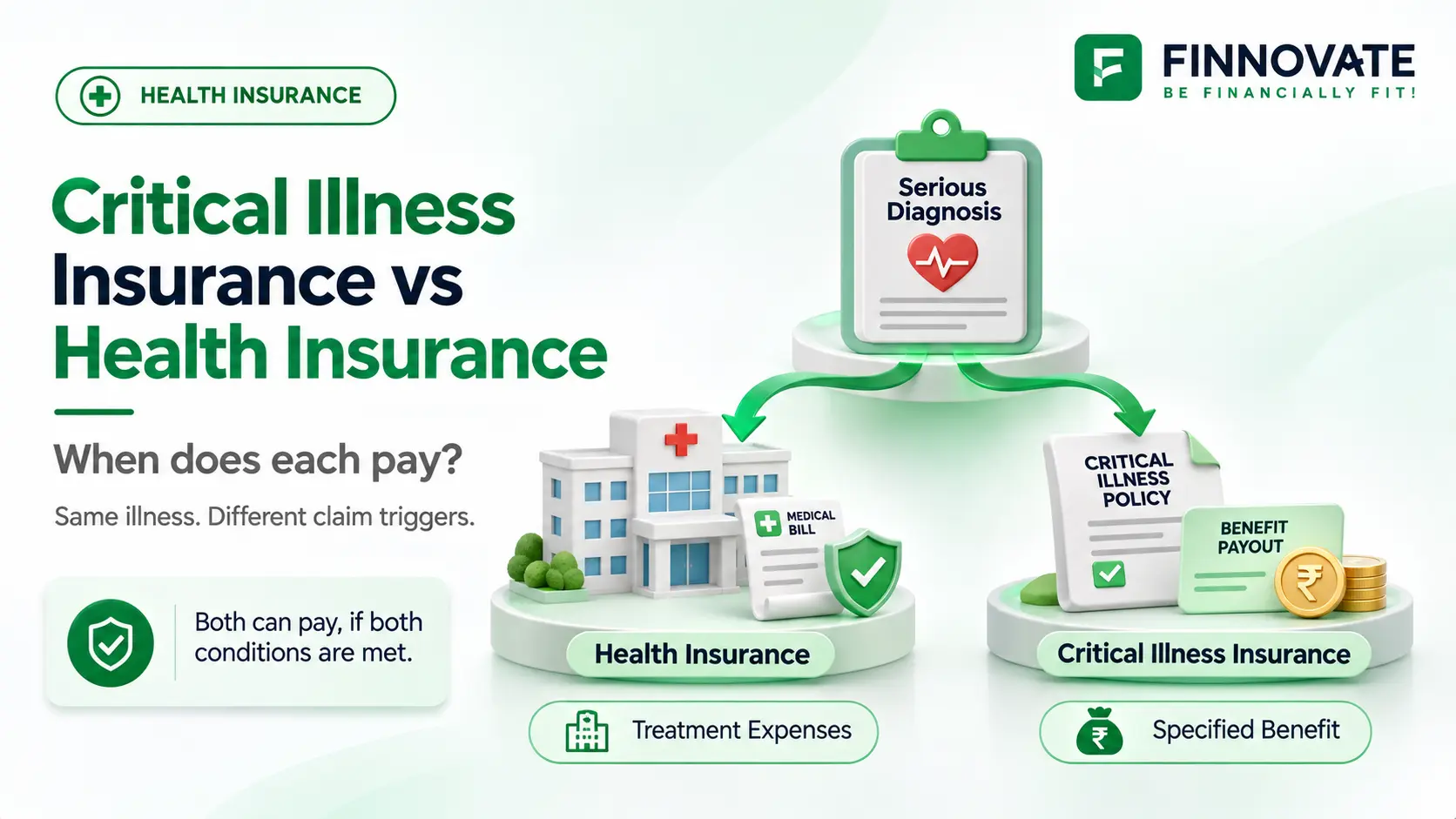
Health insurance generally pays eligible medical expenses. Critical illness cover generally pays a specified benefit when a listed illness or medical event meets the policy definition and claim conditions.
Both can pay after the same illness because their claim triggers are different.
Critical Illness Insurance vs Health Insurance: Quick Comparison
| Parameter | Medical-Expense Health Insurance | Critical Illness Cover |
|---|---|---|
| What triggers payment? | Eligible medical treatment or expense | A listed illness, procedure or medical event that meets the policy definition |
| What determines payout? | Admissible medical expenses, subject to policy conditions | Specified benefit under the policy |
| Does the hospital bill matter? | Yes, it is relevant to the admissible claim amount | Usually not for calculating the specified benefit |
| Is hospitalisation always required? | Depends on the treatment and benefit being claimed | Not always. The illness or event definition decides |
| Main financial role | Eligible treatment expenses | Cash support after a qualifying serious illness |
| Can both pay? | Yes, if its claim conditions are met | Yes, if its claim conditions are met |
Three Situations That Show When Each Policy Pays
The same illness can produce different claim outcomes because each policy is looking for a different trigger.
These are illustrations. The actual claim is assessed against the policy wording, not simply the illness name.
When Does Health Insurance Pay?
Medical-expense health insurance generally pays when an insured person receives covered treatment for an illness or injury and the resulting expenses are admissible under the policy.
Depending on the product, this can include hospitalisation, eligible day-care procedures, pre-hospitalisation and post-hospitalisation expenses, and other specifically covered treatments.
The admissible claim can still be lower than the hospital bill because of co-pay, deductibles, room-rent conditions, sub-limits, exclusions, waiting periods or non-admissible expenses.
So a ₹5 lakh hospital bill does not automatically mean the insurer will pay ₹5 lakh.
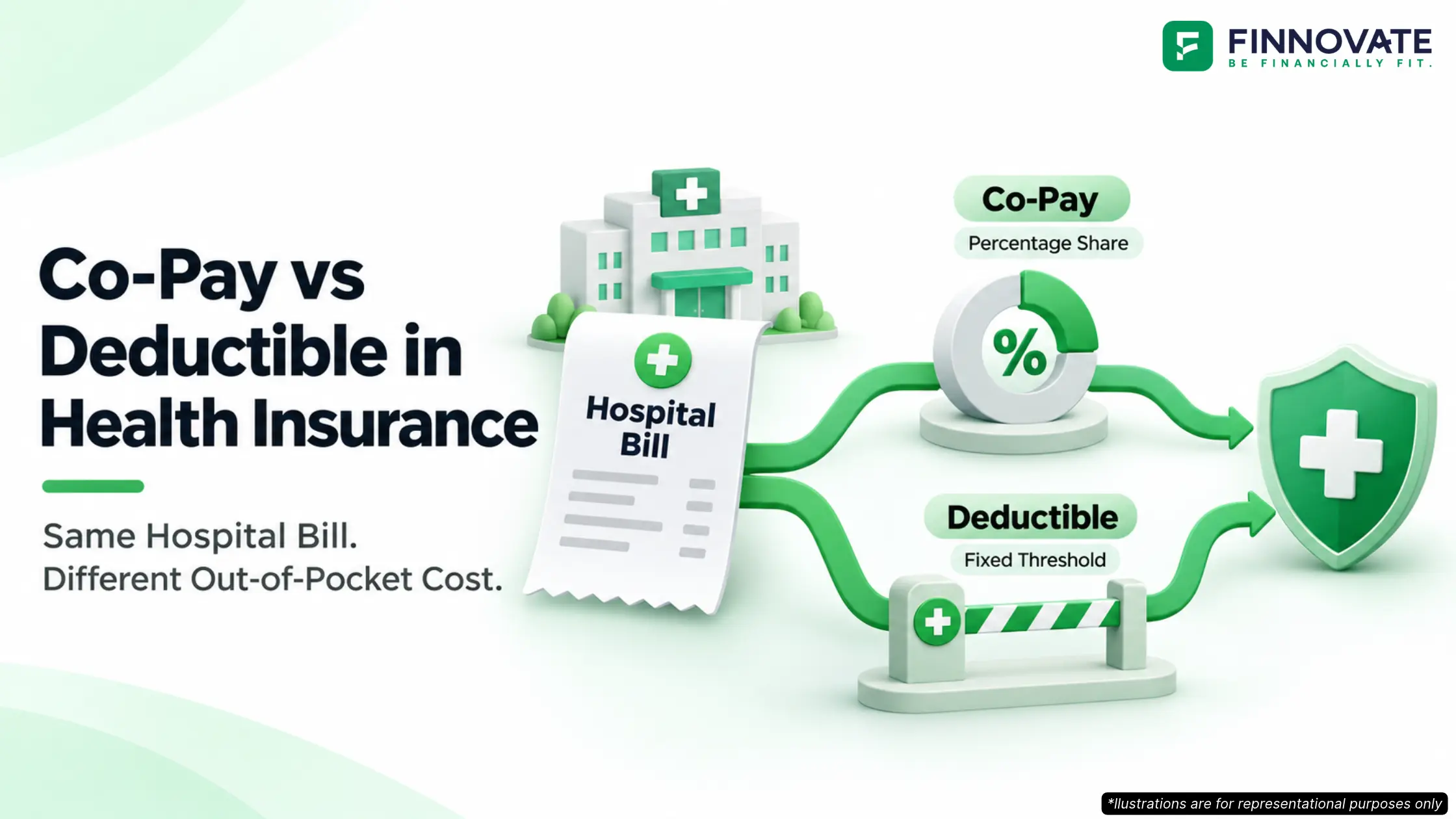
If you want to see how two common cost-sharing clauses change what you pay yourself, read our guide to co-pay vs deductible in health insurance .
When Does Critical Illness Insurance Pay?
Critical illness cover generally pays when three things line up.
1. The illness or medical event is covered
The policy must list the illness, procedure or medical event being claimed.
Depending on the product, this may include conditions such as cancer of specified severity, first heart attack of specified severity, stroke resulting in permanent symptoms, kidney failure requiring regular dialysis or major organ transplant.
2. The diagnosis meets the exact policy definition
A diagnosis carrying the name of a listed illness does not automatically qualify.
A policy may cover cancer of specified severity, for example, and define the severity, clinical findings and medical evidence required before the benefit becomes payable.
The same issue can arise with heart attack, stroke and other listed illnesses. The condition has to meet the definition in the policy being claimed under.
3. The other claim conditions are satisfied
These can include waiting periods, a survival period where applicable, exclusions, medical documentation, specialist confirmation and other conditions stated in the policy.
Does critical illness cover require hospitalisation?
Not always. The trigger is the illness, medical event or procedure described in the policy. Some definitions require surgery or specific clinical findings, while others focus on diagnosis and severity.
Waiting Period vs Survival Period: What Is the Difference?
| Parameter | Waiting Period | Survival Period |
|---|---|---|
| When does it apply? | After the policy or benefit cover begins, or after revival where specified | After the qualifying diagnosis or medical event |
| What does it mean? | Specified diagnoses or related symptoms during this period may not qualify | The insured must survive for the stated period, where the product requires it |
| Is the duration standard? | No. It varies by product and condition | No. Some products or illness definitions may specify a different period or no survival condition |
So numbers such as 90 days, 15 days or 30 days should not be treated as universal critical illness rules. Check the product you actually hold or are considering.
Can Health Insurance and Critical Illness Cover Both Pay for the Same Illness?
Yes, if each policy independently satisfies its claim conditions.
Medical-expense health insurance is generally linked to admissible treatment costs. Critical illness cover is benefit-based and pays according to the qualifying insured event and the product's specified benefit.
That is why the same illness can result in a medical-expense claim as well as a separate critical illness benefit.
For a deeper explanation of how indemnity and fixed-benefit policies work, read Fixed-Benefit vs Indemnity-Based Health Insurance in India .
If Critical Illness Cover Is a Rider, Check What Happens After a Claim
Critical illness cover may also be attached to another insurance policy as a rider.
Two broad structures are worth understanding.
The rider schedule and policy wording should state what remains in force after a claim.
Do You Need Both Health Insurance and Critical Illness Cover?
The answer depends on what financial problem would remain if a serious illness occurred.
Health insurance addresses the treatment-cost problem
It is primarily designed to meet eligible expenses such as hospitalisation, surgery, medicines, diagnostics and other covered treatment costs.
Critical illness cover addresses a wider cash-flow problem
A serious illness can affect more than medical bills.
Income may reduce during recovery while household expenses, EMIs and other commitments continue. There may also be caregiver, travel or recovery-related costs.
Because the critical illness benefit is not calculated from the hospital bill, it can generally provide cash that may help manage these wider financial pressures.
If your medical bills were paid, would a serious illness still create a financial problem for your household?
If income interruption, debt, household spending or recovery costs would still leave a gap, that is the type of financial pressure a critical illness benefit can help address.
If medical cover is adequate, emergency reserves are strong, debt is limited and the household can absorb a temporary interruption in income, the need for a separate critical illness benefit may be lower.
Critical illness cover should therefore not be treated as a replacement for medical-expense health insurance. The two respond to different financial risks.
What Should You Check Before Buying or Relying on Either Policy?
Final Takeaway
Medical-expense health insurance is linked mainly to eligible treatment costs. Critical illness cover is linked to a qualifying insured event.
The same illness can therefore result in both policies paying, only one paying, or neither claim meeting its conditions.
The useful question is not simply “Which policy is better?”
It is “What financial risk does each policy cover, and what gap would remain if I became seriously ill?”
FAQs
1. What is the main difference between critical illness insurance and health insurance?
Medical-expense health insurance generally pays eligible treatment costs. Critical illness cover generally pays a specified benefit when a listed illness or medical event meets the policy definition and claim conditions.
2. Can health insurance and critical illness insurance both pay for the same illness?
Yes. If both policies independently satisfy their conditions, health insurance may pay admissible treatment expenses while critical illness cover separately pays its specified benefit.
3. Does critical illness insurance require hospitalisation?
Not always. The trigger depends on the policy definition. Some conditions require a diagnosis of specified severity, while others may require surgery, a procedure or particular clinical evidence.
4. Does critical illness insurance pay immediately after diagnosis?
Not always. The illness must meet the policy definition, and applicable waiting periods, survival requirements, exclusions and other claim conditions must also be satisfied.
5. Are all cancers covered under critical illness insurance?
No. Policies define the type and severity of cancer that qualifies. Certain early-stage, non-invasive or pre-malignant conditions may fall outside the definition depending on the product wording.
6. What is the difference between a waiting period and a survival period?
A waiting period applies after the policy or benefit begins. A survival period, where required, is the period the insured must survive after the qualifying diagnosis or medical event.
7. Does critical illness insurance replace health insurance?
No. Health insurance primarily addresses eligible treatment expenses. Critical illness cover provides a specified benefit after a qualifying serious illness and responds to a different financial risk.
8. What should I check if critical illness cover is a rider?
Check whether the rider is additional or accelerated, whether it terminates after payout and what happens to the underlying sum assured or death benefit after the claim.