Why Is the Grey Market Premium Disappearing From IPO Apps?

Finnovate’s editorial team researches and creates financial content using trusted sources, regulatory references and inputs from subject experts.
If you've applied for an IPO in the last few years, you know the drill.
Before opening the Red Herring Prospectus to check revenue, debt or margins, you open an IPO tracking app and look for three letters: GMP.
Grey Market Premium.
If an IPO is priced at ₹100 and the GMP says ₹50, the unwritten rule of retail investing has been simple: apply now, that's a 50% listing gain waiting to happen.
This week, that number started disappearing from screens.
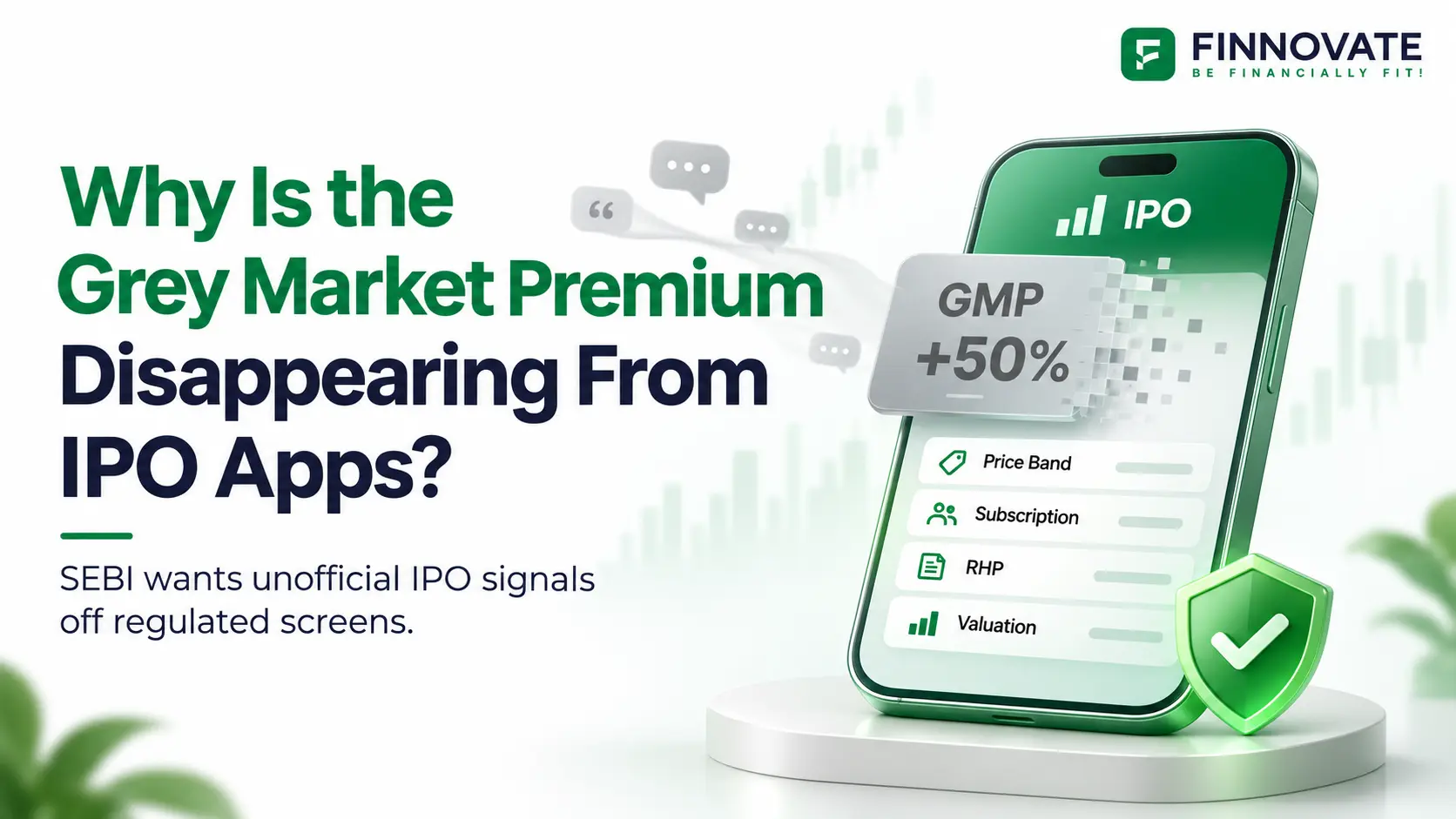
On November 23, SEBI issued an advisory (Press Release No. 75/2026) asking all registered intermediaries and market participants to stop publishing, displaying or circulating GMP figures, whether on websites, apps, email, SMS or social media.
Why would the regulator go after a number that millions of investors check before every IPO? To answer that, start with where the number comes from.
A Market With No Exchange
The grey market is an informal market where IPO shares, and sometimes just IPO applications, are traded before the company lists on the NSE or BSE.
There's no exchange overseeing it. There's no clearing corporation making sure the buyer pays or the seller delivers. Dealers work through phone calls and messaging apps, deals rest on trust, and money changes hands in cash. The activity is concentrated in centres like Ahmedabad, Jaipur and Rajkot.
What many investors don't realise is that most of these deals aren't share purchases at all. They run on word of mouth with no paperwork, and only the difference between the agreed premium and the listing price is settled. No shares change hands.
In other words, much of the grey market works less like a stock market and more like a bet on the listing price.
Two common deal types show this clearly:
- Kostak: a fixed amount paid for an IPO application, whether or not it gets an allotment.
- Subject to Sauda: an amount paid only if the application actually gets an allotment.
How a Whisper Became a Ticker
For a long time, GMP was something mostly insiders and active traders tracked.
Then came the retail IPO boom. Apps, financial portals and social media accounts turned GMP into a live ticker, shown right next to official subscription numbers and SEBI-approved price bands.
That's where the trouble began.
When a number sits inside a regulated broker's app, it looks official. SEBI's advisory pointed to exactly this: GMP was being published widely, including by some SEBI-registered intermediaries, and presented as a guide to listing prices and returns.
But nobody can verify a grey market price. There's no record of who traded, how much, or whether any trade happened at all. A GMP could reflect genuine demand or just a handful of quotes, and from the outside there's no way to tell the difference.
Now picture how this can feed on itself. A high GMP flashes on IPO apps. Retail investors rush in expecting a big listing gain. The issue gets heavily oversubscribed, which makes it look like a hit, which can push the GMP even higher.
Then listing day arrives, and the real market sets the price.
Listing Day Has Been Humbling
The IPO market of the last year has exposed how fragile that loop is.
According to Grant Thornton Bharat, average listing-day gains fell from 29% in FY25 to 7% in FY26. Only 64.6% of IPOs opened with a listing gain in FY26, the lowest share in seven years.
Bonfiglioli Transmissions is a good example. Its IPO was subscribed 46 times and carried a GMP of about 11% before listing. On October 23, it opened at ₹586, exactly its issue price, and closed the day at ₹574.50.
Investors who applied only for a quick flip got nothing, or less.
The Part That Hurts Most: No Recourse
Some investors weren't just reading GMP. They were doing grey market deals.
SEBI's advisory is blunt about what that means. If a dispute arises from a GMP-linked transaction, investors can't turn to SEBI, the stock exchanges, the exchanges' grievance systems or the Online Dispute Resolution (ODR) portal.
If the dealer doesn't pay, you're on your own.
Why Now?
SEBI has warned against the grey market for years. Its investor education material has long carried "Do not deal in shares in Black market / Grey Market" among its dos and don'ts.
What changed was the pressure. On October 21, the Small Investors Welfare Association (SIREN) wrote to SEBI seeking immediate intervention. It compared the open trading of unofficial premiums on WhatsApp, Telegram and tracking portals to illegal betting, and alleged manipulation and inflated GMPs.
About a month later, SEBI acted.
The advisory doesn't name any IPO or specific case of manipulation as its trigger. Its stated reasoning is simpler: the figures are unofficial, unverified and unregulated, and publishing them may harm investors.
Will This Kill the Grey Market?
Probably not.
The advisory changes what regulated platforms show you. It doesn't change the IPO process, and it doesn't shut down off-market trading. That activity is likely to retreat into private groups and phone calls, where it lived before.
SEBI has also talked about a longer-term fix. Since January 2025, it has discussed a regulated "when-listed" facility that would let allotted shares trade in the window between allotment and listing, exactly when grey market activity peaks. As of mid-2026, that platform was still at the proposal stage.
Until then, the official price discovery happens where it always has: on listing day, on the exchange.
What to Look At Instead
Without GMP, IPO investors are left with what was always more reliable:
- the RHP: business model, financials, risks, and how much of the issue is fresh capital versus existing shareholders selling,
- valuation: the price-to-earnings multiple at the price band compared with listed peers,
- subscription data from the exchanges: especially the qualified institutional buyer (QIB) category, which reflects demand from professional investors, and
- the anchor book: who the anchor investors are and how much they've committed.
None of these predicts the listing price. But all of them tell you something real about the business you're buying.
An IPO is a share in a business, not a bet on day one. If you'd like to see how new issues and your existing holdings fit your long-term goals, explore Finnovate's financial planning.
The Bottom Line
GMP became popular because it was simple: one number that seemed to promise easy money.
SEBI's message is that the number came from a market with no rules, no records and no recourse, and it had no business looking official.
So the next time you open an IPO app, you won't see a magic number promising listing-day profits. You'll actually have to read the fine print before hitting "Apply."
FAQs
1. Has SEBI banned GMP?
SEBI has advised all registered intermediaries and market participants to stop publishing, displaying or circulating GMP figures. It was issued as an advisory under Press Release No. 75/2026 dated November 23, 2026.
2. Why did SEBI act against GMP?
SEBI said GMP figures are unofficial, unverified and unregulated, come from trades outside the exchange system, and may mislead investors about listing prices and returns.
3. How do grey market deals work?
They are informal deals arranged through dealers, typically settled in cash. Often only the difference between the agreed premium and the listing price is settled, without any shares changing hands.
4. What happens if a grey market dealer doesn't pay?
SEBI has said investors in GMP-linked deals have no access to SEBI or exchange investor protection, grievance systems or the ODR portal.
5. What is the difference between Kostak and Subject to Sauda?
Kostak is a fixed amount paid for an IPO application whether or not it gets an allotment. Subject to Sauda is paid only if the application receives an allotment.
6. Will SEBI launch an official pre-listing trading platform?
SEBI has discussed a regulated "when-listed" facility since January 2025. As of mid-2026, it was still a proposal.
Sources
- Business Standard: SEBI asks market players to stop publishing grey market premiums for IPOs (November 23, 2026)
- Grant Thornton Bharat: IPOs in India FY26
- Business Standard: Fewer IPOs are showing listing gains as openings hit a seven-year low
- Business Standard: SEBI to start pre-listing trading in IPOs to curb grey market activity (January 2025)
Disclaimer: This article is for information and awareness only. It is not a recommendation to apply for, buy, sell or hold any IPO, security or investment product. Company names are mentioned only as examples of past listings. IPO investments carry market risk, and listing prices can differ sharply from issue prices.