
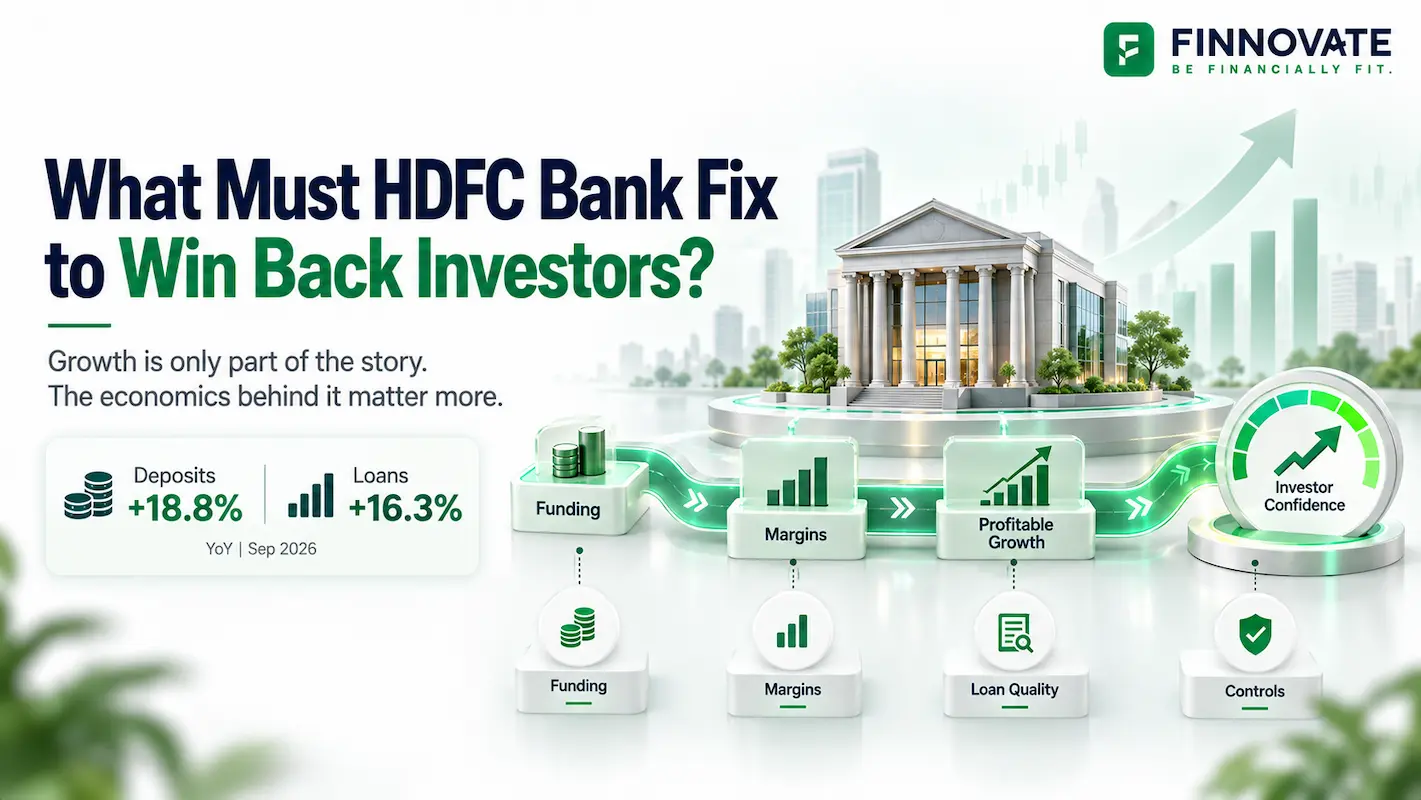
HDFC Bank: What Must Change to Win Back Investors?
Can HDFC Bank win back investors? Explore how deposit costs, profit margins, loan quality ...
12 October 2026

Finnovate’s editorial team researches and creates financial content using trusted sources, regulatory references and inputs from subject experts.
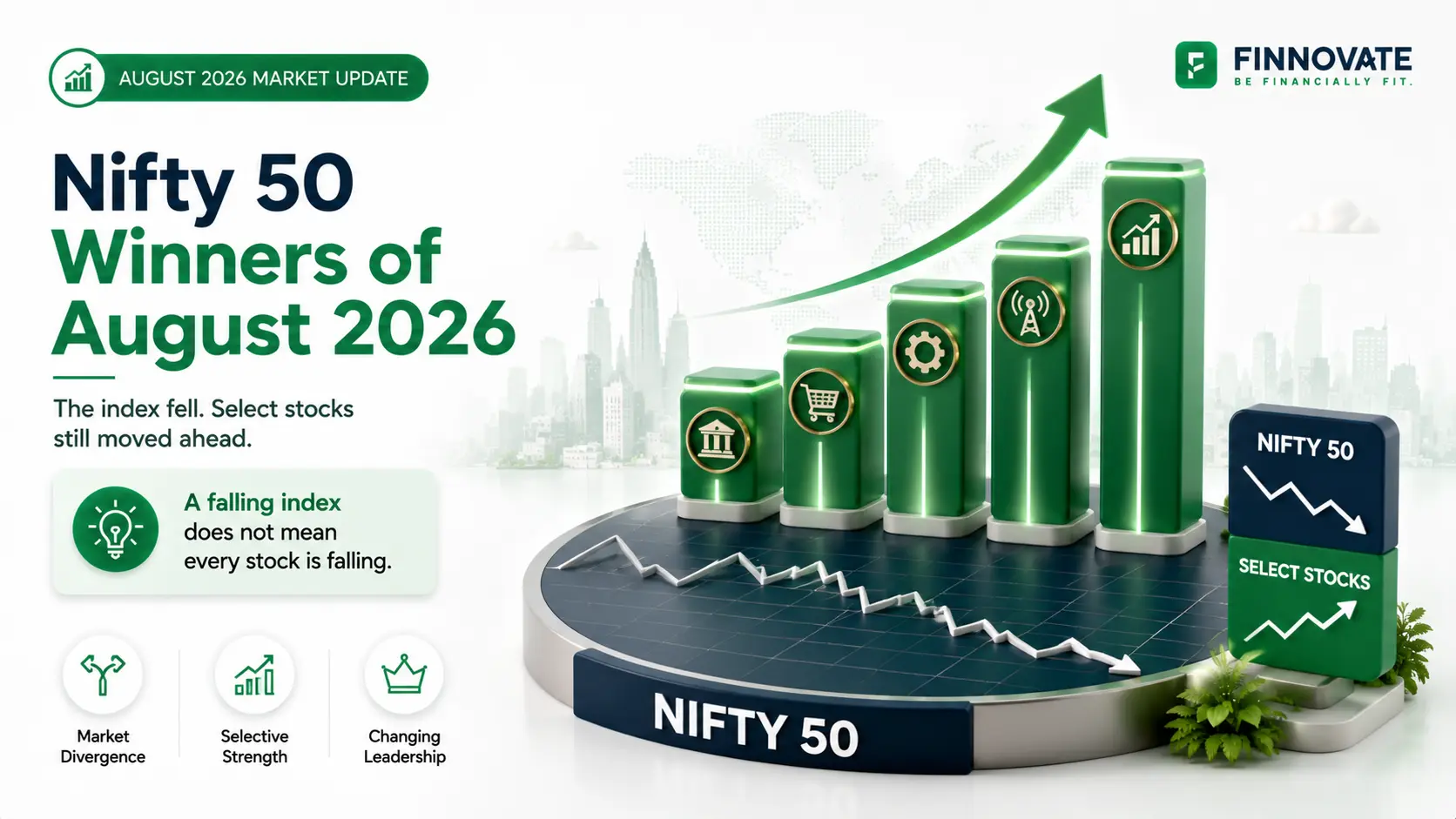
August 2026 was a strange month for Indian equities.
The Nifty 50 fell from 24,383.60 on July 31 to 24,080.40 on August 31, a decline of about 1.24%. Of the 50 index stocks, 31 finished the month lower while only 19 advanced.
Yet the broader market told a very different story.
Mid-cap stocks gained around 2.1% during August, while small-caps rose approximately 3.1%. Foreign portfolio investors also bought about $3.1 billion of Indian equities, their largest monthly inflow in nearly two years.
Large benchmark names struggled, while selected banks, metals, consumer-facing companies and industrial stocks continued to move higher.
Table of Contents
Using July 31 and August 31 closing prices, the five strongest Nifty 50 performers for the month were:
| Rank | Stock | August 2026 Return | 1-Year Return* |
|---|---|---|---|
| 1 | Grasim Industries | +8.71% | +17.69% |
| 2 | Eternal | +8.48% | +1.53% |
| 3 | Kotak Mahindra Bank | +7.46% | +8.24% |
| 4 | Bharat Electronics (BEL) | +6.86% | +9.82% |
| 5 | Shriram Finance | +6.04% | +79.36% |
The August returns are based on July 31 and August 31 closing prices, rather than intramonth highs or rolling 30-day returns. The 1-year returns are from the underlying August ranking dataset and are included to add a longer-term view alongside the independently checked monthly performance.
Grasim Industries gained approximately 8.7% during August, making it the strongest Nifty 50 performer on a month-end basis.
The stock moved from about ₹3,100.80 on July 31 to ₹3,371 at the end of August. In the underlying ranking data, Grasim also showed a 17.69% one-year return, so its August gain added to an already positive longer-term trend.
Grasim is not a single-theme business. Through its businesses and investments, the group has exposure to building materials, chemicals, paints, financial services and the broader infrastructure and construction cycle.
Eternal rose from around ₹302.45 at July-end to ₹328.10 on August 31, a gain of approximately 8.48%. Its 1.53% one-year return in the underlying ranking data is much more modest, making the August move particularly notable.
The move came after a strong period for Blinkit, Eternal's quick-commerce business.
Blinkit had ended the June quarter with 2,443 stores, while net order value grew 86% year-on-year and adjusted EBITDA turned positive at ₹102 crore.
The market is increasingly evaluating Eternal not only as a food-delivery company, but as a broader consumer and retail platform.
There was also an index-flow effect near month-end. The August 31 MSCI rebalancing increased Eternal's index weight and contributed to heavy trading activity.
Kotak Mahindra Bank gained approximately 7.46% during August. Its one-year return in the ranking dataset stood at 8.24%, showing how important the latest month's move was to its recent performance.
The move fits a broader sector trend. Several banking indices ended the month in positive territory even while the headline Nifty declined.
| Banking Index | August 2026 Return |
|---|---|
| Nifty PSU Bank | +2.9% |
| Nifty Private Bank | +1.8% |
| Nifty Bank | +1.3% |
But this does not mean every bank performed well.
HDFC Bank remained under pressure amid uncertainty surrounding leadership succession and earlier governance-related concerns. That created substantial dispersion even within the private-bank space.
August's banking story was therefore not simply "banks rallied". It was a story of selective strength within the sector.
Bharat Electronics gained approximately 6.86% during August, with its share price rising from about ₹387.85 to ₹414.45. The ranking dataset shows a 9.82% one-year return, so August accounted for a meaningful part of its latest 12-month gain.
BEL operates in defence electronics and has been one of the prominent listed businesses exposed to India's push toward domestic defence manufacturing and procurement.
The stock's August performance also illustrates a broader point: investors were still willing to own selected businesses with exposure to order visibility, government spending, domestic manufacturing and long-term capital expenditure.
Shriram Finance rose from about ₹1,046.70 on July 31 to ₹1,109.90 on August 31, giving it an approximately 6.04% monthly return. It is the clear longer-term standout among these five in the source ranking data, with a 79.36% one-year return.
Its presence among the top performers shows that August's financial-sector strength extended beyond traditional banks.
Shriram Finance has meaningful exposure to commercial-vehicle finance, MSME lending, consumer finance and used-vehicle finance.
| Sector | August 2026 Return |
|---|---|
| Nifty Metal | +3.7% |
| Nifty PSU Bank | +2.9% |
| Nifty Pharma | +2.5% |
| Nifty Private Bank | +1.8% |
| Nifty IT | +1.6% |
| Nifty Bank | +1.3% |
| Nifty Healthcare | +1.1% |
| Nifty Consumer Durables | +0.9% |
| Nifty Auto | +0.3% |
| Nifty Financial Services | -1.1% |
| Nifty Oil & Gas | -1.3% |
| Nifty Media | -3.8% |
| Nifty FMCG | -6.3% |
Foreign investors put approximately $3.1 billion into Indian equities during August, their strongest monthly buying in about 23 months.
Yet the Nifty declined because the Nifty 50 is a market-cap weighted index.
Weakness in heavyweight stocks such as HDFC Bank and Reliance Industries could offset gains across several smaller constituents.
Crude oil moved higher as Middle East tensions persisted. Higher crude can affect inflation, the trade balance, the rupee and corporate margins.
Expectations that the US Federal Reserve could remain tighter for longer pushed global bond yields higher and reduced risk appetite toward the end of the month.
The rupee actually gained around 0.2% during August, ending the month near ₹95.16 per dollar, helped by RBI intervention and equity-related inflows.
RBI's special foreign-currency mobilisation brought in far more dollars than markets initially expected. The longer-term issue is how RBI eventually manages the associated liquidity and forward-dollar obligations.
August's strongest pockets shifted toward metals, banks and selected industrial and consumer businesses.
A roughly 1.2% Nifty decline coexisted with gains of more than 8% in Grasim and Eternal.
Foreign inflows returned, but heavyweight weakness still dragged the benchmark lower.
A monthly winner tells you where the market has shown conviction, not whether the stock is attractive at today's price.
Before using monthly performance in a portfolio decision, investors should still examine earnings growth, balance-sheet strength, valuation, industry conditions, portfolio concentration, investment horizon and downside risk.
On a July 31 to August 31 closing-price basis, Grasim Industries was the strongest Nifty 50 performer, gaining approximately 8.71%.
The five strongest month-end performers were Grasim Industries, Eternal, Kotak Mahindra Bank, Bharat Electronics and Shriram Finance. Among these five, Shriram Finance had the strongest one-year return in the underlying ranking dataset at 79.36%.
The Nifty 50 declined from 24,383.60 on July 31 to 24,080.40 on August 31, a fall of approximately 1.24%.
Metals, PSU banks, pharma, private banks and IT were among the stronger major sectors. FMCG was the standout laggard.
No. Foreign portfolio investors bought around $3.1 billion of Indian equities during August, their strongest monthly inflow in nearly two years.
Large index heavyweights such as HDFC Bank and Reliance Industries underperformed, while much of the stronger performance occurred in other Nifty constituents and in the broader mid- and small-cap markets.
Not necessarily. Monthly performance measures past price movement. Investment decisions should also consider business fundamentals, valuation, risk, diversification and individual financial goals.
Disclaimer: This article is for educational and informational purposes only and does not constitute investment advice, a stock recommendation or an offer to buy or sell securities. Historical returns do not indicate future performance. Investors should evaluate their goals, risk profile, portfolio allocation and relevant financial information before making investment decisions.
No spam. Only new posts, simple explainers, and practical money checklists for busy professionals.
Finnovate is a SEBI-registered financial planning firm that helps professionals bring structure and purpose to their money. Over 3,500+ families have trusted our disciplined process to plan their goals - safely, surely, and swiftly.
Our team constantly tracks market trends, policy changes, and investment opportunities like the ones featured in this Weekly Capsule - to help you make informed, confident financial decisions.
Learn more about our approach and how we work with you:
No comments yet. Start the conversation. What would you add?
No spam. Only new posts, simple explainers, and practical money checklists.
You may also like
Can HDFC Bank win back investors? Explore how deposit costs, profit margins, loan quality ...
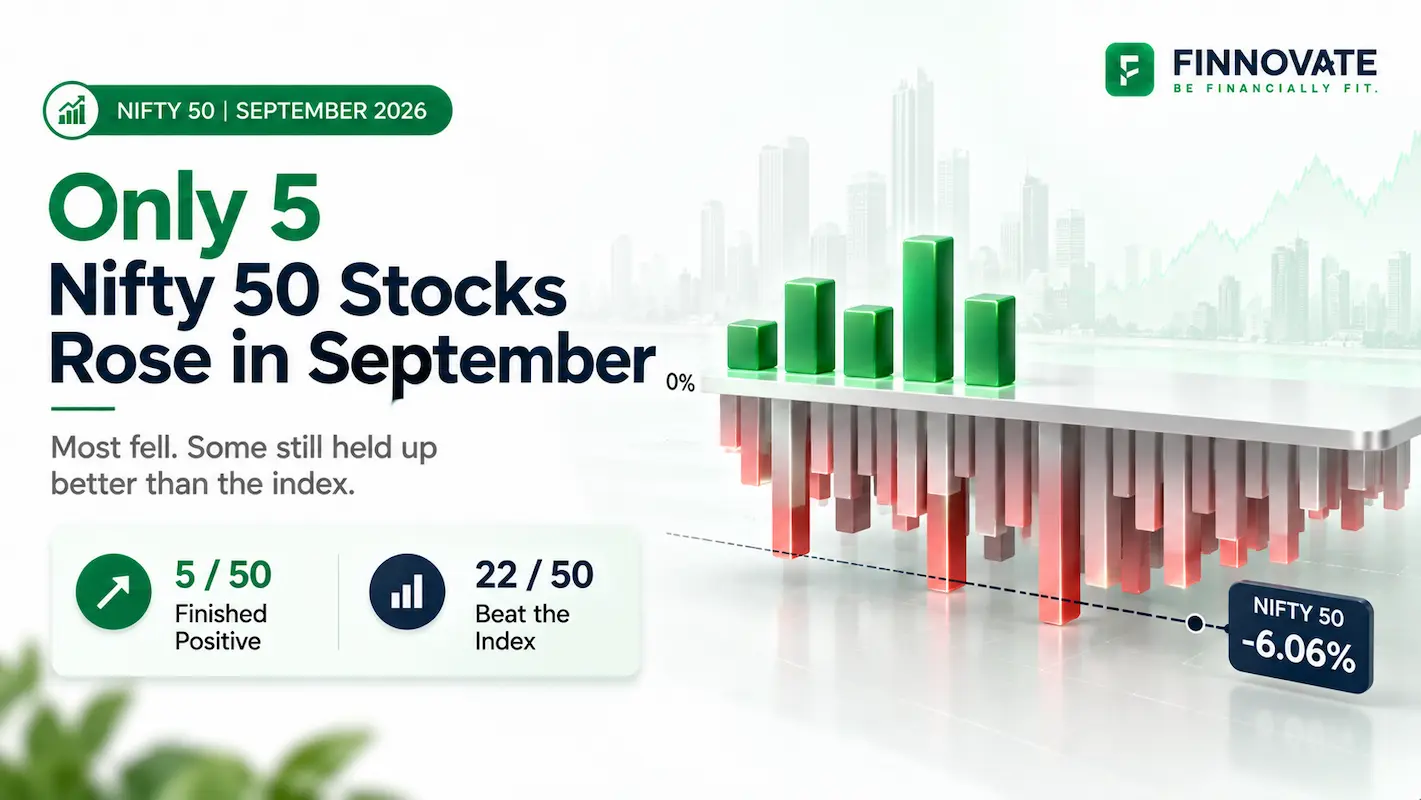
Only five Nifty 50 stocks rose in September 2026 as the index fell 6.06%. Compare monthly ...
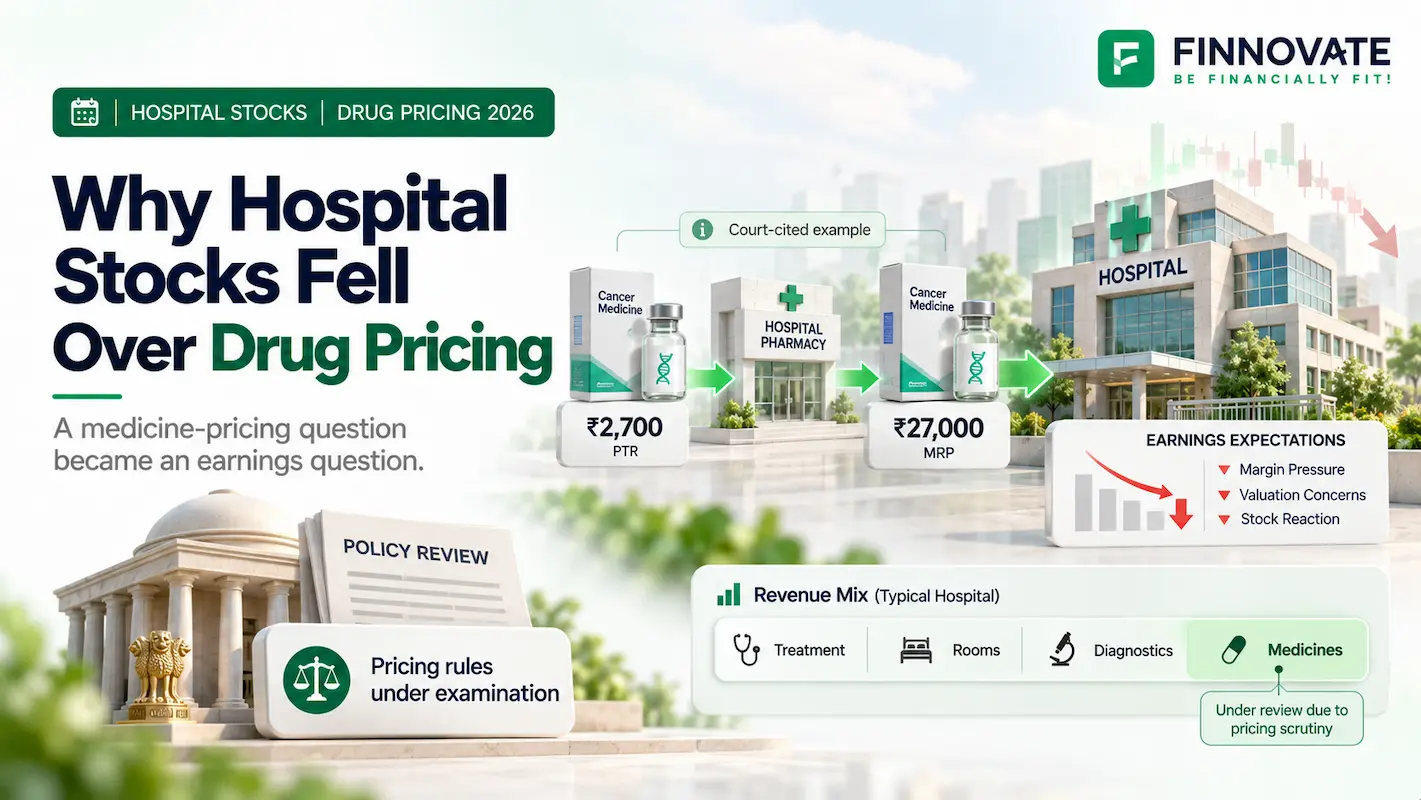
Why did hospital stocks fall after Supreme Court scrutiny of medicine prices? Understand d...
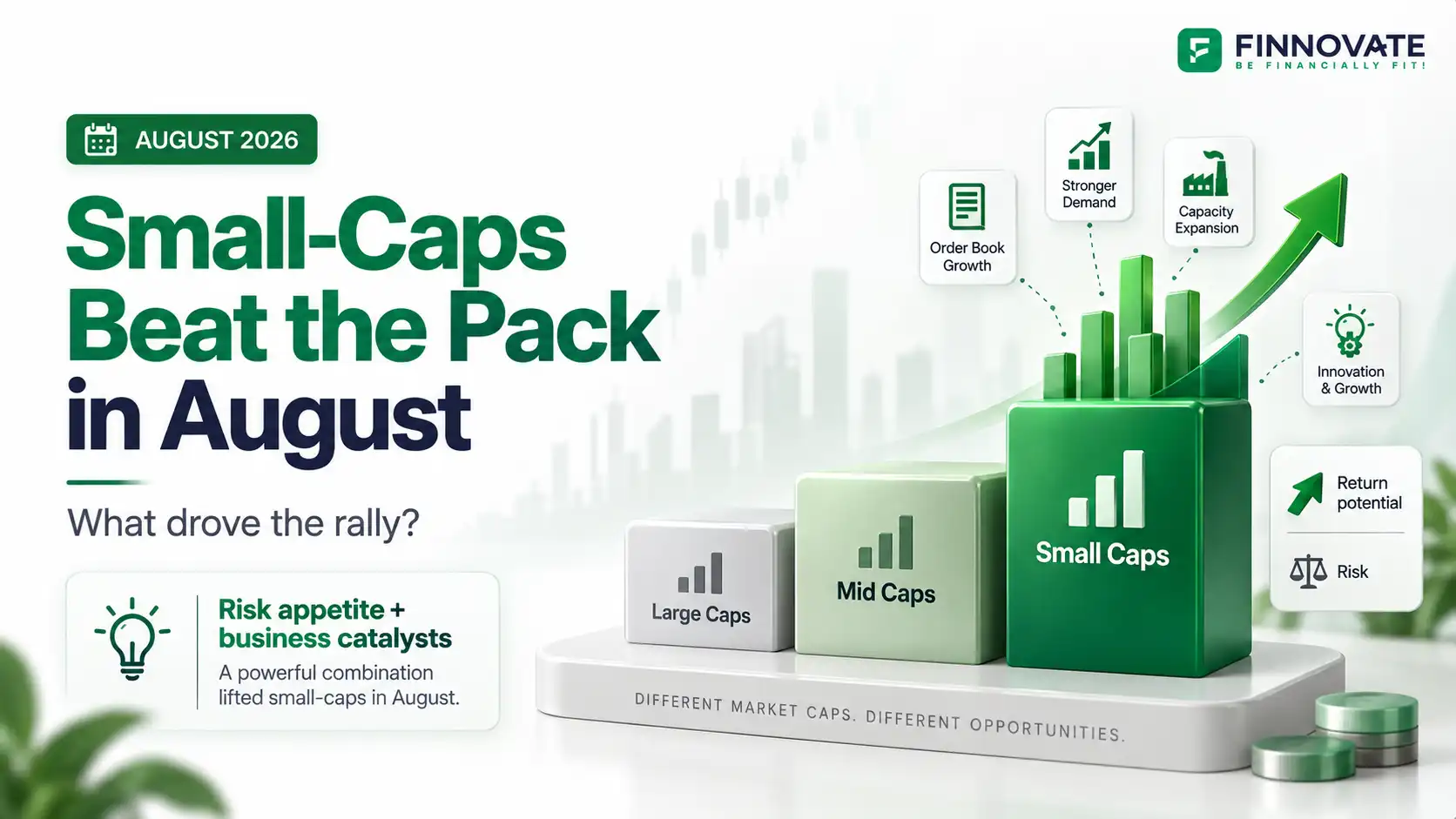
Nifty Smallcap 100 rose 3.16% in August 2026. See which small-cap stocks led, what drove t...
Popular now
Learn how to easily download your NSDL CAS Statement in PDF format with our step-by-step g...

Looking for the best financial freedom books? Here’s a handpicked 2026 reading list with...
Learn what SIF investment means in India, SEBI rules, Rs 10 lakh minimum investment, avail...
Clear guide to mutual fund taxation in India for FY 2025–26 after July 2024 changes: equ...