Fixed-Benefit vs Indemnity-Based Health Insurance in India: What’s the Difference?

Finnovate’s editorial team researches and creates financial content using trusted sources, regulatory references and inputs from subject experts.
You are hospitalised and the bill comes to ₹4 lakh. How much will your insurer pay?
The answer depends on the type of health insurance you have.
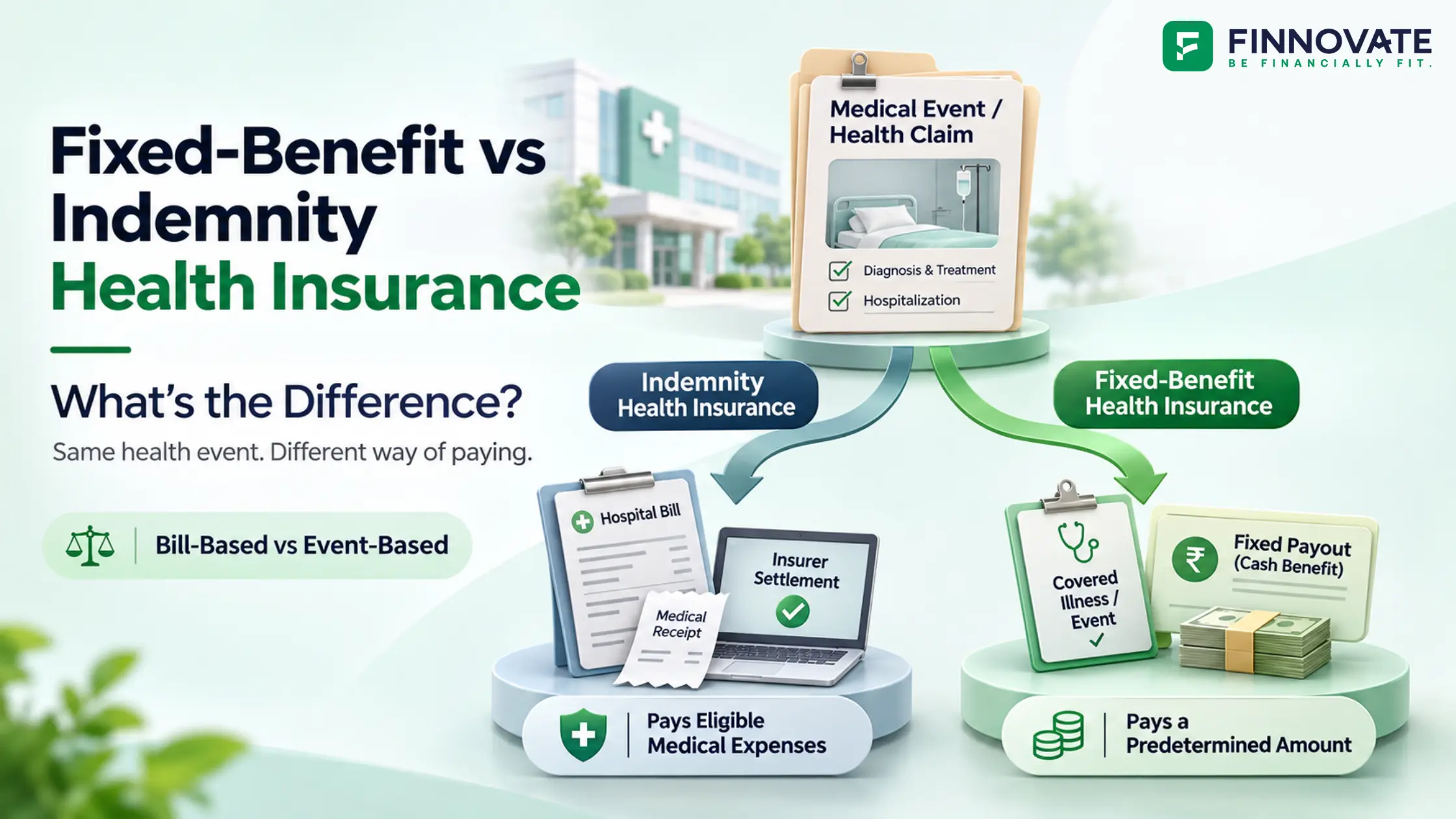
Indemnity-based health insurance pays eligible medical expenses based on the actual loss, subject to the policy terms and available sum insured.
Fixed-benefit insurance, formally referred to as benefit-based insurance under IRDAI regulations, pays a predetermined benefit when a specified insured event occurs and the applicable claim conditions are satisfied.
Fixed benefit asks: “Did the specified insured event occur?”
What Is Indemnity-Based Health Insurance?
This is the type of health insurance most people usually think of when they hear “health insurance” or “Mediclaim”.
It covers eligible medical expenses arising from hospitalisation and other covered treatment, subject to the policy terms.
Suppose you have:
In this case, the insurer may settle ₹3.6 lakh.
It does not automatically pay ₹10 lakh simply because that is the sum insured.
The actual settlement can be affected by the policy terms, including co-pay, deductibles, exclusions, available cover and applicable sub-limits.
Indemnity policies can generally settle eligible expenses through a cashless claim at an eligible hospital or through reimbursement, depending on the circumstances and policy process.
What Is Fixed-Benefit Health Insurance?
A fixed-benefit policy works differently.
Instead of calculating the benefit from the size of the hospital bill, the policy specifies an amount payable when a defined insured event or benefit trigger occurs and the claim conditions are satisfied.
Critical illness insurance is one common example.
So even if the hospital bill is ₹4 lakh, a qualifying fixed benefit could still be ₹5 lakh.
Hospital cash is another example of a benefit-based cover, although its payout may be structured as a specified amount for each covered day rather than one lump sum.
Fixed-Benefit vs Indemnity Health Insurance: Key Differences
| Feature | Indemnity-Based Health Insurance | Fixed-Benefit Health Insurance |
|---|---|---|
| Payout basis | Eligible actual medical expenses | Predetermined benefit linked to a specified insured event |
| What triggers the claim? | Covered hospitalisation or other eligible treatment | A defined insured event or benefit trigger under the policy |
| Does the hospital bill determine the payout? | Yes. The admissible expense is relevant to the claim amount | No. The benefit amount is predetermined |
| Use of payout | Used to settle or reimburse eligible medical expenses | Generally not linked to reimbursement of specific hospital bills after the benefit is paid |
| Cashless treatment | Common and directly relevant to hospitalisation claims | Generally not the way the fixed benefit itself is paid |
| Number of claims | Multiple claims may be possible, subject to available cover and policy terms | Depends on the product. Some benefits may be one-time, while others may follow a different payout structure |
| What can affect the claim? | Co-pay, deductible, exclusions, available sum insured and applicable sub-limits | Event definition, severity criteria, waiting period, survival condition where applicable, exclusions and other benefit conditions |
| Multiple policies | Cannot result in recovery beyond the same admissible medical loss | Qualifying benefit policies can pay independently according to their terms |
| Common examples | Individual or family hospitalisation health insurance | Critical illness, hospital cash and other benefit-based covers |
Same Medical Event. Two Different Claim Calculations.
Suppose someone has both:
- Indemnity health policy: ₹10 lakh
- Fixed critical illness benefit: ₹5 lakh
A qualifying critical illness results in a hospital bill of ₹4 lakh.
After applying the indemnity policy terms, suppose the admissible medical expense is ₹3.6 lakh.
Potentially, the same medical event can therefore result in:
These payments are calculated differently.
The ₹3.6 lakh indemnity settlement is linked to eligible treatment expenses.
The ₹5 lakh benefit is linked to the occurrence of the qualifying insured event.
Why Can the Fixed Benefit Still Matter?
A serious illness can affect finances beyond the hospital invoice.
Treatment and recovery may lead to time away from work, reduced income, travel, rehabilitation, home care, household expenses or difficulty managing loan payments.
What Happens If You Have More Than One Health Insurance Policy?
The answer again depends on whether the policies are indemnity-based or benefit-based.
Under the current IRDAI framework, a policyholder with multiple indemnity policies can choose the policy under which to initiate the claim.
If the available cover under that policy is insufficient for the admissible claim, the eligible balance can be coordinated under other available policies, subject to their respective terms.
Benefit-based policies work differently. If the insured event qualifies under multiple benefit policies, claims can be made under those qualifying policies according to their respective terms.
Two Common Misunderstandings
“I Have ₹10 Lakh Health Cover, So I Will Get ₹10 Lakh If I Am Hospitalised.”
Not necessarily.
If it is an indemnity policy and your hospital bill is ₹5 lakh, even that does not automatically mean the insurer will pay ₹5 lakh.
The admissible amount can depend on factors such as co-pay, deductible, exclusions, available cover and applicable sub-limits under the policy.
The sum insured is the cover available, not a guaranteed payout amount.
“Fixed Benefit Means Guaranteed Claim Payment.”
Again, not necessarily.
The benefit amount may be predetermined, but the insured event must still satisfy the policy definition and applicable claim conditions.
Where Does Each Type of Health Insurance Fit?
They can therefore complement each other, but whether someone needs both depends on the cover they already have, their financial situation and the specific benefits offered by the policies.
So rather than asking which one is universally better, it is more useful to ask:
Final Takeaway
The difference between indemnity and fixed-benefit health insurance becomes simple once you stop comparing only the sum insured.
Indemnity: How much eligible medical expense did you incur?
Fixed benefit: Did the specified insured event occur?
One mainly helps deal with eligible medical expenses.
The other can provide a predetermined financial benefit when a covered event occurs.
FAQs
1. Can a fixed-benefit payout be higher than the hospital bill?
Yes. The benefit amount is predetermined and linked to the qualifying insured event rather than the size of the hospital bill. The policy's claim conditions must still be satisfied.
2. Can I claim both fixed-benefit and indemnity insurance for the same illness?
Potentially, yes. An indemnity policy can settle eligible medical expenses while a separate qualifying fixed-benefit policy can pay its specified benefit for the covered event. Each claim is assessed according to its respective policy terms.
3. Is critical illness insurance fixed-benefit?
Many standalone critical illness policies are benefit-based and pay a predetermined amount when a listed illness meets the policy definition and applicable conditions. The specific policy wording should always be checked.
4. Can fixed-benefit insurance replace regular health insurance?
They perform different roles. Indemnity-based insurance is designed around eligible treatment expenses, while fixed-benefit insurance pays when specified policy events occur. Fixed-benefit cover can therefore complement hospitalisation cover, but it should not automatically be treated as an equivalent replacement.