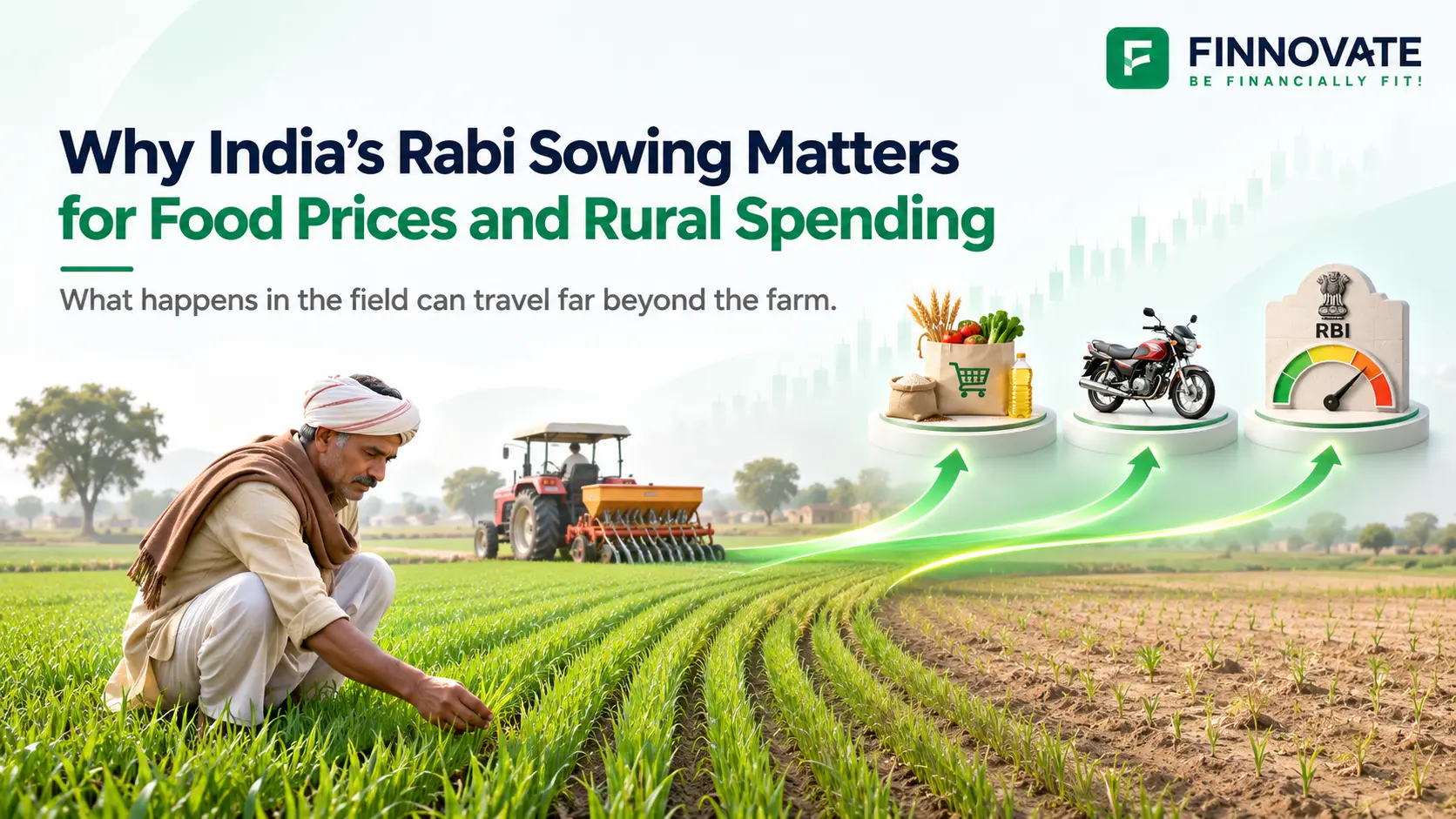
Why India’s Rabi Sowing Matters for Food Prices and Rural Spending

Finnovate’s editorial team researches and creates financial content using trusted sources, regulatory references and inputs from subject experts.
A smaller harvest can leave a family paying more for food and a farmer earning less from growing it. Between those two pressures sit businesses selling everything from biscuits to motorcycles.
That is why India’s winter sowing figures deserve attention beyond the farm sector. They offer an early indication of the crops that will reach markets months from now, and the incomes that could support the next round of rural spending.
The season began slowly. By October 30, 2026, rabi planting was almost 46% behind the previous year’s pace. A week later, that gap had narrowed to 17.2%.
That is a substantial catch-up. Yet wheat, pulses and oilseeds remain behind, leaving an important question: can farmers recover enough ground to deliver a healthy harvest without sharply higher costs?
The answer will matter at the grocery counter, in rural showrooms and at the Reserve Bank of India.
From a 46% Shortfall to 17.2%: How Much Has Improved?
Rabi crops are planted during the cooler months after the monsoon and generally harvested in spring. Wheat, gram and mustard are among the season’s important crops.
As of October 30, farmers had planted rabi crops across 37.56 lakh hectares, compared with 69.02 lakh hectares at the same stage a year earlier.
By November 6, the area had risen to 108.66 lakh hectares, against 131.26 lakh hectares in the corresponding period last year. Planting gathered pace, although several major crops continued to lag.
| Crop or category | Area sown in 2026 (lakh hectares) |
Corresponding period in 2025 (lakh hectares) |
Year-on-year change |
|---|---|---|---|
| Total rabi crops | 108.66 | 131.26 | −17.2% |
| Wheat | 19.77 | 22.47 | −12.0% |
| Pulses | 31.93 | 37.30 | −14.4% |
| Oilseeds | 42.08 | 55.09 | −23.6% |
| Rapeseed and mustard | 40.31 | 54.02 | −25.4% |
Scroll horizontally to view the full table.
Reference date: November 6, 2026. Source: Agriculture Ministry weekly sowing figures reproduced in the reports linked below. Areas are in lakh hectares; percentage changes are rounded. Rapeseed and mustard are included within oilseeds. Selected categories are shown and should not be added to the total.
Oilseeds show the largest percentage gap among the major categories above. Mustard planting matters for domestic edible-oil supply, while wheat and pulses influence staples that households buy regularly.
There is still time for additional planting. On November 6, a senior Agriculture Ministry official indicated that sowing could continue into December. The government had also prepared contingency plans for 225 districts.
The next test is whether the catch-up continues within suitable planting windows for each crop and region. After that, attention shifts to how well those crops grow.
The Water Problem Starts Before Planting
A winter crop depends on what the monsoon leaves behind.
Rain replenishes soil moisture and water sources used for irrigation. Farmers draw on both when preparing fields and supporting crops through the season. Insufficient soil moisture was identified as a reason for the slow start to wheat sowing this year.
A farmer facing dry ground has several choices: irrigate before planting, wait for better conditions, reduce the area cultivated or switch crops.
Each choice changes the economics of the season.
Extra irrigation can raise expenses. Delaying planting can compress the growing period. Switching crops changes the expected harvest and income. A farm with dependable irrigation may cope much better than one with limited access to water.
Even if the national acreage gap closes, the cost of achieving that recovery will matter for farm incomes. More land planted is encouraging, but farmers also need a harvest worth more than the money spent producing it.
How a Sowing Gap Can Reach Your Grocery Bill
Food prices were already rising as the rabi season began.
In September 2026, consumer food inflation stood at 7.74%, while headline retail inflation was 5.54%. Rural food inflation was higher, at 8.06%, according to the provisional September figures.
A lasting shortfall in winter crop production could add pressure to parts of that food basket.
Lower wheat availability could increase buying costs for flour mills. A weaker pulse harvest could tighten supplies of particular varieties. Reduced mustard production could affect domestic edible-oil availability.
The price paid by households would also depend on stocks, imports, transport costs and government action.
Grain released from public stocks can increase supply available to buyers. Imports can bridge some shortages, but their cost depends on world prices, shipping and the rupee. A domestic supply gap becomes harder to manage when overseas supplies are expensive too.
For a salaried household, a larger grocery bill leaves less money for other purchases. For a rural household, that higher bill may arrive alongside weaker farm earnings.
Why Higher Food Prices May Still Leave Farmers Worse Off
If crop prices rise, should farmers not earn more?
That depends on how much they have left to sell.
Farm income rests on three things: the quantity sold, the price received and the cost of production. A higher selling price helps, but it may fall short of covering a smaller harvest and more expensive irrigation.
A simple example
Suppose a farmer normally sells 100 units of produce at ₹100 each, earning ₹10,000 before costs. If the harvest falls to 80 units and the selling price rises to ₹110, revenue drops to ₹8,800. The price has risen by 10%, but revenue has fallen by 12%.
This is an illustration, not a forecast of crop prices or production.
Rural households also have different sources of income. A farmer with a large surplus may benefit from better prices. A farm worker or a household that buys more food than it produces faces a higher cost of living.
That is why higher food prices can coexist with weaker rural purchasing power. The gains and losses reach different households, and the extra money paid at the shop does not all become additional farm income.
From Farm Income to Tractor and Motorcycle Sales
The money earned from a harvest often finances purchases well beyond the next bag of fertiliser.
When income falls short, a household may delay replacing equipment, postpone a motorcycle or reduce spending on non-essential goods. Local retailers and service businesses can then feel the slowdown.
For investors, this connects the rabi season to tractor makers, two-wheeler manufacturers, consumer-goods companies and rural lenders. The effect will vary by region, customer group and access to credit.
Company sales figures add useful evidence, provided seasonal factors are considered.
Mahindra’s domestic tractor sales fell 13% year on year to 62,626 units in October 2026. However, domestic sales for the financial year through October remained 2% higher. The company attributed the monthly decline primarily to Diwali shifting from October in 2025 to November in 2026.
That calendar shift makes sales across the festive period more useful than October alone. Over the following months, dealer inventories, customer demand and management commentary will help show whether farm conditions are affecting purchases.
A lasting weakness across several months would carry more weight than one poor sales reading.
The RBI’s Difficult Trade-Off
Persistent food inflation creates a problem that interest rates can only partly address.
A rate increase cannot replenish soil moisture or produce an extra wheat harvest. It can restrain borrowing and spending across the wider economy.
The RBI’s concern grows when food-price increases persist and begin influencing wage demands, business pricing and expectations of future inflation. Broader price pressures can become harder to contain.
But tighter financial conditions also have costs. Households face more expensive borrowing. Businesses may delay investment. Rural buyers considering a tractor or vehicle could have another reason to wait.
The policy response will therefore depend on the duration and spread of inflation, alongside growth and other economic conditions. The sowing figures are an early input into that assessment, with the eventual harvest and food-price trend carrying greater weight.
What Matters Over the Next Few Weeks
The season will become easier to judge as four sets of evidence emerge:
- Planting progress: Whether the gaps in wheat, pulses and mustard continue to narrow within suitable sowing windows.
- Water and crop conditions: Whether newly planted fields receive adequate irrigation and favourable weather.
- Food availability: How stocks, imports and government supply measures respond to any shortage.
- Rural business performance: Whether sales and customer demand weaken across several months after allowing for seasonal effects.
India’s rabi season has recovered considerable ground after a slow start. The challenge now is to turn that recovery into a productive harvest without pushing cultivation costs too high.
A good harvest puts food into markets and spending money into rural households. If either side falls short, the effects can travel far beyond the field, from the price of flour to the next purchase at a village dealership.
Sources
- Business Standard / PTI: Rabi sowing progress as of October 30, 2026
- Moneycontrol: Rabi sowing progress as of November 6, 2026
- The Week / PTI: Agriculture Ministry comments on sowing and district contingency plans
- MoSPI / PIB: September 2026 Consumer Price Index release
- Mahindra: Official tractor sales release for October 2026
Disclaimer: This article is for information and education only and is not a recommendation to buy or sell any investment. Sowing figures are provisional and may change as the season progresses. Economic outcomes depend on weather, crop yields, prices and policy decisions.