
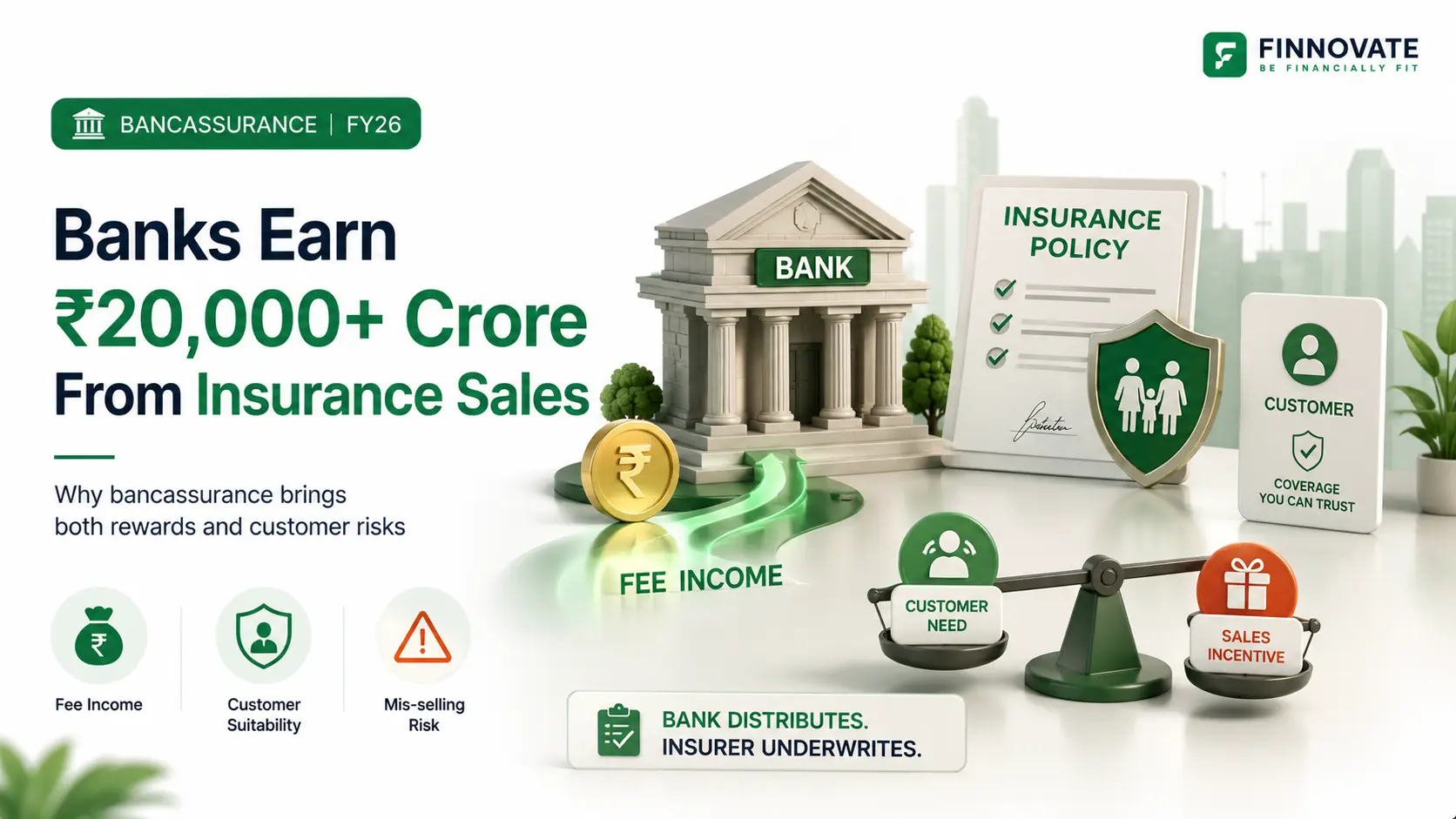
Bancassurance in India FY26: Banks Earn ₹20,000 Crore and the Risks That Come With It
Indian banks earned over ₹20,000 crore distributing insurance in FY26. HDFC Bank led at ...
28 July 2026

Published: April 2026
India's insurance distribution is on the edge of a structural debate that directly affects how millions of policyholders buy life cover. The question at the centre: should individual insurance agents be allowed to sell policies from multiple insurers, rather than remaining tied to a single company? Earlier reform discussions had considered extending open architecture to individual agents. However, the Sabka Bima Sabki Raksha (Amendment of Insurance Laws) Act, 2025, passed by Parliament in December 2025, did not include this change.
What remains is a live, unresolved conversation about distribution reform. A separate, parallel debate about bancassurance (whether banks should be required to distribute products from multiple insurers rather than preferring group companies) is also active and has more immediate consequences for India's largest private life insurers. Understanding where this reform actually stands requires a clear map of how Indian life insurance is distributed today.
Open architecture in insurance distribution means any intermediary can sell products from multiple insurers, not just one. Today, the system is only partially open. The table below maps who can distribute what under current rules.
| Intermediary Type | Current Status | Multi-Insurer Distribution? |
|---|---|---|
| Corporate agents (banks) | Multi-insurer model permitted under IRDAI limits | Yes, subject to category-wise tie-up limits |
| Insurance brokers | Already open architecture | Yes: multiple insurers permitted |
| Insurance marketing firms | Already open architecture | Yes: multiple insurers permitted |
| Individual agents | Tied model, unchanged by 2025 Act | No: one life, one non-life, one health insurer only |
Earlier reform discussions had proposed extending open architecture to individual agents. Under that proposal, an LIC agent could also sell an HDFC Life or SBI Life product. The Sabka Bima Sabki Raksha (Amendment of Insurance Laws) Act, 2025, passed by Parliament in December 2025, did not include this provision.
Three models dominate Indian life insurance distribution today, each with a distinct structural logic.
Individual agents tied to a single insurer remain the backbone of Indian insurance distribution. LIC has built its market dominance on this model. The large majority of LIC's premium flows through its exclusive individual agent network, one of the largest distribution forces in the world. Private insurers use this channel too, though reliance varies significantly by company. SBI Life's agency channel contributed 27% of APE in 9M FY26, up from 26% the prior year, reflecting deliberate investment in diversifying away from bancassurance dependence.
Banks distribute insurance products to their existing customer base through branch networks and digital platforms. This model has been the primary growth engine for private sector life insurers over the past two decades. SBI Life, HDFC Life, ICICI Prudential Life, Axis Max Life, and Kotak Life have all scaled significantly through bancassurance. The structural advantage is straightforward: banks already have the customer relationship, the trust, and the distribution infrastructure. Adding insurance to that network generates significant fee income at low incremental cost.
A growing but still smaller share of the overall mix. SBI Life's YONO platform issued over 1.6 lakh individual protection policies in FY25 through a three-click digital journey, a signal of how rapidly this channel is maturing. IRDAI's push for digital onboarding and the removal of mandatory physical documentation has accelerated this shift across the industry.
For group-backed insurers, bancassurance created a distribution advantage that would have taken decades to replicate through an independent agency network. When SBI, HDFC Bank, or ICICI Bank introduced insurance to their millions of existing customers, the product was essentially selling into a pre-qualified, captive audience. These are warmer customers because they already bank with the institution, making conversion easier than selling to completely cold prospects.
For banks, insurance distribution became a meaningful fee income contributor alongside core lending margins. For customers, the outcome has been mixed: convenient access to insurance through their bank, but product choice that has typically defaulted to the bank's own group insurance company rather than a market-wide comparison.
This concentration is what regulators and policymakers are now debating. The Department of Financial Services has publicly indicated that banks should remain neutral in their distribution, presenting the best product for the customer rather than the most profitable product for the group. This neutrality would require open architecture but has not yet been mandated through a confirmed final rule.
The push for open architecture in bancassurance is driven by two distinct regulatory concerns that have been building independently.
The current bancassurance model creates a structural bias toward group companies. A customer at an SBI branch asking about life insurance is overwhelmingly likely to be offered an SBI Life product. The same logic applies across HDFC Bank and HDFC Life, ICICI Bank and ICICI Prudential Life. The Department of Financial Services has publicly indicated that banks should act as neutral distributors, offering the best-fit product regardless of group affiliation. However, no final mandatory open architecture rule for banks has been confirmed through the 2025 Act. This remains an active policy discussion.
The RBI has raised concerns about banks over-indexing on fee income activities at the cost of core banking functions. The CD ratio reached historically elevated levels in 2024-25, with credit growth consistently outpacing deposit mobilisation. The RBI's position is that banks should focus on deposit mobilisation, responsible lending, and customer suitability rather than aggressive cross-selling of third-party financial products. Open architecture requirements, combined with scrutiny of bancassurance practices, are partly designed to redirect bank focus toward these core priorities.
The Sabka Bima Sabki Raksha (Amendment of Insurance Laws) Act, 2025 was passed by Parliament on 17 December 2025 and received Presidential assent on 20 December 2025. Its commencement is pending notification by the Central Government. The Act made several significant structural changes to Indian insurance regulation.
The bancassurance open architecture question remains an active policy and regulatory discussion driven by the Department of Financial Services and the RBI. It was not addressed by the 2025 Act and continues to be the more immediate pressure point for India's large private life insurers.
The removal of individual agent open architecture from the Amendment Bill is a structural reprieve for LIC. LIC's competitive moat is its exclusive agent network: agents who are trained, motivated, and financially tied to LIC products. Open architecture would have diluted this advantage by reducing LIC's incentive to invest in agent development. For now, that moat remains intact. The longer-term question is whether future legislative sessions revisit the provision.
SBI Life's more immediate concern is bancassurance open architecture, not individual agent reform. With 62% of APE from the SBI banking network, which does not currently operate on open architecture. Any regulatory requirement for SBI to distribute competing insurers' products alongside SBI Life would materially alter its distribution economics. SBI Life has been proactively hedging by growing its agency channel to 27% of APE in 9M FY26 and investing in digital distribution. A 14% historical CAGR target suggests the company believes it can absorb the transition, but the path requires sustained execution.
Analysts at IIFL Capital Services have assessed that open architecture, if fully implemented, would primarily benefit insurers with stronger product offerings, technology platforms, or willingness to pay higher distributor commissions. Share concentration at the top two or three insurers per bancassurance partnership is expected to remain largely intact. Larger private insurers like HDFC Life and ICICI Prudential Life, both of which carry more diversified distribution than SBI Life, are relatively better positioned. Smaller or newer players are unlikely to displace incumbents simply by gaining access to more distribution points.
Open architecture in life insurance means insurance intermediaries can sell products from multiple insurers rather than being tied to a single company. In India, corporate agents (banks), insurance brokers, and insurance marketing firms already operate on open architecture. Individual agents are currently restricted to one life, one non-life, and one standalone health insurer under IRDAI regulations.
Not under current law. The Sabka Bima Sabki Raksha (Amendment of Insurance Laws) Act, 2025, passed by Parliament in December 2025, did not include the proposal to extend open architecture to individual agents. Individual agents continue to operate under the existing tied model. Earlier reform discussions had considered this change but it was not carried forward into the final legislation.
In bancassurance, a bank distributes insurance products to its existing customers through its branch network and digital platforms, earning fee income in return. In India, most major bank-backed insurers (SBI Life via SBI, HDFC Life via HDFC Bank, ICICI Prudential Life via ICICI Bank) distribute predominantly through their parent bank's network. This exclusive group arrangement is what regulators are now scrutinising under the open architecture debate.
The RBI has raised concerns about banks over-indexing on fee income activities, including insurance and mutual fund distribution, at the cost of core banking functions such as deposit mobilisation, responsible lending, and customer suitability. The CD ratio reached historically elevated levels in 2024-25, with credit growth consistently outpacing deposit growth. The RBI's position is that banking must remain central, and that aggressive insurance cross-selling through captive bancassurance arrangements may be distorting bank priorities.
Analysts expect open architecture, if fully implemented, to primarily benefit larger private insurers with stronger brand recognition, superior product offerings, and better technology platforms. Companies like HDFC Life and ICICI Prudential Life, which already have more diversified distribution. Share concentration at the top two or three insurers per bancassurance channel is not expected to change significantly. Please consult a SEBI-registered investment adviser before making any investment decisions related to insurance sector companies.
Disclaimer: This article is for general information and educational purposes only. It does not constitute investment advice, a recommendation, or an offer to buy or sell any securities or financial instruments. Information is based on publicly available regulatory filings, company disclosures, analyst reports, and media coverage as of April 2026. Insurance regulations and the status of legislative proposals are subject to change. Figures cited for SBI Life are sourced from the company's own investor disclosures. Past performance and historical channel mix data are not indicative of future outcomes. Please consult a SEBI-registered investment adviser or qualified financial professional before making any financial or investment decision.
No spam. Only new posts, simple explainers, and practical money checklists for busy professionals.
Finnovate is a SEBI-registered financial planning firm that helps professionals bring structure and purpose to their money. Over 3,500+ families have trusted our disciplined process to plan their goals - safely, surely, and swiftly.
Our team constantly tracks market trends, policy changes, and investment opportunities like the ones featured in this Weekly Capsule - to help you make informed, confident financial decisions.
Learn more about our approach and how we work with you:
No comments yet. Start the conversation. What would you add?
No spam. Only new posts, simple explainers, and practical money checklists.
You may also like
Indian banks earned over ₹20,000 crore distributing insurance in FY26. HDFC Bank led at ...
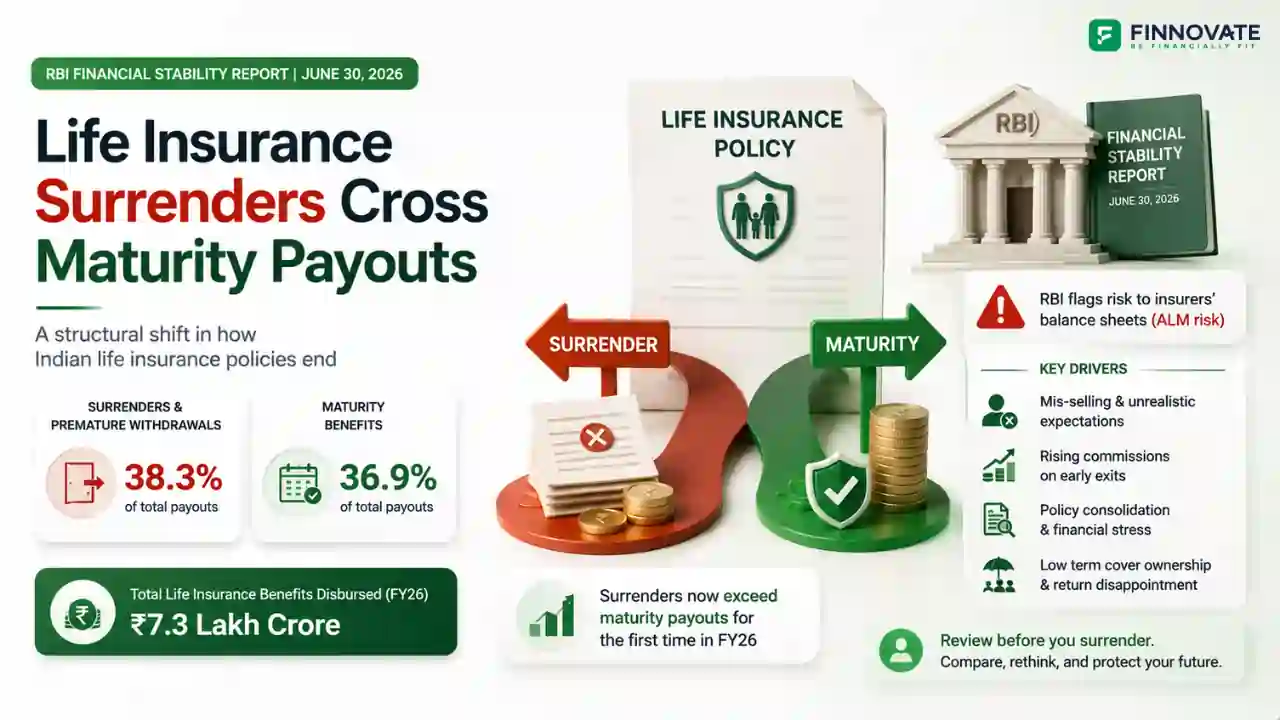
Surrenders made up 38.3% of life insurance payouts in FY26, ahead of maturity benefits at ...
Compare Term Insurance, Endowment, and ULIP in a clear, unbiased way. Understand costs, co...
Compare family floater vs individual health insurance in India - costs, coverage, pros & c...
Popular now
Learn how to easily download your NSDL CAS Statement in PDF format with our step-by-step g...

Looking for the best financial freedom books? Here’s a handpicked 2026 reading list with...
Learn what SIF investment means in India, SEBI rules, Rs 10 lakh minimum investment, avail...
Clear guide to mutual fund taxation in India for FY 2025–26 after July 2024 changes: equ...