
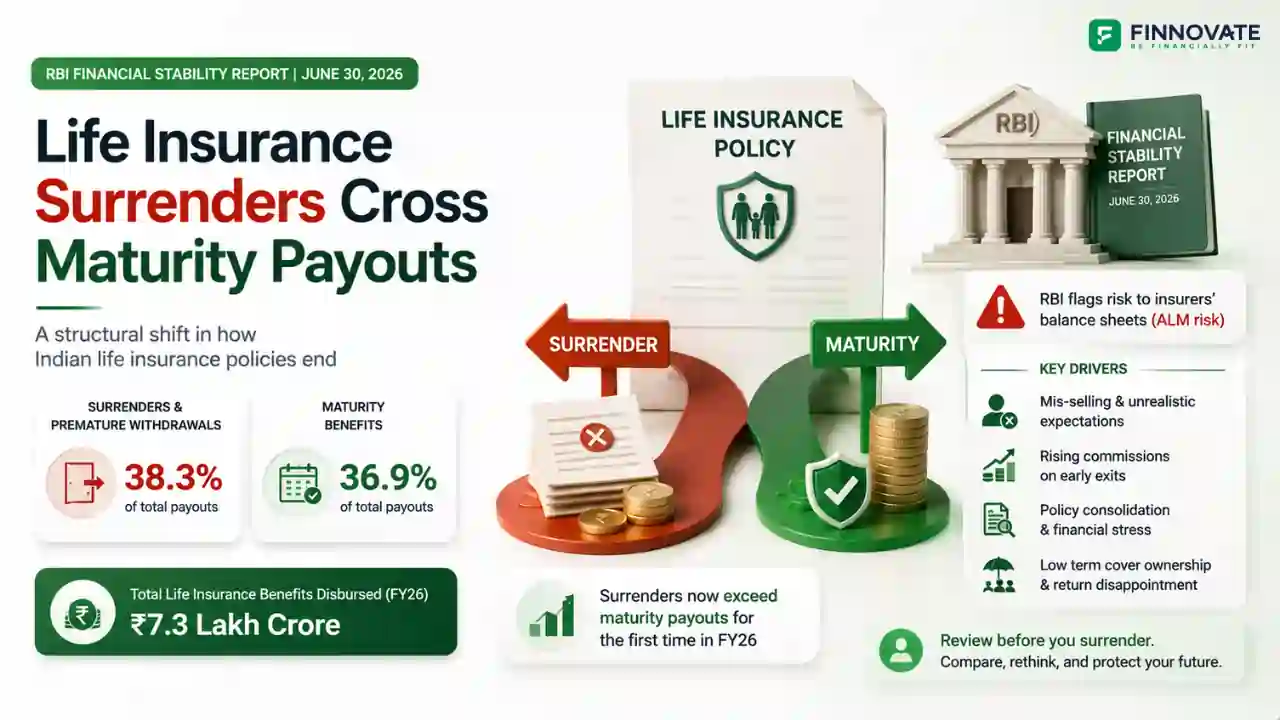
Life Insurance Surrenders Now Exceed Maturity Payouts in FY26
Surrenders made up 38.3% of life insurance payouts in FY26, ahead of maturity benefits at ...
07 July 2026

Finnovate’s editorial team researches and creates financial content using trusted sources, regulatory references and inputs from subject experts.
Insurance distribution has become a substantial source of fee income for Indian banks.
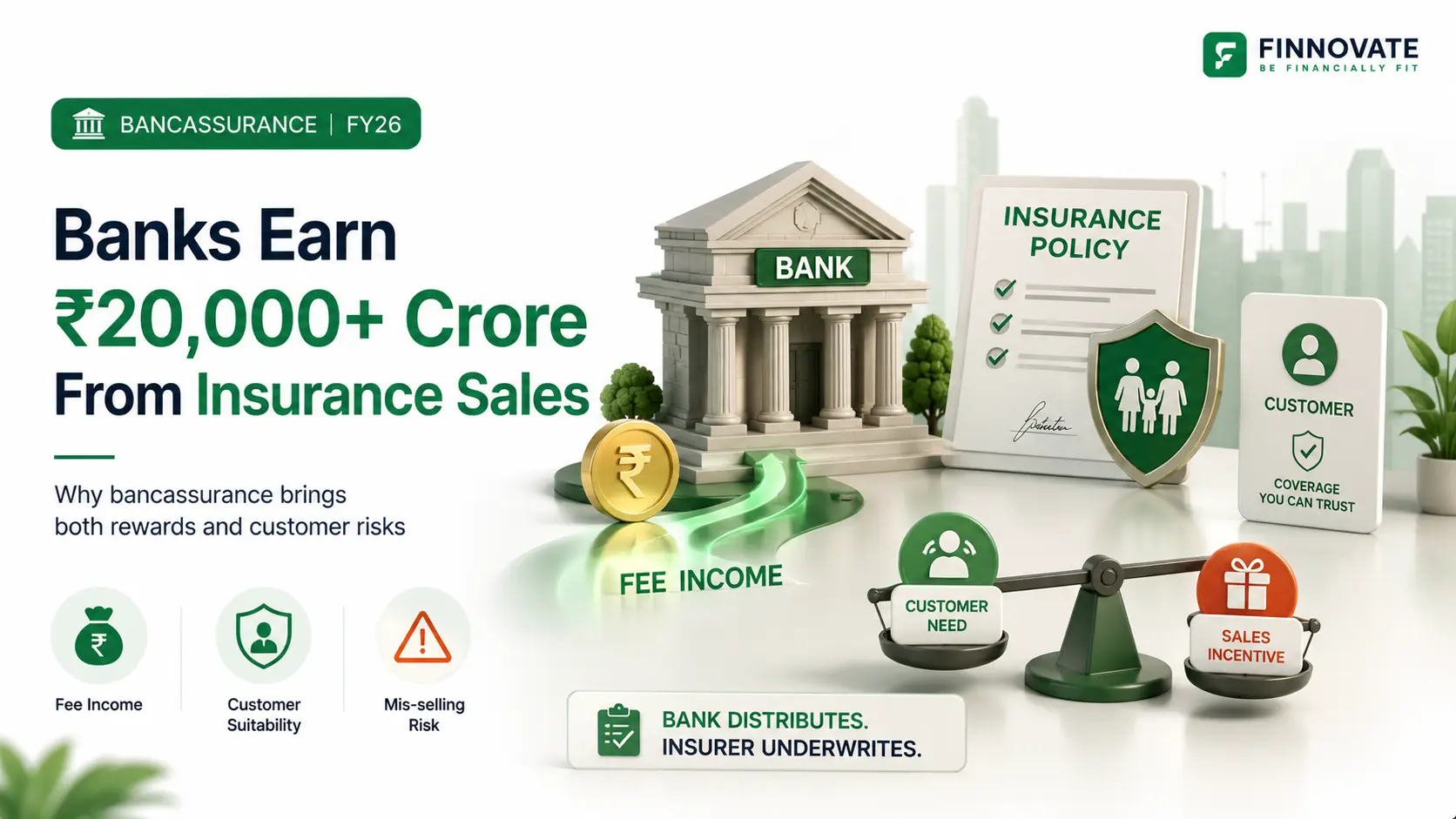
Leading public and private sector banks earned more than ₹20,000 crore in brokerage and commissions by distributing life, health and general insurance products during FY26. HDFC Bank, ICICI Bank, Axis Bank, State Bank of India and Kotak Mahindra Bank together accounted for approximately ₹18,565 crore of this income.
The numbers explain why banks are increasingly interested in insurance. They already have branches, digital platforms, customer information and established relationships. Selling an additional financial product to an existing customer is usually less expensive than acquiring a completely new customer.
However, the growth of bancassurance also raises important questions. Are customers being offered products that genuinely match their needs? Can sales incentives influence the advice they receive? And as fee income becomes more attractive, can banks maintain sufficient focus on deposits, lending and balance-sheet management?
Reported insurance-distribution income among five large banks was as follows:
| Bank | FY26 insurance-distribution income |
|---|---|
| HDFC Bank | ₹6,927 crore |
| ICICI Bank | ₹4,068 crore |
| Axis Bank | ₹3,700 crore |
| State Bank of India | ₹2,795 crore |
| Kotak Mahindra Bank | ₹1,075 crore |
| Combined total | ₹18,565 crore |
HDFC Bank’s total included approximately ₹5,688 crore from life insurance and ₹1,239 crore from health and general insurance distribution. SBI earned around ₹2,795 crore, largely through products offered by affiliated insurers such as SBI Life and SBI General Insurance.
These earnings are commissions and fees. The bank does not generally carry the underlying insurance risk.
Bancassurance is an arrangement under which a bank distributes insurance products through its branches, relationship managers, websites or mobile applications.
The roles remain separate:
This distinction matters. A bank may promote an insurance product, but the insurer is responsible for underwriting the policy, maintaining reserves and settling eligible claims.
Several major banks also have ownership or promoter relationships with insurers. HDFC Bank is associated with HDFC Life and HDFC ERGO, SBI with SBI Life and SBI General, and ICICI Bank with ICICI Prudential Life and ICICI Lombard.
These should be described as affiliated or group-linked insurers. “Group insurance” is a different term referring to policies that cover a defined group, such as employees, borrowers or members of an association.
Insurance distribution offers banks several commercial advantages.
First, it generates fee income without requiring the bank to create another loan or add credit risk to its balance sheet. This helps diversify revenue beyond the interest earned on lending.
Second, banks already know important details about their customers, including income patterns, liabilities, dependants, account balances and loan relationships. When used responsibly and with consent, this information can help identify protection gaps.
Third, customers often trust their bank and may find it convenient to purchase insurance from the same branch or application they already use.
For insurers, the bank provides immediate access to a large customer base and an established distribution network. Building an equivalent network of insurance agents, offices and digital acquisition channels can be expensive.
The model therefore creates a genuine economic benefit for both institutions. The concern begins when distribution incentives influence which product is recommended.
A large bank can deliver significant volumes of new business to an affiliated insurer. This creates scale, but it can also create concentration risk.
HDFC Life’s Q1 FY26 presentation showed that bancassurance contributed 60% of individual annualised premium equivalent, or APE. APE is commonly used to measure new life-insurance business. Once group business was included, the bank channel represented a smaller 23% of total distribution.
SBI Life received more than 60% of its business through banks, with a substantial portion coming from its parent, State Bank of India. The insurer has consequently been working to strengthen its agency and digital channels.
A bank-led distribution model creates several risks for an insurer:
Bancassurance is therefore valuable, but an insurer may still need agents, brokers, digital channels and non-bank partnerships to reduce dependence on one distributor.
Mis-selling occurs when a financial product is sold in a way that is unsuitable, misleading or inconsistent with the customer’s informed choice.
In insurance, this can include:
Mis-selling is not limited to banks. It can happen through agents, brokers, online platforms and other distributors. Bancassurance creates a particular concern because customers may assume that a recommendation from their bank is neutral.
The risk increases when employees face aggressive targets or receive incentives linked mainly to sales volumes.
A pure term plan generally provides high life cover for a comparatively low premium. It is most relevant when the objective is to protect dependants against the loss of the policyholder’s income.
Endowment plans, money-back policies and ULIPs combine insurance with savings or investment features. These products are not automatically unsuitable, but they have different costs, benefits, lock-ins and return characteristics.
The correct question is not whether one category is universally good or bad. It is whether the policy matches the customer’s protection requirement, affordability and time horizon.
For a product-level comparison, readers can refer to Finnovate’s guide to term insurance, endowment plans and ULIPs.
The Reserve Bank of India finalised stricter rules governing how banks and other regulated lenders advertise and sell financial products. The rules will take effect from January 1, 2027.
The framework:
The rules materially improve the customer-protection framework. The next challenge will be implementation across branches, digital channels, outsourced sales teams and individual relationship managers.
IRDAI is also examining changes to insurance commissions. One proposal under consideration would spread commission payments over the life of a policy instead of paying a large portion upfront. The objective is to reduce incentives for unsuitable sales and repeated policy replacement.
Traditional banking is built around two central activities:
Insurance and mutual-fund distribution can complement these activities, but they should not replace them.
Concerns have grown because bank credit has been expanding faster than deposits. When deposit growth is insufficient, banks may rely more heavily on certificates of deposit and other wholesale funding instruments.
Certificates of deposit are legitimate short-term funding tools. The risk arises when a bank becomes excessively dependent on short-term borrowing to support longer-duration loans. This can increase refinancing requirements and expose the bank to changes in wholesale funding costs.
Recent policy measures reduced three-month certificate-of-deposit rates by as much as 60 basis points during June 2026, temporarily easing the cost of short-term funding.
However, insurance selling cannot be identified as the direct cause of slower deposit growth. Deposit mobilisation is influenced by interest rates, competition from mutual funds, changes in household savings, loan demand and bank pricing.
The more appropriate governance question is:
Are sales targets for third-party products receiving greater management attention than stable deposits, lending quality and customer service?
Fee income is valuable, but banks must ensure that it does not distort branch priorities.
A bank branch can be a convenient place to buy insurance, but customers should evaluate the policy independently.
Before signing, ask:
Insurance should not be presented as mandatory for a loan unless legally or contractually required.
Identify whether the product offers protection, savings, investment, health coverage or a combination.
Separate guaranteed benefits from illustrations and market-linked projections.
Check whether the premium commitment fits future cash flow.
Understand lapse, paid-up, revival and surrender rules.
Review mortality charges, investment charges, waiting periods and claim exclusions.
Ask whether the bank distributes comparable policies from more than one insurer.
When the main objective is family protection, compare the proposed policy with pure term cover.
Insurance distribution has become a highly profitable fee business for Indian banks. It also gives insurers access to customers at a scale that would be difficult to build independently.
The model itself is not the problem.
The risk emerges when the commercial relationship between the bank and insurer begins to influence customer suitability, disclosure or consent. A second concern arises when the pursuit of commission income diverts organisational attention from deposits, lending and balance-sheet discipline.
Bancassurance can expand insurance access and generate legitimate revenue. Its long-term credibility, however, will depend on a simple principle:
The policy recommended to a customer should be based on the customer’s need, not merely on the commission available to the distributor.
Leading banks earned more than ₹20,000 crore in insurance-related brokerage and commissions. Five major banks together earned approximately ₹18,565 crore.
Generally, no. The insurance company underwrites the policy and carries the insurance risk. The bank acts as a distributor and earns a commission.
Not necessarily. A bank can be a convenient and legitimate distribution channel. Customers should still compare products, examine suitability and understand charges, exclusions and exit conditions.
Banks cannot ordinarily force customers to purchase an additional paid product merely as a condition for accessing a banking service. RBI’s new rules explicitly restrict compulsory bundling.
The main concerns include mis-selling, incentive-driven recommendations, insurer dependence on bank channels and the possibility that aggressive cross-selling may distract banks from core activities.
Bancassurance refers to a bank distributing insurance products. Group insurance refers to a policy covering a defined group of people, such as employees or borrowers.
Disclaimer: This article is for general information and educational purposes only. It does not constitute insurance, investment or financial advice. Policy benefits, costs, exclusions and suitability differ across products and customers.
No spam. Only new posts, simple explainers, and practical money checklists for busy professionals.
Finnovate is a SEBI-registered financial planning firm that helps professionals bring structure and purpose to their money. Over 3,500+ families have trusted our disciplined process to plan their goals - safely, surely, and swiftly.
Our team constantly tracks market trends, policy changes, and investment opportunities like the ones featured in this Weekly Capsule - to help you make informed, confident financial decisions.
Learn more about our approach and how we work with you:
No comments yet. Start the conversation. What would you add?
No spam. Only new posts, simple explainers, and practical money checklists.
You may also like
Surrenders made up 38.3% of life insurance payouts in FY26, ahead of maturity benefits at ...

India's 2025 insurance law passed by Parliament didn't extend open architecture to individ...
Compare Term Insurance, Endowment, and ULIP in a clear, unbiased way. Understand costs, co...
Compare family floater vs individual health insurance in India - costs, coverage, pros & c...
Popular now
Learn how to easily download your NSDL CAS Statement in PDF format with our step-by-step g...

Looking for the best financial freedom books? Here’s a handpicked 2026 reading list with...
Learn what SIF investment means in India, SEBI rules, Rs 10 lakh minimum investment, avail...
Clear guide to mutual fund taxation in India for FY 2025–26 after July 2024 changes: equ...