
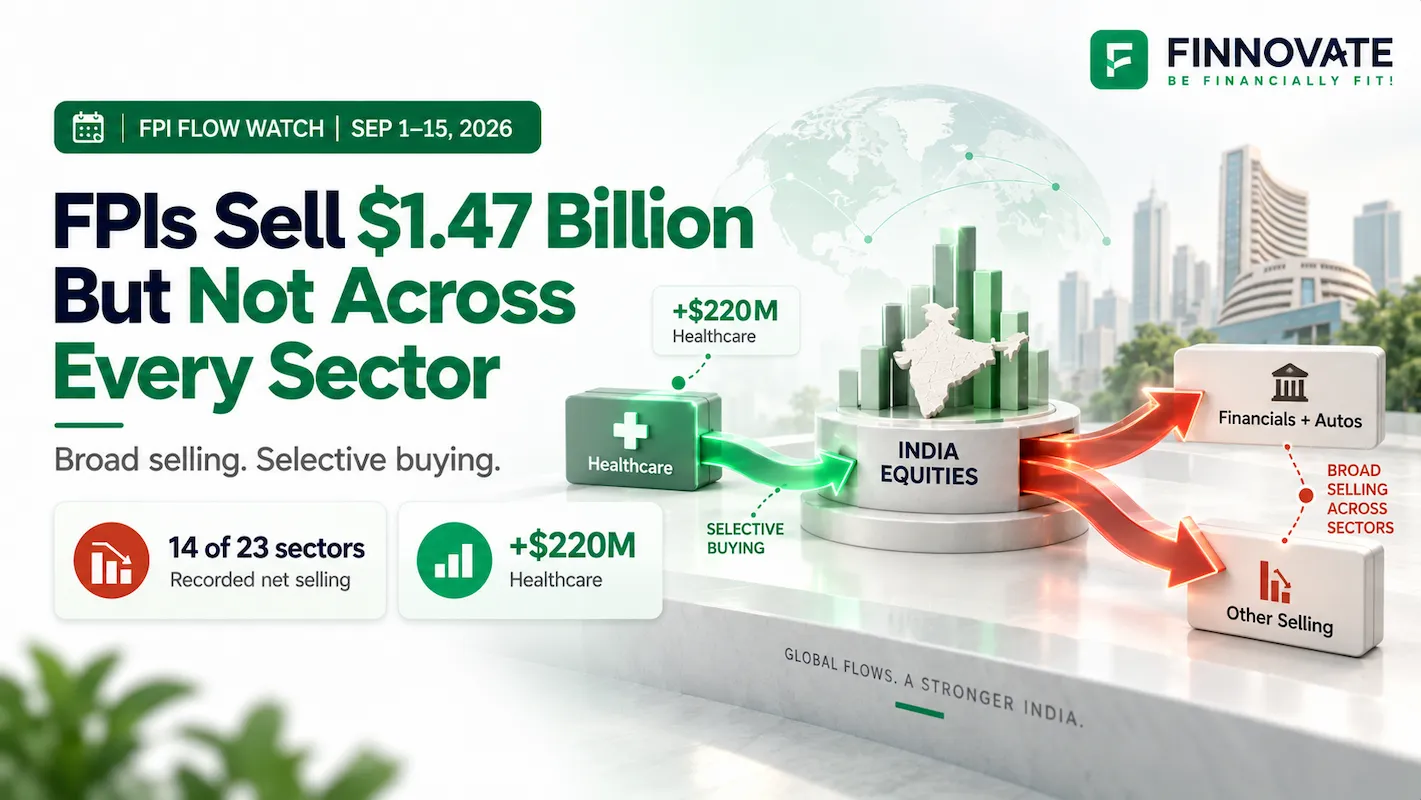
FPI Flows First Half September 2026: $1.47 Billion Net Selling
FPIs net sold $1.47 billion in Indian equities during September 1–15, 2026. Explore sect...
23 September 2026

Finnovate’s editorial team researches and creates financial content using trusted sources, regulatory references and inputs from subject experts.
An empty aluminium can still has value after the drink is gone. The metal inside it still has work to do. Collect it, sort it and process it, and it can become material for another product.
That is why a rule about shipping waste can matter to factories far beyond the recycling industry.
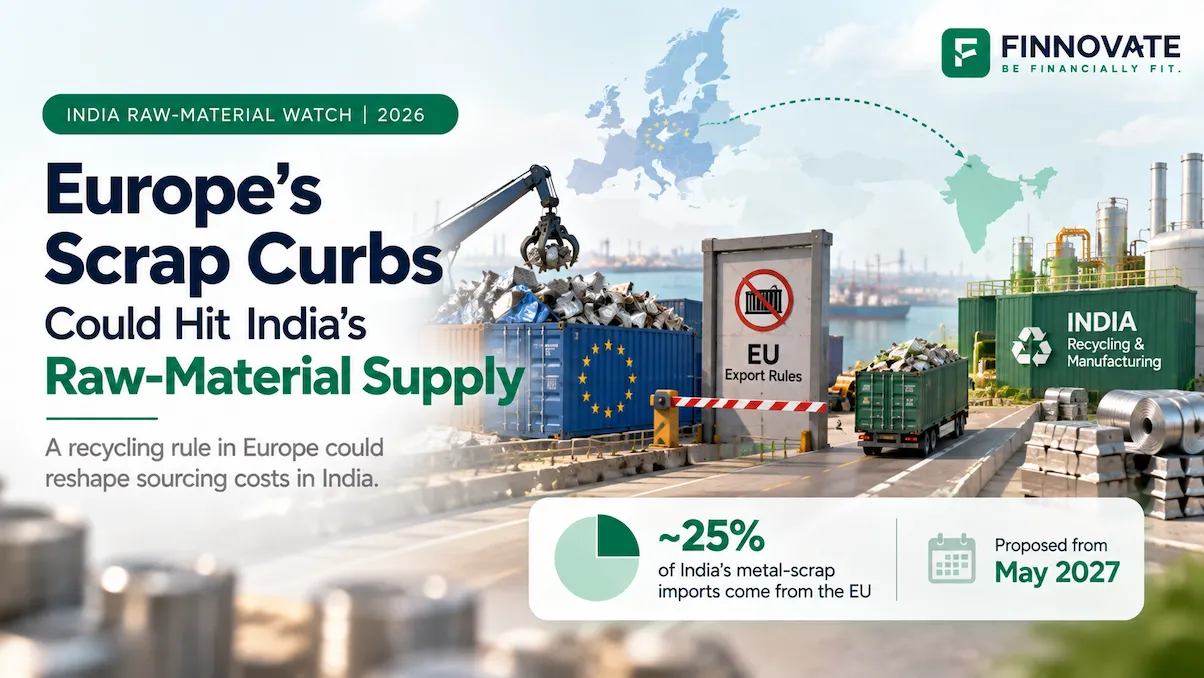
On September 18, 2026, the European Commission published a proposal that would restrict India’s access to EU metal scrap. On September 23, Indian recyclers sought government intervention.
The concern is straightforward. If an established source of scrap becomes harder to access, businesses that turn it into usable metal may have to rethink their supplies and costs.
For India, this is a story about how environmental rules can shape access to industrial raw materials.
The proposal sits under the EU’s Waste Shipment Regulation, adopted in 2024. The relevant export restrictions begin on 21 May 2027.
For certain non-hazardous waste exports to non-OECD countries, continued access depends on approval. Countries must request permission and demonstrate that they can manage the material in an environmentally sound way.
The Commission’s September draft sets out the proposed permissions. India would be excluded from receiving the covered metal waste.
There is still a process ahead. Public consultation runs until 16 October 2026, and the Commission expects to establish the first approved list by the end of the year. Countries can reapply, and the list must be updated at least every two years.
So businesses have a proposed restriction and a future implementation date to prepare for. Shipments have not stopped because of this announcement.
Industry estimates put the EU’s share at roughly one-quarter of India’s metal-scrap imports. The dependence varies by metal.
| Scrap category | EU share of India’s imports in FY2025/26 |
|---|---|
| Aluminium | About 20% |
| Copper and copper alloys | About 22% |
| Lead | About 20% |
| Zinc | About 40% |
Source: Material Recycling Association of India estimates reported by Reuters.
These figures measure the EU’s share of scrap imports. Domestic scrap and primary metal production also contribute to India’s supply.
The table tells us where an import disruption could matter. It cannot tell us how much prices would rise. That depends on the material affected, available substitutes and the terms on which buyers can secure them.
Think of the chain in four steps: scrap is collected, processed, converted into usable metal and supplied to manufacturers.
The exact process differs by metal and the product being made. But the commercial logic is familiar. A recycler buys an input, spends money turning it into something useful and sells the output.
If access to that input changes, the business must adjust.
Consider a recycler that regularly buys a suitable grade of scrap from Europe. If that supply becomes unavailable, finding another seller is only the first task. The replacement must also meet the plant’s processing needs and the customer’s quality requirements.
Three possible pressures follow.
First, the replacement material could cost more once freight and handling are included. Second, longer or less predictable deliveries could encourage the recycler to hold more stock, tying up cash. Third, changes in material quality could require adjustments in processing.
These are possible effects, not measured outcomes of the September proposal. Their scale will depend on the final rules and each business’s sourcing options.
If costs do rise, a recycler may absorb them through lower margins, negotiate higher selling prices or change its production plans. That is how a restriction at the scrap-import stage could eventually reach downstream manufacturers.
Recycling allows metal already in circulation to be used again. Producing primary metal starts with mined resources and involves a different production chain.
That distinction matters for energy use.
The figure applies to that specific comparison. Savings differ across metals and production methods, but it shows why access to recyclable material has value beyond its purchase price.
For a manufacturer, replacing recycled metal with primary metal could change its input costs and environmental footprint. For a recycler, it could require a much more fundamental change in operations. The two production routes cannot simply be swapped at every plant.
This also explains why scrap policy belongs in the wider discussion about manufacturing and resource security.
Recycling can conserve resources while still causing harm if waste is handled badly. The EU’s stated aim is to ensure that exported waste is managed safely in the receiving country.
For metal waste, the Commission has pointed to the potential presence of persistent and toxic heavy metals.
The distinction is between a material’s economic value and the conditions under which it is processed. Valuable scrap still needs sound handling, treatment and management of the waste left behind.
Indian recyclers dispute the proposed exclusion. MRAI points to India’s environmental framework and describes the proposal as “resource protectionism”.
Europe’s own industry has a commercial interest in retaining scrap. Earlier in September, the Commission dropped a separate proposed 15% aluminium-scrap export duty. European Aluminium had supported that measure as a way to keep more raw material within Europe.
Environmental safeguards and industrial interests therefore meet in the same policy debate. The practical question for India is what evidence and changes would secure continued access under the EU’s assessment.
MRAI has also sought zero-duty scrap imports under the India–EU trade deal.
The wider agreement has moved beyond negotiations. Talks concluded in January 2026, and the Commission submitted proposals for signature in September. Further approval and ratification steps remain before it can enter into force.
But there are two separate questions here.
What does a shipment cost? And is that shipment permitted?
A lower import duty can reduce the cost of an eligible shipment. It cannot, by itself, make a shipment eligible under another jurisdiction’s export rules.
That makes regulatory access central to this dispute. Tariff concessions would have limited use for a supply route that remains closed.
The immediate priority is the approval process. The consultation and final list will determine whether the proposed position changes and what access is available for the relevant waste categories.
Businesses also need to assess their own exposure. The national import share is a starting point, but a recycler’s risk depends on its suppliers, grades of scrap, contracts and ability to source alternatives.
Domestic collection and processing offer a longer-term response. India’s Steel Scrap Recycling Policy already recognises the need for organised collection, dismantling and processing, along with suitable scrap quality.
Building that system takes more than collecting additional tonnes. Material must reach processors in a form they can use, consistently and at a workable cost. Investment in sorting and processing therefore matters alongside the amount collected.
Alternative overseas suppliers could help too. Whether they can replace European material at comparable quality, volume and cost remains an open question.
Scrap sits at the intersection of two goals: managing waste safely and supplying factories with useful material.
As countries try to recycle more within their own borders, access to that material can become a source of competition. Rules governing what leaves one market can influence what it costs to manufacture in another.
For India, the task is to preserve access to suitable scrap while improving the strength of its own recycling system. For businesses, the lesson is equally practical: raw-material security includes the metal that has already been used once.
Disclaimer: This article is for educational and informational purposes only and does not constitute investment advice. The EU proposal discussed is subject to consultation and final regulatory decisions. Potential effects on supply and costs are uncertain. Information is current as of 24 September 2026.
No spam. Only new posts, simple explainers, and practical money checklists for busy professionals.
Finnovate is a SEBI-registered financial planning firm that helps professionals bring structure and purpose to their money. Over 3,500+ families have trusted our disciplined process to plan their goals - safely, surely, and swiftly.
Our team constantly tracks market trends, policy changes, and investment opportunities like the ones featured in this Weekly Capsule - to help you make informed, confident financial decisions.
Learn more about our approach and how we work with you:
No comments yet. Start the conversation. What would you add?
No spam. Only new posts, simple explainers, and practical money checklists.
You may also like
FPIs net sold $1.47 billion in Indian equities during September 1–15, 2026. Explore sect...
Nearly 39% of India’s monitored coal power plants were critically low on fuel in Septemb...
Tata Sons faces a major governance dispute over N Chandrasekaran’s reappointment, RBI li...
India’s CPI inflation rose to 4.82% in August 2026 as food inflation neared 6% and rural...
Popular now
Learn how to easily download your NSDL CAS Statement in PDF format with our step-by-step g...

Looking for the best financial freedom books? Here’s a handpicked 2026 reading list with...
Learn what SIF investment means in India, SEBI rules, Rs 10 lakh minimum investment, avail...
Clear guide to mutual fund taxation in India for FY 2025–26 after July 2024 changes: equ...