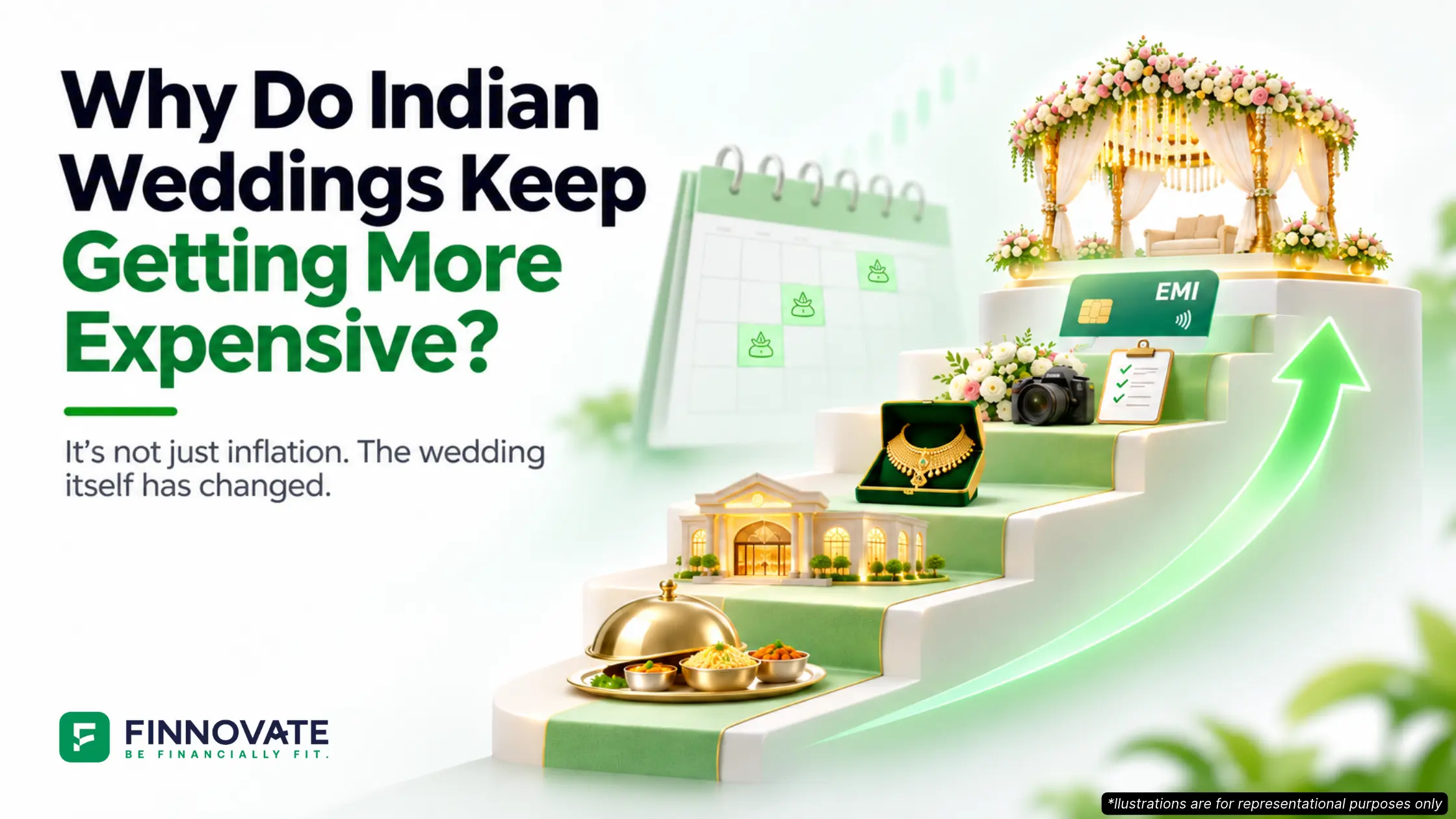
Why Do Indian Weddings Keep Getting More Expensive?

Finnovate’s editorial team researches and creates financial content using trusted sources, regulatory references and inputs from subject experts.
India is in the middle of what could be its biggest wedding season yet.
Between November 21 and December 15, 2026, an estimated 52 lakh weddings are expected to take place across the country. According to the Confederation of All India Traders (CAIT), these weddings could generate ₹7.5 lakh crore in business in just 25 days.
In 2022, that figure stood at ₹3.75 lakh crore.
India's wedding economy has effectively doubled since 2022. But have weddings themselves become twice as expensive?
The numbers tell a slightly different story.
CAIT's 2022 estimate covered 32 lakh weddings. That works out to roughly ₹11.7 lakh in business per wedding. In 2026, the corresponding figure stands at around ₹14.4 lakh.
Overall wedding business has grown by 100% since 2022. The estimated business generated per wedding has grown by around 23%.
A significant part of the industry's growth comes from the sheer number of weddings taking place. But families are also spending more, both because things have become expensive and because the nature of Indian weddings has changed.
The economics of wedding season
Consider one of the most basic expenses at an Indian wedding: food.
India's retail inflation rose to 6.09% in October 2026, breaching the RBI's upper tolerance limit of 6% for the first time under the new CPI series. Food inflation was considerably higher at 8.94%, according to government data.
Ingredients such as ghee, milk, butter, vegetables and dry fruits are essential to most Indian wedding menus. When these become expensive, caterers have little choice but to absorb some of the additional costs or pass them on to customers.
A Business Standard report published on November 23, 2026 featured a wedding venue owner in Muzaffarnagar, Uttar Pradesh, who estimated that local per-plate catering costs had risen by nearly 25–30%, owing to higher ingredient and labour costs.
The same report highlighted a bride-to-be whose venue's per-plate charges had increased from ₹3,100 to ₹3,575.
For a wedding with 500 guests, a price difference of ₹475 per plate translates into an additional expense of ₹2.38 lakh. And that's before making any changes to the menu or guest list.
But rising input costs are only part of the problem.
Indian weddings operate within a rather unusual market. A large number of families want to get married on a limited number of auspicious dates.
There are only so many banquet halls, photographers, caterers and makeup artists available on any given day. This season, CAIT expects more than two lakh weddings a day, roughly double the daily pace of the 2025 season.
Unlike a manufacturer that can increase production when demand rises, a popular wedding venue cannot create another banquet hall overnight.
WedMeGood's 2025–26 wedding industry report found that the availability of preferred wedding dates accounted for nearly 38% of reported venue-related frustrations.
This concentration of demand gives vendors greater pricing power during the wedding season.
We are also buying a different kind of wedding
Of the ₹7.5 lakh crore in business projected this season, CAIT expects ₹4.05 lakh crore to come from the purchase of goods such as jewellery, clothing, gifts and household items.
The remaining ₹3.45 lakh crore is expected to flow into services.
Catering alone could account for ₹75,000 crore. Wedding venues and hotels could generate another ₹60,000 crore. Wedding planners, decorators, photographers and beauty professionals are expected to account for a substantial share of the remaining expenditure.
Services account for nearly half of India's projected wedding-season business.
Many activities that families once handled themselves or with help from relatives are increasingly being outsourced to professionals.
A wedding photographer is often accompanied by a cinematographer, a drone operator and a team creating short videos for social media. There are specialised planners for individual functions, customised invitations, elaborate décor and pre-wedding shoots.
Each of these represents an additional purchase that may not have featured in a wedding budget a generation ago.
And even having fewer guests may not necessarily translate into a cheaper wedding.
According to WedMeGood's survey of more than 2,000 couples, the average wedding budget stood at ₹39.5 lakh in 2025, up 8% from the previous year. Destination weddings averaged ₹58 lakh.
Interestingly, destination weddings hosted an average of 280 guests, compared with 420 at local weddings.
Accommodation, hospitality and logistics can absorb much of the money saved by inviting fewer people.
These figures reflect the wedding platform's survey respondents rather than the average Indian household. Nevertheless, they offer a useful glimpse into how wedding spending is evolving among urban and relatively affluent families.
The gold equation
Then there is gold.
CAIT expects jewellery and precious metals to generate approximately ₹1.2 lakh crore in business this wedding season, making it the largest individual spending category in its estimates.
However, higher gold expenditure doesn't necessarily mean families are buying more jewellery.
The World Gold Council's November 2026 market update found that average gold prices during this year's festive period were nearly 10% higher than during the 2025 festive period, despite the correction since mid-October.
Gold is about 29% below its January 2026 peak, as we covered in Bought Gold or Silver at the Peak? What History Says. Even so, it is still costlier than it was during the 2025 festive season.
Retailers reported stronger sales in value terms, while purchase volumes remained largely flat or marginally higher.
Customers were also opting for lighter ornaments and exchanging existing jewellery to fund new purchases.
In other words, a family may walk into a jewellery store with the same budget as last year and walk out with less gold.
Similar adjustments are visible elsewhere.
Wedding vendors interviewed by Business Standard reported families reducing the size of guest lists, in some cases from about 1,000 guests to 500, choosing smaller venues and limiting hall bookings to one day instead of two or three.
Some are moving the celebration out of the city altogether. A Delhi caterer told the paper that a farmhouse costing ₹6 lakh in Delhi can be booked for around ₹60,000 in Rishikesh.
Some brides are purchasing one elaborate outfit for the wedding itself and choosing less expensive outfits for the remaining functions.
These are examples of how households are adapting to rising costs, even as the overall wedding industry continues to grow.
Who is paying for all of this?
For most surveyed couples, the answer is still savings.
WedMeGood's 2025–26 report found that nearly 79% of respondents financed their weddings through savings. Around 15% relied on loans from banks, friends or family, while approximately 6% financed their weddings by selling assets. The average reported loan amount was ₹15.5 lakh.
A loan of that size, repaid over a few years, can add lakhs of rupees in interest alone. But the larger cost is often the one that never shows up on a loan statement.
Savings that pay for a wedding are usually savings that were meant for something else: a retirement corpus, a home down payment, a child's education. Money withdrawn from those goals stops compounding the day it is spent. The gap tends to surface years later, when there is far less time to rebuild it.
That is why the same wedding looks very different on an invoice than on a family's balance sheet. The invoice ends on the wedding day. The balance sheet carries it for years.
India's growing wedding economy is undoubtedly good news for jewellers, hotels, caterers, small businesses and the millions of people whose livelihoods depend on these celebrations.
For individual households, however, the economics are different.
What represents higher revenue for a wedding business represents an expense for a family. And while the wedding industry can look forward to the next season of celebrations, households continue to carry the financial commitments that remain long after the wedding is over.
FAQs
1. How many weddings will take place in the 2026 wedding season?
CAIT estimates about 52 lakh weddings between November 21 and December 15, 2026, generating ₹7.5 lakh crore in business. That is more than two lakh weddings a day.
2. Have Indian weddings become twice as expensive since 2022?
No. Total wedding business has doubled from ₹3.75 lakh crore in 2022 to ₹7.5 lakh crore in 2026, but the estimated business per wedding rose by around 23%, from roughly ₹11.7 lakh to ₹14.4 lakh. Much of the growth comes from a larger number of weddings.
3. Why do wedding venues and vendors charge more during the wedding season?
A large number of families want to marry on a limited number of auspicious dates, while venues, caterers and photographers cannot expand overnight. This concentration of demand gives vendors greater pricing power.
4. How are Indian couples paying for their weddings?
WedMeGood's 2025–26 report found that nearly 79% of couples used savings, around 15% took loans from banks, friends or family, and about 6% sold assets. The average loan was ₹15.5 lakh.
5. What is the hidden cost of paying for a wedding from savings?
Savings used for a wedding are often money set aside for goals such as retirement, a home or a child's education. Once withdrawn, that money stops compounding, which can leave a larger gap to fill later.
Sources
- Business Standard: Band, baja, inflation: How rising prices are reshaping this wedding season, November 23, 2026
- Finnovate: India CPI inflation, October 2026
- WedMeGood Annual Wedding Industry Report 2025–2026
- World Gold Council: India gold market update, November 17, 2026
- Finnovate: Bought Gold or Silver at the Peak? What History Says
Disclaimer: This article is for information and education only and is not a recommendation to buy, sell or hold any security or financial product. Wedding-season figures are estimates by the organisations named and may differ from actual spending. The loan example is illustrative and excludes processing fees and other charges.