
June 23, 2026
21 min read
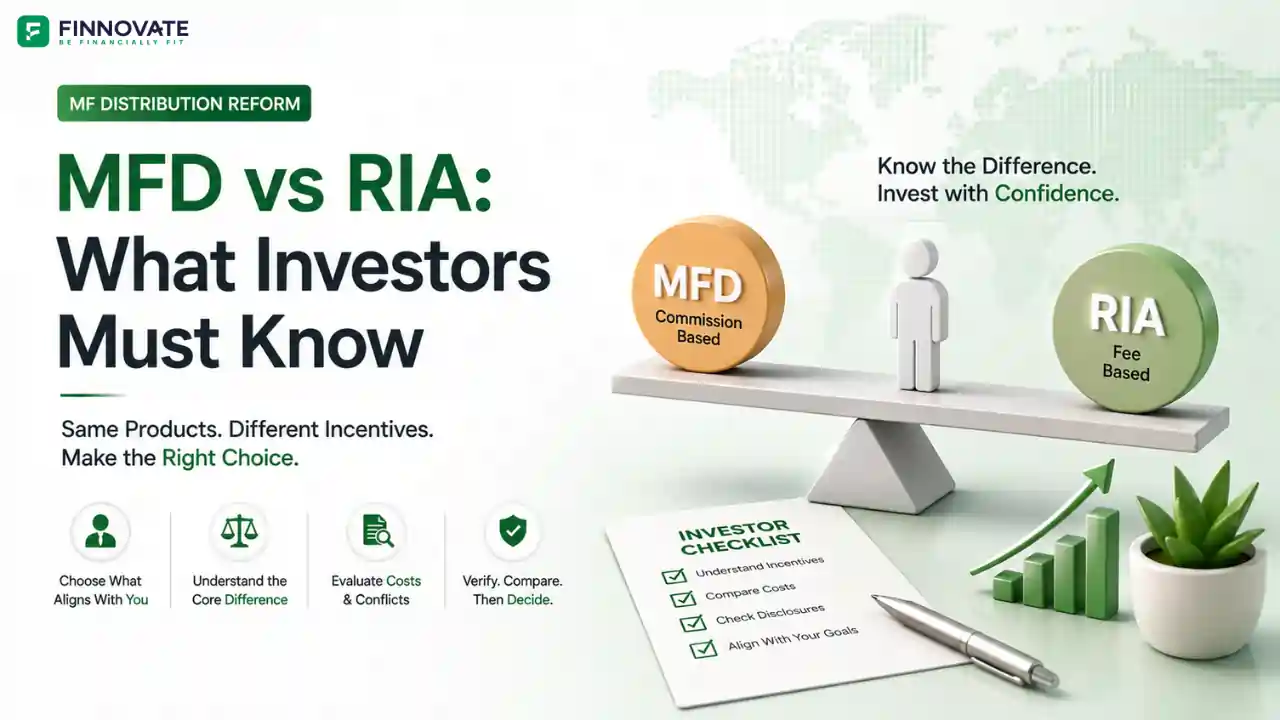
3D blog banner showing the difference between SEBI RIAs and Mutual Fund Distributors, with a seesaw balancing MFD (commission-based) and RIA (fee-based), checklist for investors, comparison icons, charts, and clean white-green professional infographi

SEBI RIA vs Mutual Fund Distributor: What Every Investor Should Know

India has over 1,54,000 mutual fund distributors and a significantly smaller number of SEBI-registered investment advisers. Both sit across from you to discuss your investments. Both use the word "advisor." But only one is legally required to act in your interest. Understanding the difference is a useful starting point before your next financial planning conversation.

Key Takeaways

  • A SEBI RIA is bound by fiduciary duty and must act in your interest. An MFD operates on a suitability standard with no such obligation.
  • MFDs earn trail commission (typically 0.5 to 1.0% on equity AUM annually) from fund houses. The investor pays nothing directly, but the cost is embedded in the regular plan's higher expense ratio.
  • MFDs are legally prohibited from giving financial planning or goal-based advice under SEBI regulations, even if they currently do so.
  • SEBI-registered RIAs are significantly fewer than MFDs. Verify the current count at sebi.gov.in/intermediaries (search: Investment Advisers). As of June 2026 there were 1,034 registered RIAs serving 20+ crore investors.
  • You can verify any SEBI RIA in under a minute on SEBI's intermediary portal at sebi.gov.in.

The Core Difference in One Sentence

A Mutual Fund Distributor (MFD) is an AMFI-registered professional who facilitates investments in mutual funds and earns trail commission from fund houses, not fees from investors. A SEBI Registered Investment Adviser (RIA) is a SEBI-registered professional who provides financial planning and investment advice for a fee paid directly by the client.

A Mutual Fund Distributor earns from the products they sell. A SEBI Registered Investment Adviser earns from the client they serve. This single structural difference, not qualifications, not experience, not personality, determines whose interest they are legally required to prioritise when giving you advice. A fiduciary duty means the adviser is legally required to act in the client's best interest: not merely recommend something suitable, but recommend what is genuinely optimal for that client's situation.

ParameterMutual Fund Distributor (MFD)SEBI Registered Investment Adviser (RIA)
Primary roleDistributes mutual fund unitsProvides financial planning and investment advice
Regulated bySEBI + AMFI (ARN holder)SEBI (IA Regulations 2013, as amended)
Earns fromTrail commission paid by fund houses (0.5 to 1.0% on equity AUM per year)Fees paid directly by the client (fixed or AUA-based)
Fiduciary dutyNo (suitability standard applies)Yes, legally bound to act in client's best interest
Can give financial planning adviceNo, prohibited by SEBI IA RegulationsYes, core scope of practice
Delivers a written financial planNoYes, mandatory under SEBI rules
Advises across all asset classesNo, limited to products they are licensed to distributeYes, mutual funds, equity, insurance, NPS, debt, and more
Can earn commission and charge feeNo, must choose one model; individuals cannot hold both licencesNo, fee-only with zero trail commission
Max fee / earning capNo cap on trail commissions earned from fund housesUp to ₹1.51 lakh per family per year (fixed) or 2.5% of AUA (verify current cap at sebi.gov.in as SEBI reviews this every three years)
Verify registrationAMFI ARN portal at amfiindia.comSEBI intermediary portal at sebi.gov.in (intmId=13)
Note on standards: "Fiduciary duty" means the adviser must act in the client's best interest, recommending the genuinely optimal option, not just a suitable one. "Suitability standard" means the adviser must recommend products appropriate to the investor's situation, but is not required to recommend the single best option available.

How Each Earns Money, and Why It Matters

The earnings model is not just an accounting detail. It determines, at the structural level, which recommendations serve you and which serve the adviser's income. Understanding it removes the need to guess about anyone's motives.


How a Mutual Fund Distributor Earns

When you invest through an MFD, you typically buy the "regular plan" of a mutual fund. The fund house charges a higher expense ratio (the annual cost deducted from the fund's NAV to cover management and distribution expenses) on regular plans compared to direct plans. The difference, typically 0.5% to 1.0% per year on equity funds, is paid by the fund house to the MFD as a trail commission (an annual payment calculated as a percentage of the investor's AUM, paid every year the investment stays in the fund), as long as your money stays invested. You never see a separate invoice. The cost is embedded in the NAV of the fund.

SEBI banned upfront commissions for MFDs in October 2018 (SEBI Circular, October 22, 2018). All commissions are now trail-based, which removed the churn incentive but did not remove the commission model itself. The total mutual fund distributor commission pool has grown significantly with AUM growth, reaching approximately ₹21,107 crore in FY 2024-25, a 42% increase over the prior year (Cafemutual annual industry data; updated each financial year).


How a SEBI RIA Earns

A SEBI-registered investment adviser charges you directly. Either a fixed annual fee or an AUA-based fee. SEBI caps both: as of January 2025, the fixed cap is ₹1,51,000 per family per year and the AUA-based cap is 2.5% of assets under advice per year. These limits are reviewed every three years; verify the current cap at sebi.gov.in before engaging an adviser. There is no trail commission, no payment from any fund house, no product-linked income of any kind. The adviser earns the same whether they recommend Scheme A or Scheme B, whether markets go up or down, and whether you invest in equity or debt. The only source of income is the fee you agree to pay.


The Structural Conflict of Interest

When an adviser earns more if you stay invested in higher-commission regular plans, and earns less if you switch to direct plans, the structural incentive is clear regardless of the individual's character. This is not a statement about any particular MFD. It is a statement about what the earnings model makes rational.

"We built Finnovate as a fee-only RIA because a commission-based model creates a conflict of interest that is structural, not personal. It doesn't matter how ethical an individual adviser is. If their income depends on what you hold, their recommendation cannot be fully independent. The fee-only model removes that problem at the root." Finnovate Financial Services, SEBI-registered Investment Adviser (INA000013518)
MUTUAL FUND DISTRIBUTOR Investor buys regular plan Fund House higher TER collected invests MFD earns trail commission 0.5 to 1.0% equity AUM paid annually No direct invoice cost embedded in NAV Commission from product. Not from you. SEBI REGISTERED RIA Investor pays adviser directly RIA earns advisory fee fee Zero trail no fund house payment Up to ₹1.51L/yr or 2.5% of AUA (SEBI 2025) Fee from you. Advice aligned to you.

Source: SEBI IA Regulations (as amended); SEBI Circular on upfront commission ban (October 2018)


What Each Can and Cannot Do for You

The licensing boundary between MFDs and RIAs is not just a technicality. It determines what kind of advice you can legally receive, and whether the person across the table is working within or outside their permitted scope.


What a Mutual Fund Distributor Is Permitted to Do

An MFD can recommend and execute investments in mutual funds through the regular plan route. They can also distribute insurance products (earning commissions), refer National Pension System (NPS) subscriptions, and distribute other permitted financial products. An MFD is permitted to explain product features, help with KYC and paperwork, and assist in operational matters like SIP setup and redemptions.


What a SEBI RIA Is Permitted to Do

A SEBI RIA can provide comprehensive, written financial advice across all asset classes: mutual funds (direct plans only), equity, fixed income, NPS, insurance coverage assessment, real estate allocation, and tax-optimised structures. Critically, a SEBI RIA is required to deliver a written financial plan, conduct annual reviews with written updates, and sign a formal client agreement outlining the scope of advice and fees before beginning any advisory relationship. This is not optional: it is mandated by SEBI IA Regulations.


The Grey Zone: Where Investors Get Confused

Many mutual fund distributors routinely provide what is functionally financial planning advice: "Put 60% in equity and 40% in debt given your age," "You need to build a retirement corpus of ₹3 crore," "Your insurance is insufficient, take this policy." Each of these statements is financial planning advice. Under SEBI regulations, an MFD providing this type of advice is acting outside their permitted scope.

Additionally, SEBI's guidelines restrict MFDs from using titles like "financial planner," "financial adviser," "investment adviser," or "wealth manager" unless they hold the corresponding SEBI registration. Many distributors use these titles in business cards and websites. The distinction matters because an investor relying on goal-based or planning-level advice from an MFD has no legal recourse if that advice proves wrong. The MFD was not licensed to give it in the first place.


The Numbers That Tell the Story

Two data points from independent sources explain the current state of financial advice in India better than any description.

Financial Advisers in India: The Disparity 1,54,000+ Mutual Fund Distributors (MFDs) AMFI, 2024 ~1,034 SEBI RIAs (Jun 2026*) SEBI portal* 1 RIA for every ~149 MFDs. 1 RIA for every ~1,93,000 investors.

Sources: SEBI intermediary portal (1,034 RIAs as of June 2026; verify current count at sebi.gov.in); AMFI distributor data (as of early 2024, the most recently published figure)

A second data point comes from the AMFI-CRISIL Mutual Fund Factbook, the most recently published edition (2024) shows that direct plan mutual funds grew from a 27.4% share of total AUM in March 2019 to 41.2% by March 2024. The trend toward direct plans has been directional and consistent across each annual Factbook.

Direct Plan AUM Share: 2019 to 2024 20% 27% 34% 41% 48% 27.4% 41.2% 2019 2020 2021 2022 2023 2024 Direct plan AUM as % of total MF industry AUM

Source: AMFI-CRISIL Mutual Fund Factbook (2024 edition, the most recently published annual data). Intermediate years (2020 to 2023) are approximate interpolations; endpoints are confirmed. Chart will be updated when a newer Factbook is published.

One nuance worth noting: the same AMFI-CRISIL Factbook (2024 edition) shows that regular plan investors hold their funds for longer. 21.2% of regular plan investors held for 5 or more years, compared to 7.7% for direct plan investors. This suggests that the advisory relationship, even when commission-based, provides behavioural value by keeping investors invested through volatile periods. The debate is not simply "regular bad, direct good." It is about whether the cost of the commission model is worth the behavioural benefit it provides, and whether a fee-only adviser can deliver that same behavioural value more cost-effectively.


The Regulatory Timeline: How SEBI Drew This Line

SEBI has been progressively tightening the separation between distribution and advice since 2013. Understanding this timeline helps investors see that the current rules are not arbitrary. They are the result of a decade of enforcement experience and investor protection policy.

  • January 2013: SEBI IA Regulations 2013 notifiedFirst formal framework establishing RIA registration, fiduciary duty, and the explicit prohibition on individuals simultaneously acting as both distributor and adviser.
  • October 2018: Upfront commission banSEBI circular banning upfront commissions for MFDs. All commissions moved to trail-only to reduce portfolio churning incentives.
  • July 2020: SEBI IA Amendment RegulationsWritten client agreements made mandatory for RIAs. Client-level segregation between advisory and distribution services enforced. Fee caps introduced for the first time.
  • December 2024: SEBI IA Second Amendment RegulationsGraduate degree made sufficient for RIA qualification (postgraduate degree no longer mandatory). Net-worth requirement replaced by a graded deposit system. A new Part-Time Investment Adviser (PTIA) category introduced, capped at 75 clients. Individual RIA threshold raised from 150 to 300 clients or ₹3 crore fee per year.
  • June 2025: SEBI Master Circular for Investment AdvisersConsolidated all IA-related circulars and directions up to June 2025 into a single operative document. Now the primary compliance reference for all registered RIAs.

The direction of SEBI's rulemaking since 2013 has been consistent: widen access to the RIA model, tighten the boundary between distribution and advice, and increase accountability through written agreements and formal plans. The December 2024 amendments, in particular, are significant. Removing the postgraduate requirement and eliminating the net-worth clause has lowered the barrier to entry for qualified individuals to become RIAs. The supply of fee-only advisers should gradually increase.


A Practical Scenario: Same Investor, Two Different Conversations

Consider Dr. Anand, 38, a surgeon with a monthly take-home of ₹2.8 lakh. He has ₹45 lakh in a savings account, ₹30 lakh in regular plan SIPs running since 2019, and three goals: a home in Mumbai in 4 years (₹1.8 crore), his son's higher education in 12 years, and retirement at 55. He has not done a formal review in three years.

With an MFD

  • Existing regular plan SIPs continue. No review of whether fund selection is goal-aligned.
  • MFD cannot create a written financial plan. Goals are discussed verbally but not quantified or tracked.
  • Home purchase corpus: no specific allocation or timeline planning. Bank savings sit idle.
  • Insurance audit: not in scope unless MFD also distributes insurance. No cross-check of coverage adequacy.
  • Tax optimisation: not in scope. NPS for 80CCD(1B) benefit not raised.
  • No formal written agreement. No annual review report. No record of advice given.

With a SEBI RIA

  • Discovery session maps all three goals with timelines and inflation-adjusted corpus targets.
  • Written financial plan delivered. Home corpus plan: ₹45L moved to a short-duration debt and liquid allocation over 4 years.
  • ₹30L SIPs reviewed. Switch from regular to direct plans saves approximately 0.8% per year in expense ratio.
  • NPS contribution recommended for ₹50,000 additional tax deduction under 80CCD(1B).
  • Insurance audit: term cover found to be underinsured by ₹1.5 crore. Correction recommended.
  • Annual written review report. Formal client agreement. Fee: ₹72,000/year.

The cost of ₹72,000/year in RIA fees needs context. The switch from regular to direct plans on ₹30 lakh of existing SIPs, at an estimated 0.8% annual saving, returns approximately ₹24,000 per year in year one, growing as the corpus grows. The NPS deduction saves approximately ₹15,000 to ₹22,000 in income tax at the 30% slab. The insurance correction eliminates an underinsurance risk that a claim would have exposed. In this illustrative scenario, the savings from direct plan switching and tax efficiency partially offset the advisory fee within the first year, and the compound effect of the planning decisions grows over time.

₹50,000/month SIP: Regular vs Direct Plan (20 Years) ₹0 1 Cr 2 Cr 3 Cr 4 Cr 5 Cr ₹4.05 Cr ₹4.62 Cr ₹57L gap Yr 0 Yr 5 Yr 10 Yr 15 Yr 20 Direct plan (11.5% net) Regular plan (10.5% net)

Illustrative only. Assumes ₹50,000/month SIP, constant gross return of 12% p.a., direct plan net TER 0.5% (net 11.5%), regular plan net TER 1.5% (net 10.5%). Actual returns will vary. Past performance does not guarantee future returns.

Direct plan vs regular plan: the long-term cost difference

At ₹50,000 per month over 20 years, the projected corpus at 11.5% net (direct plan) is approximately ₹4.62 crore, compared to ₹4.05 crore at 10.5% net (regular plan). The difference is approximately ₹57 lakh. This is a modelling exercise with fixed assumptions. Real markets do not deliver constant returns. But the directional point holds: a 1% annual drag, compounded over two decades, becomes meaningful at the corpus level.


How to Check If Your Adviser Is SEBI Registered

Verification takes under two minutes and is straightforward to do independently.


Verify a SEBI RIA

  1. Go to sebi.gov.in and navigate to Intermediaries / Market Infrastructure Institutions.
  2. Select "Investment Advisers" from the intermediary type dropdown (or use intmId=13 in the URL).
  3. Search by the adviser's name or registration number.
  4. Confirm the registration is active and that the name matches the entity you are dealing with.

Verify an MFD (ARN Holder)

  1. Go to amfiindia.com and navigate to the distributor section.
  2. Search by name or AMFI Registration Number (ARN), the unique identifier issued to every registered MFD by AMFI.
  3. Confirm the ARN is active and the name matches.

Red Flags to Watch

  • Using titles like "financial planner," "investment adviser," or "wealth manager" without a SEBI RIA registration.
  • Charging a planning fee while also earning trail commissions from the same client's portfolio.
  • Refusing to provide a written client agreement before beginning advisory work.
  • Unable to produce a written financial plan after months of "advisory" engagement.
  • Recommending only products from a single fund house or insurance company.

Which One Is Right for You?

The honest answer is that the right choice depends on what you actually need. Not every investor requires a full goal-based financial plan. Recognising this honestly is more useful than a blanket recommendation.

An MFD may suit you if

  • Your financial situation is straightforward: one goal, one product type.
  • Your investable corpus is at an early stage, with mutual funds as your primary focus.
  • You primarily need help with SIP execution and fund selection within mutual funds.
  • You are comfortable doing your own tax planning and insurance review.
  • You want someone to keep you invested and disciplined, and are less concerned about cross-asset optimisation.

A SEBI RIA suits you if

  • You have multiple goals at different horizons: home, education, retirement.
  • Your finances are complex: business income, multiple assets, inheritance, NRI connections.
  • You want a written plan you can refer to and hold your adviser accountable against.
  • You value cross-asset advice: mutual funds, insurance, NPS, direct equity, and tax coordination in one relationship.
  • You want to know, with certainty, that your adviser has no financial reason to recommend one product over another.

As a general guide: for simple mutual fund investing with no complex goals, an MFD can be sufficient. For multiple goals, complex finances, or cross-asset advice with no commission conflict, a SEBI RIA is the appropriate relationship.

For anyone managing complex goals, significant assets, or planning for retirement or long-term wealth, the case for a fee-only RIA is structural, not just philosophical. Whether the fee is worth paying depends on each investor's situation, goals, and financial complexity. In the Dr. Anand example, the illustrative savings from direct plan switching and tax efficiency partially offset the advisory fee within the first year.


Want to see what a goal-based financial plan looks like?

Finnovate is a SEBI-registered, fee-only investment adviser (INA000013518). The first conversation is free, no commitment required.

Book a Free First Call

FAQs

1. What is the main difference between a SEBI RIA and a Mutual Fund Distributor?

The core difference is who pays them and what that means for their advice. A SEBI RIA earns fees paid directly by you and is legally bound by fiduciary duty to act in your interest. An MFD earns trail commissions from fund houses on regular plan investments and operates on a suitability standard, with no fiduciary obligation to prioritise your interest over their income.

2. Is my MFD's advice free?

Not exactly. You do not pay an invoice to your MFD, but the cost is built into the fund's regular plan expense ratio. You pay a higher Total Expense Ratio (TER) on regular plans compared to direct plans. The difference, typically 0.5 to 1.0% per year on equity funds, is passed by the fund house to the MFD as trail commission. The cost is real; it just is not visible as a separate line item.

3. Can a Mutual Fund Distributor give financial planning advice?

No. SEBI's Investment Adviser Regulations explicitly prohibit MFDs from providing investment advice as defined under those regulations. This includes goal-based planning, asset allocation advice, and written financial plans. MFDs who provide this type of advice are acting outside their permitted scope. Only a SEBI-registered investment adviser is licensed to provide financial planning advice. Please consult a SEBI-registered investment adviser for personalised financial planning.

4. What is the maximum fee a SEBI RIA can charge?

SEBI caps RIA fees at a fixed amount per family per year or a percentage of assets under advice. As of January 2025, the fixed cap is ₹1,51,000 per family per year and the AUA-based cap is 2.5% per year. These limits are reviewed every three years and adjusted for inflation. Verify the current applicable cap at sebi.gov.in before engaging an adviser.

5. Can an MFD and RIA be the same individual?

No. An individual cannot simultaneously hold an AMFI ARN (as an MFD) and a SEBI RIA registration. SEBI's rules require a clear separation between distribution and advisory roles at the individual level. A corporate entity may have separate teams, but an individual must choose one registration. This separation is the regulatory mechanism that eliminates the commission-and-fee conflict at the source.

6. How do I verify if someone is a SEBI-registered investment adviser?

Visit sebi.gov.in, navigate to the Intermediaries section, and search for Investment Advisers (intermediary type ID 13). You can search by name or registration number. The search returns active registrations with the registered entity name. If the person you are dealing with does not appear, or the registration is listed as inactive or cancelled, they are not a current SEBI RIA.

7. What is a Part-Time Investment Adviser (PTIA) under the 2024 SEBI amendment?

The SEBI IA Second Amendment Regulations (December 16, 2024) introduced a Part-Time Investment Adviser (PTIA) category for individuals who wish to provide investment advice as a secondary activity. PTIAs are capped at 75 clients and must meet the same qualification requirements as full-time RIAs. This category was introduced to widen access to fee-based advice and increase the supply of SEBI-registered advisers across India.


Disclaimer: This article is for general information and educational purposes only. It does not constitute investment advice, a recommendation, or an offer to buy or sell any securities or financial instruments. Regulatory details, fee caps, and registration requirements referenced in this article are based on SEBI IA Regulations and circulars as of June 2026 and are subject to amendment. The illustrative SIP corpus calculations are modelling exercises with fixed assumptions; actual returns will vary. Please consult a SEBI-registered investment adviser before making any financial decision.

Published At: Jun 23, 2026 08:18 am
32