6 Steps to Take Within 24 Hours After an Investment Scam

Finnovate’s editorial team researches and creates financial content using trusted sources, regulatory references and inputs from subject experts.
You transferred money to an investment that looked genuine. Now the platform will not let you withdraw it, the person who persuaded you to invest has stopped responding, or you are being asked to pay another fee to get your money back.
Treat this as suspected investment fraud.
Do not wait to collect every document before reporting. Use the information you already have and add supporting evidence as required.
The first 24 hours are a useful action window, not a reporting deadline. If you discover the scam later, report it as soon as you become aware of it.
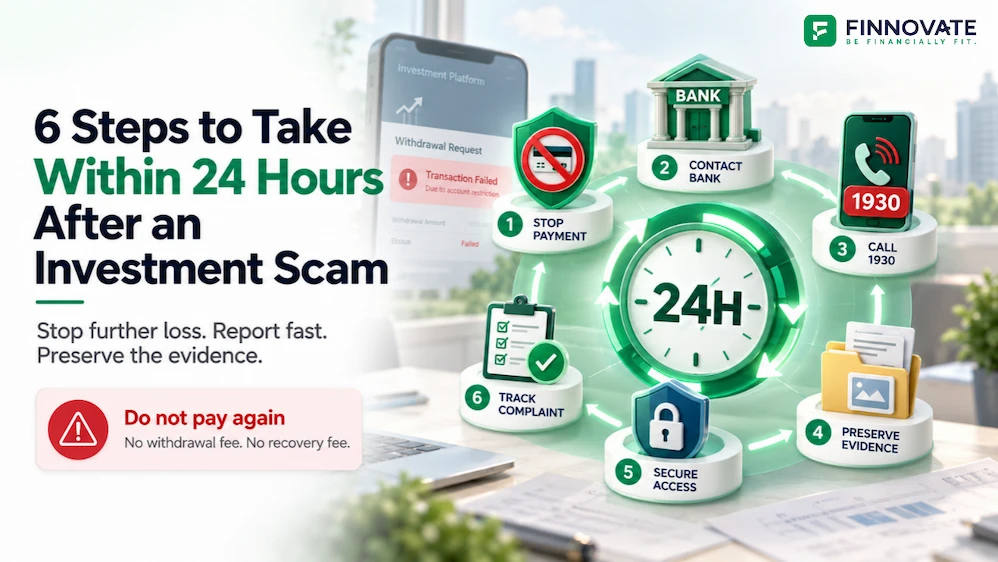
1. Stop All Further Payments
If a platform demands a tax, withdrawal fee, verification charge or account-unlocking payment before releasing your investment, do not pay it.
The same applies to someone who appears after the scam and offers to recover your money in exchange for an advance fee.
The person may:
- Threaten legal action.
- Claim your funds will be permanently blocked.
- Insist that one final payment will release everything.
- Contact you from another number while claiming to be a recovery agent, lawyer, bank official or government representative.
Someone who has already lost money can be targeted again with a promise to recover the original amount. Do not pay an unsolicited recovery fee or share OTPs, passwords, UPI PINs or remote access to your device.
Save any new payment demands, threats or recovery messages as evidence.
If someone claims to represent a bank, regulator or government agency, verify the contact independently using the organisation's official website or app. Do not use a phone number or link supplied by the caller.
2. Contact Your Bank or Payment Provider Immediately
Use your bank's official fraud-reporting number, verified mobile app or official website.
If the payment was made through UPI, a card, wallet or another payment service, report the incident to the relevant provider as well.
Keep the transaction reference and beneficiary information ready and explain that you suspect an investment-fraud transfer.
Was the transaction authorised or unauthorised?
Be precise when you describe what happened. These two situations are not the same.
If the payment was made through UPI
After reporting the suspected fraud to your bank and through 1930, you can also raise or track a UPI transaction complaint through NPCI's MyUPI / UPI Help facility where applicable.
If your UPI app itself offers a UPI Help, Raise Complaint or Raise Dispute option for the transaction, you can use that route as well and retain the complaint reference.
3. Call 1930 and Complete the Cybercrime Complaint
Call 1930, India's national helpline for reporting financial cyber fraud.
Keep the following information nearby:
- Transaction ID, UTR or payment reference.
- Date and time of payment.
- Amount transferred.
- Bank, wallet or payment-provider details.
- Beneficiary or recipient details, where available.
- Any immediate evidence of the fraudulent investment.
Note the acknowledgement, login ID or reference information provided during the reporting process.
Follow the instructions to complete the complaint through the National Cyber Crime Reporting Portal and submit the transaction and supporting information requested.
Reporting allows the incident to enter the appropriate cybercrime process and may enable coordination with the relevant financial institutions where action is still possible.
Reporting does not guarantee that the money will be recovered.
Is the cybercrime acknowledgement an FIR?
No. A complaint acknowledgement or reference from the cybercrime reporting system is not, by itself, an FIR number.
The relevant police or cybercrime authorities may take further action depending on the complaint and circumstances. If formal police action is required, follow the instructions provided by the relevant police or cybercrime unit.
4. Preserve the Evidence
Investment-scam websites, apps, advertisements and conversations can disappear quickly.
Save what you can, but do not postpone reporting simply because your evidence folder is incomplete.
Keep original messages wherever possible and place copies of the records in one folder for easier submission and follow-up.
5. Secure Any Account or Device the Scammer May Have Accessed
What you need to secure depends on what information or access was exposed.
- Contact the bank immediately.
- Block affected cards or payment access where needed.
- Change compromised passwords or credentials from a trusted device.
- Review recent transactions and report anything unauthorised.
- Disconnect the affected device from the internet if active remote control is suspected.
- Use another trusted device to contact your bank.
- Preserve relevant evidence where safe.
- Change sensitive credentials using a device you trust.
- Prioritise reporting the payment.
- Preserve beneficiary and transaction information.
- Do not assume every account you own is compromised.
- Secure additional accounts only where exposure is suspected.
6. Keep the References and Track the Complaint
Once the immediate reports are made, keep every reference in one place.
Keep the complaint number, date and any written response.
Retain the complaint or acknowledgement number for tracking and follow-up.
If you also raised a UPI transaction grievance through your app or MyUPI, retain that reference separately.
Keep the UTR, transaction ID, statements and beneficiary details linked to the complaint.
Save additional messages from the scammer, bank, authorities or anyone claiming to offer recovery.
Use these references whenever you follow up with the bank, payment provider, cybercrime authorities or another eligible grievance channel.
Which Reporting Channel Applies to Your Situation?
Different complaint systems serve different purposes. Using the right channel matters.
| What happened? | Where should you report it? |
|---|---|
| You transferred money to a fake investment platform, adviser, impersonator or fraudulent recipient. | Contact your bank or payment provider, call 1930 and complete the complaint through the National Cyber Crime Reporting Portal . |
| The fraudulent payment was made through UPI. | Follow the bank + 1930 route above first. You can additionally raise or track a supported UPI transaction complaint through your UPI app or NPCI MyUPI / UPI Help . |
| Someone accessed your account and made transactions without your permission. | Contact your bank, card issuer or payment provider immediately, secure the affected access and report the suspected financial cyber fraud through the cybercrime system as well. |
| Your grievance concerns a SEBI-registered broker or another eligible securities-market intermediary. | First use the intermediary's designated grievance process. If the complaint falls within scope and remains unresolved, consider SEBI SCORES . |
| Your complaint concerns how a bank or another covered regulated entity handled your service grievance. | First complain to the regulated entity. If the grievance remains unresolved and the applicable conditions are met, check whether it can be escalated through the RBI Complaint Management System . |
What Should You Do After the Initial Report?
You may not know within the first day whether the money can be recovered.
Continue to:
- Track your bank and cybercrime complaint references.
- Track any UPI transaction complaint you have raised.
- Provide additional documents if requested by the bank or authorities.
- Save any new messages or payment demands from the scammer.
- Keep copies of responses from banks, intermediaries or authorities.
- Use the appropriate grievance or police channel if further escalation is required.
A second person contacting you after the scam may know that you are already looking for help. Verify any claimed institution independently and be especially cautious of anyone asking for an advance fee.
FAQs
1. Is calling 1930 enough to report investment fraud?
Calling 1930 starts the financial cyber-fraud reporting process. Follow the acknowledgement instructions and complete the online complaint through the National Cyber Crime Reporting Portal as directed.
2. Should I report an unauthorised transaction through the cybercrime system too?
Yes, where you suspect online financial fraud. Contact your bank, card issuer or payment provider immediately as well, and clearly state that the transaction was unauthorised if you did not initiate or approve it.
3. Can my bank reverse money transferred to a scammer?
Not necessarily. Ask the bank what action is possible for the specific transaction. Money you personally transferred after being deceived is not automatically reversible.
4. Should I raise a UPI dispute through NPCI if I paid the scammer through UPI?
You can additionally use your UPI app's complaint facility or NPCI's MyUPI / UPI Help for supported transaction grievances. But for suspected investment fraud, this should not replace immediately informing your bank and reporting the incident through 1930 and the cybercrime portal.
5. What if I discover the scam after 24 hours?
Report it as soon as you discover it. Contact your bank or payment provider and use the appropriate cybercrime reporting channel. The first-24-hours framework is an action guide, not a deadline after which reporting becomes pointless.
6. Is a cybercrime complaint the same as an FIR?
No. A complaint acknowledgement or reference is not, by itself, an FIR number. The relevant police or cybercrime authority may take further action depending on the circumstances.
7. Should I complain to SEBI about a fake trading or investment app?
For suspected financial cyber fraud involving a fake platform or impersonator, report the transaction through your bank or payment provider and the cybercrime channels first. SCORES may be relevant where the grievance concerns an eligible SEBI-regulated securities-market entity, but it is not a universal reporting channel for fake platforms.
8. Someone has offered to recover my money for a fee. Should I pay?
Be cautious. Do not rely on unsolicited recovery promises or claims of guaranteed results. Verify the person's identity independently and do not share payment credentials, OTPs, passwords or remote access.
9. What if the scammer is still messaging me?
Stop making payments, preserve the messages as evidence and do not share additional credentials or install software. Do not rely on promises that one more payment will unlock your investment or release a refund.