

The Great Economic Decoupling of 2026: Oil, AI & India
Rising oil prices and booming AI investment are shaping an uneven global economy in 2026. ...
24 October 2026

Finnovate’s editorial team researches and creates financial content using trusted sources, regulatory references and inputs from subject experts.
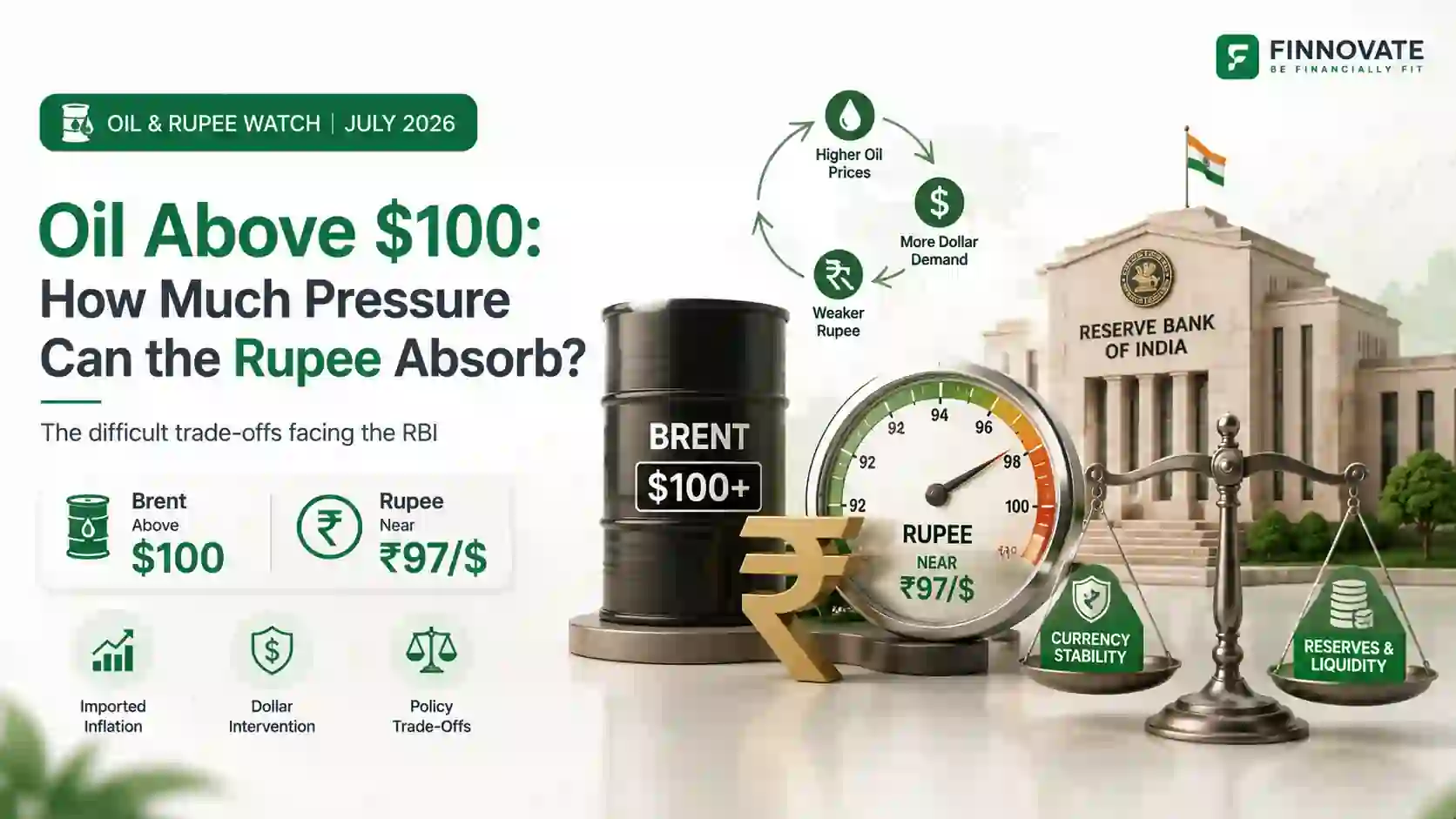
Brent crude crossed $100 per barrel on July 24, 2026, after a fresh escalation in Middle East supply risks. The rupee weakened to around ₹96.80 against the US dollar before recovering towards ₹96.50, following dollar sales by state-run banks that traders associated with Reserve Bank of India intervention.
The currency remains close to its record low of ₹96.96, reached in May 2026. India's dependence on imported crude means that oil above $100 and a rupee near ₹97 can reinforce each other, placing pressure on inflation, the current account and RBI policy.
| Indicator | Current position |
|---|---|
| Brent crude | Crossed $100 per barrel |
| Rupee during July 24 trading | Weakened to around ₹96.80 per dollar |
| Record rupee low | ₹96.96 per dollar |
| India's crude import dependence | Nearly 90% |
| Foreign-exchange reserves | Around $675 billion |
| RBI net short-dollar forward position | $106.6 billion |
India is not facing an immediate foreign-exchange crisis. It has substantial reserves, access to external funding and several policy tools. The harder question is how long the pressure lasts and what RBI must give up to contain it.
India pays for most of its imported crude in US dollars.
When oil prices rise, refiners need more dollars to purchase the same quantity of crude. This increases demand for foreign currency and can weaken the rupee.
A weaker rupee then increases the domestic cost of every dollar of oil imported.
The impact becomes stronger when both oil and the dollar-rupee exchange rate are already elevated.
Oil at $100 has a different domestic effect when the rupee is near ₹97 than when it is near ₹80. The pressure depends on the global crude price, the exchange rate, import volumes, freight costs and the discounts available on alternative supplies.
Discounts on Russian crude, which had provided some protection to Indian refiners, have also narrowed amid renewed Middle East disruption.
Our earlier analysis of the rupee's move from a market story to a policy challenge examined how oil shocks, capital flows and RBI intervention began placing greater pressure on the currency.
The immediate market reaction is visible in the rupee, but the wider economic impact develops through several channels.
A higher oil bill increases the value of India's merchandise imports unless the country reduces consumption or receives lower prices from alternative suppliers.
A sustained $10-per-barrel increase in oil prices could widen India's current-account deficit by around 0.4% of GDP, based on a sensitivity estimate cited in an IMF assessment.
The actual outcome would depend on how long oil remains elevated, changes in import volumes, export income, services receipts and remittances.
Higher crude prices can affect petrol, diesel, aviation fuel, transport, chemicals, plastics, packaging and logistics.
The speed of the inflation impact depends on how much of the increase is passed to consumers.
If retail fuel prices remain unchanged, the initial burden may be absorbed by oil-marketing companies or the government. If prices are increased, the effect can move more directly into transport and household expenses.
Higher oil prices transfer more domestic income abroad to pay for energy.
Companies face higher production and logistics costs, while households may have less income available for discretionary consumption. Rate-sensitive sectors can face additional pressure if inflation concerns reduce the scope for monetary easing.
Private-sector estimates of the economic effect vary widely and depend heavily on how long oil remains above $100. Any single growth or inflation estimate should therefore be treated as a scenario rather than a forecast.
RBI has several ways to manage currency pressure, but each tool involves a trade-off.
| RBI tool | Immediate purpose | Main limitation |
|---|---|---|
| Sell dollars in the spot market | Increase dollar supply and slow rupee weakness | Reduces reserves and withdraws rupee liquidity |
| Use forward contracts | Manage currency demand without an immediate spot-market transaction | Creates future dollar obligations |
| Attract external inflows | Strengthen the balance of payments | Some inflows must later be repaid or hedged |
| Raise interest rates | Support inflation expectations and currency sentiment | Can weaken credit demand and growth |
| Allow gradual depreciation | Preserve reserves and permit market adjustment | Raises imported costs |
| Inject domestic liquidity | Offset liquidity removed through currency intervention | Must remain consistent with the inflation stance |
The objective is generally not to fix the rupee permanently at one number. RBI can instead reduce excessive volatility and prevent disorderly market conditions.
Recent reporting suggests that the central bank may prefer a more market-driven exchange rate while stepping in when currency moves become too sharp or one-sided.
When RBI sells dollars, banks or market participants pay for them in rupees.
Those rupees move out of the banking system and onto RBI's balance sheet, reducing domestic liquidity. If intervention is large or prolonged, banks may have fewer surplus funds available in the money market.
RBI can offset this through separate liquidity operations, including purchases of government securities, repos or other injections.
This creates a policy-balancing exercise:
RBI must therefore manage the foreign-exchange market and domestic liquidity together rather than treating them as separate problems.
India's foreign-exchange reserves remain substantial at around $675 billion. This provides protection against external shocks and covers several months of imports.
However, the headline reserve figure does not fully show RBI's available flexibility.
RBI's net short-dollar forward position reached a record $106.6 billion at the end of May, with about $29 billion due within three months. In May alone, RBI sold a net $6.1 billion in the spot market after selling $8.9 billion in April.
A short-dollar forward position means RBI has agreed to provide dollars at future dates. These commitments are not the same as an immediate reserve loss, but they influence how much future dollar demand the central bank may need to manage.
Our analysis of RBI's dollar shorts, FCNR(B) exposure and other foreign-currency obligations explains why the gross reserve number should be viewed alongside the forward book.
RBI's June measures have attracted more than $20 billion in foreign-currency inflows, with most of the amount reportedly coming through FCNR(B) deposits.
The inflows strengthen India's balance-of-payments position and give banks access to longer-term foreign currency. However, foreign-exchange reserves increased by only around $3 billion between the launch of the measures and July 10.
Economists believe RBI may have used part of the inflows to reduce its short-dollar forward position instead of adding the entire amount to reserves. This remains a market interpretation until subsequent RBI data provides confirmation.
This would still be a useful outcome.
Reducing near-term forward obligations can improve RBI's ability to respond to future currency pressure, even if the benefit is not immediately visible in the headline reserve number.
Our earlier review of FCNR(B) inflows and the expectations surrounding the 2026 window examined the initial mobilisation. The newer package-level inflow figure suggests that dollar-raising measures have gathered momentum since then.
Higher interest rates can support a currency by improving the relative return available on rupee assets. They can also help contain inflation expectations.
But an interest-rate increase cannot create additional oil supply, reopen shipping routes or reduce the global dollar price of crude.
A rate increase would also affect:
The initial shock is external and supply-driven. Responding too aggressively through domestic demand management could weaken growth without fully solving the oil problem.
RBI's decision therefore depends on whether higher oil begins producing broader and persistent inflation, rather than only a temporary increase in imported costs.
The effects may reach households through more than petrol and diesel prices.
A weaker rupee can raise the cost of:
For investors, higher oil and currency pressure can influence:
These effects are not uniform. A weaker rupee may support some exporters and increase the rupee value of overseas assets, while higher input costs can hurt import-dependent companies.
India has enough reserves and policy tools to prevent an immediate external crisis.
The larger risk would arise if oil remains above $100 for an extended period while the rupee continues weakening and external capital flows remain uncertain.
RBI can sell dollars, use forward markets, attract foreign-currency inflows and manage domestic liquidity. But none of these tools is cost-free.
The central bank's challenge is not to defend ₹97 indefinitely. It is to prevent a disorderly currency adjustment while preserving enough reserves, liquidity and policy flexibility to manage inflation and growth.
A temporary oil spike can be absorbed. A prolonged combination of expensive oil and a weak rupee would require increasingly difficult choices.
India imports most of its crude oil and normally pays for it in US dollars. Higher oil prices increase demand for dollars, which can place downward pressure on the rupee.
No. RBI has not announced a fixed exchange-rate level that it will defend. Its intervention is generally aimed at managing excessive volatility and preventing disorderly market movements.
India has substantial reserves of around $675 billion. However, the adequacy of reserves should also be considered alongside import requirements, market intervention and RBI's forward dollar obligations.
It represents future contracts under which RBI is expected to provide dollars. These contracts allow intervention to be spread across time but create future foreign-currency obligations.
Not necessarily. The impact depends on government taxes, company margins, pricing decisions and how long crude prices remain elevated. Delayed pass-through can shift the cost to oil companies or public finances.
It could consider higher rates if oil produces broader and persistent inflation. However, rate increases cannot resolve the external supply shock and may weaken domestic demand and growth.
Disclaimer: This article is for general information and educational purposes only and does not constitute investment, financial or economic-policy advice.
No spam. Only new posts, simple explainers, and practical money checklists for busy professionals.
Finnovate is a SEBI-registered financial planning firm that helps professionals bring structure and purpose to their money. Over 3,500+ families have trusted our disciplined process to plan their goals - safely, surely, and swiftly.
Our team constantly tracks market trends, policy changes, and investment opportunities like the ones featured in this Weekly Capsule - to help you make informed, confident financial decisions.
Learn more about our approach and how we work with you:
No comments yet. Start the conversation. What would you add?
No spam. Only new posts, simple explainers, and practical money checklists.
You may also like
Rising oil prices and booming AI investment are shaping an uneven global economy in 2026. ...

Explore FPI equity flows for October First Half, 2026: ₹47,955 crore in net outflows, th...

Understand the India–Mauritius tax treaty’s Principal Purpose Test, its August 2026 ef...

Explore India’s AI hardware opportunity through the proposed Adani–Jabil venture, from...
Popular now

Learn how to easily download your NSDL CAS Statement in PDF format with our step-by-step g...

Looking for the best financial freedom books? Here’s a handpicked 2026 reading list with...

Learn what SIF investment means in India, SEBI rules, Rs 10 lakh minimum investment, avail...

Clear guide to mutual fund taxation in India for FY 2025–26 after July 2024 changes: equ...