

Can India Build the Hardware Behind the AI Boom?
Explore India’s AI hardware opportunity through the proposed Adani–Jabil venture, from...
14 October 2026

Finnovate’s editorial team researches and creates financial content using trusted sources, regulatory references and inputs from subject experts.
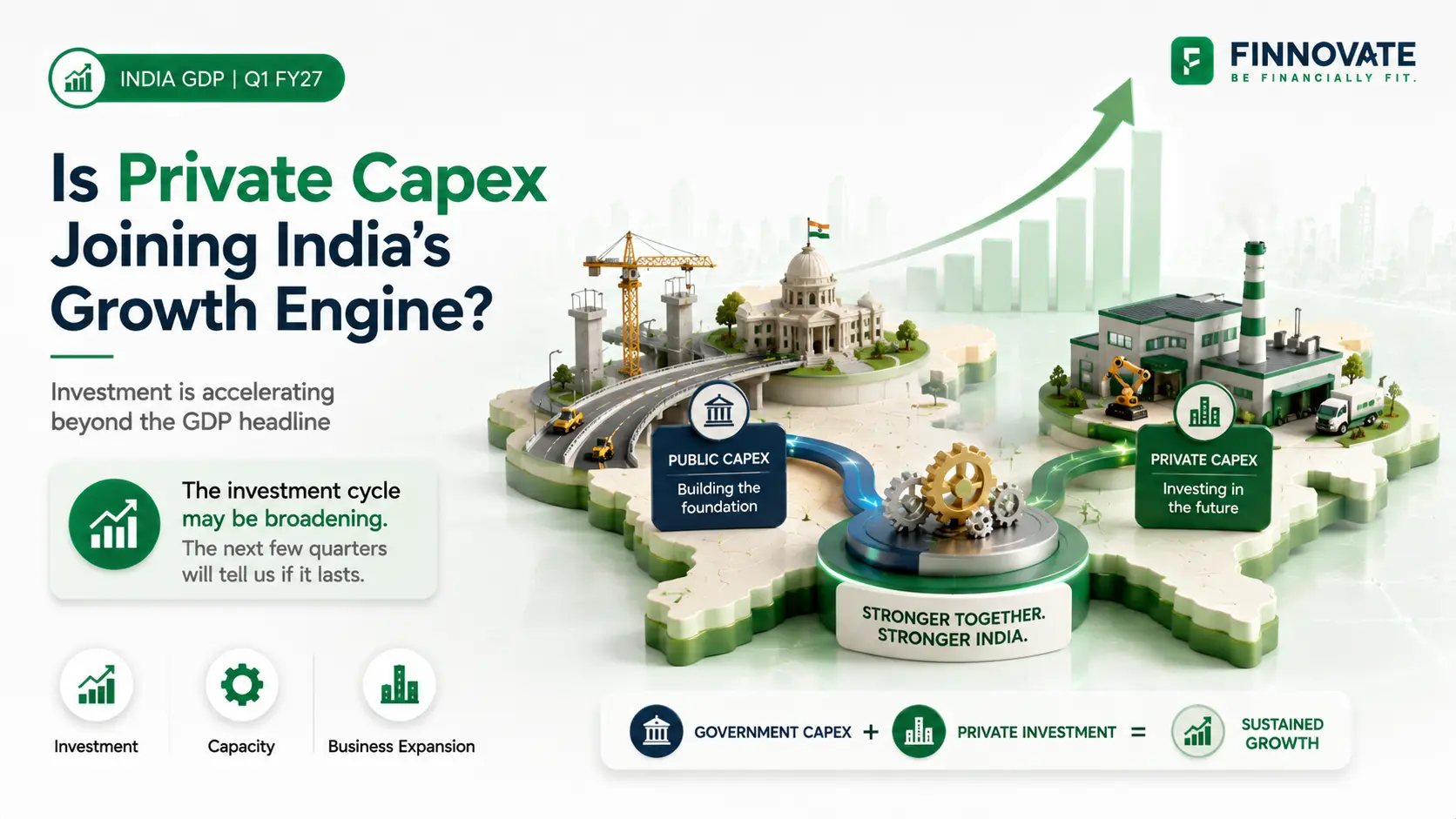
India's economy started FY2026-27 much stronger than expected.
Real GDP grew 7.8% year-on-year in April-June 2026, compared with 6.9% in the same quarter last year. The reading was also ahead of the RBI's 7.0% estimate and the roughly 7.1% market consensus.
But the 7.8% headline may not be the most interesting number in the GDP report.
That distinction belongs to investment.
Its share of nominal GDP also rose from around 31.4% to 34.3%.
That raises a bigger question:
Table of Contents
| Indicator | Q1 FY26 | Q1 FY27 |
|---|---|---|
| Real GDP growth | 6.9% | 7.8% |
| Real GVA growth | 7.0% | 8.2% |
| Gross Fixed Capital Formation | 5.8% | 11.9% |
| Household consumption | 6.8% | 7.1% |
| Exports | 6.0% | 12.0% |
Real GDP reached approximately ₹81.36 lakh crore, while nominal GDP grew 10.3% to about ₹88.27 lakh crore.
The broad picture is clear: consumption remained healthy, exports accelerated, manufacturing and services performed strongly, and investment grew much faster than the overall economy.
Investment today creates productive capacity for tomorrow.
A business that builds a factory, installs machinery or expands a warehouse is adding assets that can help produce more goods or services over several years.
Economists capture a large part of this activity through Gross Fixed Capital Formation.
GFCF broadly includes investment in factories, machinery and equipment, commercial buildings, roads, infrastructure and other fixed productive assets.
This distinction is critical.
GFCF is an economy-wide investment measure. It includes investment by businesses, government and other institutional sectors.
Total fixed investment in the economy grew 11.9% in real terms.
Private-sector capex itself grew 11.9%.
The quarterly GDP release does not split the 11.9% figure cleanly into public and private investment.
To judge whether private companies are joining the cycle, we need separate corporate-capex, utilisation, credit and industrial indicators.
India's investment recovery has been supported for years by government infrastructure spending.
During April-June 2026, Central government capital expenditure was approximately:
That works out to growth of roughly 24% year-on-year.
So it would be premature to say India's growth engine has shifted from public investment to private investment.
Reuters, citing Citi's analysis of listed Indian companies, reported that corporate capital expenditure increased around 11% in FY26, compared with roughly 8% previously.
Investment activity is appearing across manufacturing, automobiles, renewable energy, defence, semiconductors, technology infrastructure and data centres.
The NSO's private corporate capex survey estimated provisional aggregate investment of approximately ₹11.44 lakh crore in FY2025-26.
For FY2026-27, participating companies reported investment intentions of about ₹9.55 lakh crore.
For companies covered in consecutive rounds, actual FY25 capex came in at around 96.3% of previously reported investment intentions.
The same NSO survey found that about 65.35% of FY26 corporate capex was funded through internal accruals, while approximately 23.25% came from domestic debt.
Healthy internal cash generation can allow companies to invest without depending entirely on fresh borrowing or equity capital.
Reuters' post-GDP analysis cited manufacturing capacity utilisation approaching 77% in the January-March 2026 quarter.
If a factory capable of producing 100 units is consistently producing only 55, management may have little reason to build another plant. If it is producing 75 or 80 and expects demand to keep rising, adding capacity becomes easier to justify.
Higher utilisation does not guarantee new capex, but it creates one of the conditions that can support it.
| Credit Category | July 2025 Growth | July 2026 Growth |
|---|---|---|
| Credit to industry | 6.5% | 20.0% |
| Credit to services | 10.2% | 22.9% |
Not every corporate loan finances a new factory. Businesses also borrow for working capital, acquisitions and other purposes.
Manufacturing GVA grew 9.2% in Q1 FY27.
Financial, real estate, IT and professional services grew even faster at 12.1%.
| Manufacturing Category | Q1 FY27 Growth |
|---|---|
| Electrical equipment | 27.0% |
| Other transport equipment | 19.5% |
| Computers, electronic and optical products | 12.4% |
| Machinery and equipment | 9.1% |
Capital-goods production itself grew 15.2% during Q1 FY27, compared with 8.8% a year earlier.
July offered another supportive signal: overall IIP grew 6.7%, manufacturing output rose 7.3%, and capital-goods production increased 16.1%.
This is not only an investment story.
Household consumption grew 7.1% in real terms, slightly faster than the 6.8% growth recorded a year earlier.
That matters because businesses are more likely to invest when they believe future demand will justify additional capacity.
Real exports of goods and services also grew 12.0%, compared with 6.0% a year earlier.
So Q1's growth was supported by multiple engines rather than a single one.
Investment can be volatile. Several more quarters are needed before calling this a structural private capex boom.
Central government capital expenditure grew strongly in Q1, so the public sector continues to do substantial heavy lifting.
Oil prices, geopolitical disruptions, rupee weakness and tighter global financing conditions can affect corporate investment decisions.
Data centres, automation and advanced manufacturing can be highly capital intensive without creating proportionate employment.
The evidence is stronger than it has been for some time.
Put together, these indicators suggest India's investment cycle may be broadening.
But the next two or three quarters will matter more than one strong GDP print.
India's real GDP grew 7.8% year-on-year during April-June 2026, compared with 6.9% in Q1 FY26.
Gross Fixed Capital Formation measures investment in fixed productive assets such as machinery, factories, buildings and infrastructure.
Real GFCF grew 11.9%, compared with 5.8% in the corresponding quarter last year.
No. GFCF includes both public and private investment. Separate indicators are needed to judge the strength of private-sector capex.
Yes. Central government capital expenditure reached approximately ₹3.40 lakh crore during April-June 2026, up strongly from the previous year.
Financial, real estate, IT and professional services grew 12.1%, while manufacturing GVA grew 9.2%.
There are encouraging signals, but one quarter is not enough to establish a long-term cycle. Corporate investment, capacity utilisation, credit, capital-goods production and GFCF should be watched over the next several quarters.
Disclaimer: This article is for educational and informational purposes only. Economic data may be revised in subsequent official releases. References to sectors, investment activity and economic trends are not investment recommendations. Investors should evaluate their financial goals, risk profile and other relevant factors before making investment decisions.
No spam. Only new posts, simple explainers, and practical money checklists for busy professionals.
Finnovate is a SEBI-registered financial planning firm that helps professionals bring structure and purpose to their money. Over 3,500+ families have trusted our disciplined process to plan their goals - safely, surely, and swiftly.
Our team constantly tracks market trends, policy changes, and investment opportunities like the ones featured in this Weekly Capsule - to help you make informed, confident financial decisions.
Learn more about our approach and how we work with you:
No comments yet. Start the conversation. What would you add?
No spam. Only new posts, simple explainers, and practical money checklists.
You may also like
Explore India’s AI hardware opportunity through the proposed Adani–Jabil venture, from...
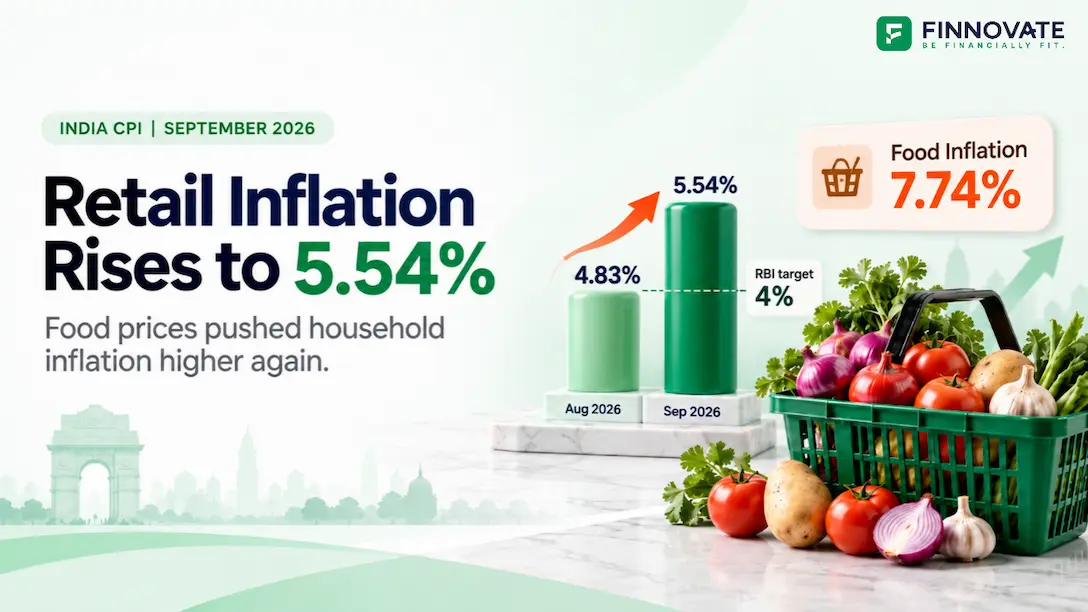
India’s CPI inflation rose to 5.54% in September 2026. Compare monthly trends, food pric...
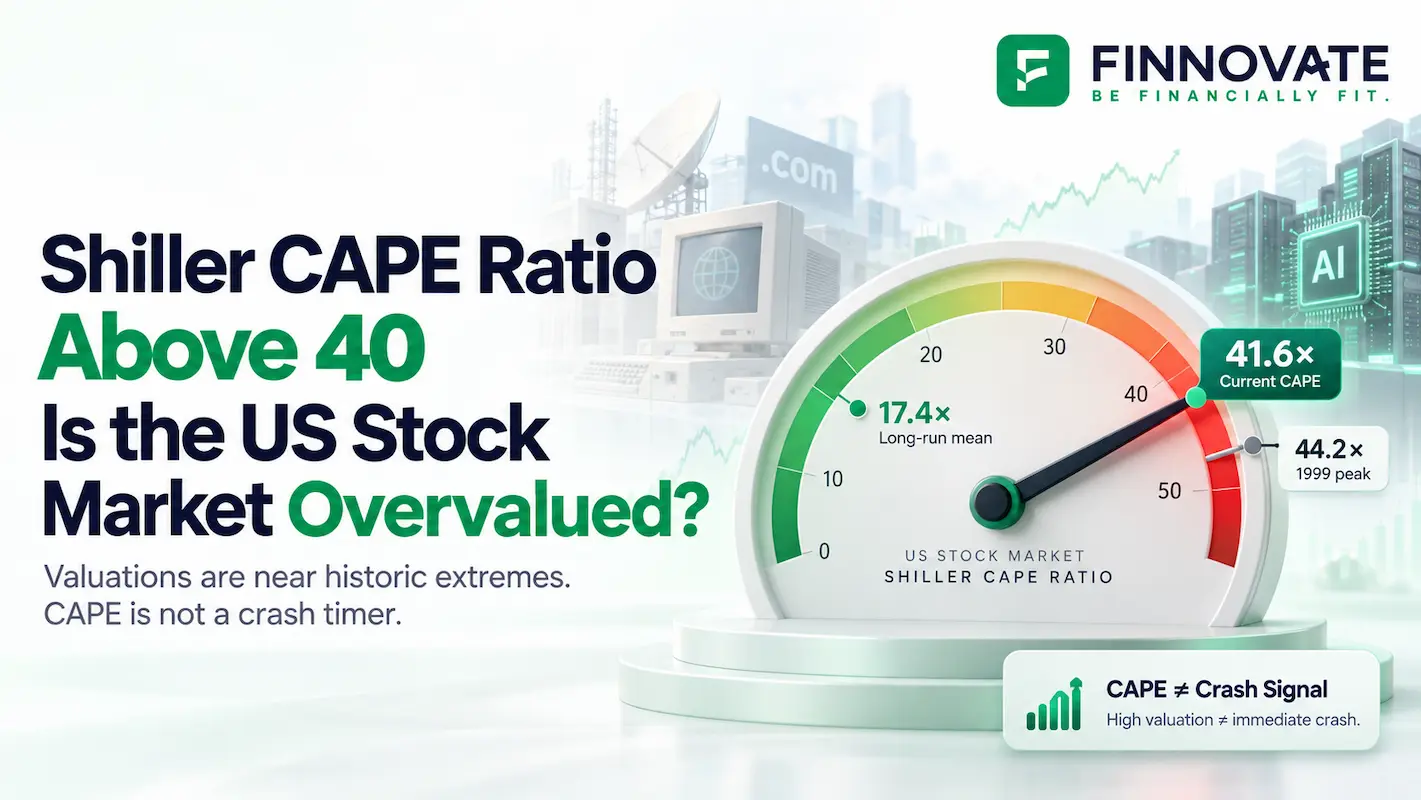
The Shiller CAPE ratio is near its 1999 peak. Explore what it means for US stock valuation...

Can Starlink change internet access in India? Explore why Jio and Airtel signed deals, how...
Popular now

Learn how to easily download your NSDL CAS Statement in PDF format with our step-by-step g...

Looking for the best financial freedom books? Here’s a handpicked 2026 reading list with...
Learn what SIF investment means in India, SEBI rules, Rs 10 lakh minimum investment, avail...

Clear guide to mutual fund taxation in India for FY 2025–26 after July 2024 changes: equ...