
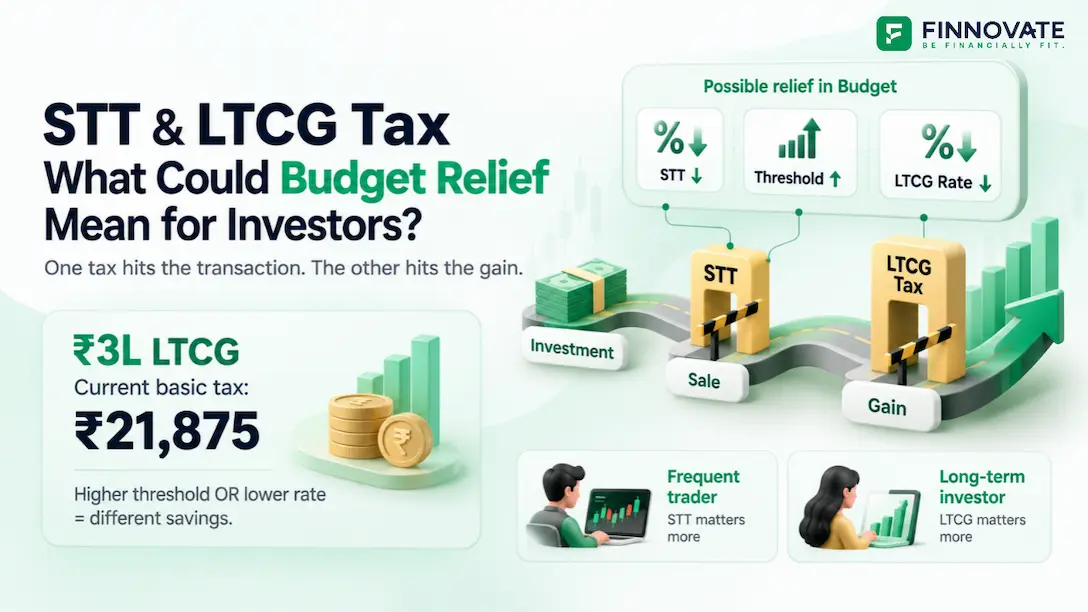
STT and LTCG Tax: What Budget Relief Could Mean for Investors
Understand how STT cuts, a higher LTCG exemption or lower capital gains tax could affect i...
19 October 2026


Finnovate’s editorial team researches and creates financial content using trusted sources, regulatory references and inputs from subject experts.

Marriage often brings two financial lives together. You may start sharing household expenses, insurance, investments, a home loan and long-term goals.
Income tax, however, does not combine you into one taxpayer.
In India, husband and wife continue to be taxed separately. There is no general joint tax return or special married-couple tax slab. The opportunity lies in coordinating two separate tax profiles correctly, such as choosing tax regimes independently, planning eligible deductions, structuring joint ownership properly and understanding what happens when money moves between spouses.
This guide covers the rules applicable under the Income-tax Act, 2025 for Tax Year 2026-27, which began on 1 April 2026.
Table of Contents
There is no tax deduction or lower tax rate available simply because you are married.
Each spouse generally has their own PAN and income-tax return, taxable income, tax slab, tax-regime choice and deduction limits.
Marriage can still create useful tax-planning opportunities because both taxpayers may independently qualify for deductions, jointly own a home or divide genuine household expenses between them.
At the same time, shifting an investment to the lower-income spouse does not automatically shift its tax liability.
| Decision | How It Generally Works |
|---|---|
| Income-tax return | Separate |
| Tax regime | Each spouse chooses separately |
| Deductions | Based on individual eligibility |
| Health insurance | Payments can be planned between spouses |
| Joint home loan | Ownership and borrowing structure matter |
| Investments | Ownership and source of funds matter |
| Gift to spouse | Gift and income from the gift can be treated differently |
Not necessarily.
For Tax Year 2026-27, the new regime under Section 202 of the Income-tax Act, 2025 is the default regime. Its tax rates start at nil up to ₹4 lakh and rise progressively to 30% above ₹24 lakh. Salaried taxpayers can claim a standard deduction of ₹75,000 under the new regime, compared with ₹50,000 otherwise. Several deductions and exemptions available under the old regime are not available under Section 202.
This means two spouses can reach completely different conclusions.
Consider Rahul and Meera.
Rahul earns ₹22 lakh and has substantial eligible HRA, home-loan interest, qualifying investments, health-insurance payments and an additional eligible NPS contribution.
Meera earns ₹14 lakh, but has fewer deductions.
Based on the assumptions below:
| Choice | Rahul's Tax | Meera's Tax | Combined Tax |
|---|---|---|---|
| Both use old regime | ₹1,87,200 | ₹1,71,600 | ₹3,58,800 |
| Both use new regime | ₹2,40,500 | ₹81,900 | ₹3,22,400 |
| Rahul old + Meera new | ₹1,87,200 | ₹81,900 | ₹2,69,100 |
In this example, choosing different regimes results in the lowest combined tax.
The broader point is more important than the numbers:
Calculate it separately for each spouse.
Taxpayers with business or professional income should also be careful because the rules for opting out of the default regime and subsequently changing the option are more restrictive than for taxpayers without business or professional income.
Illustration assumes resident individuals below 60, no special-rate income or surcharge, 4% health and education cess, and full eligibility for the deductions stated.
A married couple does not get one larger deduction limit. Instead, each eligible spouse can use their own limits.
Section 123 of the Income-tax Act, 2025 broadly replaces the familiar Section 80C framework and allows qualifying payments and investments up to an aggregate limit of ₹1.5 lakh for an eligible taxpayer.
Therefore, where both spouses use the old regime and each separately qualifies:
The household may therefore have up to ₹3 lakh of deductions between two taxpayers, but marriage itself has not doubled anyone's individual limit.
Also check what is already being counted before investing purely for tax saving. EPF, life-insurance premiums and other qualifying payments may already use a large part of the available limit.
Health-insurance deductions are now covered under Section 126, corresponding to the earlier Section 80D.
For an individual, qualifying health-insurance payments can generally be claimed up to ₹25,000 for self/family and separately up to ₹25,000 for parents, with higher limits applying in specified senior-citizen situations. The provision treats the taxpayer's spouse and dependent children as "family" while parents are covered separately.
This means it can matter who actually pays which premium.
For example, one spouse may pay the family floater and premiums for their own parents, while the other spouse pays for their parents, subject to each taxpayer satisfying the applicable conditions.
Section 124 deals with eligible NPS contributions. Employer NPS deserves particular attention because specified employer contributions remain deductible even under the new regime, and the applicable limit for a non-government employer is treated as 14% of salary where Section 202 applies.
The right approach is not for both spouses to copy the same tax-saving investments. First check each person's regime, salary structure and existing deductions.
Yes, potentially, but adding both names to the loan does not automatically create double tax benefits.
Three things matter:
Co-owner: the spouse has an ownership share in the property.
Co-borrower: the spouse is liable for the home loan.
Actual financial arrangement: ownership and repayment should support the claim being made.
For a qualifying self-occupied property, Section 22 provides for borrowed-capital interest deduction, with the aggregate eligible deduction capped at ₹2 lakh for the applicable properties and subject to the statutory conditions. The new regime specifically removes this self-occupied interest deduction.
Arjun and Neha:
Their attributable interest is ₹2.5 lakh each.
Because the applicable self-occupied limit is ₹2 lakh each in this example:
| Arjun | Neha | |
|---|---|---|
| Share of interest | ₹2,50,000 | ₹2,50,000 |
| Eligible deduction | ₹2,00,000 | ₹2,00,000 |
Combined deduction: ₹4 lakh
The important point is that ₹5 lakh of interest did not automatically become a ₹5 lakh deduction, and merely becoming a co-borrower would not by itself establish the same result.
A detailed joint-home-loan guide can separately cover unequal ownership, one spouse paying the EMI, let-out property and principal repayment.
This is one of the most misunderstood areas of tax planning between husband and wife.
You need to separate two questions:
Section 92 excludes qualifying money or property received from a relative from the general gift-tax provision. It also separately excludes qualifying receipts on the occasion of an individual's marriage.
So if one spouse gifts money to the other, the receipt itself is generally not taxed merely because of its value.
Section 99 is different.
Where an individual transfers an asset directly or indirectly to their spouse without adequate consideration, income arising from that transferred asset can be included in the transferor's taxable income, subject to the stated exceptions.
Vikram gifts ₹10 lakh to Priya, his wife.
Priya has little or no independent income and invests the ₹10 lakh in an FD earning 7%.
Annual interest:
₹70,000
The broad tax result is:
| Transaction | General Treatment |
|---|---|
| ₹10 lakh received from spouse | Gift itself generally not taxable |
| ₹70,000 FD interest | Generally clubbed with Vikram's income |
So simply placing the FD in Priya's name does not automatically allow the ₹70,000 to be taxed using her lower income level.
This is also why the common idea of "invest everything in my non-working spouse's name" can fail. The source of the money matters, not just the name appearing on the investment.
A separate article on gifting and clubbing can go deeper into FDs, mutual funds, property, capital gains and reinvested income.
Not every couple needs detailed planning around the following areas, but they are worth understanding.
Two salaried spouses receiving HRA do not automatically get to claim the same rent twice. Any exemption must reflect the genuine rent arrangement, actual payment, salary structure, documentation and the tax regime used. The new regime restricts HRA-related exemption.
Putting two names on an FD, bank account or investment does not by itself mean the income is taxable 50:50.
Who provided the funds, who genuinely owns the asset and whether spouse-clubbing rules apply can affect the result.
Section 92 specifically excludes qualifying money or property received on the occasion of the individual's marriage from the general gift provision. This exemption is listed separately from the exemption for gifts received from relatives.
For significant gifts, maintaining basic documentation around the donor, amount and occasion is sensible.
An HUF should not be treated as an automatic "extra taxpayer" that every couple can use after getting married.
The Income-tax Act contains specific rules where an individual's separate property is converted or transferred into HUF property, including provisions that can attribute income back to the individual.
HUF planning is therefore better considered only where there is a genuine family-property or HUF situation rather than as a generic marriage tax-saving technique.
Instead of beginning with products or deduction limits, use this sequence:
For example, investing ₹1.5 lakh simply because a deduction is available may not make sense if the product does not suit your goals or liquidity needs.
Tax planning should therefore answer two questions:
Does this reduce tax legally?
Does it also make financial sense for the household?
For the wider money decisions that begin after marriage, see Finnovate's guide to financial planning for newly married couples.
Your incomes and deductions may be very different.
Each spouse must independently qualify for their own deduction.
One genuine expense does not automatically become two deductions.
The source of funds matters.
Home-loan eligibility depends on more than the loan application.
Two names do not automatically establish 50:50 beneficial ownership.
A deduction does not make an unsuitable investment suitable.
For a married couple, tax decisions can interact with salary structure, home ownership, insurance, investments, capital gains and long-term financial goals. Finnovate's tax-planning approach looks at these elements together instead of treating tax saving as a last-minute investment exercise.
Explore Finnovate's Tax Planning AdvisoryMarriage does not give you a joint tax return or a special tax slab in India. You remain two separate taxpayers.
But once financial decisions start overlapping, tax planning should no longer happen in isolation.
Choose tax regimes based on each spouse's numbers, use deductions only where individually eligible, structure joint assets carefully and understand the tax effect before transferring money between spouses.
The objective is not to find the maximum number of deductions. It is to reduce avoidable tax while keeping the couple's complete financial plan on track.
No. Marriage does not create a general joint ITR system in India. Each spouse normally files based on their own taxable income and filing requirements.
Yes. Each taxpayer can make the regime decision based on their own circumstances, subject to the applicable rules. Taxpayers with business or professional income have additional restrictions around changing the option.
Yes, where both independently qualify and use a regime under which the deduction is available. The limit is up to ₹1.5 lakh per eligible taxpayer, not one combined ₹3 lakh marriage deduction.
Potentially, where the ownership, borrowing and other applicable conditions support both claims. Simply being named as a co-borrower is not enough to assume the full deduction.
The gift itself is generally excluded from the gift provision because it is received from a relative. However, income generated from assets transferred to a spouse without adequate consideration can be subject to clubbing under Section 99.
Not automatically. If the investment was funded through money or assets transferred by you without adequate consideration, income from the transferred asset may be clubbed with your income.
Each spouse can claim qualifying payments they actually make for eligible persons, subject to Section 126 limits and conditions.
Disclaimer: This article is for general educational purposes and reflects provisions applicable to Tax Year 2026-27 based on the Income-tax Act, 2025 as amended by the Finance Act, 2026. Actual tax treatment depends on income type, residential status, age, ownership, documentation and other individual facts. Consider professional advice for significant transfers, property ownership, HUFs or complex tax situations.
No spam. Only new posts, simple explainers, and practical money checklists for busy professionals.
Finnovate is a SEBI-registered financial planning firm that helps professionals bring structure and purpose to their money. Over 3,500+ families have trusted our disciplined process to plan their goals - safely, surely, and swiftly.
Our team constantly tracks market trends, policy changes, and investment opportunities like the ones featured in this Weekly Capsule - to help you make informed, confident financial decisions.
Learn more about our approach and how we work with you:
No comments yet. Start the conversation. What would you add?
No spam. Only new posts, simple explainers, and practical money checklists.
You may also like
Understand how STT cuts, a higher LTCG exemption or lower capital gains tax could affect i...
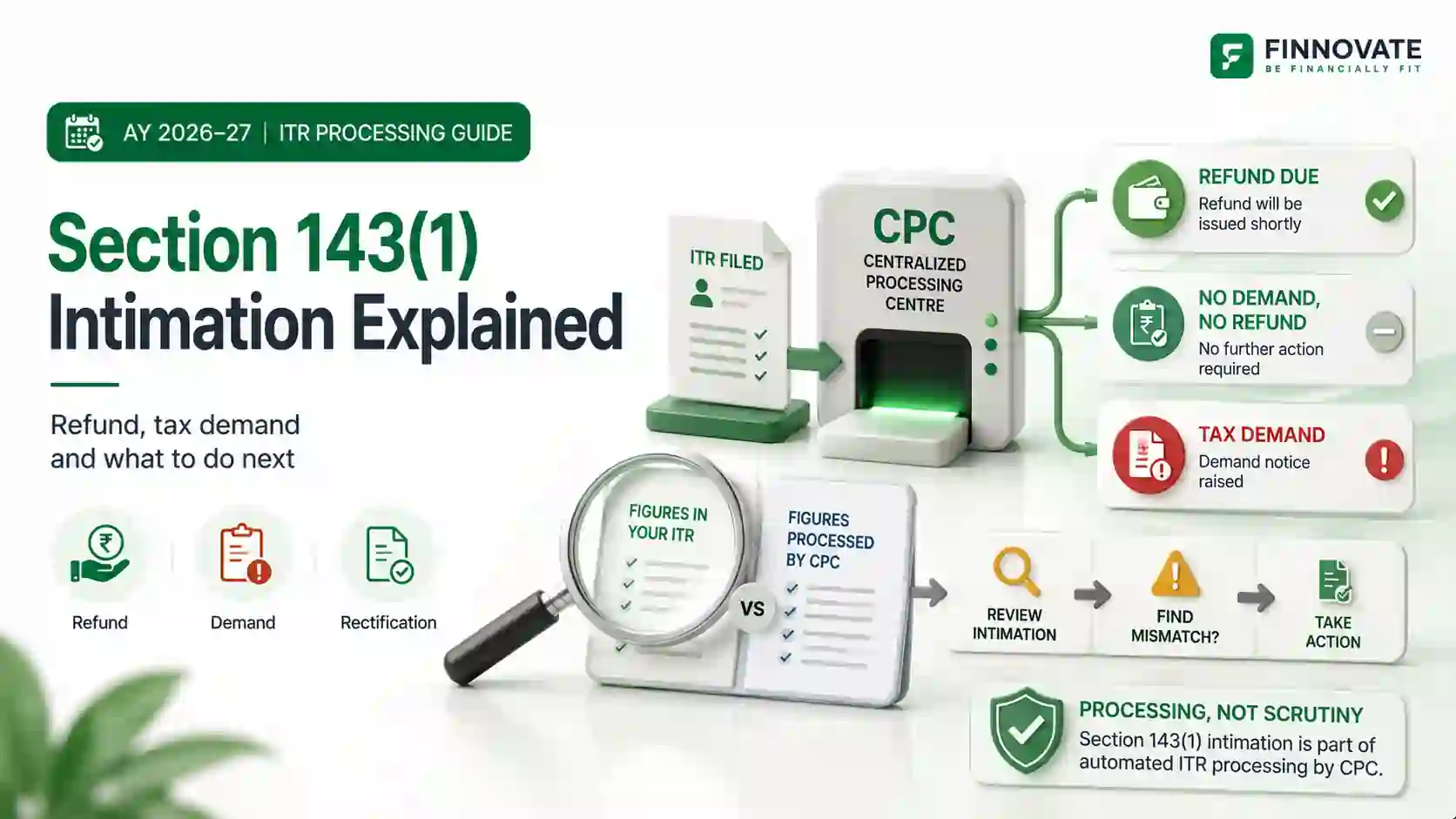
Received a Section 143(1) intimation? Understand CPC adjustments, refunds, tax demands, re...
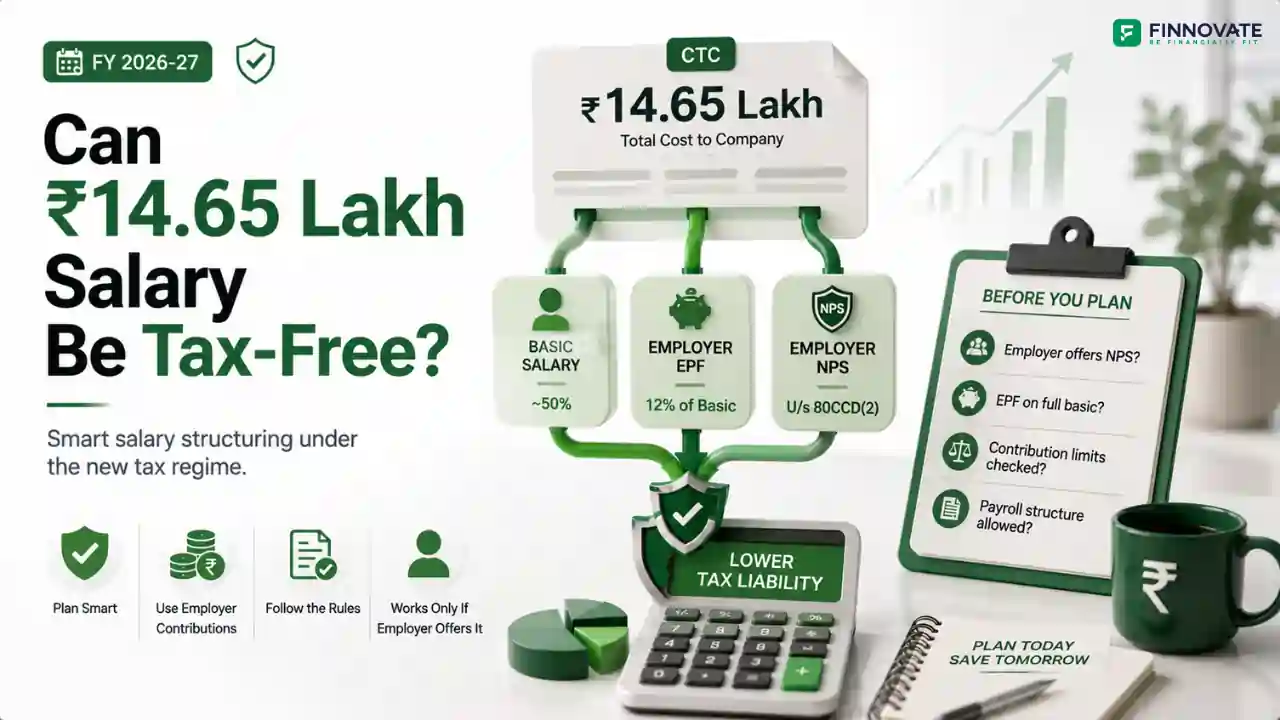
Zero tax on a ₹14.65 lakh salary is real, but only if your employer contributes EPF on f...

Changed jobs in FY 2025-26? See why combining two Form 16s can create a tax shortfall past...
Popular now

Learn how to easily download your NSDL CAS Statement in PDF format with our step-by-step g...

Looking for the best financial freedom books? Here’s a handpicked 2026 reading list with...
Learn what SIF investment means in India, SEBI rules, Rs 10 lakh minimum investment, avail...
Clear guide to mutual fund taxation in India for FY 2025–26 after July 2024 changes: equ...