

FPI Flows First Half October 2026: ₹47,955 Crore Outflow
Explore FPI equity flows for October First Half, 2026: ₹47,955 crore in net outflows, th...
23 October 2026

Finnovate’s editorial team researches and creates financial content using trusted sources, regulatory references and inputs from subject experts.
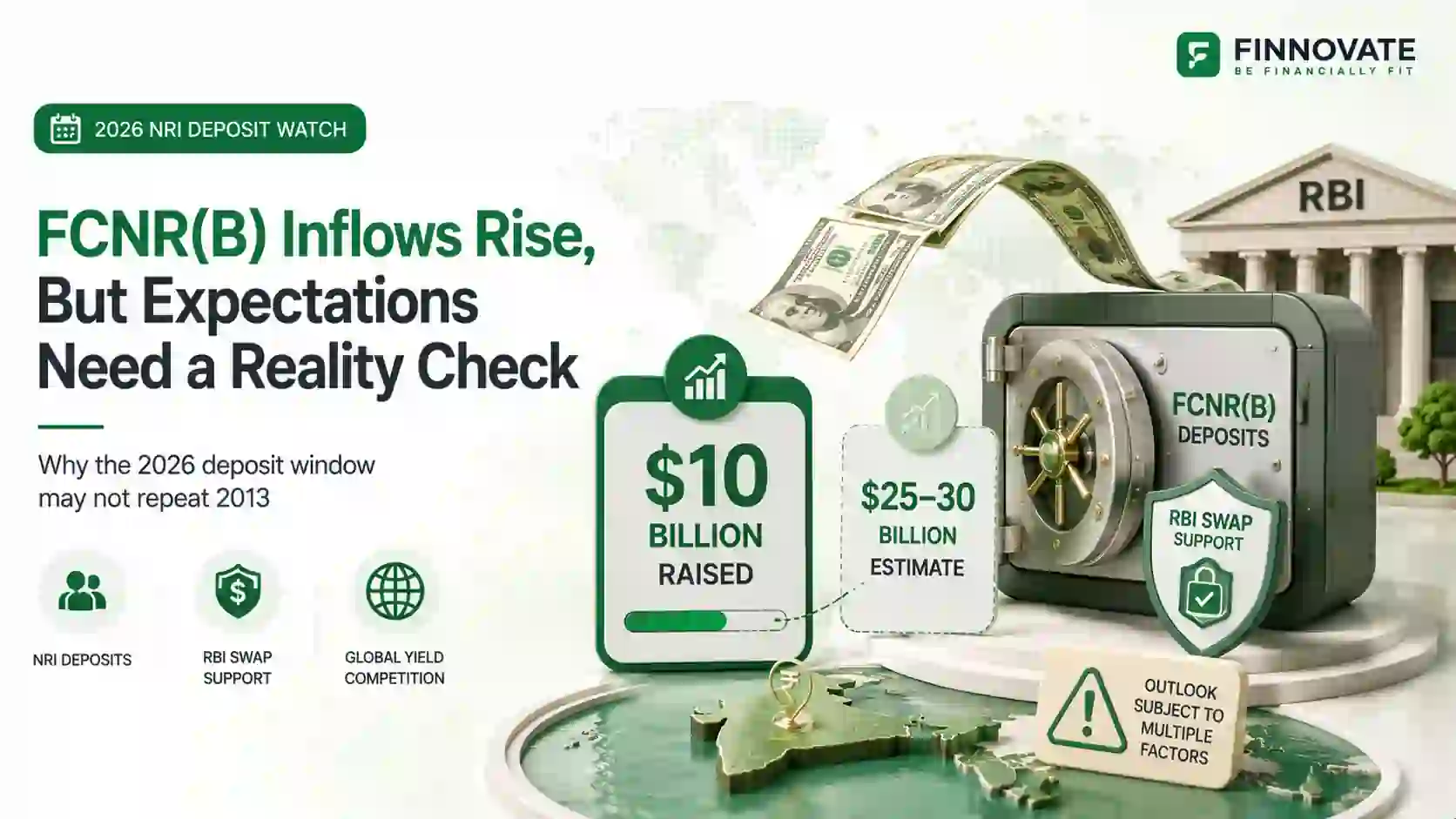
India's special 2026 FCNR(B) deposit window has started attracting larger NRI inflows, but final mobilisation may still fall short of the most optimistic early estimates.
Around $10 billion had reportedly been raised by 14 July 2026. This was higher than the $5 billion to $6 billion reported earlier, suggesting that inflows accelerated after the Reserve Bank of India clarified how banks could structure loans and collateral against eligible deposits.
The scheme is therefore not a failure. But it is also too early to assume that it will repeat the scale and speed of the 2013 mobilisation.
| Detail | Current position |
|---|---|
| Eligible deposits | Fresh or renewed FCNR(B) deposits |
| Deposit tenure | Three to five years |
| Mobilisation window | 8 June to 30 September 2026 |
| RBI support | US dollar-rupee swap covering deposit principal |
| Reported inflows by 14 July | Around $10 billion |
| Barclays estimate | $25 billion to $30 billion |
| Official RBI target | No official target announced |
FCNR(B) deposits allow eligible NRIs to hold term deposits in permitted foreign currencies. Our earlier article explains how the 2026 FCNR(B) deposit window works.
The main policy support is a special foreign-exchange swap facility for eligible deposits mobilised during the window.
Under the facility, RBI covers the bank's principal US dollar-rupee hedging requirement. The swap does not cover the interest component. This lowers the cost banks would otherwise incur while accepting long-term foreign-currency deposits and converting the funds for use in India.
That improved economics has allowed banks to offer higher FCNR(B) deposit rates than before the announcement. But rates still vary by bank, currency and tenure. There is no verified market-wide rate of 7.2%.
Interest on eligible FCNR(B) deposits is generally exempt from Indian income tax for qualifying non-residents. The depositor's country of residence may still tax the income, reducing the post-tax advantage for NRIs based in markets such as the US or UK.
Since the final decision depends on tax residency, account structure, liquidity, repatriation and wider India-linked goals, FCNR(B) deposits can be evaluated within a broader NRI financial planning and advisory framework rather than through the headline rate alone.
RBI clarified on 23 June that banks could extend loans to FCNR(B) account holders, mark a lien on deposits and issue standby letters of credit in favour of overseas lenders.
This opened the door for leveraged structures in which an NRI contributes part of the deposit amount and borrows the balance. Inflows reportedly accelerated after the clarification.
However, leverage does not create a risk-free return.
The actual structure depends on the bank's credit policy, customer eligibility, borrowing cost, margin requirement and the jurisdiction through which the loan is arranged. Overseas dollar funding costs also increased after the clarification, limiting the economics for some banks and depositors.
Leverage can increase the benefit when the deposit rate remains comfortably above the borrowing cost. It can also increase the impact if funding costs rise, the deposit is exited early or the expected tax treatment differs from the depositor's assumptions.
The current scheme is often compared with the special FCNR(B) window introduced in 2013, when India faced a sharp fall in the rupee, a wide current-account deficit and declining market confidence.
The two concessional swap windows used in 2013 collectively mobilised around $34 billion. Approximately $26 billion came through the FCNR(B) route, while the balance came through overseas foreign-currency borrowings by banks.
But the global rate environment was very different. Major overseas interest rates were close to zero, making Indian foreign-currency deposit yields comparatively attractive.
In 2026, NRIs can earn meaningful returns from US dollar deposits, money-market products and government bonds outside India. The additional yield available on an FCNR(B) deposit is therefore narrower, particularly after home-country tax and any borrowing cost are considered.
The 2013 experience is useful as a policy comparison, but not as a direct forecast for 2026.
Three constraints are becoming visible.
FCNR(B) rates are higher than before the special window, but the alternative returns available in global markets are also much higher than in 2013.
Tax exemption in India does not automatically make the deposit tax-free for an NRI. The final return depends on the rules of the country where the depositor is tax resident.
Regional conflict has affected dollar liquidity and risk limits among some Middle Eastern lenders. This matters because the Gulf is a major source of NRI deposits and leveraged funding.
These constraints help explain why estimates vary widely.
Barclays expects FCNR(B) mobilisation of around $25 billion to $30 billion. State-run banks have also indicated an aggregate expectation close to $30 billion. HDFC Bank's management has suggested a higher range of $50 billion to $55 billion, below earlier industry projections of $60 billion to $80 billion.
There is no official RBI mobilisation target of $70 billion.
Fresh FCNR(B) inflows can add to India's foreign-exchange resources and provide near-term support to the rupee.
But these dollars are deposits, not permanent capital. Banks will eventually need to repay the principal and interest in foreign currency. RBI's swap exposure also creates a future dollar obligation linked to the principal amount.
This makes the quality, cost and maturity of the inflows as important as the headline number. Our earlier analysis explains how FCNR(B) swaps add to the RBI's foreign-currency exposure.
The final result will depend on four variables:
The 2026 FCNR(B) window has moved beyond its slow initial phase. Around $10 billion had reportedly been mobilised by mid-July, and the leverage clarification appears to have improved momentum.
Still, the scheme operates in a more competitive global rate environment than in 2013. Overseas taxation, funding costs, regional liquidity and product complexity can reduce the headline attraction.
A final mobilisation of $25 billion to $30 billion would still represent a meaningful foreign-currency inflow. It would simply be lower than the most ambitious market estimates, not evidence that the scheme failed.
An FCNR(B) deposit is a term deposit maintained by an eligible NRI in a permitted foreign currency. Since the deposit is denominated in foreign currency, the depositor does not directly take rupee-conversion risk on the principal.
No. RBI's swap covers the principal amount of eligible deposits. It does not cover the interest component, credit risk on leveraged loans or every operational and funding risk faced by banks.
Interest is generally exempt from Indian income tax for eligible non-residents. It may still be taxable in the depositor's country of residence.
No. RBI has permitted banks to lend against eligible deposits and mark a lien on them. The actual leverage depends on the bank's credit policy, funding structure, customer profile and applicable jurisdiction.
No official RBI target of $70 billion has been announced. Figures between $30 billion and $70 billion have come from banks, analysts and market estimates.
Disclaimer: This article is for general information and educational purposes only. It does not constitute investment, tax or legal advice, a recommendation, or an offer to invest in any deposit or financial product. FCNR(B) deposit rates, tax treatment, leverage terms and eligibility vary by bank and jurisdiction. NRIs may consult qualified tax and financial professionals before evaluating any deposit or leveraged structure.
No spam. Only new posts, simple explainers, and practical money checklists for busy professionals.
Finnovate is a SEBI-registered financial planning firm that helps professionals bring structure and purpose to their money. Over 3,500+ families have trusted our disciplined process to plan their goals - safely, surely, and swiftly.
Our team constantly tracks market trends, policy changes, and investment opportunities like the ones featured in this Weekly Capsule - to help you make informed, confident financial decisions.
Learn more about our approach and how we work with you:
No comments yet. Start the conversation. What would you add?
No spam. Only new posts, simple explainers, and practical money checklists.
You may also like
Explore FPI equity flows for October First Half, 2026: ₹47,955 crore in net outflows, th...

Understand the India–Mauritius tax treaty’s Principal Purpose Test, its August 2026 ef...

Explore India’s AI hardware opportunity through the proposed Adani–Jabil venture, from...

India’s CPI inflation rose to 5.54% in September 2026. Compare monthly trends, food pric...
Popular now

Learn how to easily download your NSDL CAS Statement in PDF format with our step-by-step g...

Looking for the best financial freedom books? Here’s a handpicked 2026 reading list with...

Learn what SIF investment means in India, SEBI rules, Rs 10 lakh minimum investment, avail...

Clear guide to mutual fund taxation in India for FY 2025–26 after July 2024 changes: equ...