

The Great Economic Decoupling of 2026: Oil, AI & India
Rising oil prices and booming AI investment are shaping an uneven global economy in 2026. ...
24 October 2026

Finnovate’s editorial team researches and creates financial content using trusted sources, regulatory references and inputs from subject experts.
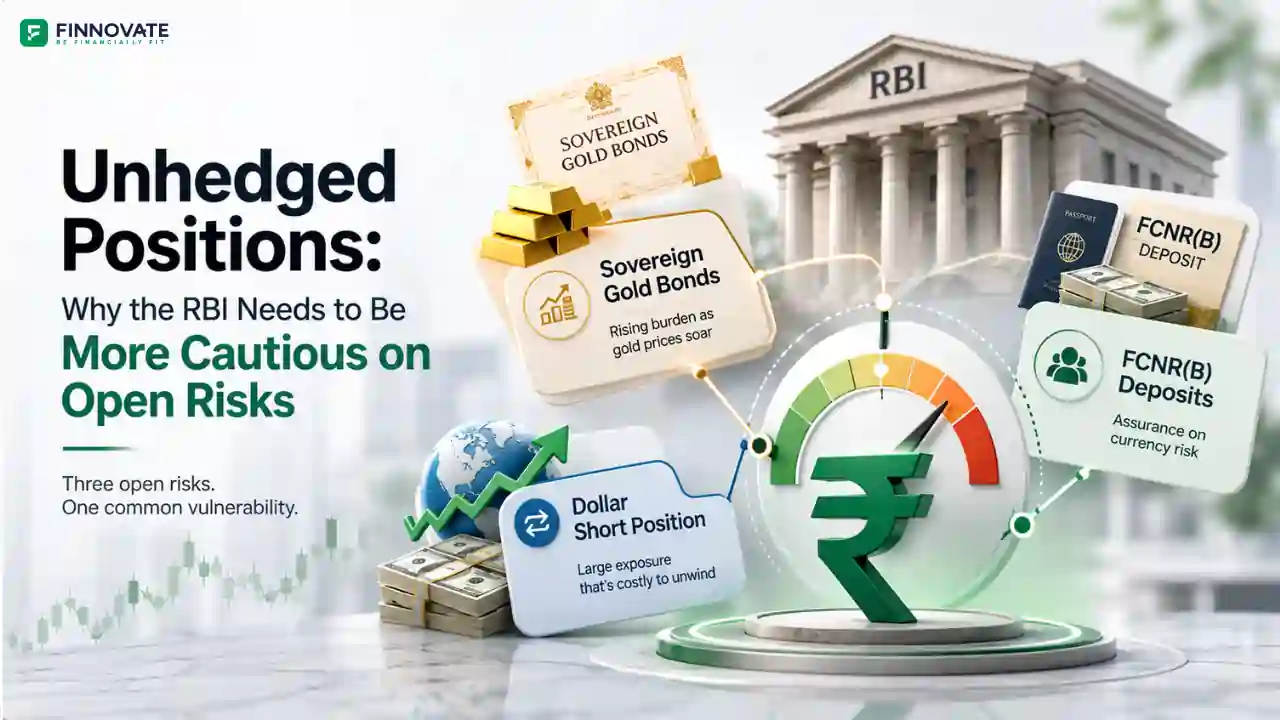
It is good to create a product that sells, especially if it sells like hot cakes. However, every aggressive sale has a cost. In the Indian context, several products over the last few years have come with a huge hidden cost in the form of open-ended risk. Three of these stand out, and all three share a single common thread underneath them.
The RBI and government are carrying three open-ended risks at once: an estimated $15-20 billion SGB burden, a dollar short position past $110 billion, and a currency-risk guarantee on $50-70 billion of incoming FCNR(B) deposits. All three get more expensive if the rupee weakens further, and none of them unwind on their own.
When sovereign gold bonds (SGBs) were first issued by the government through the RBI, they looked like a great product. Investors got interest, tax relief, and full participation in gold's capital appreciation. The open question the government never quite addressed at the time was simple: how much higher can gold actually go?
What was manna from heaven for investors became a burden for the government, which eventually stopped issuing SGBs in February 2024. The 2025 gold rally of roughly 70%, its best calendar year since 1979, pushed the government's overall SGB burden into the broad range of $15-20 billion in redemption losses and forfeited tax revenue, based on independent analyst estimates (India Infoline, The Quint). That figure has moved around considerably as gold kept climbing through 2025 and into 2026, and it can get worse still if gold rallies further from here.
The second unhedged position the government has built up is the RBI's dollar short position, which has crossed $110 billion (Business Standard, Bloomberg). That position has grown sharply over the past year, in some readings close to doubling, depending on which month is used as the starting point.
It looked like a good idea at first, since it capped rupee depreciation without directly depleting dollar reserves. But that is itself another unhedged risk, for a specific reason. The dollar short position is a derivative position, and it eventually has to be unwound, since there is a real cost to rolling it over indefinitely. When the dollar short position is unwound, it tends to harden the dollar further, which increases the losses on the very position being unwound. Unwinding at scale would also tighten domestic liquidity in the money markets.
The third major unhedged position now being taken on is the RBI's assurance to Indian banks that it will bear the currency risk on FCNR(B) deposits, for a limited window running through September 2026. This window is conservatively expected to attract FCNR(B) deposits in the range of $50-70 billion, a scale explored in more detail in Finnovate's own coverage of the RBI's FCNR(B) 2026 scheme.
For NRIs, this is a genuine win-win. They get tax-free returns of up to 7% on their FCNR deposits, in some cases higher at select banks, with the currency risk entirely absorbed by the RBI through a par swap arrangement. Ideally, the RBI would look to do back-to-back hedging of such risks as they come in. If that does not happen and the currency weakens sharply from here, the RBI has to foot the bill on currency losses itself. That, again, becomes an open-ended cost for the government, not a fixed or budgeted one.
There is a single common thread running through all three of these open positions, and that thread is the value of the rupee. If the rupee weakens, rupee gold prices surge further, unwinding the dollar short position becomes more expensive, and the RBI ends up footing a larger bill on its FCNR(B) currency assurance. The Indian rupee has weakened on an annualized basis in most years since this NDA government took office in 2014, so that remains a real and present risk sitting underneath all three positions at once.
If the rupee were to harden meaningfully from here, many of these problems would resolve themselves. But as history keeps reminding us, wishful thinking makes for a wonderful breakfast. It also makes for an awful supper.
| When | What Happened |
|---|---|
| February 2024 | Government issues its final SGB tranche and halts new issuance |
| Through 2025 | Gold rallies roughly 70%, its best year since 1979, sharply raising the government's SGB redemption liability |
| 2025 into mid-2026 | RBI's dollar short position climbs past $110 billion as it defends the rupee via forwards |
| June-September 2026 | RBI opens a FCNR(B) window, absorbing currency risk on an estimated $50-70 billion of fresh NRI deposits |
None of these three positions were created recklessly. Each solved a real problem in the moment it was designed: SGBs curbed physical gold imports, dollar shorts defended the rupee without draining reserves, and the FCNR(B) window is pulling in dollar liquidity precisely when it is needed. But all three share the same underlying vulnerability, and none of them are naturally self-correcting if the rupee continues to weaken. That is the open risk worth watching closely from here.
The government stopped issuing new sovereign gold bond tranches in February 2024, as the scheme had become an increasingly high-cost form of borrowing given gold's sustained price appreciation, which the government has to pay out on redemption.
The RBI's net dollar short position, built through forward contracts to defend the rupee, has crossed $110 billion. It matters because this position eventually has to be unwound, and unwinding it tends to push the dollar higher, working against the very stability the position was meant to protect.
The RBI has agreed to absorb the currency risk on fresh FCNR(B) deposits mobilised through a window running until September 2026, through a par swap arrangement with banks, allowing banks to offer NRIs materially higher, tax-free interest rates without bearing rupee risk themselves.
All three positions share the same underlying sensitivity to the value of the rupee. A weaker rupee makes each of them more expensive for the government or the RBI to manage, since it raises rupee gold prices, raises the cost of unwinding dollar shorts, and raises the RBI's own currency-assurance bill on FCNR(B) deposits.
The rupee has weakened on an annualized basis in most years since 2014, with only rare exceptions, making sustained rupee weakness a recurring feature of this period rather than an occasional event.
Disclaimer: This article reflects general commentary and analysis on public policy and macroeconomic positions and is for general information and educational purposes only. It does not constitute investment advice, a recommendation, or an offer to buy or sell any securities or financial instruments. Figures relating to gold prices, government liabilities, RBI forward positions, and FCNR(B) deposits are drawn from publicly available sources and are estimates subject to revision. Please consult a SEBI-registered investment adviser or qualified financial professional before making any investment decision.
No spam. Only new posts, simple explainers, and practical money checklists for busy professionals.
Finnovate is a SEBI-registered financial planning firm that helps professionals bring structure and purpose to their money. Over 3,500+ families have trusted our disciplined process to plan their goals - safely, surely, and swiftly.
Our team constantly tracks market trends, policy changes, and investment opportunities like the ones featured in this Weekly Capsule - to help you make informed, confident financial decisions.
Learn more about our approach and how we work with you:
No comments yet. Start the conversation. What would you add?
No spam. Only new posts, simple explainers, and practical money checklists.
You may also like
Rising oil prices and booming AI investment are shaping an uneven global economy in 2026. ...

Explore FPI equity flows for October First Half, 2026: ₹47,955 crore in net outflows, th...

Understand the India–Mauritius tax treaty’s Principal Purpose Test, its August 2026 ef...

Explore India’s AI hardware opportunity through the proposed Adani–Jabil venture, from...
Popular now

Learn how to easily download your NSDL CAS Statement in PDF format with our step-by-step g...

Looking for the best financial freedom books? Here’s a handpicked 2026 reading list with...
Learn what SIF investment means in India, SEBI rules, Rs 10 lakh minimum investment, avail...

Clear guide to mutual fund taxation in India for FY 2025–26 after July 2024 changes: equ...