
India–Mauritius Tax Treaty: Principal Purpose Test Explained
Understand the India–Mauritius tax treaty’s Principal Purpose Test, its August 2026 ef...
22 October 2026

Finnovate’s editorial team researches and creates financial content using trusted sources, regulatory references and inputs from subject experts.
Reliance has entered another crowded consumer category.
On September 1, 2026, Reliance Consumer Products Limited launched Bombay Creamery, its new ice cream brand. The range includes cups, cones, sticks, bars and tubs, with prices starting at just ₹10. It is being launched first in western India, with a wider national rollout planned.
Reliance describes the proposition as “accessible premium”, combining dairy ingredients with an aggressive mass-market entry price.
The obvious comparison is Campa.
Reliance revived the soft-drink brand, priced it aggressively, pushed it through a rapidly expanding distribution network and turned Campa into a business with more than ₹4,700 crore of gross sales in FY26.
Can Bombay Creamery repeat that playbook?
That may decide whether Reliance merely creates a price war or genuinely reshapes India's ice cream market.
Table of Contents
India's ice cream market is already sizeable and still expanding.
One widely cited IBEF estimate puts the industry at around ₹30,000 crore in 2023, with the market projected to reach approximately ₹50,000 crore by 2028.
But market growth alone does not explain why the category is attractive.
The bigger opportunity lies in how fragmented it remains.
| Market Characteristic | Approx. Position |
|---|---|
| Amul retail value share | ~19% |
| Kwality Wall's India retail value share | ~9% |
| Several regional/national players | ~4-6% each |
| Organised market | ~60-65% |
| Unorganised/local market | ~35-40% |
| 2023 market estimate | ~₹30,000 crore |
| 2028 estimate | ~₹50,000 crore |
Even India's largest player controls less than one-fifth of retail value.
Ice cream is already a mass-market product. Reliance is not inventing affordable ice cream.
The significance of ₹10 is that it lowers the barrier to trial.
A consumer does not have to think much before experimenting with a ₹10 cup or stick from an unfamiliar brand. If the product tastes good and remains consistently available, trial can turn into repeat purchases.
That matters particularly in an impulse-led category.
But the bigger challenge comes after the first purchase. A ₹10 price can encourage someone to try Bombay Creamery once. It cannot by itself make them buy it again.
RCPL describes Bombay Creamery as an accessible premium dairy ice cream and highlights the use of dairy ingredients.
Dairy ingredients, product quality and brand presentation.
Single-serve products beginning at ₹10.
The dairy message is worth watching because the distinction between ice cream and frozen desserts has become more visible in India.
FSSAI recognises ice cream and frozen desserts containing added vegetable oil or fat as distinct standardised product categories.
Campa is the obvious reference point because it shows how quickly Reliance can scale a consumer brand.
Reliance's FY26 disclosures show Campa crossed ₹4,700 crore in gross sales and became India's fourth-largest carbonated soft-drinks brand, with double-digit share in key markets.
RCPL (Reliance Consumer Products Limited) itself generated approximately ₹22,000 crore of gross revenue in FY26.
RCPL now reaches more than 3 million retail outlets through 5,000+ distributors. Reliance also says more than 80% of RCPL's sales come through external channels rather than only through Reliance-owned stores.
Lower the barrier to trial and force competitors to respond.
Put the product physically close to consumers across independent retail.
Use branded coolers and retailer support to improve visibility and availability.
Keep funding manufacturing, logistics, promotions and retailer support while the brand scales.
A Campa bottle can sit on a warehouse shelf.
An ice cream cannot.
The product has to remain frozen throughout the journey from manufacturing to consumption.
A retailer can put another packet of biscuits on an ordinary shelf relatively easily. Freezer capacity is limited.
Reliance Retail ended FY26 with around 20,160 stores. Its consumer-products business separately reaches millions of general-trade outlets.
That gives Bombay Creamery several possible routes to customers:
The growth of quick commerce makes this launch more interesting.
Ice cream is particularly suited to fast delivery. It is an impulse product, relatively low-ticket and highly time-sensitive. The consumer also avoids the inconvenience of travelling home with a melting product.
It is tempting to look at Amul's roughly 19% share and conclude that Reliance can easily take market share because no one dominates.
The opposite argument is equally important.
India's fragmented ice cream market exists partly because the category has strong regional economics.
A regional manufacturer may know exactly which flavours work locally and may already have freezer relationships built over many years.
Competitors are clearly paying attention.
Kwality Wall's India shares fell after the Bombay Creamery launch as investors assessed the possibility of stronger competition.
A ₹10 entry point can create pressure in lower-priced single-serve products.
But the key question is not whether existing brands are capable of selling inexpensive ice cream. They already do.
The real question is whether Reliance can combine aggressive pricing with distribution and infrastructure to generate unusually high trial volumes.
If that happens, established brands may respond through pricing, retailer incentives, promotions, freezer placements or new products.
Pricing can start the competitive battle. It does not decide the winner.
There is one useful similarity with Jio: Reliance has repeatedly shown that it is willing to enter a large market aggressively, keep prices attractive and invest heavily until scale develops.
But ice cream does not have a true network effect.
What Reliance can build instead is a scale loop:
That loop can become powerful. But it depends on execution, not merely scale.
Early sales headlines will not be enough.
Can the brand expand beyond western India without losing availability or quality?
Can Reliance build enough frozen retail capacity outside its own stores?
Do consumers return after the initial ₹10 trial?
Can Reliance grow both low-priced single serves and higher-value tubs, cones and bars?
Does Bombay Creamery generate enough throughput for retailers to keep stocking it?
Does the brand build durable share rather than temporary launch-driven volumes?
The similarities are real.
Both brands combine affordable pricing, mass-market ambition, large-scale distribution and Reliance's ability to invest aggressively behind a new consumer proposition.
India's ice cream market is also attractive. It is growing, fragmented and increasingly accessible through modern retail and quick commerce.
But Bombay Creamery's challenge is harder.
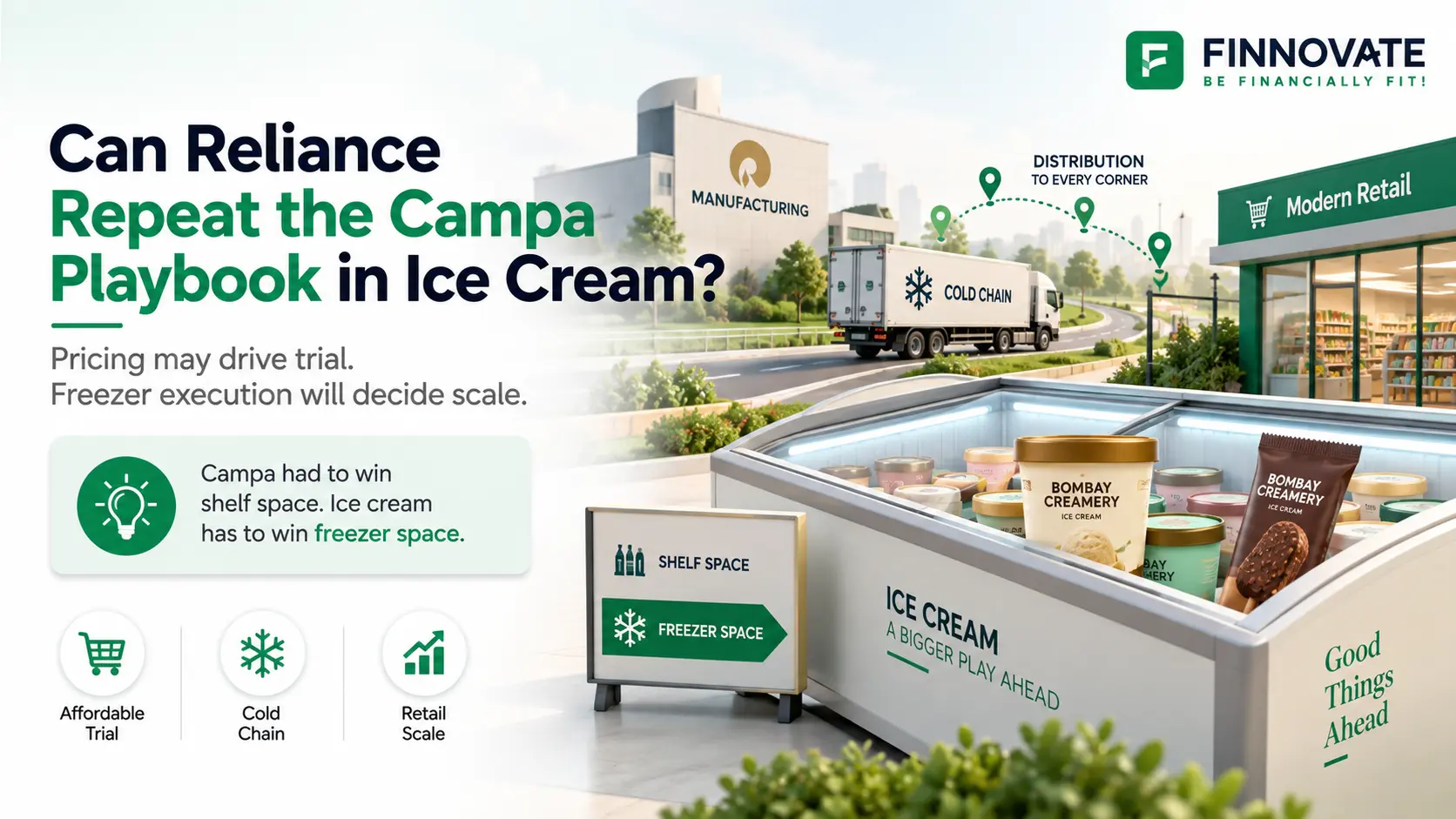
Campa had to win shelf space.
Bombay Creamery has to win freezer space, maintain a frozen supply chain and generate repeat purchases after the initial ₹10 trial.
If Reliance can combine the Campa distribution machine with reliable cold-chain execution, strong retailer economics and products people repeatedly choose, India's fragmented ice cream market gives it a genuine opportunity to become a serious national player.
But that outcome is not guaranteed simply because Campa worked.
Bombay Creamery is Reliance Consumer Products' new dairy ice cream brand, launched in September 2026 with cups, cones, bars, sticks and tubs.
The range starts at ₹10, with Reliance initially launching the brand in western India before a planned wider rollout.
IBEF cites an estimate of about ₹30,000 crore in 2023, potentially rising to around ₹50,000 crore by 2028. Market estimates vary depending on methodology and category definitions.
Euromonitor estimates Amul's parent, Gujarat Cooperative Milk Marketing Federation, at roughly 19% retail value share in 2026, followed by Kwality Wall's India at around 9%.
Reliance says Campa generated more than ₹4,700 crore of gross sales in FY26 and became India's fourth-largest carbonated soft-drinks brand.
Ice cream requires temperature-controlled storage, transport and retailer freezers. That makes distribution more infrastructure-heavy than ambient products such as packaged drinks.
Reliance has significant advantages in pricing, capital, distribution and retail reach, but the outcome will depend on cold-chain execution, freezer availability, product quality, repeat purchases and retailer economics.
Disclaimer: This article is for educational and informational purposes only. References to companies, brands, sales, market shares and business strategies are based on publicly available information and are not investment recommendations. Market estimates may vary by source and methodology, and business strategies can change over time.
No spam. Only new posts, simple explainers, and practical money checklists for busy professionals.
Finnovate is a SEBI-registered financial planning firm that helps professionals bring structure and purpose to their money. Over 3,500+ families have trusted our disciplined process to plan their goals - safely, surely, and swiftly.
Our team constantly tracks market trends, policy changes, and investment opportunities like the ones featured in this Weekly Capsule - to help you make informed, confident financial decisions.
Learn more about our approach and how we work with you:
No comments yet. Start the conversation. What would you add?
No spam. Only new posts, simple explainers, and practical money checklists.
You may also like
Understand the India–Mauritius tax treaty’s Principal Purpose Test, its August 2026 ef...
Explore India’s AI hardware opportunity through the proposed Adani–Jabil venture, from...
India’s CPI inflation rose to 5.54% in September 2026. Compare monthly trends, food pric...
The Shiller CAPE ratio is near its 1999 peak. Explore what it means for US stock valuation...
Popular now
Learn how to easily download your NSDL CAS Statement in PDF format with our step-by-step g...

Looking for the best financial freedom books? Here’s a handpicked 2026 reading list with...
Learn what SIF investment means in India, SEBI rules, Rs 10 lakh minimum investment, avail...
Clear guide to mutual fund taxation in India for FY 2025–26 after July 2024 changes: equ...