
Nifty Sector Performance September 2026: IPO, Pharma & Metal Lead
Compare 19 sector and thematic indices with Nifty 50 for September 2026, covering monthly ...
01 October 2026

Finnovate’s editorial team researches and creates financial content using trusted sources, regulatory references and inputs from subject experts.
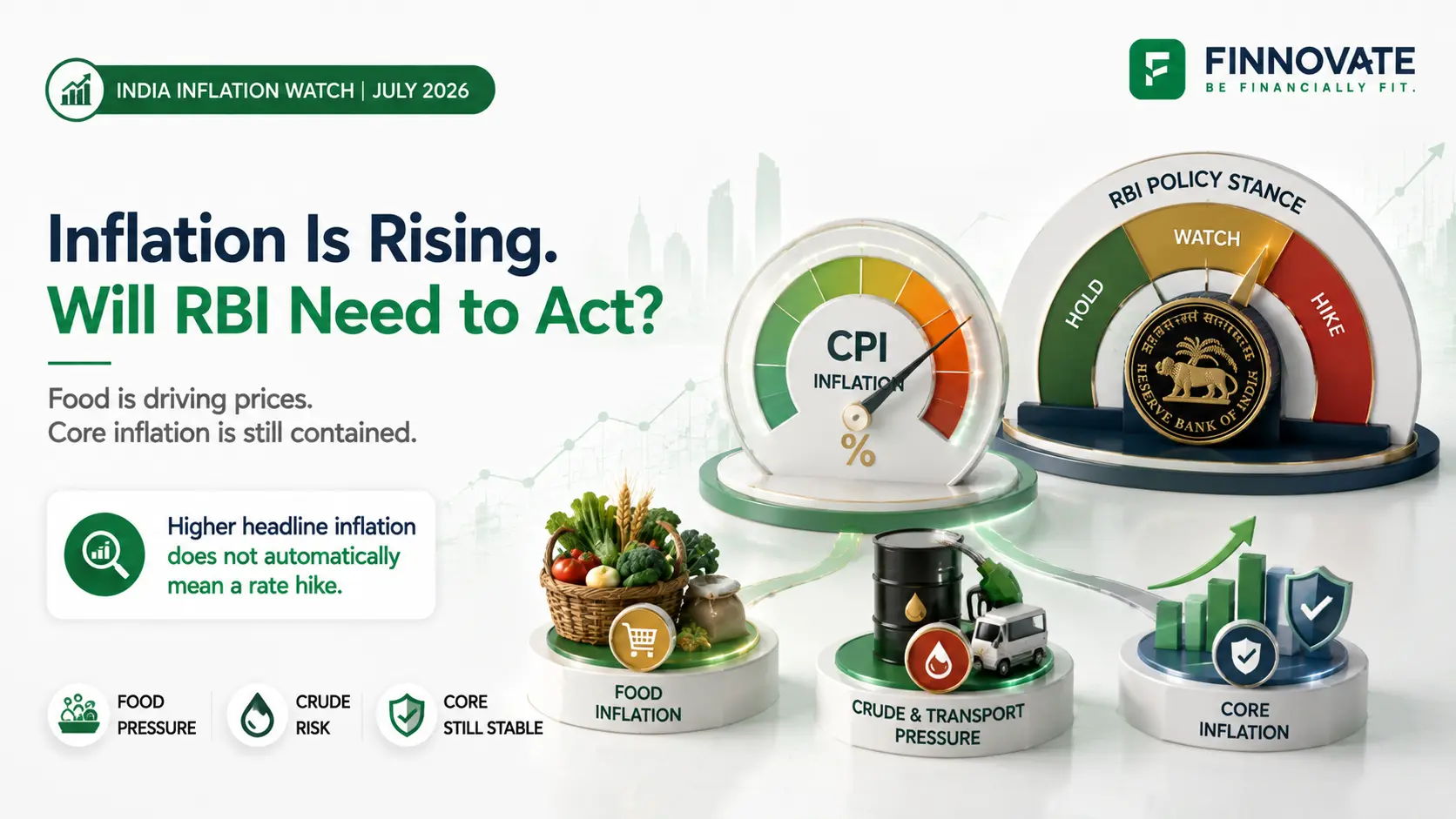
India’s retail inflation moved higher again in July 2026.
Headline Consumer Price Index (CPI) inflation rose to 4.45%, from 4.38% in June and 3.93% in May.
The increase was small, but it matters for one reason: inflation has now stayed above the Reserve Bank of India’s 4% medium-term target for a second straight month.
Food remains the biggest immediate pressure. Food inflation increased to 5.52%, while transport inflation stayed elevated at 4.43%.
Yet another number tells a more reassuring story.
Analyst-calculated core inflation was around 3.9%, suggesting that higher food and fuel costs have not yet spread broadly across the economy.
Table of Contents
| Inflation Measure | May 2026 | June 2026 | July 2026 |
|---|---|---|---|
| Headline CPI | 3.93% | 4.38% | 4.45% |
| Food inflation | 4.78% | 5.32% | 5.52% |
| Food & beverages | 4.55% | 5.05% | 5.24% |
| Transport | 1.75% | 4.31% | 4.43% |
| Restaurants & accommodation | 5.75% | 6.91% | 7.72% |
| Personal care, gold & silver | 18.46% | 16.72% | 14.77% |
The headline number remains inside the RBI’s 2% to 6% tolerance band, but the direction has changed.
Inflation has moved from 3.93% in May to 4.45% in July, with food becoming progressively more expensive.
Food inflation rose from 5.32% in June to 5.52% in July.
That sounds like a broad food-price problem. The item-level data tells a more complicated story.
| Items With High July Inflation | July 2026 Inflation |
|---|---|
| Silver jewellery | 109.84% |
| Ginger | 83.62% |
| Garlic | 35.36% |
| Gold, diamond & platinum jewellery | 32.98% |
| Onion | 22.54% |
At the same time, several commonly purchased products were cheaper than a year earlier.
| Items in Deflation | July 2026 Inflation |
|---|---|
| Potato | -16.56% |
| Motor car & jeep | -6.72% |
| Lady’s finger | -5.52% |
| Peas | -5.27% |
| Tomato | -4.59% |
Tomatoes are a particularly useful example of how quickly food inflation can change. Tomato inflation swung from a sharp increase in June to year-on-year deflation in July.
This volatility is one reason the RBI generally looks beyond one month’s food reading when making interest-rate decisions.
The next major food risk is the monsoon. El Niño conditions remain an important variable for the 2026 crop season. Uneven rainfall can affect Kharif production first, and reservoir levels can later influence the Rabi crop.
That makes rainfall distribution, rather than simply the national rainfall total, important for the inflation outlook.
Transport inflation was 4.43% in July, up only slightly from 4.31% in June.
The bigger increase had actually happened earlier, from 1.75% in May to 4.31% in June.
So July’s transport reading should not be explained entirely by the latest jump in crude oil.
Why does higher crude still matter?
If elevated oil prices persist, they can work through the economy in stages:
But the full impact depends on how much of the increase is passed through domestically.
If fuel retailers absorb part of the cost, the immediate CPI effect can remain limited. If elevated crude persists long enough, the risk of broader pass-through increases.
That makes oil one of the most important variables to watch over the next few months.
Another important feature of the July numbers is the rural-urban gap.
4.84%
3.96%
That is a difference of 88 basis points.
Food inflation showed a similar pattern:
5.79%
5.05%
The rural food inflation rate was therefore about 74 basis points higher.
This matters because food forms a meaningful part of household spending, particularly in rural India.
Rural inflation was also higher in several categories including food and beverages, clothing, footwear, household fuel and some transport-related expenses.
While retail inflation is at 4.45%, wholesale inflation remains much higher.
India’s Wholesale Price Index inflation was 9.78% in July, only marginally lower than 9.87% in June.
Several wholesale categories remained under significant pressure:
High WPI inflation does not automatically mean CPI must rise by the same amount.
Businesses can absorb some of the increase through lower margins, negotiate lower costs elsewhere, delay price increases or pass costs on to customers.
Probably not by itself.
The RBI held the repo rate at 5.25% in its August policy meeting.
July CPI at 4.45% remains inside the central bank’s tolerance band, and analyst-calculated core inflation remains relatively contained at around 3.9%.
That makes the composition of inflation more important than the headline number alone.
Food inflation can be volatile. Fuel prices can move rapidly with geopolitics. The RBI becomes more concerned when these shocks begin creating second-round effects.
For example:
Inflation then becomes broader and more persistent.
The August MPC minutes show that policymakers are increasingly alert to this risk. RBI officials indicated that tighter policy could become necessary if food, fuel and other input-cost shocks begin spreading into wider inflation.
If core inflation remains contained, the RBI has more room to wait.
If food, fuel and producer costs begin pushing core inflation materially higher, the case for tightening becomes stronger.
Four indicators matter most over the next few months.
Whether vegetable and cereal pressures ease as crop arrivals improve.
Whether rainfall distribution affects Kharif output or creates risks for the Rabi season.
Whether Brent remains around $90 or higher long enough to produce a broader domestic cost impact.
Whether inflation outside volatile food and fuel categories begins moving materially higher.
WPI will also remain important because producer prices are already rising much faster than retail prices.
For borrowers, the immediate takeaway is that a quick return to rate cuts now looks difficult.
For fixed-income investors, a more hawkish RBI outlook can influence bond yields and debt-fund returns.
For equity investors, persistent inflation can affect company margins, consumer demand and valuations differently across sectors.
But one CPI number should not determine an investment decision. The trend and composition matter much more.
The next phase will therefore depend less on whether headline CPI temporarily crosses 5% and more on whether today’s food, fuel and producer-price pressures begin spreading across the wider economy.
India’s headline CPI inflation was 4.45% in July 2026, compared with 4.38% in June and 3.93% in May.
Consumer food inflation was 5.52%, with rural food inflation at 5.79% and urban food inflation at 5.05%.
Yes. It is above the RBI’s 4% medium-term target, but remains within the central bank’s tolerance range of 2% to 6%.
Not necessarily. The RBI kept the repo rate at 5.25% in August. Policymakers have indicated that tightening may become necessary if food and fuel inflation spreads into broader prices, but no specific rate hike has been committed.
Wholesale inflation was 9.78% in July, compared with 9.87% in June.
Disclaimer: This article is for educational and informational purposes only and should not be treated as investment, tax or financial advice. Inflation, interest rates and market conditions can change rapidly. Investors should consider their financial goals, asset allocation and risk profile before making investment decisions.
No spam. Only new posts, simple explainers, and practical money checklists for busy professionals.
Finnovate is a SEBI-registered financial planning firm that helps professionals bring structure and purpose to their money. Over 3,500+ families have trusted our disciplined process to plan their goals - safely, surely, and swiftly.
Our team constantly tracks market trends, policy changes, and investment opportunities like the ones featured in this Weekly Capsule - to help you make informed, confident financial decisions.
Learn more about our approach and how we work with you:
No comments yet. Start the conversation. What would you add?
No spam. Only new posts, simple explainers, and practical money checklists.
You may also like
Compare 19 sector and thematic indices with Nifty 50 for September 2026, covering monthly ...

Understand the Growpital case, SEBI’s refund order, the LLP investment structure and wha...
India plans to borrow ₹7.86 lakh crore in the second half of FY2026–27. Learn how the ...

Proposed EU scrap export curbs could affect India’s metal supply and manufacturing costs...
Popular now

Learn how to easily download your NSDL CAS Statement in PDF format with our step-by-step g...

Looking for the best financial freedom books? Here’s a handpicked 2026 reading list with...
Learn what SIF investment means in India, SEBI rules, Rs 10 lakh minimum investment, avail...
Clear guide to mutual fund taxation in India for FY 2025–26 after July 2024 changes: equ...