

India’s EV Two-Wheeler Share Crosses 10%: What’s Driving Growth?
India’s electric two-wheeler share stayed above 10% in August 2026. See what is driving ...
11 September 2026

Finnovate’s editorial team researches and creates financial content using trusted sources, regulatory references and inputs from subject experts.
India's trade relationship with BRICS has become much bigger in just five years.
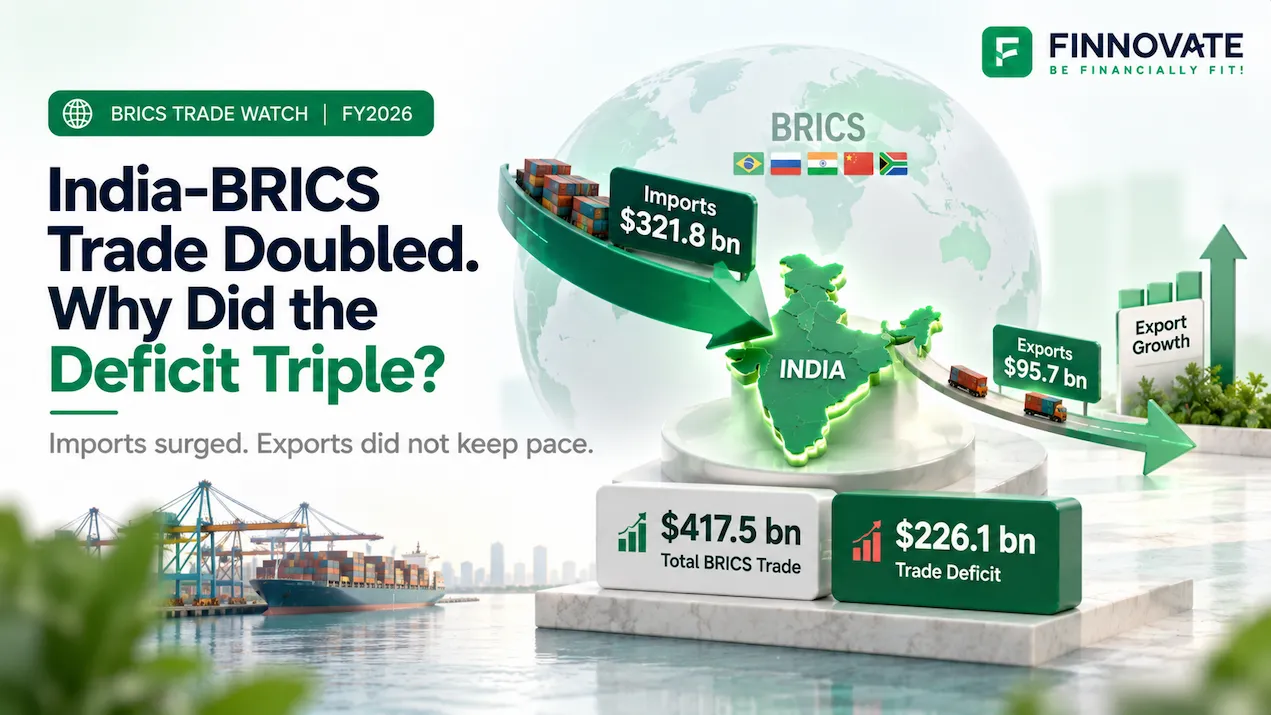
In FY2021, India's merchandise trade with BRICS countries stood at about $203.1 billion. By FY2026, it had more than doubled to $417.5 billion.
But there is a catch.
India exported goods worth only $95.7 billion to BRICS economies last year while importing $321.8 billion from them. The result was a $226.1 billion merchandise trade deficit, more than three times the $74.5 billion deficit recorded five years earlier.
That creates an unusual position for India.
BRICS has become increasingly important to India's trade, but much more as a source of goods than as a market for Indian goods.
And that may be one of the biggest economic questions left behind by the BRICS Summit held in New Delhi on September 12–13, 2026.
The challenge is not simply to import less from BRICS. India buys oil, machinery, electronics, industrial inputs and other goods that its economy genuinely needs.
The harder challenge is this:
Table of Contents
The headline growth looks impressive.
India's total goods trade with BRICS increased from $203.1 billion in FY2021 to $417.5 billion in FY2026, a rise of more than 100%.
But exports and imports followed very different paths.
| India-BRICS Merchandise Trade | FY2021 | FY2026 | Change |
|---|---|---|---|
| Exports | $64.3 bn | $95.7 bn | +48.8% |
| Imports | $138.8 bn | $321.8 bn | +131.8% |
| Total Trade | $203.1 bn | $417.5 bn | +105.6% |
| Trade Deficit | $74.5 bn | $226.1 bn | +203.5% |
Imports grew nearly three times as fast as exports.
BRICS economies supplied 41.5% of India's total merchandise imports in FY2026, up from 35.2% in FY2021. Yet they accounted for only 21.7% of India's merchandise exports.
The $226.1 billion BRICS deficit was also equivalent to roughly 68% of India's entire FY2026 merchandise trade deficit of $334.3 billion.
So the imbalance is large.
But before calling it a problem, it is important to understand what exactly India is importing.
Suppose a country imports machinery that helps factories produce more.
Or crude oil that keeps transport, manufacturing and power running.
Or electronic components that are assembled into products eventually sold elsewhere.
Those imports create a trade deficit, but that does not necessarily mean the economy is becoming weaker.
This distinction matters for India because a meaningful part of its imports from BRICS countries consists of energy, industrial machinery, electronics, chemicals, commodities and manufacturing inputs.
So India's objective cannot simply be:
The more useful question is:
That is where the imbalance becomes more meaningful.
And when the deficit is broken down country by country, an even clearer story appears.
India does not have the same trade relationship with every BRICS economy.
China, Russia and the UAE together supplied roughly $251 billion of goods to India in FY2026, accounting for nearly 84% of India's imports from its BRICS partners.
But each relationship looks very different.
| BRICS Partner | Indian Exports | Indian Imports | Approx. Indian Deficit |
|---|---|---|---|
| China | $19.5 bn | $131.6 bn | $112.2 bn |
| Russia | $4.5 bn | $55.4 bn | $50.9 bn |
| UAE | $37.4 bn | ~$63.9 bn | $26.5 bn |
Together, these three relationships account for roughly $190 billion of India's BRICS merchandise deficit.
But lumping all three together would hide what is actually happening.
China alone accounts for almost half of India's BRICS trade deficit.
Indian imports from China increased from $65.2 billion in FY2021 to $131.6 billion in FY2026.
Indian exports went the other way, falling from $21.2 billion to $19.5 billion.
So the bilateral deficit reached about $112 billion.
Part of this imbalance exists because Chinese goods sit deep inside Indian supply chains.
India buys electronics, machinery, industrial equipment, chemicals, pharmaceutical inputs and components used across manufacturing.
That creates a difficult policy problem.
If some Chinese imports are inputs into Indian factories, simply restricting those imports can raise costs for Indian businesses unless domestic or alternative suppliers already exist.
Reducing dependence therefore requires more than trade restrictions.
India would need to manufacture more critical inputs locally, diversify suppliers and simultaneously win better access for Indian products in China.
This is why the India-China discussion at the BRICS Summit was significant.
During their September 12 meeting, Prime Minister Narendra Modi and Chinese President Xi Jinping specifically acknowledged the need to address structural trade imbalance, supply-chain issues and meaningful and predictable market access.
So India's largest BRICS trade imbalance was directly on the table.
India's imports from Russia have changed dramatically since FY2021.
They increased from just $5.5 billion to $55.4 billion in five years.
Exports to Russia increased too, but much more slowly, from roughly $2.7 billion to $4.5 billion.
The result is a bilateral deficit of about $50.9 billion.
But unlike China, this is primarily an energy story.
India sharply increased purchases of Russian crude following the Russia-Ukraine war as discounted oil became available.
That means India's Russian deficit cannot be interpreted in the same way as its Chinese deficit.
One reflects deep dependence on industrial supply chains.
The other largely reflects a deliberate shift in where India buys energy.
In fact, cheaper crude can benefit the Indian economy even if it increases the bilateral merchandise deficit.
The real imbalance with Russia is that Indian exports have not grown anywhere close to the increase in imports.
The UAE also gives India a merchandise deficit.
India imported nearly $64 billion of goods from the UAE in FY2026 and exported $37.4 billion, creating a gap of roughly $26.5 billion.
But there is an important difference.
The UAE is India's largest export market within BRICS, and Indian shipments to the country have increased by around 124% since FY2021.
That makes the UAE relationship much more two-sided.
India is a major buyer of crude oil and other commodities from the UAE, but it has also managed to build a substantial export market there.
That is closer to the model India would ideally like to develop with other BRICS partners.
This is where the discussion becomes more difficult.
An ASSOCHAM study estimates that India could increase merchandise exports to BRICS economies from around $96 billion in FY2026 to $200 billion by 2030.
Potential sectors include engineering goods, electronics, automobiles and components, chemicals, pharmaceuticals, textiles, leather, gems and jewellery, rice, food products and marine products.
It is an opportunity estimate, not an official government export target.
And the number is ambitious.
Going from $95.7 billion to $200 billion in four years would require BRICS exports to grow at roughly 20% a year.
For comparison, India's exports to BRICS increased only about 49% over the previous five years.
So reaching $200 billion would require a significant acceleration.
The question is therefore not whether India has products to sell.
It clearly does.
The challenge is whether Indian companies can gain enough market access, distribution, pricing competitiveness and scale across very different BRICS economies.
This is one of the more interesting contradictions.
The 11 BRICS economies exported around $5.67 trillion of goods globally in 2025 and imported about $4.58 trillion.
That left the grouping with a combined merchandise trade surplus of roughly:
BRICS is therefore an enormous force in world trade.
Yet only around 18.8% of BRICS exports go to other BRICS economies.
In other words, BRICS is not yet anything close to an EU-style integrated trading market.
Its countries remain heavily connected to buyers and suppliers outside the grouping.
Even intra-BRICS commerce is highly concentrated around China.
China alone exported about $550.8 billion to other BRICS economies and imported roughly $464.9 billion from them.
So simply expanding trade inside BRICS does not automatically create balanced opportunities for every member.
India could theoretically trade much more with BRICS and still see its deficit grow if imports continue to expand faster than exports.
The New Delhi Declaration recognised this broader challenge and put several trade-related mechanisms on the agenda.
BRICS members backed work on the Strategy for BRICS Economic Partnership 2030, aimed at guiding longer-term economic cooperation.
They also supported:
These are potentially useful.
For example, an Indian MSME trying to export engineering products may struggle less because demand does not exist and more because financing, documentation, standards, logistics and market access make cross-border trade difficult.
Reducing these frictions can help.
But none of these measures instantly solves India's $226 billion deficit.
There was no BRICS-wide free-trade agreement or sweeping removal of tariffs announced at the summit.
This is another area where BRICS discussions often become exaggerated.
The New Delhi Declaration supported continued work on improving cross-border payment systems and exploring settlement of trade and investment in BRICS members' local currencies.
But it also explicitly recognised that there is no one-size-fits-all approach.
BRICS is therefore not launching a common currency.
The grouping is trying to make transactions cheaper, faster and less dependent on a single payment route.
That can matter, particularly where sanctions, banking restrictions or dollar settlement create friction.
But payment currency cannot fix India's fundamental trade imbalance.
If India imports $100 worth of goods and exports only $20, settling the transaction in rupees, yuan or another currency changes how the payment happens.
It does not change the underlying $80 trade gap.
Ultimately, trade rebalancing requires India to sell more.
There is one important caveat to the $226.1 billion figure.
It measures merchandise trade, meaning physical goods.
India's global external position looks considerably better once services are included because the country runs a large services trade surplus.
India's strength in IT services, consulting, financial services, digital solutions, healthcare, education and other professional services could also become an increasingly important part of its BRICS economic relationship.
But services should not be used to make the merchandise imbalance disappear.
The two tell different stories.
The goods deficit highlights India's dependence on imported energy, commodities and industrial inputs.
The services surplus highlights an area where India has strong global competitiveness.
A stronger BRICS strategy would ideally use both.
There is unlikely to be one solution.
India would need progress on several fronts at the same time.
China, Russia, Indonesia and other markets need to become easier destinations for competitive Indian products.
Engineering goods, electronics, automobiles, chemicals and pharmaceuticals offer much more scale than relying only on traditional low-value exports.
Reducing dependence on imported industrial inputs requires producing more components, materials and technology domestically, not merely assembling the final product in India.
India does not necessarily have to manufacture every imported product itself. Sourcing critical inputs from a broader set of economies can reduce excessive dependence on one supplier.
India's strongest global export advantage should also become a larger part of its BRICS relationship.
This is the same challenge seen across India's wider import-substitution push.
The numbers can easily lead to the wrong conclusion.
India buys $321.8 billion of goods from BRICS and sells only $95.7 billion.
That imbalance deserves attention.
But BRICS economies also supply India with energy, machinery, commodities and inputs that help the rest of the economy function.
So the goal should not simply be to shrink the relationship.
It should be to improve its composition.
India needs BRICS to become more than a source of oil, industrial inputs, machinery and commodities.
It also needs BRICS to become a much larger market for Indian manufactured goods, pharmaceuticals, engineering products, food, technology and services.
The New Delhi Summit has created mechanisms that could make some of that easier.
But frameworks, payment systems and trade-finance initiatives can only go so far.
Trade with the bloc has doubled.
Imports have more than doubled.
The next test is whether Indian exports can finally begin catching up.
India's merchandise trade with BRICS economies reached about $417.5 billion in FY2026, up from $203.1 billion in FY2021.
India exported $95.7 billion of goods to BRICS partners and imported $321.8 billion in FY2026, creating a $226.1 billion merchandise trade deficit.
China. India imported about $131.6 billion from China in FY2026 while exporting $19.5 billion, leaving a deficit of roughly $112 billion.
The deficit expanded sharply after India increased imports of Russian energy, particularly crude oil. Imports reached $55.4 billion in FY2026 compared with only $4.5 billion of Indian exports.
ASSOCHAM estimates that Indian merchandise exports to BRICS could reach $200 billion by 2030 from around $96 billion in FY2026. Achieving that would require roughly 20% annual export growth over four years, making it an ambitious opportunity rather than a guaranteed outcome.
No. BRICS is exploring local-currency trade settlement and greater interoperability between cross-border payment systems. The 2026 New Delhi Declaration itself says there is no single approach suitable for every member.
No. The summit advanced initiatives around trade finance, global value chains, local-currency payments, Special Economic Zones and trade digitisation, but these are longer-term facilitation measures rather than an immediate solution to India's trade imbalance.
Disclaimer: This article is for educational and informational purposes only. References to countries, industries, trade flows, economic policies and projections do not constitute investment advice or recommendations. Trade data, policy frameworks and forecasts can change with commodity prices, exchange rates, geopolitical developments and government policy.
No spam. Only new posts, simple explainers, and practical money checklists for busy professionals.
Finnovate is a SEBI-registered financial planning firm that helps professionals bring structure and purpose to their money. Over 3,500+ families have trusted our disciplined process to plan their goals - safely, surely, and swiftly.
Our team constantly tracks market trends, policy changes, and investment opportunities like the ones featured in this Weekly Capsule - to help you make informed, confident financial decisions.
Learn more about our approach and how we work with you:
No comments yet. Start the conversation. What would you add?
No spam. Only new posts, simple explainers, and practical money checklists.
You may also like
India’s electric two-wheeler share stayed above 10% in August 2026. See what is driving ...

India is the world’s largest sponge-iron producer, yet prices hit a 2-year high in Augus...

India cleared ₹1.10 lakh crore of defence acquisition proposals in September 2026. Learn...
FCNR(B) deposits surged to $127.23 billion in 2026. See how RBI is managing record forex r...
Popular now

Learn how to easily download your NSDL CAS Statement in PDF format with our step-by-step g...

Looking for the best financial freedom books? Here’s a handpicked 2026 reading list with...

Learn what SIF investment means in India, SEBI rules, Rs 10 lakh minimum investment, avail...
Clear guide to mutual fund taxation in India for FY 2025–26 after July 2024 changes: equ...