

How Much Corpus for ₹2 Lakh/Month Retirement in India?
Want ₹2 lakh per month after retirement? See the corpus needed today and after 10, 20 or...
16 September 2026

Rs 1 lakh per month in retirement sounds like a clean, specific target. It is not. It is a starting point that means very different things depending on when you are retiring, how long you are likely to live, and how you plan to draw from your corpus.
A 35-year-old planning to retire at 60 and a 52-year-old planning to retire in 8 years both want Rs 1 lakh per month. Their required corpus figures are not the same. Not even close. And most articles on this topic give one number without explaining why.
This article works through the calculation age by age, explains why different sources give different answers, and surfaces what most retirement planning conversations miss entirely.
In This Article
If you have searched this topic, you have seen figures ranging from Rs 2 crore to Rs 12 crore for the same stated goal. Every one of those answers can be mathematically correct. Four variables explain why.
Getting these four variables right for your specific situation (your retirement age, inflation exposure, how long your corpus must last, and the right withdrawal rate) is what a structured retirement plan does. Finnovate's retirement planning advisory covers corpus estimation, SIP structuring, and drawdown planning: retirement planning advisory at Finnovate
Before computing a corpus, the inflation-adjusted monthly expense at the point of retirement needs to be established. Rs 1 lakh per month today is not Rs 1 lakh per month at retirement if that event is 15 or 20 years away.
The table below shows what Rs 1 lakh per month in today's purchasing power translates to at retirement, at 6% annual inflation.
| Years to Retirement | Inflation-Adjusted Monthly Expense at Retirement |
|---|---|
| 5 years | Rs 1.34 lakh |
| 10 years | Rs 1.79 lakh |
| 15 years | Rs 2.40 lakh |
| 20 years | Rs 3.21 lakh |
| 25 years | Rs 4.29 lakh |
| 30 years | Rs 5.74 lakh |
This is why different sources produce such different corpus estimates. They are calibrating to different starting expenses, inflation rates, and retirement timelines. With this inflation-adjusted figure established, the corpus calculation becomes straightforward.
Three inputs determine the answer. The flowchart below shows how they connect.
| Monthly Income Target (Today's Value) | Retire in 10 Years | Retire in 20 Years | Retire in 30 Years |
|---|---|---|---|
| Rs 50,000 | Rs 2.69 crore | Rs 4.81 crore | Rs 8.62 crore |
| Rs 75,000 | Rs 4.03 crore | Rs 7.22 crore | Rs 12.92 crore |
| Rs 1 lakh | Rs 5.37 crore | Rs 9.62 crore | Rs 17.23 crore |
| Rs 1.5 lakh | Rs 8.06 crore | Rs 14.43 crore | Rs 25.85 crore |
| Rs 2 lakh | Rs 10.75 crore | Rs 19.24 crore | Rs 34.46 crore |
Know your target corpus. Now check if your investments are on track to get there.
For those in the accumulation phase, the practical question that follows is: what monthly SIP is required to reach the target corpus by retirement?
The table below shows the monthly SIP required to build four corpus targets, starting from zero, across four investment timelines. It assumes a 12% CAGR on a diversified equity-heavy portfolio during the accumulation phase, consistent with the historical long-term return range of Indian equity markets. Past performance is not indicative of future returns and actual results will vary.
| Target Corpus | 30 Years | 25 Years | 20 Years | 15 Years |
|---|---|---|---|---|
| Rs 3 crore | Rs 8,600 | Rs 15,900 | Rs 30,300 | Rs 60,000 |
| Rs 5 crore | Rs 14,300 | Rs 26,600 | Rs 50,500 | Rs 1,00,100 |
| Rs 8 crore | Rs 22,900 | Rs 42,600 | Rs 80,900 | Rs 1,60,100 |
| Rs 10 crore | Rs 28,600 | Rs 53,200 | Rs 1,01,100 | Rs 2,00,200 |
Most salaried professionals already have EPF building passively. The SIP figures above assume starting from zero. Existing EPF, PPF, and other retirement savings reduce the monthly amount required. A practical two-step adjustment:
For a structured view of how post-retirement asset allocation is typically structured, the Finnovate guide on age-based allocation covers the transition from accumulation to drawdown.
The corpus figures above address lifestyle expenses. Two components are frequently omitted from retirement calculations and materially affect the plan.
Medical costs inflate faster than general inflation in India. Standard health insurance covers hospitalisation but leaves gaps in critical illness, long-term care, and chronic condition costs. A dedicated buffer kept in liquid instruments outside the main corpus is a standard component of retirement planning.
The method used to draw retirement income materially affects both the tax outgo and the longevity of the corpus. Two common approaches compared:
| Factor | Fixed Deposit (FD) | SWP from Mutual Fund |
|---|---|---|
| Tax treatment | Full interest income taxed at slab rate (20% or 30%) | Only capital gains portion taxed, not the full withdrawal |
| Effective post-tax return | 7% pre-tax at 30% slab = ~4.9% post-tax | LTCG at 12.5% on gains above Rs 1.25 lakh/year |
| Corpus longevity | Lower: higher tax drag accelerates depletion | Higher: tax efficiency preserves corpus longer |
| Market exposure | None. Fixed return, capital secure | Yes. Returns vary; depletion risk in weak markets |
| Flexibility | Limited. Breaking FD carries penalties | High. Withdrawal amount adjustable anytime |
A retirement income plan typically combines both approaches. For a detailed breakdown of how SWP withdrawals are taxed in India, the Finnovate taxation guide covers the mechanics in full. Please consult a SEBI-registered investment adviser to structure the withdrawal approach for your specific situation.
Your actual retirement corpus depends on your specific monthly expenses, existing portfolio, EPF balance, planned retirement age, and risk tolerance. A SEBI-registered adviser can map the full picture for your situation.
Learn about our retirement planning advisory →Rs 1 lakh per month in retirement is an achievable target for most salaried professionals who start early and stay consistent. The numbers in this article may look large, but they are the product of inflation over time, not an unreachable aspiration. The earlier the plan is built, the smaller the monthly commitment required to get there. A 30-year-old targeting Rs 9.62 crore needs Rs 14,300 per month. A 45-year-old targeting the same corpus needs over Rs 1 lakh per month. The gap is not effort. It is time.
The corpus required depends on years to retirement, inflation rate, and the withdrawal rate used. At a 4% withdrawal rate and 6% annual inflation, sustaining Rs 1 lakh per month (today's value) requires approximately Rs 5.37 crore for someone retiring in 10 years and approximately Rs 9.62 crore for someone retiring in 20 years. Please consult a SEBI-registered investment adviser to compute the figure for your specific situation and map it as a structured financial goal.
At a 4% withdrawal rate, a Rs 3 crore corpus generates Rs 1 lakh per month in the first year of retirement. However, this does not account for inflation in subsequent years. A retiree starting at Rs 1 lakh per month will need Rs 1.79 lakh per month 10 years later and Rs 3.21 lakh per month 20 years later at 6% inflation. Without the corpus growing at a comparable rate, it depletes well before a 25-year retirement is complete. Whether Rs 3 crore is sufficient depends entirely on the withdrawal rate, post-retirement portfolio return, and retirement duration.
Financial planners in India broadly reference a safe withdrawal rate of 3.5% to 4% for a 25 to 30-year retirement. This is calibrated slightly below the US 4% rule because India's average inflation is higher, healthcare cost inflation runs at 10% to 13% annually, and private sector workers have no government-funded social security. A 3.5% rate provides a wider margin for longer retirement periods or higher inflation scenarios.
A Systematic Withdrawal Plan (SWP) allows investors to withdraw a fixed amount from a mutual fund corpus at regular intervals while the remaining corpus stays invested and continues generating returns. The tax advantage over FDs is that only the capital gains portion of each withdrawal is taxable, not the full amount withdrawn. For equity fund holdings over one year, gains above Rs 1.25 lakh annually are taxed at 12.5% long-term capital gains rate, which is materially lower than the slab-rate taxation on FD interest income.
EPF accumulates through mandatory contributions during employment: 12% of basic salary from the employee and an equal amount from the employer, compounding at the EPFO-declared interest rate each year. For most salaried professionals, the EPF corpus at retirement covers a meaningful portion of the total required fund. The practical approach is to project the EPF corpus at retirement using the current balance and remaining working years, and treat the shortfall as the target for personal investment through SIP, PPF, or NPS.
At a 12% pre-retirement CAGR, building Rs 5 crore requires approximately Rs 14,300 per month over 30 years, Rs 26,600 per month over 25 years, or Rs 50,500 per month over 20 years, starting from zero. Existing savings and EPF reduce the monthly SIP required proportionally. Past performance is not indicative of future returns and actual SIP requirements will vary based on portfolio returns achieved.
Disclaimer: This article is for general information and educational purposes only. It does not constitute investment advice, a recommendation, or an offer to buy or sell any securities or financial instruments. Corpus figures, SIP calculations, and inflation projections presented are illustrative estimates based on assumed parameters. They are not guaranteed outcomes or personalised financial targets. Actual figures will vary based on individual circumstances, market conditions, portfolio returns achieved, and changes in tax or regulatory frameworks. Past investment performance is not indicative of future returns. Please consult a SEBI-registered investment adviser or qualified financial professional before making any financial planning or investment decision. Investments in mutual funds and other market-linked instruments are subject to market risks. Read all scheme-related documents carefully before investing.
No spam. Only new posts, simple explainers, and practical money checklists for busy professionals.
Finnovate is a SEBI-registered financial planning firm that helps professionals bring structure and purpose to their money. Over 3,500+ families have trusted our disciplined process to plan their goals - safely, surely, and swiftly.
Our team constantly tracks market trends, policy changes, and investment opportunities like the ones featured in this Weekly Capsule - to help you make informed, confident financial decisions.
Learn more about our approach and how we work with you:
No comments yet. Start the conversation. What would you add?
No spam. Only new posts, simple explainers, and practical money checklists.
You may also like
Want ₹2 lakh per month after retirement? See the corpus needed today and after 10, 20 or...

SWP vs FD for retirement: compare income, risk, inflation, tax, liquidity and corpus susta...

NPS vs mutual funds for retirement: compare liquidity, tax, lock-in, asset allocation, ann...
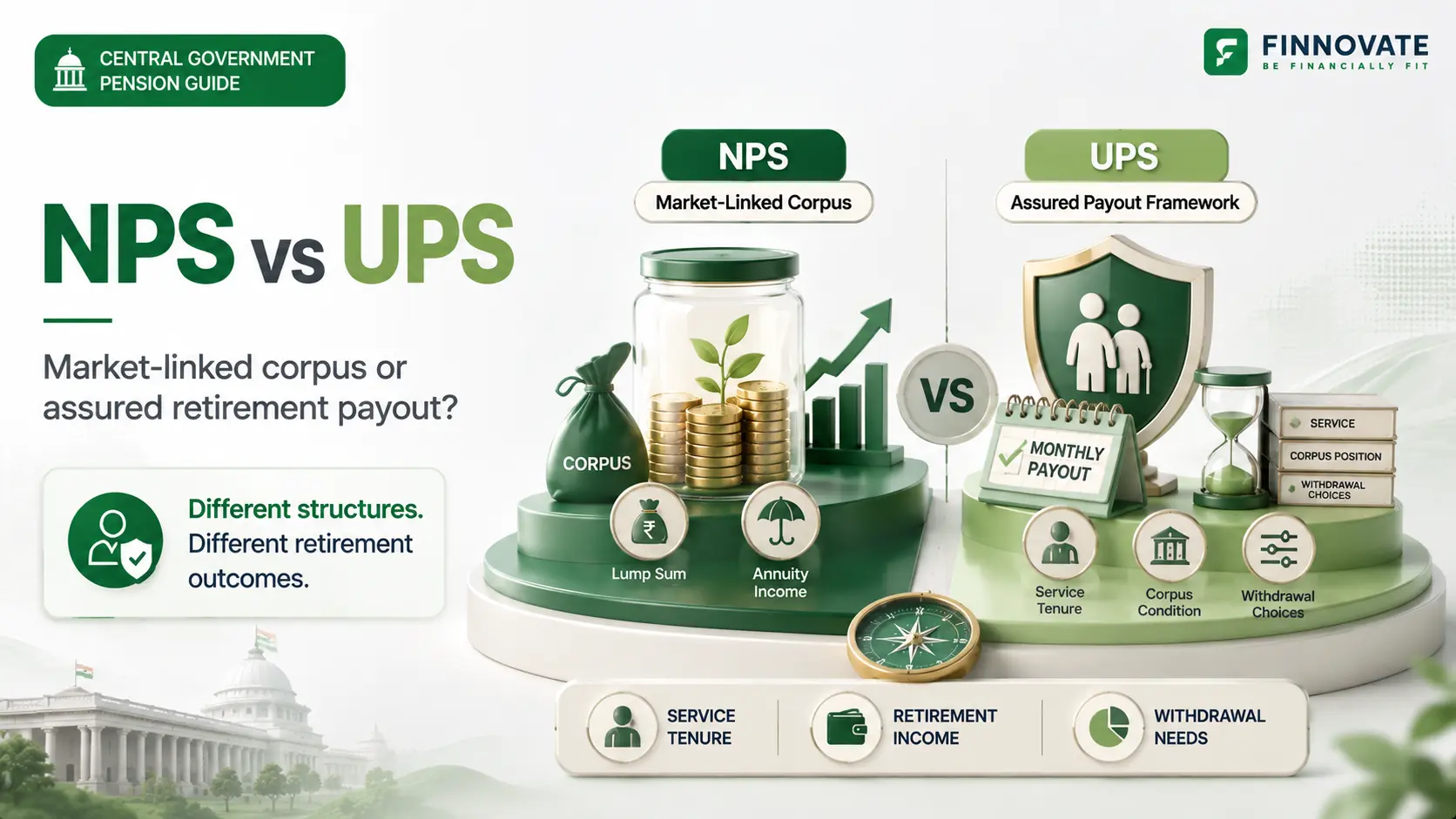
Compare NPS and UPS for Central Government employees, including contributions, pension cal...
Popular now

Learn how to easily download your NSDL CAS Statement in PDF format with our step-by-step g...

Looking for the best financial freedom books? Here’s a handpicked 2026 reading list with...
Learn what SIF investment means in India, SEBI rules, Rs 10 lakh minimum investment, avail...
Clear guide to mutual fund taxation in India for FY 2025–26 after July 2024 changes: equ...