

How Much Corpus for ₹2 Lakh/Month Retirement in India?
Want ₹2 lakh per month after retirement? See the corpus needed today and after 10, 20 or...
16 September 2026

Most people start retirement planning with one goal.
“I need a fixed monthly income.”
So they do the most common thing.
They try to live off interest or dividends, and keep the principal untouched.
That works, but it is not the only way.
There’s another popular method called a Systematic Withdrawal Plan (SWP). If you want a quick explainer before you go deeper, read what an SWP is.
An SWP flips the logic.
Instead of depending on payouts, you withdraw a fixed amount yourself, and the remaining corpus keeps compounding. You can also try the numbers on the SWP calculator.
So which one is better, and why?
| Feature | Annuity style (interest/dividend income) | SWP (Systematic Withdrawal Plan) |
|---|---|---|
| How income comes | Fund pays interest/dividend | You set withdrawal amount |
| What happens to principal | Kept largely intact | Reduces over time |
| Monthly income potential | Lower because corpus stays static | Higher for a fixed tenure |
| Flexibility | Rigid | High, you can tweak amount and tenure |
| Risk choices | Often kept low risk | Can be structured, including hybrid allocation |
| Taxation angle | Interest/dividend is taxable at slab rate | Capital gains taxation applies only on gains part |
| Legacy goal | Easier, corpus remains | Needs planning, corpus may reduce sharply |

A corpus of ₹2 crore invested in a liquid fund giving 5% annualised returns can offer a monthly annuity of ₹83,333, keeping the corpus intact.
Simple math:
This is pre-tax. Post-tax will be lower.
A similar ₹2 crore corpus in an SWP over 20 years at 8.2% yield can generate monthly withdrawals of ₹1,70,000 for 20 years.
That is the big appeal.
It uses the corpus over time instead of preserving it fully. To see how the math behaves with different inputs, use the SWP calculator.
Straightforward.
If you want stable monthly dividends, you typically avoid high risk. You assume best-case returns of 5% to 6% per annum.
So you get a monthly flow like:
Again, this is pre-tax.
SWP does not require the fund to pay regular dividends.
So you can structure the portfolio to target a higher long-term return, while still staying reasonable on risk.
In this illustration:
The corpus winds down steadily.
Assumption: Start with ₹2 crore, earn 8.2% annually, withdraw ₹20.40 lakhs every year (which is ₹1.70 lakhs per month).
| Year | Start Corpus | Annual Returns | Net Corpus | Withdrawal | Closing Corpus |
|---|---|---|---|---|---|
| 1 | 2,00,00,000 | 16,40,000 | 2,16,40,000 | 20,40,000 | 1,96,00,000 |
| 2 | 1,96,00,000 | 16,07,200 | 2,12,07,200 | 20,40,000 | 1,91,67,200 |
| 3 | 1,91,67,200 | 15,71,710 | 2,07,38,910 | 20,40,000 | 1,86,98,910 |
| 4 | 1,86,98,910 | 15,33,311 | 2,02,32,221 | 20,40,000 | 1,81,92,221 |
| 5 | 1,81,92,221 | 14,91,762 | 1,96,83,983 | 20,40,000 | 1,76,43,983 |
| 6 | 1,76,43,983 | 14,46,807 | 1,90,90,790 | 20,40,000 | 1,70,50,790 |
| 7 | 1,70,50,790 | 13,98,165 | 1,84,48,955 | 20,40,000 | 1,64,08,955 |
| 8 | 1,64,08,955 | 13,45,534 | 1,77,54,489 | 20,40,000 | 1,57,14,489 |
| 9 | 1,57,14,489 | 12,88,588 | 1,70,03,077 | 20,40,000 | 1,49,63,077 |
| 10 | 1,49,63,077 | 12,26,972 | 1,61,90,049 | 20,40,000 | 1,41,50,049 |
| 11 | 1,41,50,049 | 11,60,304 | 1,53,10,353 | 20,40,000 | 1,32,70,353 |
| 12 | 1,32,70,353 | 10,88,169 | 1,43,58,522 | 20,40,000 | 1,23,18,522 |
| 13 | 1,23,18,522 | 10,10,119 | 1,33,28,641 | 20,40,000 | 1,12,88,641 |
| 14 | 1,12,88,641 | 9,25,669 | 1,22,14,310 | 20,40,000 | 1,01,74,310 |
| 15 | 1,01,74,310 | 8,34,293 | 1,10,08,603 | 20,40,000 | 89,68,603 |
| 16 | 89,68,603 | 7,35,425 | 97,04,028 | 20,40,000 | 76,64,028 |
| 17 | 76,64,028 | 6,28,450 | 82,92,479 | 20,40,000 | 62,52,479 |
| 18 | 62,52,479 | 5,12,703 | 67,65,182 | 20,40,000 | 47,25,182 |
| 19 | 47,25,182 | 3,87,465 | 51,12,647 | 20,40,000 | 30,72,647 |
| 20 | 30,72,647 | 2,51,957 | 33,24,604 | 20,40,000 | 12,84,604 |
By the end of 20 years, the corpus is down to ₹12.85 lakhs.
This shows how ₹2 crore can be used efficiently to create monthly cashflow for a defined retirement period.
Related reads:
If you rely on interest or dividends from a debt fund, those payouts are fully taxable at your slab rate.
That can significantly reduce post-tax income.
In an SWP, withdrawals are taxed as capital gains, and only the gains portion of the withdrawal is taxed.
The principal portion is not taxed again.
If you want a simple breakdown with examples, read is SWP taxable in India.
Annuity-style income can work well if:
SWP is not magic. It is a system, and systems break under stress if built poorly.
To stress-test your plan, start with your target corpus and timeline. Many people first estimate their FIRE corpus, then design withdrawals around it. You can calculate a starting number using the FIRE calculator.
Ask these questions:
Want a retirement income plan that balances monthly cashflow, taxes, and risk? Talk to a SEBI-registered RIA team.
Often yes if you want higher monthly cashflow for a fixed period and you are okay with the corpus reducing over time. Annuity-style income keeps the principal largely intact, but monthly income is usually smaller because it depends mainly on interest or dividends.
No. SWP is a withdrawal method, not a guarantee. You can set a monthly withdrawal, but portfolio returns are not assured, so the plan may need changes if markets are weak early on.
SWP withdrawals are treated as redemptions. Tax applies as capital gains, and only the gains portion of each withdrawal is taxed. The principal portion is not taxed again. For a simple explainer, see is SWP taxable in India.
It is the risk of poor returns early in retirement. Withdrawals during a downturn can reduce the corpus faster because you sell more units at lower prices, which can make recovery harder later.
You can, but it needs planning. Since SWP is designed to draw down the corpus over a tenure, the residual amount can be small near the end. If legacy matters, consider a separate bucket or a blended structure.
Many people do. One common structure is to keep essential expenses covered by a safer, more stable income method, and use SWP for lifestyle expenses where flexibility helps. This also reduces stress during bad markets.
Disclaimer: This content is for education only and is not a recommendation. Returns and tax rules are not guaranteed and can change. Always evaluate suitability based on your goals, time horizon, risk tolerance, and latest regulations.
No spam. Only new posts, simple explainers, and practical money checklists for busy professionals.
Finnovate is a SEBI-registered financial planning firm that helps professionals bring structure and purpose to their money. Over 3,500+ families have trusted our disciplined process to plan their goals - safely, surely, and swiftly.
Our team constantly tracks market trends, policy changes, and investment opportunities like the ones featured in this Weekly Capsule - to help you make informed, confident financial decisions.
Learn more about our approach and how we work with you:
No comments yet. Start the conversation. What would you add?
No spam. Only new posts, simple explainers, and practical money checklists.
You may also like
Want ₹2 lakh per month after retirement? See the corpus needed today and after 10, 20 or...

SWP vs FD for retirement: compare income, risk, inflation, tax, liquidity and corpus susta...

NPS vs mutual funds for retirement: compare liquidity, tax, lock-in, asset allocation, ann...
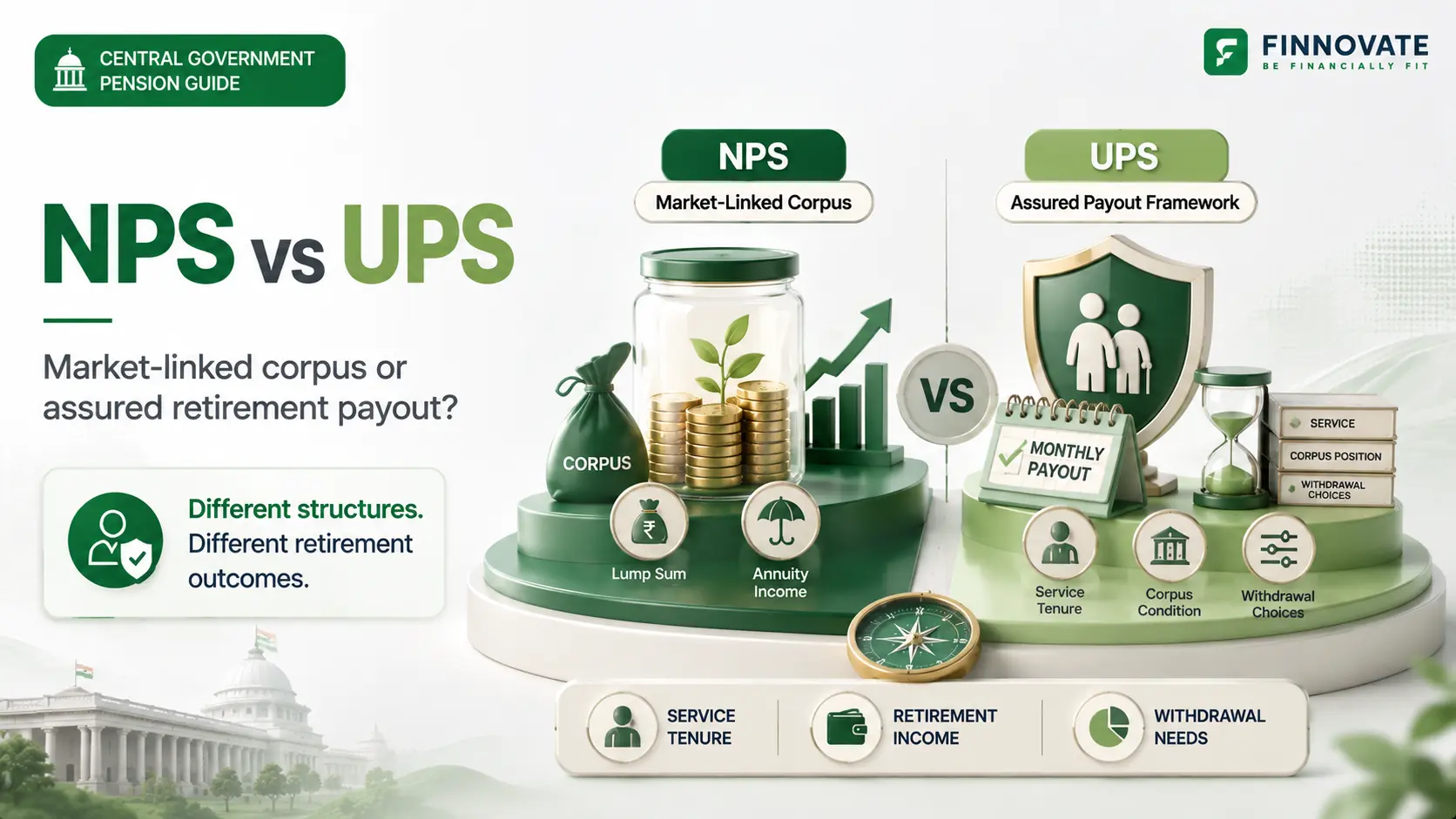
Compare NPS and UPS for Central Government employees, including contributions, pension cal...
Popular now

Learn how to easily download your NSDL CAS Statement in PDF format with our step-by-step g...

Looking for the best financial freedom books? Here’s a handpicked 2026 reading list with...
Learn what SIF investment means in India, SEBI rules, Rs 10 lakh minimum investment, avail...
Clear guide to mutual fund taxation in India for FY 2025–26 after July 2024 changes: equ...