

The Great Economic Decoupling of 2026: Oil, AI & India
Rising oil prices and booming AI investment are shaping an uneven global economy in 2026. ...
24 October 2026


Finnovate’s editorial team researches and creates financial content using trusted sources, regulatory references and inputs from subject experts.
India has approved defence acquisition proposals worth about ₹1.10 lakh crore, and the Ministry of Defence says approximately 98% of the approved procurements are expected to come from Indian industry. The number is large enough to attract attention on its own, but the headline needs some unpacking.
It may sound like ₹1.10 lakh crore of new orders have already been handed to Indian defence companies. They have not. What the Defence Acquisition Council, or DAC, granted on September 7 was Acceptance of Necessity, or AoN, which the government describes as an in-principle administrative approval.
That distinction matters for investors, but it does not make the approval unimportant. The larger economic story is that future defence spending is increasingly being directed toward India's domestic manufacturing ecosystem.
Table of Contents
The September 7 meeting covered requirements across the Army, Navy and Air Force. The equipment spans mobility, battlefield engineering, helicopters, surveillance, propulsion, electronic warfare and secure digital systems.
| Service | Major Approved Capabilities |
|---|---|
| Army | CBRN reconnaissance vehicles, high-mobility vehicles, mechanical mine layers, Advanced Light Helicopters, trawl tanks and Sarvatra bridge systems |
| Navy | Arudhra radars, plus design, development and subsequent procurement of marine gas turbines |
| Air Force / Joint Systems | Fighter, transport and helicopter capability proposals, ground-based jammers and a secure access-card system |
This matters because India's defence-manufacturing story is much wider than aircraft and missiles. It also includes heavy engineering, vehicle platforms, radar, propulsion, electronics, communications, software, sensors, precision manufacturing, testing and maintenance.
Acceptance of Necessity is one of the most important stages in India's capital procurement process. Under the Defence Acquisition Procedure 2020, a normal acquisition can still pass through several steps after AoN before a final contract is signed.
DAP 2020 lists AoN, RFP, technical evaluation, field trials, staff evaluation, negotiations, financial approval and contract award as separate stages. In simple terms, AoN means the government has formally accepted that the capability is required and has approved the proposal to move forward. It does not mean the equipment has already been purchased.
The ₹1.10 lakh crore is the estimated value of the proposals approved at the AoN stage. Before final contracts are awarded, the government may still issue RFPs, receive bids, evaluate technical compliance, conduct trials, negotiate commercial terms and decide final quantities and delivery schedules.
DAP 2020 also sets validity periods for moving an AoN forward. AoNs under normal Buy categories are generally valid for six months, while Buy & Make (Indian) and turnkey cases generally have one-year validity. If the required RFP is not issued within that period, the AoN may need revalidation or fresh approval.
The final contract value may also differ from the initial AoN estimate because pricing, quantities, configurations and negotiations can still change. This is why the full ₹1.10 lakh crore should not be treated as revenue already secured by defence companies.
The government says approximately 98% of the procurements covered by these AoNs are expected to be made from Indian industry. That is a powerful demand signal for domestic defence manufacturing, but it needs another important distinction.
Indian sourcing tells us who the procurement is expected to come from. Indigenous content tells us how much of the product's value is actually created in India.
Under DAP 2020, this category generally requires at least 50% indigenous content.
Where the product is not indigenously designed, this category generally requires 60% indigenous content.
Different procurement categories have different rules. So it would be wrong to say that 98% of the ₹1.10 lakh crore will necessarily consist of Indian-made components.
The government released a Draft Defence Acquisition Procedure 2026 earlier this year, but it is still a draft. The Ministry has said it will replace DAP 2020 once approved, so DAP 2020 remains the operative framework for the September 7 approvals.
The draft proposes several changes, including simpler categories and higher indigenous-content requirements in some areas. Those proposals matter for the future, but they should not be presented as the current procurement rules.
The comparison looks striking at first. India's FY2026-27 defence budget includes a total Ministry of Defence allocation of ₹7.85 lakh crore, with more than ₹2.19 lakh crore under the capital head and around ₹1.85 lakh crore for capital acquisition.
| FY27 Defence Measure | Amount |
|---|---|
| Total Ministry of Defence allocation | ₹7.85 lakh crore |
| Capital head | ₹2.19 lakh crore+ |
| Capital acquisition allocation | ₹1.85 lakh crore |
| Earmarked for domestic defence industry | ₹1.39 lakh crore |
| September DAC AoNs | ₹1.10 lakh crore |
The September AoN amount is equivalent to roughly 59% of the entire FY27 capital-acquisition allocation. But this does not mean 59% of this year's acquisition budget has suddenly been spent.
A major defence programme can take years to move through trials, contracting, production, delivery and milestone payments. That is why a large AoN announcement can be compared with the annual budget for scale, but not treated as same-year expenditure.
September is not the first large approval of FY27. On July 3, the DAC cleared another ₹52,000 crore of capital acquisition proposals covering air defence, anti-drone systems, missiles and other capabilities.
Put the July and September rounds together and approximately ₹1.62 lakh crore of proposals have received AoN through these two announced meetings alone. This still represents procurement pipeline, not contracts signed, but it shows how quickly future acquisition requirements are building.
The domestic industry that may eventually serve this demand has expanded sharply. India's defence production reached a record ₹1.78 lakh crore in FY2025-26, up 15.6% from the previous year and more than double FY2020-21 levels.
The composition is also important. Public-sector defence companies and other PSUs still accounted for about 76% of production, while private companies contributed around 24%, or roughly ₹42,000 crore. The private-sector share was at a record high.
A defence platform is rarely manufactured by one company from start to finish. A helicopter, radar or military vehicle can involve suppliers of electronics, cables, sensors, precision-machined components, software, specialised metals, composites, testing equipment, tooling and maintenance systems.
The government's Srijan defence ecosystem had more than 41,000 vendors and around 2.7 lakh products listed by May 2026. More than 15,700 defence items had also been indigenised through the wider programme over the previous five years.
If domestic sourcing becomes deeper, demand can move through engineering suppliers, MSMEs, technology companies and component manufacturers. This connects with India's broader investment cycle, where manufacturing and capital-goods activity have also been strengthening.
One of the least-discussed approvals may also be one of the most interesting. The Navy received approval for the design, development and subsequent procurement of marine gas turbines, which power warships, and the Ministry specifically linked the programme to reducing dependence on foreign vendors.
An Indian company supplies the final product, but important technology or components may still come from overseas.
India develops the underlying technology, engineering know-how and supplier network itself.
The second is harder, but it is also where import dependence can fall more meaningfully. That is the same challenge India faces in its wider manufacturing push: moving from domestic assembly toward deeper component, engineering and technology ownership.
India's defence exports reached a record ₹38,424 crore in FY2025-26, up 62.66% from the previous year. The export mix is more balanced than production, with public-sector companies accounting for around 54.8% and private companies contributing about 45.2%.
That chain is not automatic. A product built for India's armed forces does not automatically become globally competitive, but large domestic programmes can help companies develop the manufacturing scale and technical credibility required to compete for exports later.
Markets reacted quickly to the September announcement, and defence shares outperformed the broader market on the following day. That reaction is understandable because a large domestically sourced procurement pipeline can improve long-term opportunities for the industry.
But the September announcement does not provide final vendors, item-wise contract values, complete quantities, commercial terms or delivery schedules. It is therefore too early to say that a particular listed company has already received part of the ₹1.10 lakh crore unless an actual contract is officially announced.
Which proposals formally move into bidding will be the first sign that the AoN is progressing toward procurement.
Buy Indian-IDDM, Buy Indian or another route will determine the applicable sourcing and indigenous-content rules.
The companies that qualify and compete matter far more than market speculation immediately after the AoN announcement.
Complex platforms and systems may still need technical evaluation and field trials before commercial negotiations begin.
This is the stage where an estimated procurement value finally becomes an actual order for a selected vendor.
Production and payment milestones determine when manufacturing activity and company revenue begin to appear.
It does not mean Indian defence companies received ₹1.10 lakh crore of orders on September 7. It means the government has given in-principle approval to a large new group of defence acquisition proposals that must still move through the procurement process before many of them become contracts.
But the other part of the announcement should not be ignored. Approximately 98% of the approved procurement is expected to come from Indian industry, while domestic defence production has already reached ₹1.78 lakh crore, private-sector participation is rising and defence exports have hit a record ₹38,424 crore.
The next test is whether those approvals turn into contracts, and whether domestic sourcing eventually translates into deeper Indian technology, components and supply chains rather than only local final assembly.
The Defence Acquisition Council granted Acceptance of Necessity to defence acquisition proposals with an estimated value of about ₹1.10 lakh crore across the Army, Navy and Air Force.
Acceptance of Necessity is an in-principle administrative approval that allows a defence procurement proposal to move forward. It comes before later stages such as RFP issuance, technical evaluation, trials, negotiations and final contract award.
No. An AoN is an approval to proceed with the acquisition process, while a contract is signed only after the required procurement stages are completed.
It means around 98% of the approved procurement value is expected to be sourced through Indian industry. It does not mean every system will contain 98% Indian-made components, because indigenous-content requirements vary by procurement category.
The FY2026-27 budget earmarks approximately ₹1.85 lakh crore for capital acquisition, with about ₹1.39 lakh crore earmarked for procurement from domestic defence industries.
India's defence production reached a record ₹1.78 lakh crore in FY2025-26, with public-sector entities accounting for about 76% and the private sector around 24%.
Final vendors for the full set of proposals have not been announced. Companies must still progress through the relevant procurement process before contracts are awarded.
Disclaimer: This article is for educational and informational purposes only. References to defence procurement, industries, sectors and companies do not constitute investment recommendations or advice to buy, sell or hold any security. Defence acquisition proposals can change before contract award, and estimated procurement values should not be treated as guaranteed company revenues or orders.
No spam. Only new posts, simple explainers, and practical money checklists for busy professionals.
Finnovate is a SEBI-registered financial planning firm that helps professionals bring structure and purpose to their money. Over 3,500+ families have trusted our disciplined process to plan their goals - safely, surely, and swiftly.
Our team constantly tracks market trends, policy changes, and investment opportunities like the ones featured in this Weekly Capsule - to help you make informed, confident financial decisions.
Learn more about our approach and how we work with you:
No comments yet. Start the conversation. What would you add?
No spam. Only new posts, simple explainers, and practical money checklists.
You may also like
Rising oil prices and booming AI investment are shaping an uneven global economy in 2026. ...

Explore FPI equity flows for October First Half, 2026: ₹47,955 crore in net outflows, th...
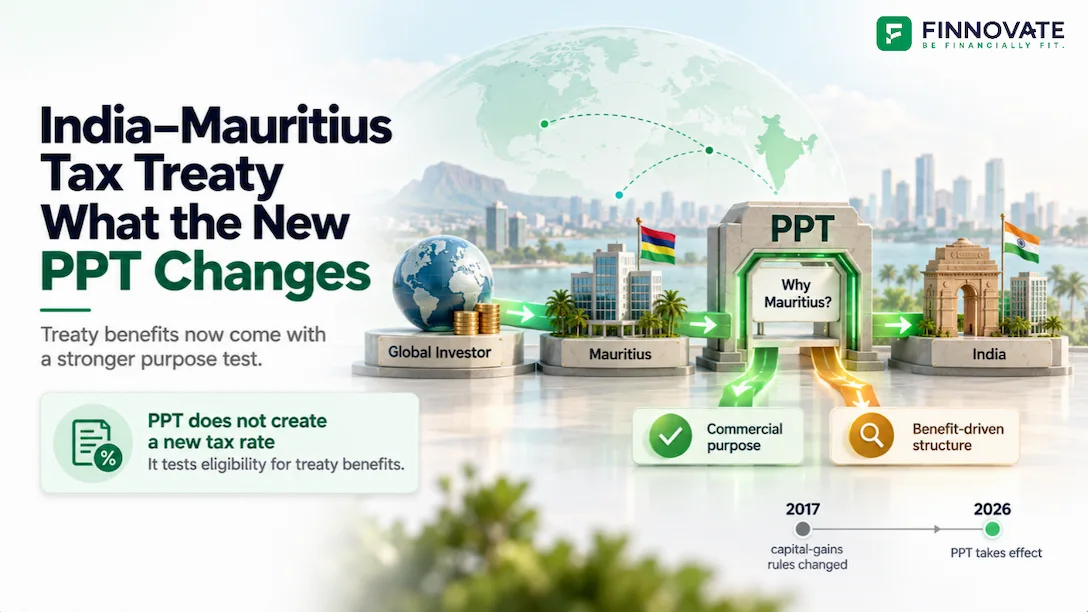
Understand the India–Mauritius tax treaty’s Principal Purpose Test, its August 2026 ef...

Explore India’s AI hardware opportunity through the proposed Adani–Jabil venture, from...
Popular now

Learn how to easily download your NSDL CAS Statement in PDF format with our step-by-step g...

Looking for the best financial freedom books? Here’s a handpicked 2026 reading list with...

Learn what SIF investment means in India, SEBI rules, Rs 10 lakh minimum investment, avail...

Clear guide to mutual fund taxation in India for FY 2025–26 after July 2024 changes: equ...