

EU Scrap Export Curbs: India’s Raw-Material Risk Explained
Proposed EU scrap export curbs could affect India’s metal supply and manufacturing costs...
24 September 2026

Finnovate’s editorial team researches and creates financial content using trusted sources, regulatory references and inputs from subject experts.
The government is preparing to borrow ₹7.86 lakh crore over the next six months. Some of that money could come from a debt mutual fund you own.
Debt funds can buy government bonds, lending money to the government in exchange for interest payments. These bonds also trade in the market, and changes in their prices can affect the value of your investment.
On September 25, the government announced its borrowing plan for October 2026 to March 2027. It expects full-year borrowing through dated securities to be slightly below its earlier plan. It is also changing the mix of bonds it will sell, with a larger share carrying longer repayment periods.
Both changes matter because the supply of bonds can influence their prices.
The government plans to raise ₹7.86 lakh crore through dated securities in the second half of FY2026–27. These are bonds with specified repayment dates.
That takes expected full-year borrowing through these securities to ₹15,99,506 crore, or about ₹16 lakh crore.
The original Budget estimate was higher. But much of the reduction had already happened before September.
| Announcement | Full-year gross borrowing through dated securities |
|---|---|
| Union Budget 2026–27 | ₹17.20 lakh crore |
| March 2026 borrowing plan | ₹16.09 lakh crore |
| September 2026 borrowing plan | About ₹16 lakh crore |
The latest figure is about ₹1.20 lakh crore below the Budget estimate. Compared with the March plan, however, the reduction is around ₹9,500 crore.
The March reduction followed switches of government securities.
In a switch, the government can replace bonds due for repayment sooner with bonds that mature later. This spreads its repayments across years.
That matters because gross borrowing includes money raised to repay maturing debt. If some repayments move to a later year, the government may need to refinance less debt in the current year.
So the borrowing figure reflects both its funding needs and the timing of repayments.
When the government sells bonds, investors decide what price they are willing to pay.
If it offers more bonds than investors want at prevailing prices, prices may need to fall to attract buyers. If supply is lower than expected and demand holds up, prices may receive support.
This is why the borrowing calendar attracts attention. It tells investors how much supply is scheduled to enter the market.
For an existing bondholder, a price increase raises the market value of their holding. A debt fund holding that bond can benefit through its net asset value, or NAV.
There is a related effect: when a fixed-rate bond’s price rises, its yield falls.
Suppose a bond with a face value of ₹1,000 pays ₹70 in annual interest.
| Purchase price | Annual interest payment | Current yield |
|---|---|---|
| ₹1,000 | ₹70 | 7% |
| ₹1,050 | ₹70 | About 6.67% |
The interest payment stays the same. But someone paying ₹1,050 receives a smaller annual payment relative to the amount invested.
This example shows current yield, calculated by dividing annual interest by the purchase price. The return from holding a bond until maturity also depends on its repayment value and the time remaining.
The total amount is only one part of the borrowing plan.
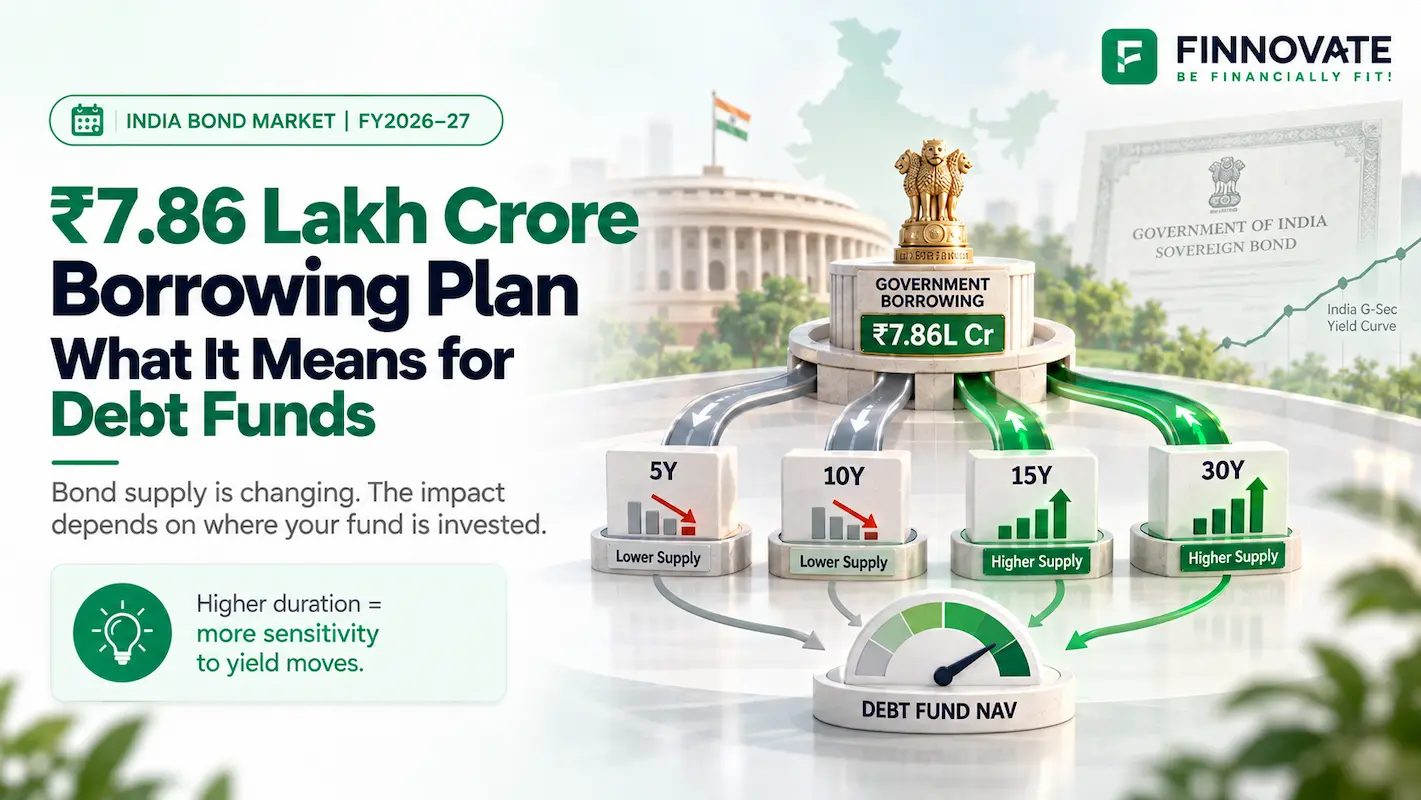
The government sells bonds with different repayment periods. In the second half, five-year and ten-year bonds will account for a smaller share of issuance, while longer-maturity bonds will account for more.
| Bond maturity | Share in first-half plan | Share in second-half plan |
|---|---|---|
| 5 years | 15.4% | 12.1% |
| 10 years | 29.0% | 26.3% |
| 15 years | 14.5% | 17.6% |
| 30 years | 7.3% | 9.2% |
Selected maturities shown. Percentages refer to each half-year’s planned issuance.
Lower planned supply in the five-year and ten-year segments could support prices there, depending on demand.
Longer-maturity bonds face a different supply picture. Their share of issuance is increasing, and the effect will depend partly on how much buyers want to hold.
Investors also have different needs. A buyer looking to invest for a few years may have little interest in a bond that matures decades later.
That is why a change in the borrowing mix can affect different parts of the bond market differently.
The effect depends on what the fund owns.
A fund holding bonds whose market prices rise may see an increase in its NAV. A fund invested mainly in short-term instruments may respond differently from one holding longer-term bonds.
One useful measure is duration, which indicates how sensitive a bond or portfolio is to changes in yields.
A portfolio with higher duration generally sees larger price movements for a similar change in yields. Falling yields can help it more. Rising yields can hurt it more.
This also explains why government bonds can fluctuate in value despite confidence in the government’s ability to repay them. Repayment risk and market-price risk are different.
For debt-fund investors, the fund’s holdings and sensitivity to yield changes matter more than the borrowing headline alone.
There is also a difference between existing holdings and future purchases. Higher bond prices can benefit investments already held, while lower yields can reduce the returns available when fresh money is invested.
The borrowing plan arrives after a period of pressure on bonds.
India’s benchmark ten-year government-bond yield closed at 7.12% on September 25, following six consecutive weekly increases.
Investors are weighing several factors alongside government supply:
A smaller borrowing requirement may offer support while these other forces pull in the opposite direction. The calendar therefore gives investors useful information, but it cannot establish the direction of returns.
If a debt fund holds money for an upcoming expense, fluctuations in its value matter because you may need to withdraw on a specific date.
If it forms part of a longer-term portfolio, its role may be different. The amount of interest-rate risk you can accept should fit that purpose.
The latest borrowing plan helps explain one force acting on your investment: the supply of government bonds.
Whether your fund suits you still depends on when you need the money and how much fluctuation you can accept along the way.
Disclaimer: This article is for educational purposes and is not an investment recommendation. Debt mutual funds carry risks, and returns are not guaranteed. The bond example is illustrative.
No spam. Only new posts, simple explainers, and practical money checklists for busy professionals.
Finnovate is a SEBI-registered financial planning firm that helps professionals bring structure and purpose to their money. Over 3,500+ families have trusted our disciplined process to plan their goals - safely, surely, and swiftly.
Our team constantly tracks market trends, policy changes, and investment opportunities like the ones featured in this Weekly Capsule - to help you make informed, confident financial decisions.
Learn more about our approach and how we work with you:
No comments yet. Start the conversation. What would you add?
No spam. Only new posts, simple explainers, and practical money checklists.
You may also like
Proposed EU scrap export curbs could affect India’s metal supply and manufacturing costs...

FPIs net sold $1.47 billion in Indian equities during September 1–15, 2026. Explore sect...

Nearly 39% of India’s monitored coal power plants were critically low on fuel in Septemb...

Tata Sons faces a major governance dispute over N Chandrasekaran’s reappointment, RBI li...
Popular now

Learn how to easily download your NSDL CAS Statement in PDF format with our step-by-step g...

Looking for the best financial freedom books? Here’s a handpicked 2026 reading list with...
Learn what SIF investment means in India, SEBI rules, Rs 10 lakh minimum investment, avail...
Clear guide to mutual fund taxation in India for FY 2025–26 after July 2024 changes: equ...